Fed Decision October 2026: What a Hawkish Hold Means for Markets
The Fed is expected to hold at 3.75% to 4.00% on Oct 28 while keeping a December hike in play. Here is what a hawkish hold means and how to read the day.
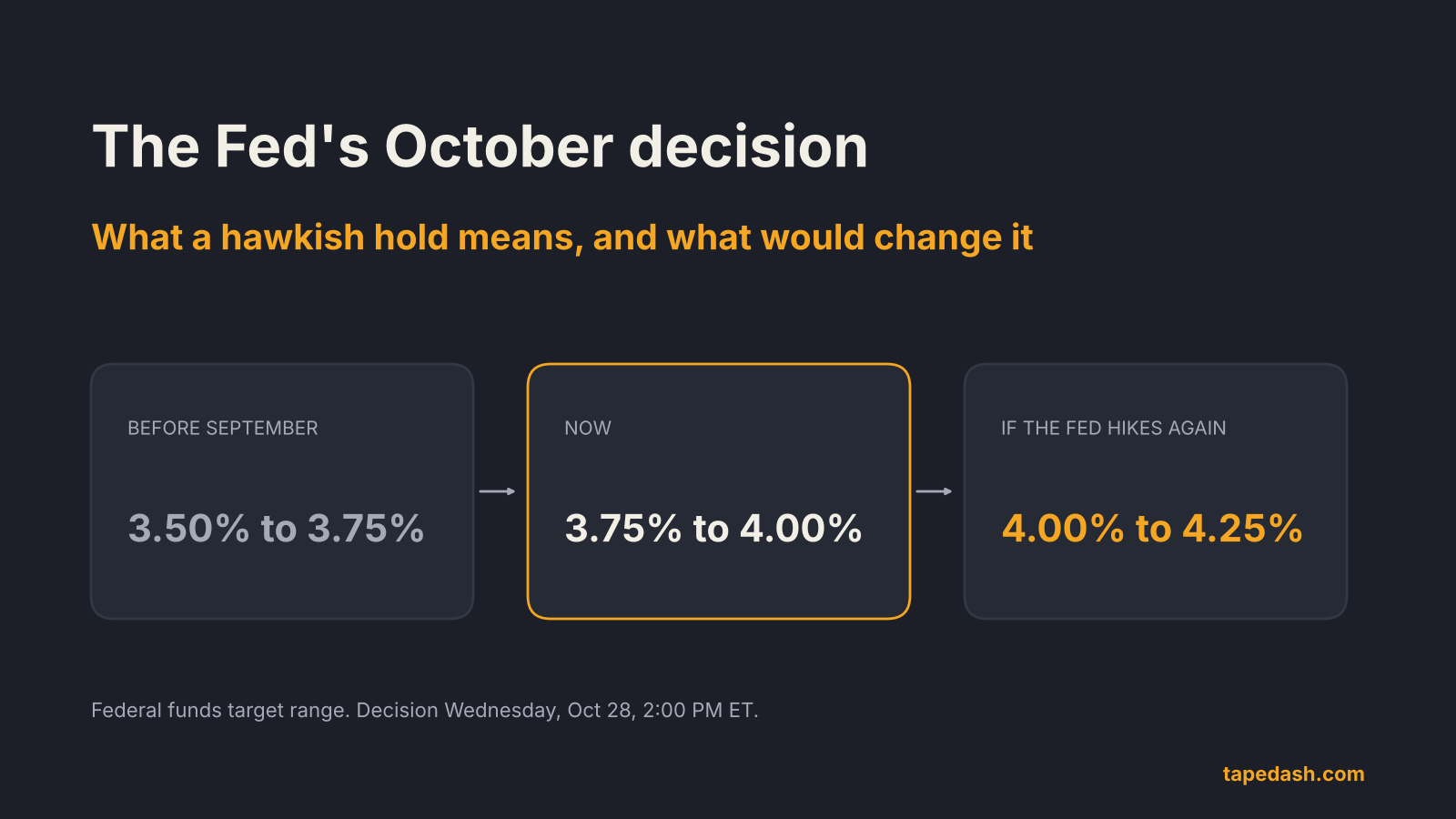
The Federal Reserve announces its October decision on Wednesday at 2:00 PM ET, and the market has mostly made up its mind about the headline. Traders using CME FedWatch put the odds of a hold near 90%, which would leave the federal funds rate at 3.75% to 4.00% after September’s quarter-point hike, the Fed’s first increase since 2023. The real question for Wednesday is not whether the Fed moves. It is how firmly the Fed signals that it will move in December.
That is what people mean by a “hawkish hold.” The Fed leaves rates alone today but tells you, in the statement and the press conference, that the next step is more likely up than down. With September inflation running at 3.7% and hiring close to a standstill, the committee is stuck between two bad readings, and the way it describes that tension will move bonds, the dollar and the stocks that led Tuesday’s rally.
This piece explains how we got here, what a hawkish hold looks like in practice, the three outcomes worth planning for, and the specific things I watch in the first hour after 2:00 PM.
- The Fed is widely expected to hold at 3.75% to 4.00% on Oct 28. CME FedWatch put hike odds near 10% for this meeting.
- Markets price a hike by the December 8 to 9 meeting at roughly 73% to 80%, so the tone matters more than the decision.
- September CPI rose to 3.7% from a year earlier while payrolls grew just 29,000. That split is the Fed’s whole problem.
- Watch the 2-year Treasury yield, the December odds and how growth stocks react in the first hour, then Thursday’s GDP and PCE at 8:30 AM.
Why the Fed is expected to hold rates in October 2026
Start with where policy sits. At its September 15 to 16 meeting, the Fed raised the federal funds target range by a quarter point to 3.75% to 4.00%. The vote was unanimous, and it was the first increase in three years. Chair Kevin Warsh described the move as “removing a dose of accommodation,” which is central-bank language for a fine-tuning step rather than the start of an aggressive campaign.
Six weeks later, the case for doing it again right away is weaker than it looks. Inflation did move the wrong way, but a big share of that came from energy. Gasoline prices rose 9.1% in September alone, with oil trading near $100 a barrel this week. A central bank cannot do much about a fuel shock in the short run, and raising rates into one risks squeezing the economy twice.
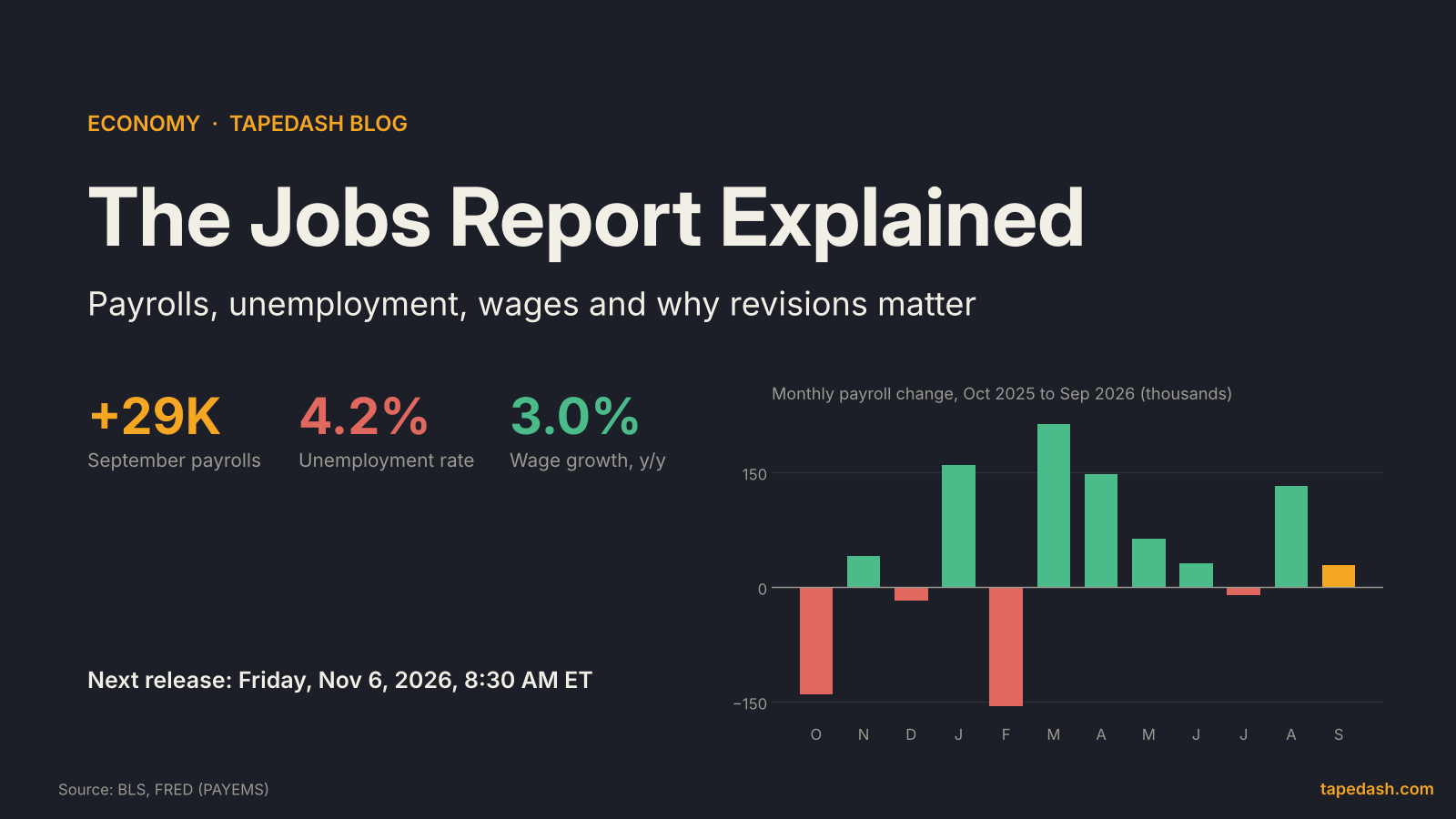
The labor market is the other reason for patience. The September jobs report showed payrolls up just 29,000 against a consensus of about 90,000, and the unemployment rate ticked up to 4.2% from 4.1%. Revisions took a combined 60,000 jobs out of July and August. When hiring slows that sharply, the Fed usually wants at least one more month of data before tightening again.
So the base case is simple. Hold now, keep December open, and let the data decide.
What a “hawkish hold” actually means
The phrase gets used loosely, so it helps to be precise. A hawkish hold has three parts.
First, the rate does not change. Second, the statement keeps language that points toward further tightening, usually by describing inflation as elevated and leaving room for “additional firming.” Third, the chair’s press conference avoids anything that sounds like the job is done.
The opposite, a dovish hold, keeps rates steady but leans on the weak jobs data, softens the inflation language, or hints that September’s hike may have been enough. Both outcomes print the same number at 2:00 PM. They can produce very different markets by 3:00 PM.
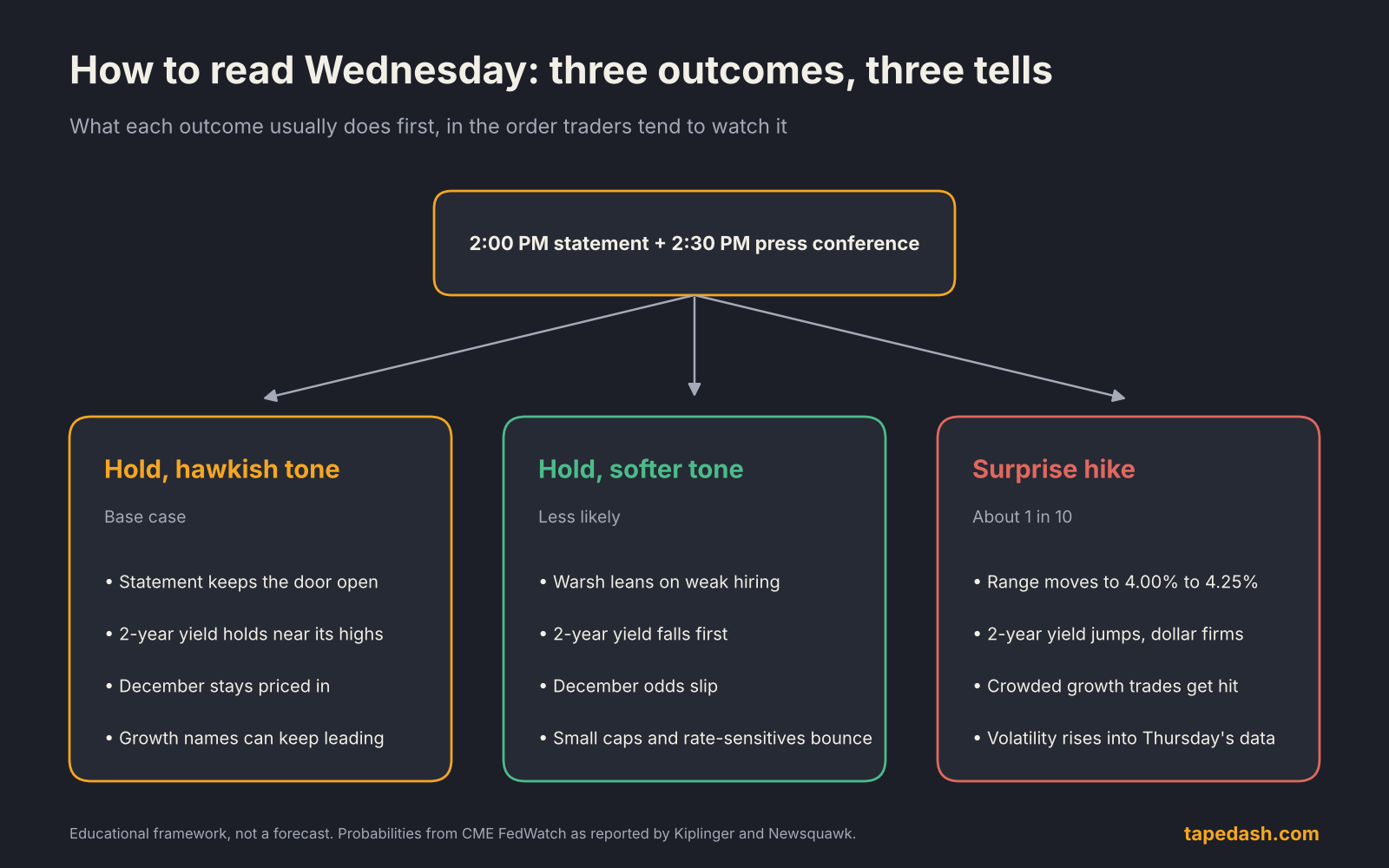
Warsh has made this harder to read in advance on purpose. At an IMF event in mid-October he said, “I don’t prejudge meetings,” and he has been reluctant to give the kind of explicit forward guidance markets got used to in past cycles. That means the press conference carries more information than usual, and traders will parse single words.
The two numbers the Fed is weighing
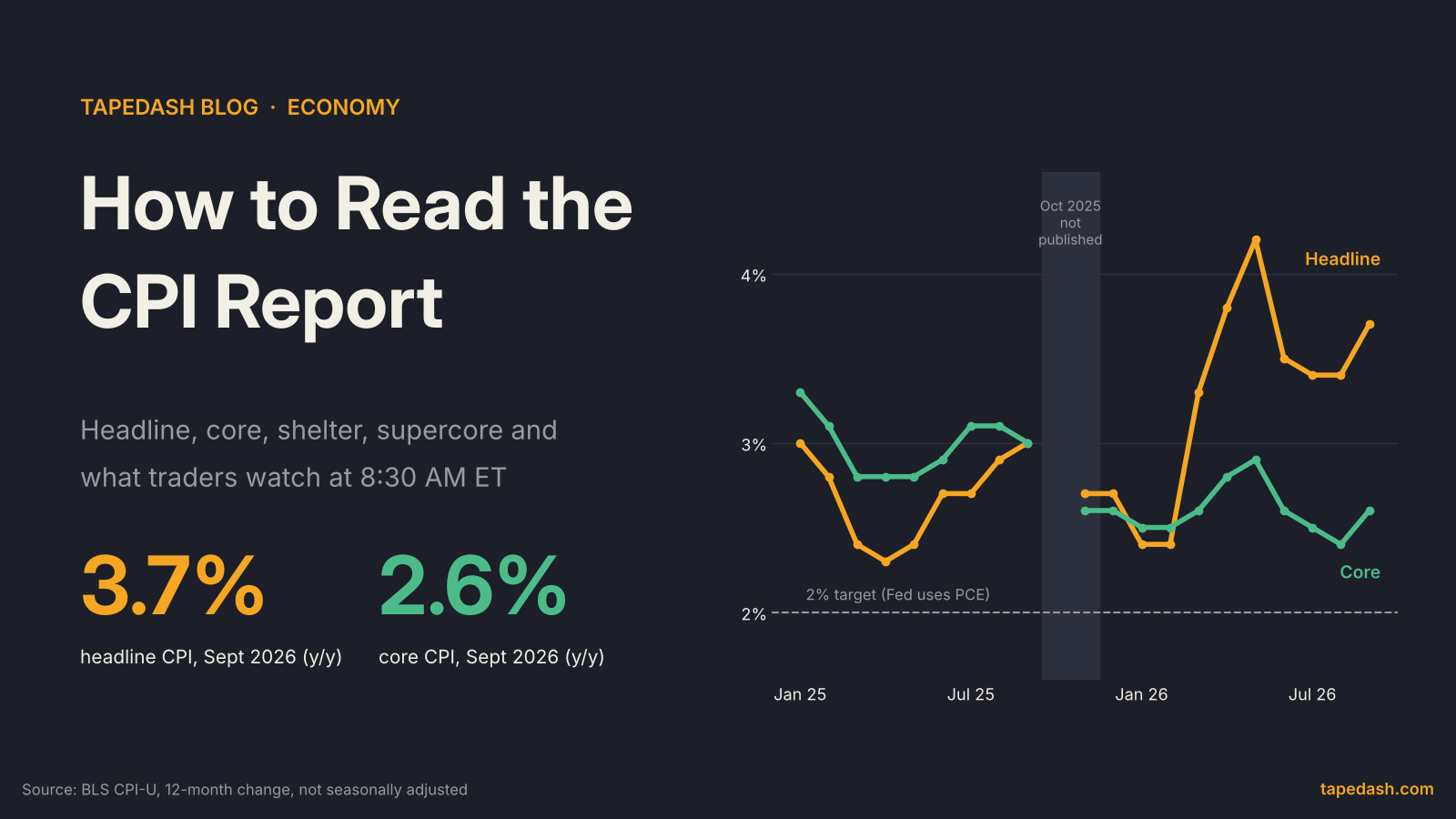
Here is the conflict in two charts. Inflation turned back up in September. Headline CPI rose 0.6% for the month and 3.7% from a year earlier, up from 3.4% in August and above the 3.6% economists expected. Core CPI, which strips out food and energy, rose 0.3% for the month and 2.6% from a year earlier, up from 2.4%.
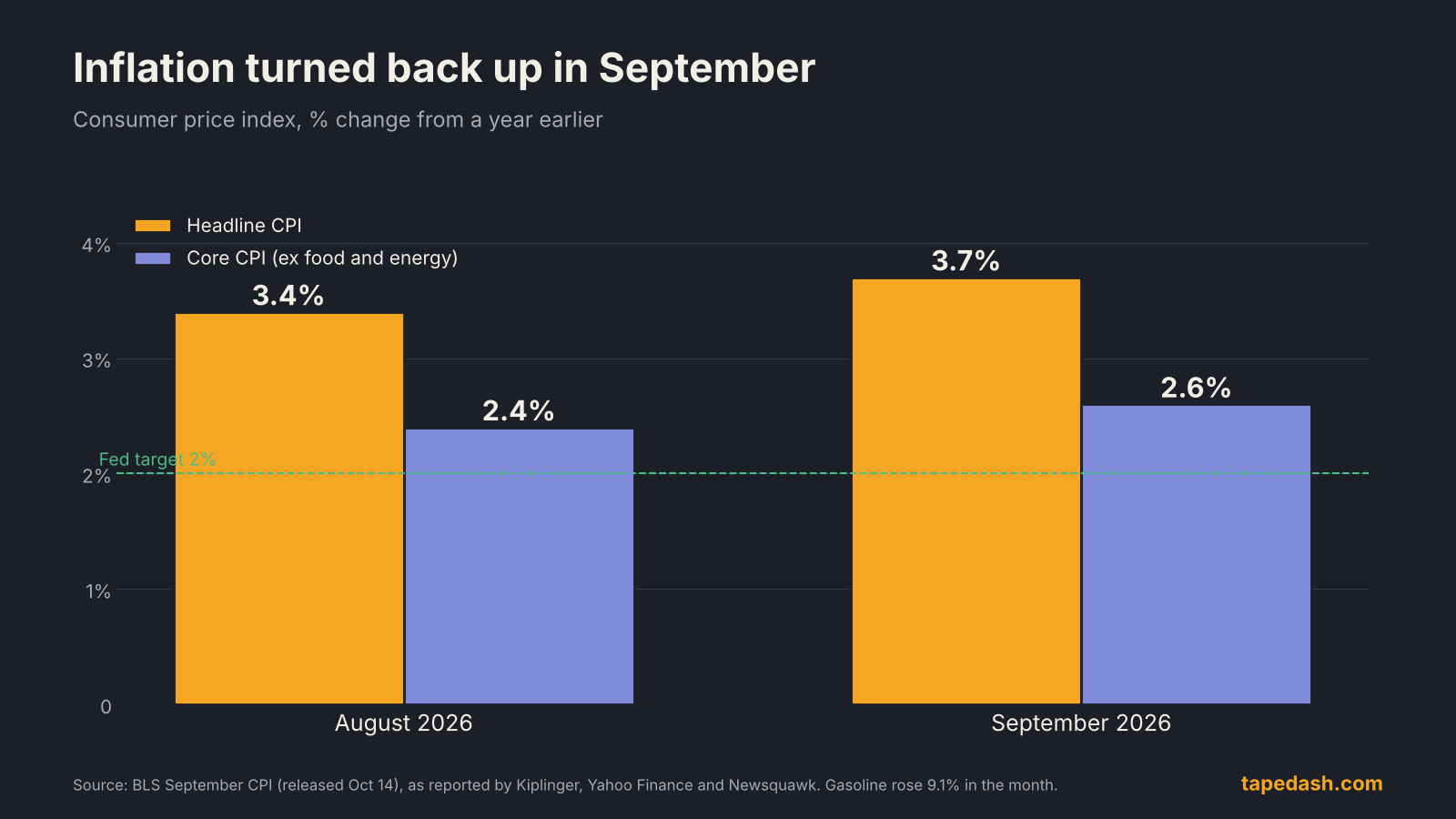
The core number is the one I would focus on. Energy can reverse. A core rate that climbs from 2.4% to 2.6% in a month says price pressure is spreading beyond the gas pump, and that is the argument the hawks on the committee will make.
Now the other side of the ledger.
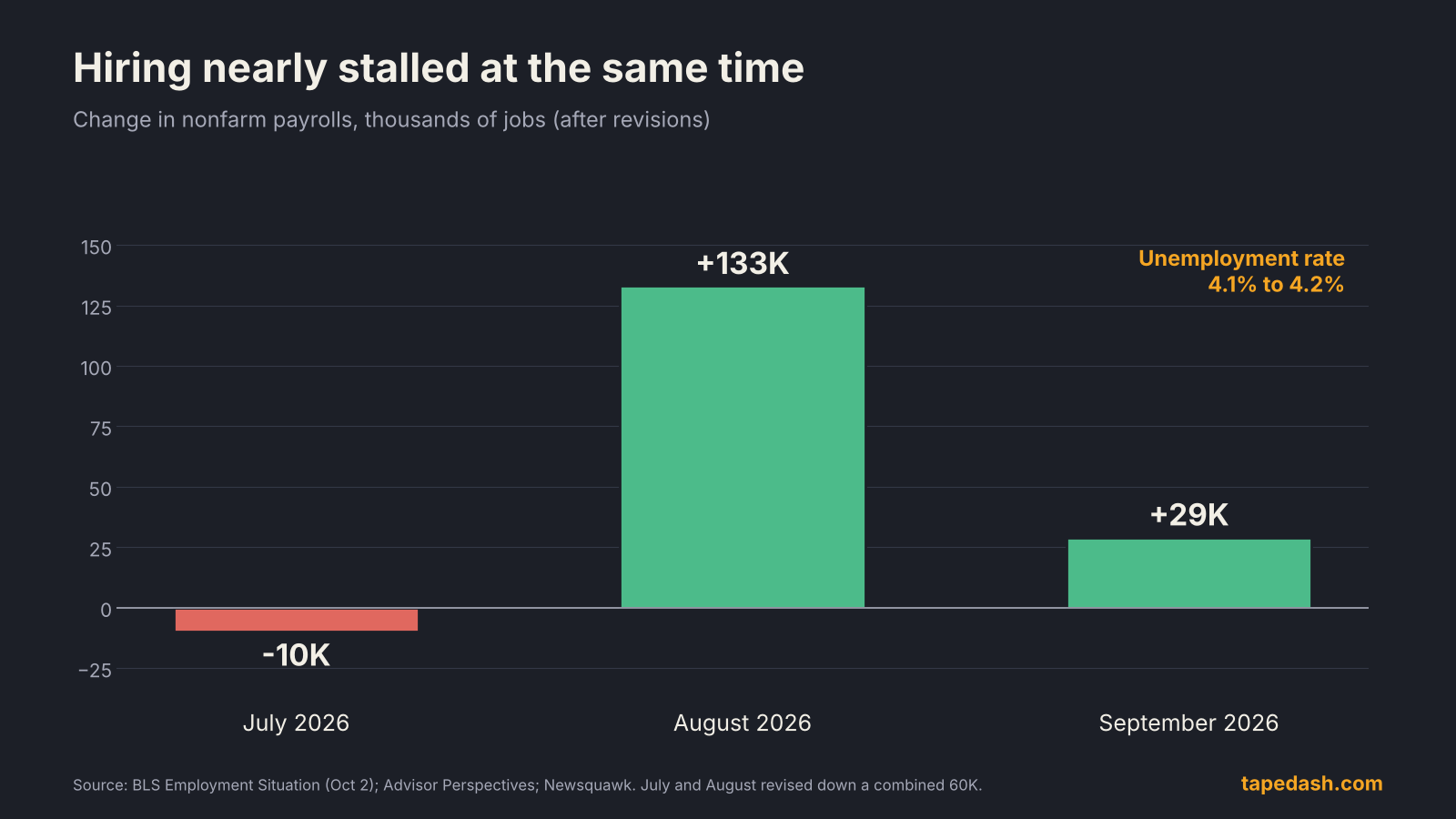
A 29,000 print is close to the pace at which unemployment starts to rise on its own, and it did. If the next report confirms the slowdown, the Fed will have a hard time justifying another hike in December no matter what inflation does. That is why the market treats December as likely but not locked.
Fed rate hike odds: what the market is pricing
Prediction is not my job here, but reading the market’s pricing is. As of Monday and Tuesday, CME FedWatch implied roughly a 90% chance of a hold on Wednesday and about a 10% chance of a quarter-point hike. For December, the probability of a hike was reported between about 73% and 80%, depending on the snapshot and on whether you count “at least one hike by December.”
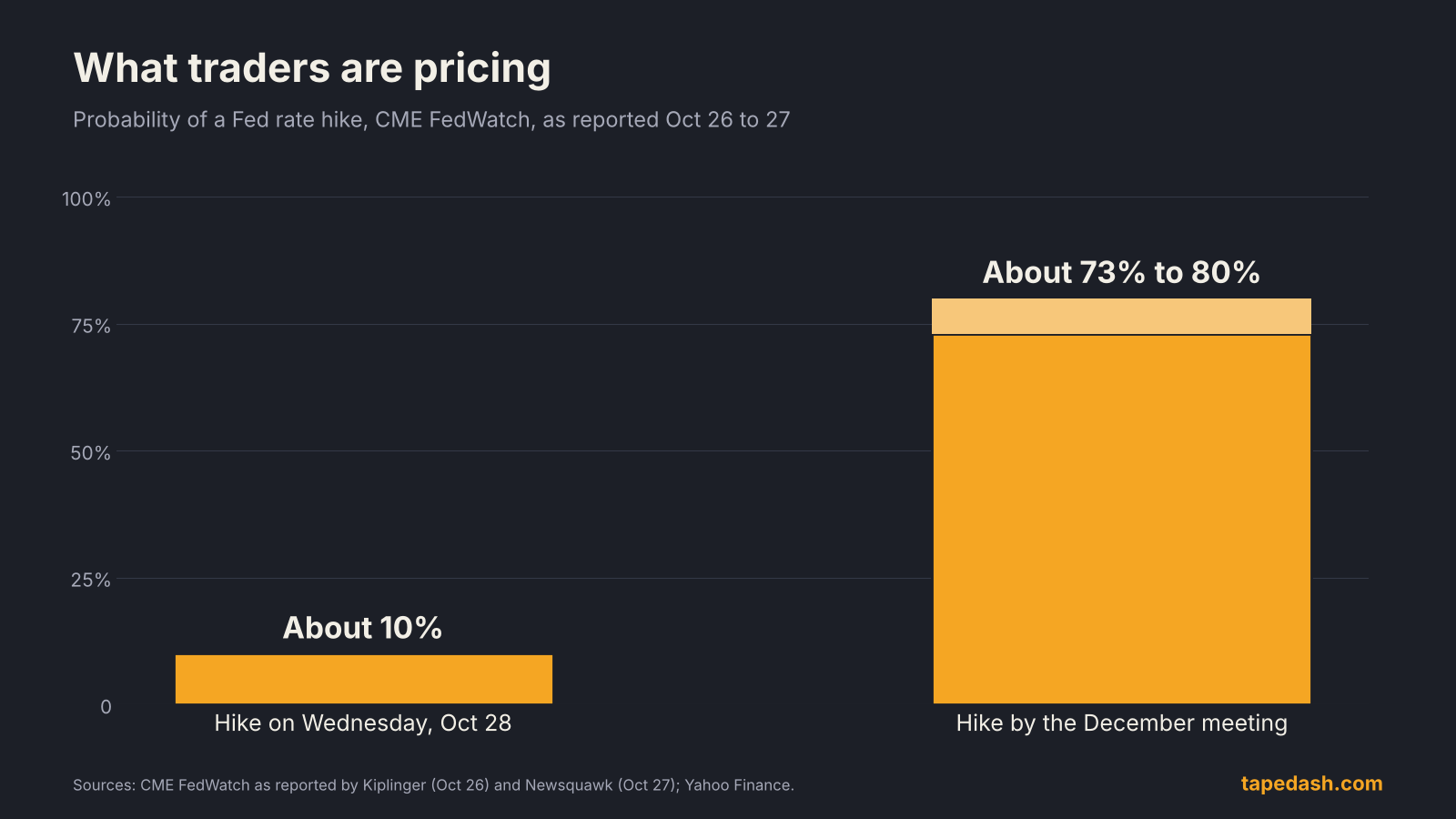
That December figure is the number to watch after 2:00 PM. If the statement and press conference read hawkish, December odds should firm up toward the top of that range. If Warsh leans on the jobs data, they will slip, and the 2-year Treasury yield will usually fall first.
For context, the 10-year Treasury yield sat just under 5% heading into the meeting, around 4.98% to 4.99% across Monday and Tuesday. That level matters for everything from mortgage rates to how much investors will pay for long-dated growth stories.
How stocks set up into the decision
Tuesday’s close tells you how the market is positioned. The Nasdaq Composite rose 1.18% and the Russell 2000 gained 1.16%, while the S&P 500 added 0.60% and the Dow finished essentially flat, up 0.03%. Technology led and energy lagged as oil eased.
That mix is a market leaning toward a calm outcome. Small caps are among the most rate-sensitive stocks in the index because they carry more floating-rate debt, so a strong day for them the day before a Fed meeting is a quiet vote for “no surprise.” Growth leadership says the same thing in a different way, since long-duration earnings streams are worth more when traders expect rates to stop rising soon.
The risk in that positioning is obvious. If Wednesday sounds more hawkish than expected, the stocks that rallied hardest into the meeting have the most room to give back.
The three outcomes and what to watch first
Here is how I break the day into scenarios. None of this is a forecast, and the probabilities come from the market, not from me.
| Outcome | What it looks like | First market tell | Who usually feels it |
|---|---|---|---|
| Hold, hawkish tone (base case) | Rate unchanged, statement keeps tightening language, press conference avoids “done” | 2-year yield holds near its highs, December odds firm | Rate-sensitive small caps, long-duration growth |
| Hold, softer tone | Rate unchanged, more weight on weak hiring, softer inflation language | 2-year yield falls, dollar eases, December odds slip | Small caps, homebuilders, regional banks rally |
| Surprise hike (about 1 in 10) | Range moves to 4.00% to 4.25% | 2-year yield jumps, dollar firms, volatility rises | Crowded growth trades, high-multiple tech |
The order of operations matters as much as the scenario. At 2:00 PM the statement comes out, and algorithms trade the wording within seconds. That first move is often wrong. At 2:30 PM the press conference starts, and the real repricing happens over the next 30 to 45 minutes as traders hear how Warsh answers questions about the jobs data.
How to read the Fed decision in real time
This is the routine I use on Fed days, and it works for anyone who wants to understand the move instead of chasing it.
Read the statement against the last one. Changes in a few words carry the signal. If the description of inflation gets stronger, or the line about further adjustments survives untouched, the tone is hawkish. If the committee adds language about a softening labor market, that is the dovish tell.
Watch the 2-year yield before stocks. The 2-year Treasury is the market’s cleanest read on near-term Fed policy. Stocks react to it, not the other way around. If the 2-year rises after the statement, equities usually follow lower within minutes.
Check December odds after the press conference, not before. The statement sets the first move. The press conference decides whether it sticks. If December hike odds are higher at 3:15 PM than they were at 1:55 PM, the market heard a hawkish hold, whatever the opening headline said.
Wait for the close. Fed-day moves often reverse by the closing bell, and sometimes by the next morning. The close tells you which reading the market settled on. The next morning tells you whether it meant it.
Size for the gap. If you hold positions through 2:00 PM, assume the first move can go hard against you. Position size is the one thing you fully control on a day like this.
What to watch after Wednesday
The Fed decision is only the first event in a crowded stretch. Microsoft and Alphabet report after the close on Wednesday, so the stocks carrying the index will react to earnings on top of the Fed within the same few hours.
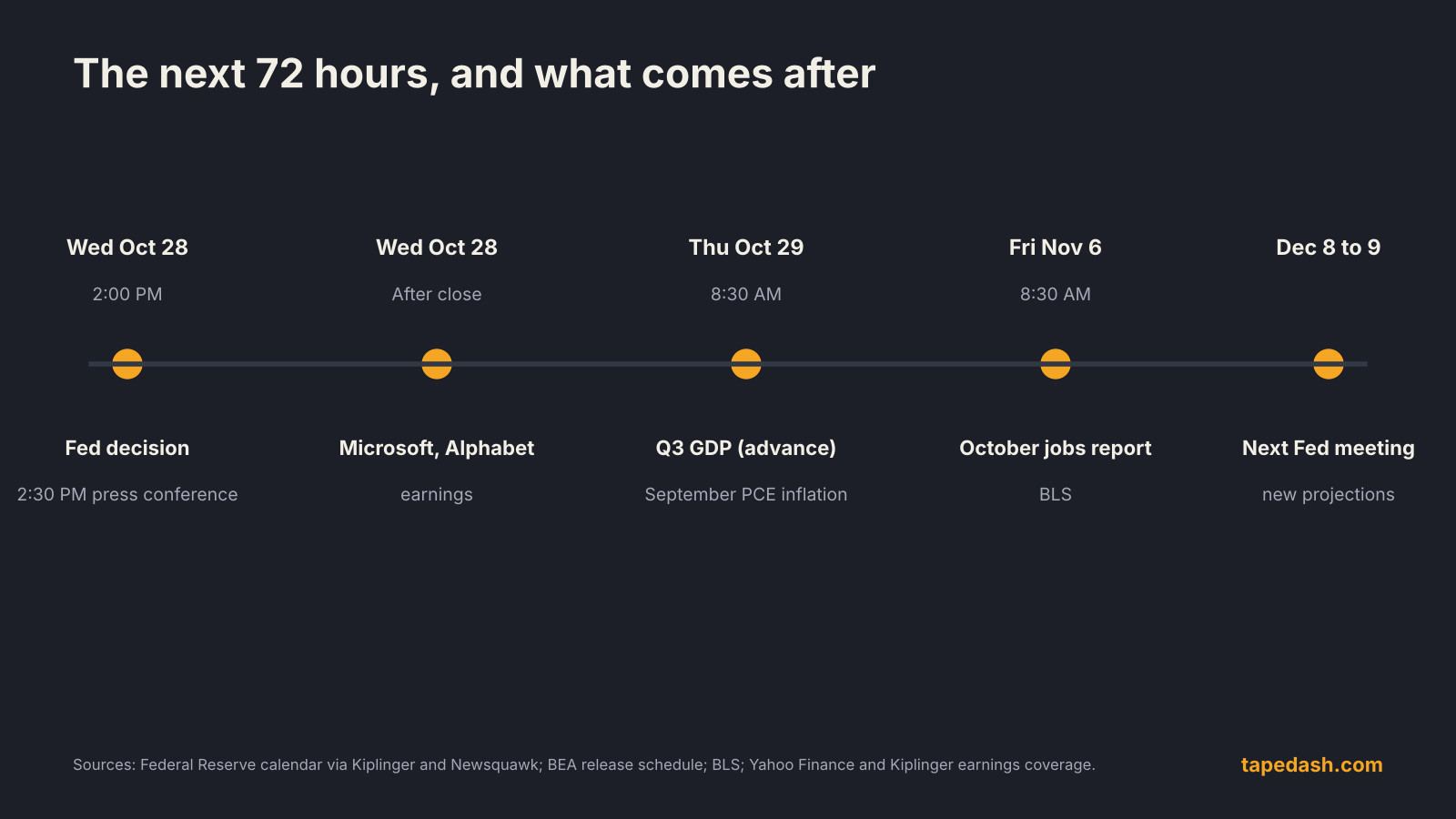
Then, on Thursday, October 29 at 8:30 AM ET, the Bureau of Economic Analysis releases the advance estimate of third-quarter GDP and the September personal income and outlays report, which includes PCE inflation. PCE is the Fed’s preferred inflation gauge. A hot core PCE reading on Thursday would do more to cement a December hike than any phrase in Wednesday’s statement.
After that, the October jobs report on Friday, November 6 is the next big test of the labor market. And the December 8 to 9 meeting brings updated economic projections, which is where a hike, if it comes, is most likely to be explained.
Here is the short version of how those pieces fit together:
- If Wednesday sounds hawkish and Thursday’s core PCE runs hot, December becomes close to a done deal and rate-sensitive stocks have the most to lose.
- If Wednesday sounds hawkish but PCE cools and November’s jobs data is weak again, the market will start to doubt the December hike, and that is usually when small caps and long-duration growth find their footing.
- If Wednesday sounds soft and PCE runs hot, expect a volatile Thursday as the market decides which signal to believe.
How to track the Fed decision with TapeDash
If you want to watch whether this plays out as a hawkish hold or something else, these are the pieces of TapeDash we built for exactly this kind of day. The Macro and Regime page tracks the market’s risk regime alongside rates, the dollar and credit, so you can see whether Wednesday changes the broader backdrop or just causes a one-day wobble. The Economy page lines up each release, including Thursday’s GDP and PCE, against the forecast and its own history, so a “hot” print has context the moment it lands.
On the day itself, the Live Scanner flags the moves that matter as they happen: sudden spikes, gaps, unusual options flow and large dark pool prints. The Fed and the earnings that follow tend to bring exactly those. You can try the scanner and the rest of the terminal in the Terminal Preview without an account.
If you would rather get the read after the close, the free TapeDash Daily newsletter covers what moved and why every evening. Memberships open January 1, and the first 200 members lock Pro at $99 a month for as long as they stay.
Fed decision FAQ
Will the Fed raise rates on October 28, 2026?
Markets do not expect it. CME FedWatch implied about a 10% chance of a quarter-point hike at this meeting, with roughly 90% odds of a hold at 3.75% to 4.00%. A surprise is possible, which is why the scenario table above includes it, but it is not the base case.
What does a hawkish hold mean?
It means the Fed leaves rates unchanged but signals that its next move is more likely to be a hike than a cut. The signal comes through the wording of the statement and the chair’s answers in the press conference rather than through the rate itself.
When is the next Fed meeting after October?
The final meeting of 2026 is scheduled for December 8 to 9. It includes updated economic projections, and markets currently price a high chance of a hike there.
The one idea to keep
On Wednesday, the number will probably not change. The sentence around it will. Treat 2:00 PM as the opening statement and 2:30 PM as the cross-examination, let the 2-year yield and the December odds tell you how the market scored it, and remember that Thursday’s PCE report gets the final word before December.
See it on the tape, not just in the headlines
TapeDash is the research desk for traders and investors: live options flow, dealer positioning, a real-time market scanner and trade alerts graded in public. Memberships open January 1, 2027, and the first 200 members lock Pro at $99 a month for as long as they stay.
Join the waitlistClick through the terminalSee the track recordSources
- Kiplinger: October Fed Meeting live updates and commentary (Oct 26 to 27, 2026)
- Newsquawk: Preview of the Federal Reserve rate decision due Oct 28
- Yahoo Finance: Traders price odds for an October Warsh Fed hike
- Yahoo Finance: Stock market today, Tuesday Oct 27, 2026 (closing quotes)
- U.S. Bureau of Labor Statistics: The Employment Situation, September 2026
- Advisor Perspectives: Employment report, 29K jobs added in September
- Bureau of Economic Analysis: Release schedule
- Trading Economics: Fed raises rates for the first time since 2023
- AP via BNN Bloomberg: AI stocks lift Wall Street closer to its record (Oct 27)
- Reuters via Kitco: S&P 500, Nasdaq advance as oil eases ahead of Fed decision (Oct 27)
This article is for educational and informational purposes only. It is not financial, investment, medical or legal advice, and it is not a recommendation to buy or sell any security. Figures come from the sources listed and were checked on the date of publication; markets change quickly. Options trading involves substantial risk of loss.