Jensen Huang Resigns as Nvidia CEO: The Full Story and What's Next
Jensen Huang resigns as Nvidia CEO. How Nvidia grew from a Denny's booth to a $5 trillion company, the investigation that ended his run, and what comes next.
Jensen Huang resigned as Nvidia’s president, chief executive and director on Thursday, effective immediately, ending a 33-year run at the company he co-founded in 1993. The board named Colette Kress, Nvidia’s chief financial officer since 2013, interim CEO, and made longtime director Harvey Jones the company’s first-ever board chair. A search for a permanent CEO, inside and outside the company, has started (NVIDIA press release, SEC Form 8-K).
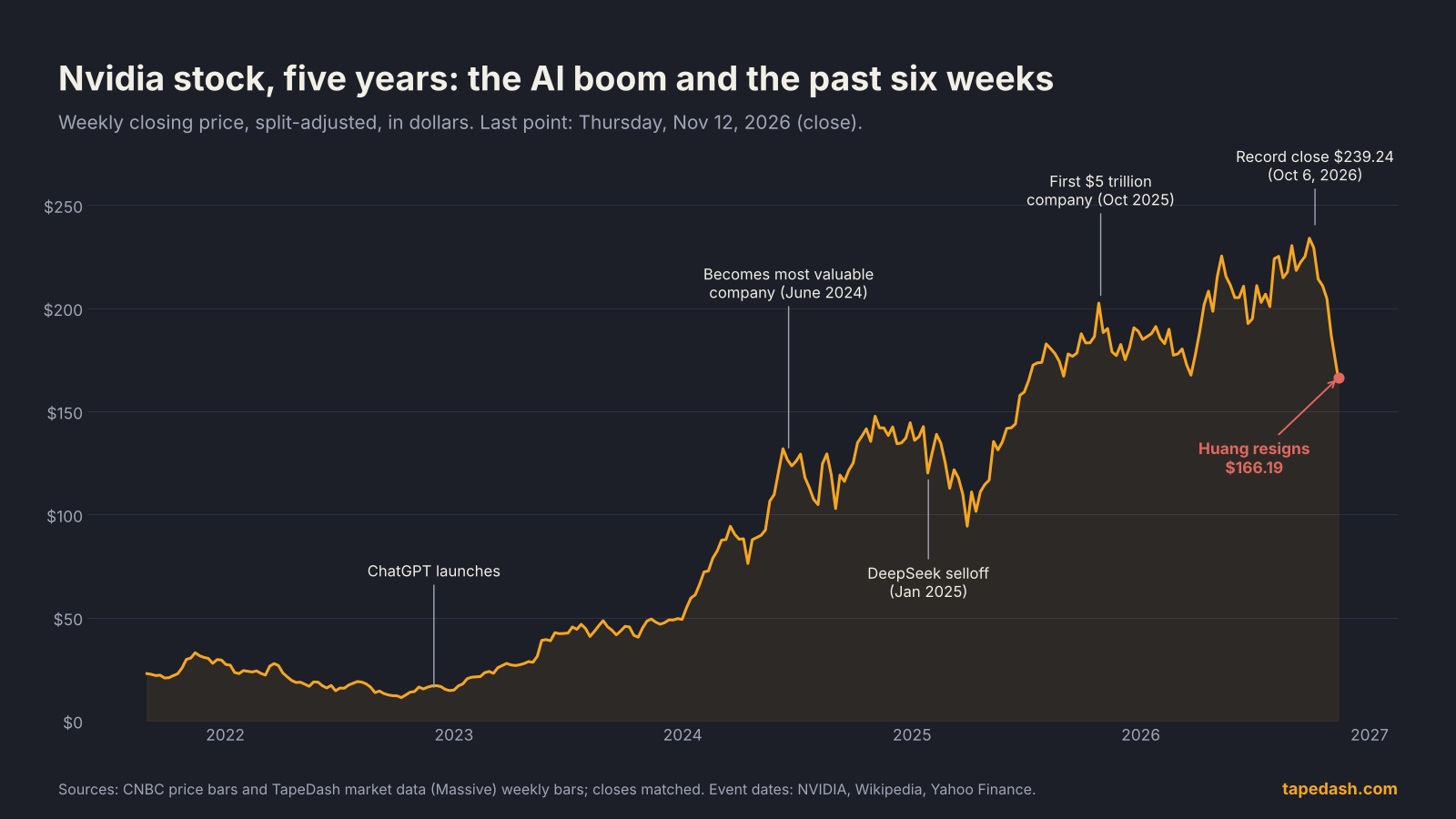
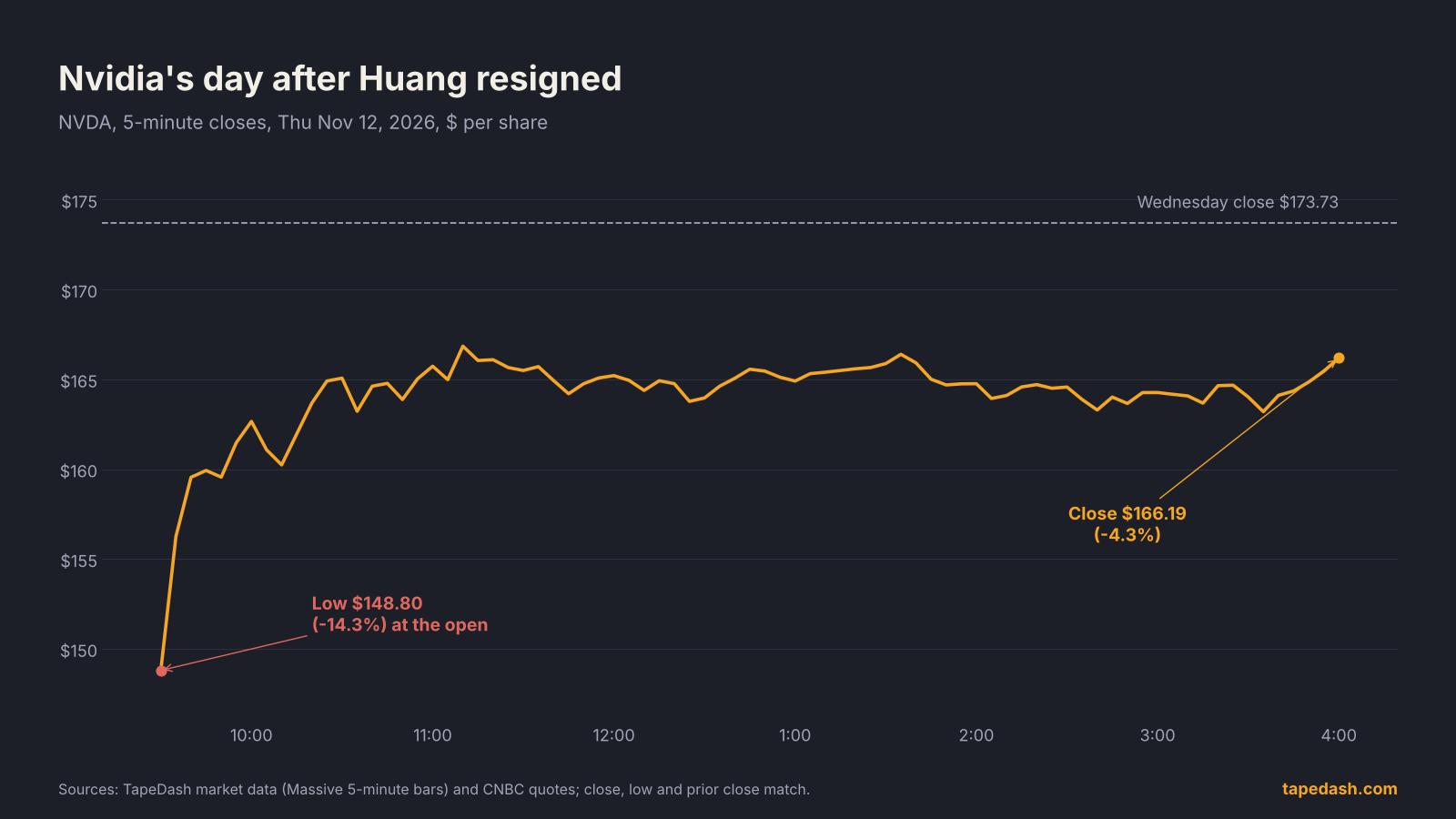
The resignation came four days after Huang told employees he had been unfaithful to his wife, and after Nvidia’s board opened an independent investigation into reports that he had been the target of a foreign intelligence effort through a relationship with an executive at Megaspeed, a Singapore-based Nvidia customer (AP via OPB, CNBC). The board has said it has no reason to believe national security or Nvidia secrets were compromised. Nvidia stock fell as much as 14.3% at Thursday’s open, to $148.80, then recovered to close down 4.3% at $166.19 (CNBC and TapeDash market data).
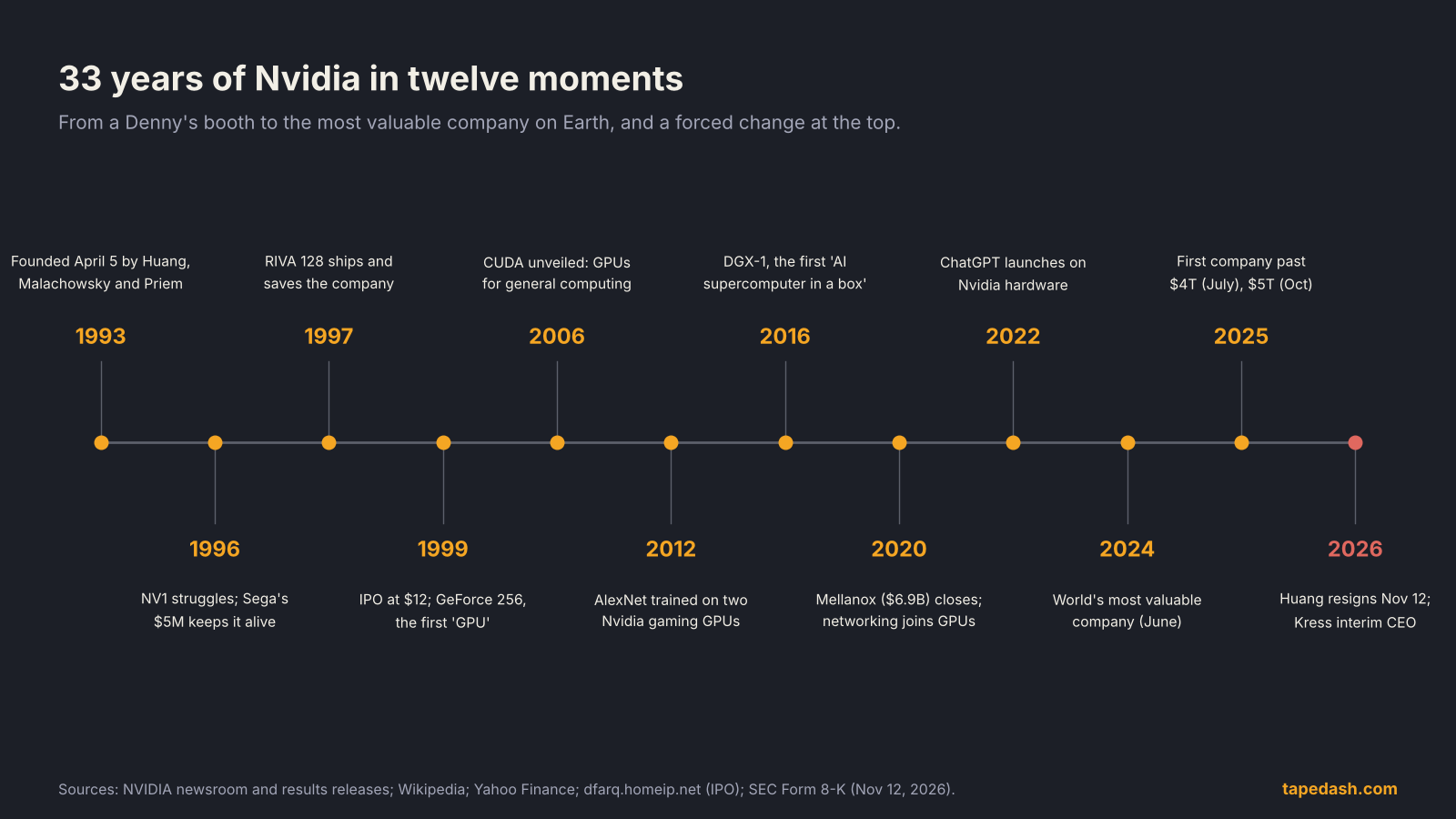
This is the biggest leadership change at the most valuable chip company in the world, five days before it reports earnings. To understand why it matters this much, you have to understand how unusual Nvidia’s history is, and how much of it ran through one person. So this piece starts at a Denny’s in San Jose in 1992 and ends with the dates that will decide what happens next.
- Jensen Huang resigned as Nvidia CEO, president and director on Nov. 12, 2026. CFO Colette Kress is interim CEO and Harvey Jones is the first board chair in Nvidia’s history.
- The trigger was a fast-moving story: an Oct. 29 New York Times report on U.S. officials’ concerns about a Megaspeed executive, Huang’s Nov. 8 admission to employees, a board investigation led by former federal prosecutor Joon Kim, and a second reported relationship on Nov. 11.
- Huang built Nvidia from $600 in founders’ capital and a near-death experience in 1996 into the first $5 trillion company, mostly by betting early that GPUs would become general-purpose computers.
- Nvidia’s business is in its strongest stretch ever (revenue of $96.2 billion last quarter, guidance of $108 billion for this one), so the question for investors is key-person risk and China exposure, not demand.
- The next hard dates: earnings on Tuesday, Nov. 17, the CEO search, and congressional and federal inquiries into Megaspeed.
How Nvidia started: three engineers and a Denny’s booth
Jensen Huang was born in Taipei in February 1963. His family moved to Thailand when he was five, and at nine he was sent to the United States with his older brother. An aunt and uncle enrolled the boys at the Oneida Baptist Institute in Kentucky, believing it was a prep school; it was a school for troubled kids. Two years later his parents settled in Oregon, where Huang graduated high school at 16 and worked as a dishwasher, busboy and waiter at a Denny’s. He earned an electrical engineering degree from Oregon State in 1984, designed microprocessors at AMD, moved to LSI Logic, and finished a master’s at Stanford in 1992 (Wikipedia: Jensen Huang).
At LSI he worked with two Sun Microsystems engineers, Chris Malachowsky and Curtis Priem, on a graphics chip for Sun’s workstations. In late 1992 the three met at a Denny’s on Berryessa Road in East San Jose and sketched out a company that would build 3D graphics chips for PCs. The bet was specific: video games were one of the hardest computing problems around and also a mass market, so a company that solved games could fund research on bigger problems later. Nvidia was incorporated on April 5, 1993 (Wikipedia: Nvidia, Yahoo Finance). The lawyer who set it up asked for the cash in Huang’s pocket, $200, and each founder put in the same, so Nvidia’s first capital was $600. Sequoia Capital and Sutter Hill Ventures followed with venture money. Huang was 30 and became CEO on day one; Priem later said the other two simply deferred to him.
The near-death years: NV1, Sega and “thirty days”
Nvidia’s first chip, the NV1, drew 3D scenes with four-sided shapes (quadrilaterals) instead of the triangles the rest of the industry was standardizing on. It flopped. Nvidia had also signed on to design graphics for Sega’s next console, and that chip fell short too. Instead of walking away, Sega invested $5 million, which kept Nvidia alive long enough to change course (dfarq, Yahoo Finance). The company laid off about half its staff and, by Huang’s own retelling, got within about a month of missing payroll. “Our company is thirty days from going out of business” became an unofficial motto he repeated to staff for years.
The rescue was the RIVA 128, released in 1997, which sold more than a million units in its first four months. Nvidia had learned the lesson it would apply for the next three decades: when the market is standardizing on something, get on the standard and then out-execute everyone on speed.
The 1999 IPO and the first “GPU”
Nvidia went public on January 22, 1999, selling 3.5 million shares at $12 each and raising $42 million (dfarq, Yahoo Finance). Later that year it released the GeForce 256 and marketed it as the world’s first “graphics processing unit.” The label was partly marketing, but it stuck, and it framed the GPU as a processor in its own right rather than an accessory.
The next few years built the gaming franchise. Nvidia won the graphics contract for Microsoft’s original Xbox, bought most of the assets of its fallen rival 3dfx in December 2000, and joined the S&P 500 in 2001, replacing Enron (Wikipedia: Nvidia). Of the dozens of graphics-chip startups from the 1990s, only Nvidia and ATI (later bought by AMD) survived as major players.
From GeForce to CUDA: how a gaming chip became an AI computer
A graphics chip does one thing extremely well: it runs the same simple math on millions of pixels at once. A regular processor (a CPU) is built to run a few complicated tasks one after another. Through the early 2000s, a handful of researchers noticed that a lot of scientific computing looks more like the pixel problem than the CPU problem, and started tricking GPUs into doing physics and math by disguising their work as graphics.
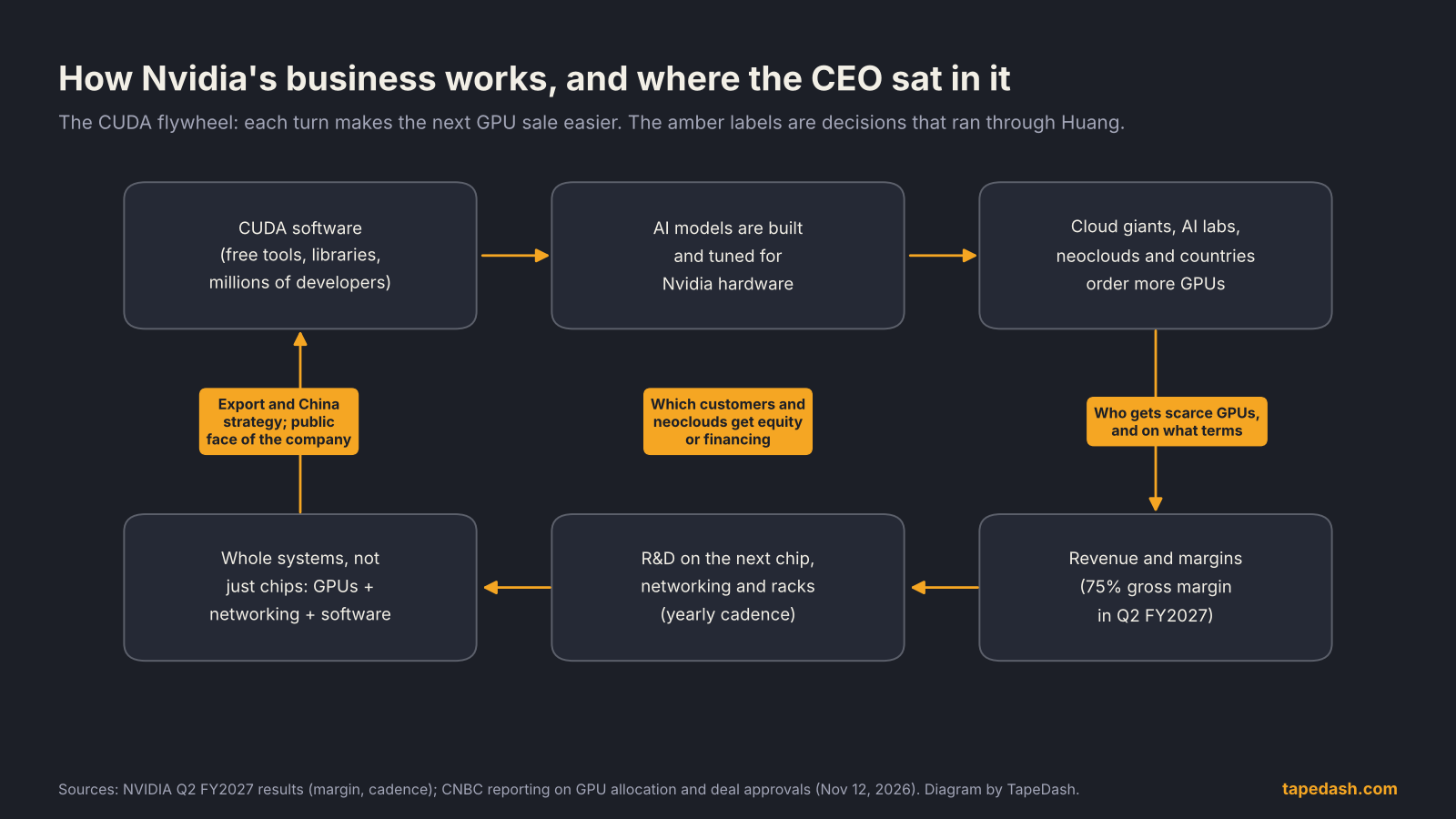
Huang decided to make that a product. In 2006 Nvidia unveiled CUDA, a programming platform that let developers write ordinary code for its GPUs, and released it the following year (Yahoo Finance, Wikipedia: Nvidia). Every Nvidia gaming card from then on doubled as a small parallel computer. It cost the company heavily for years before there was a clear market, and it is the single decision that best explains where Nvidia is today, because it created a developer base that competitors still have trouble pulling away.
2012: AlexNet and the deep learning moment
The market showed up in 2012. A University of Toronto team trained an image-recognition network, later known as AlexNet, on two Nvidia GeForce GTX 580 gaming cards and crushed the field in a major image-recognition contest (Yahoo Finance). Deep learning had found its hardware, and that hardware already had a software platform.
Nvidia leaned in. In April 2016 it announced the DGX-1, an eight-GPU “AI supercomputer in a box,” and handed early units to research labs, including OpenAI. In 2019 it agreed to buy the Israeli networking company Mellanox for $6.9 billion, a deal that closed in April 2020 and gave Nvidia the high-speed connections that let thousands of GPUs act like one machine (Wikipedia: Nvidia). Its $40 billion bid for chip designer Arm, announced in 2020, fell apart under regulatory opposition. There were rough patches too: crypto-mining demand swung its gaming sales up and down, and the stock fell sharply in 2018 and again in 2022.
How Nvidia became the world’s most valuable company
Then OpenAI released ChatGPT in November 2022, built on Nvidia hardware, and every large company on earth decided at roughly the same moment that it needed AI computing capacity. Nvidia’s H100 chip, announced in March 2022, became the most sought-after piece of hardware in the industry.
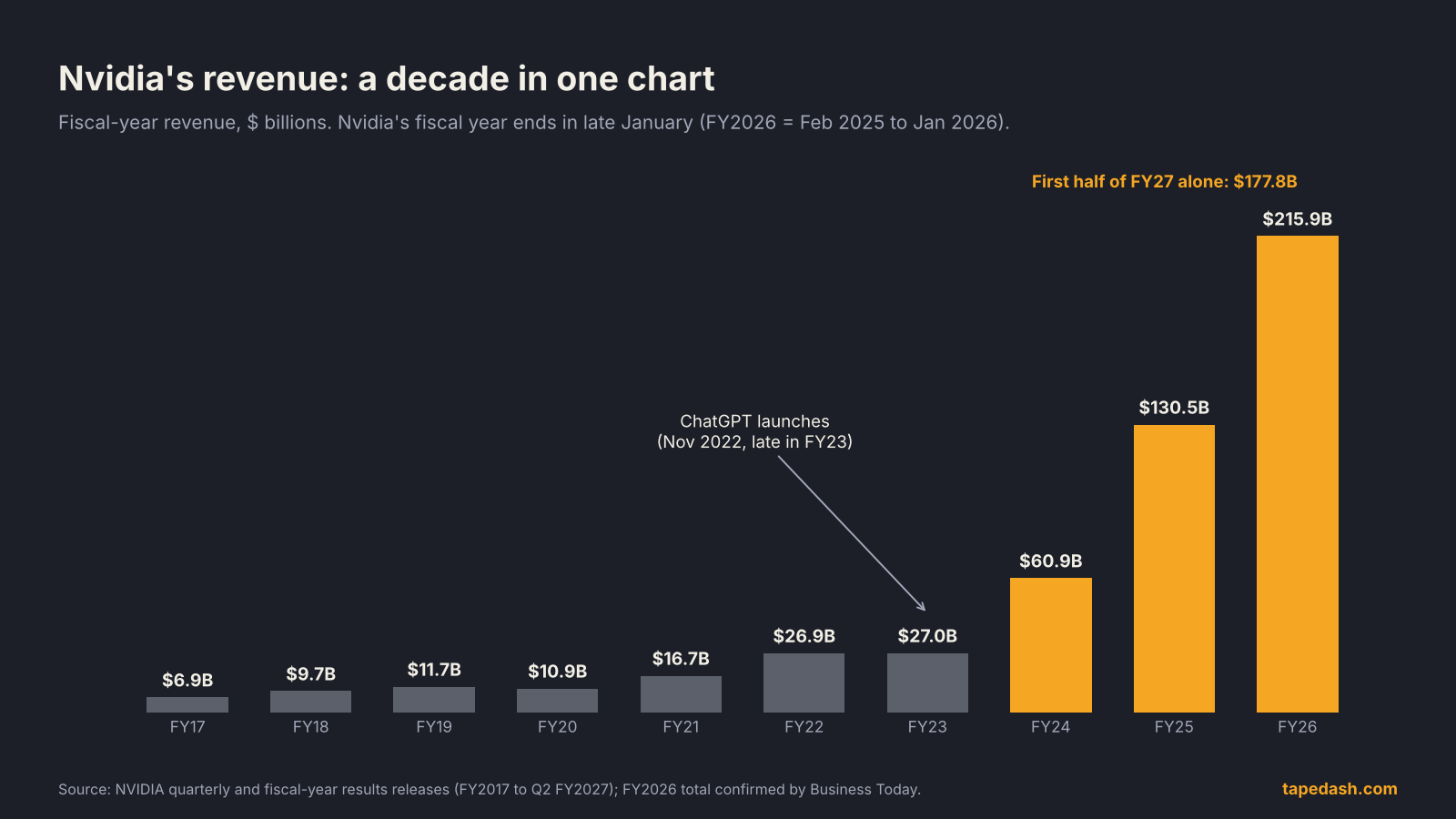
The revenue line tells the story better than any adjective:
| Fiscal year (ends late January) | Revenue | Change from prior year |
|---|---|---|
| FY2017 | $6.9 billion | |
| FY2020 | $10.9 billion | down 7% |
| FY2023 | $27.0 billion | flat |
| FY2024 | $60.9 billion | up 126% |
| FY2025 | $130.5 billion | up 114% |
| FY2026 | $215.9 billion | up 65% |
| FY2027, first half only | $177.8 billion |
Sources: NVIDIA fiscal-year results releases; FY2026 also reported by Business Today.
In fiscal 2023, the year ChatGPT launched, Nvidia’s revenue was $27.0 billion. Three years later it was $215.9 billion (NVIDIA FY2023, NVIDIA FY2026). In the quarter that ended July 26, 2026, the most recent one reported, revenue was $96.2 billion, up 106% from a year earlier, with gross margins of 75% and net income of $59.7 billion. Data center sales alone were $89.0 billion. For the quarter it reports next week, Nvidia guided to $108.0 billion, plus or minus 2%, and assumed no data center compute revenue from China (NVIDIA Q2 FY2027).
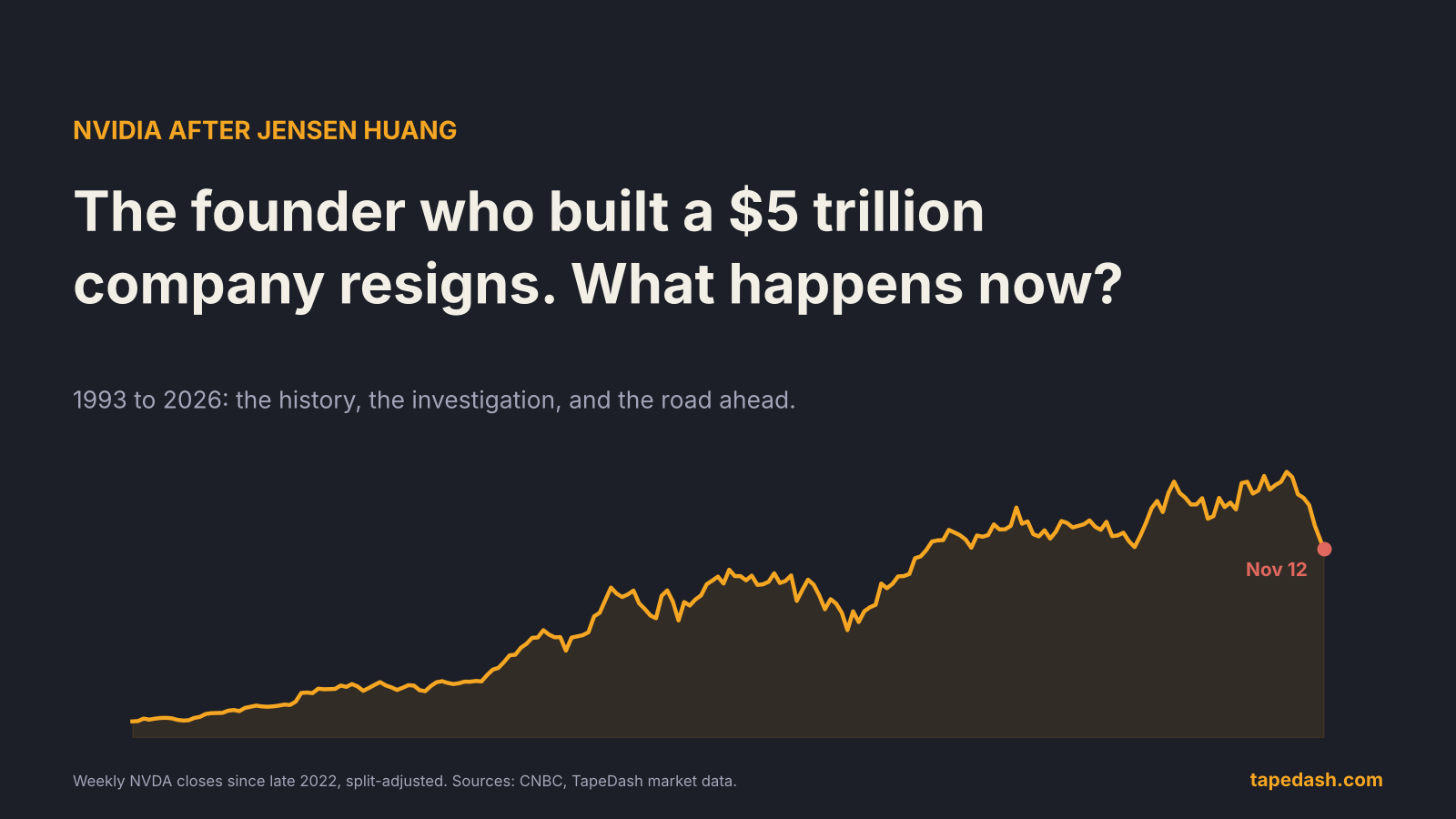
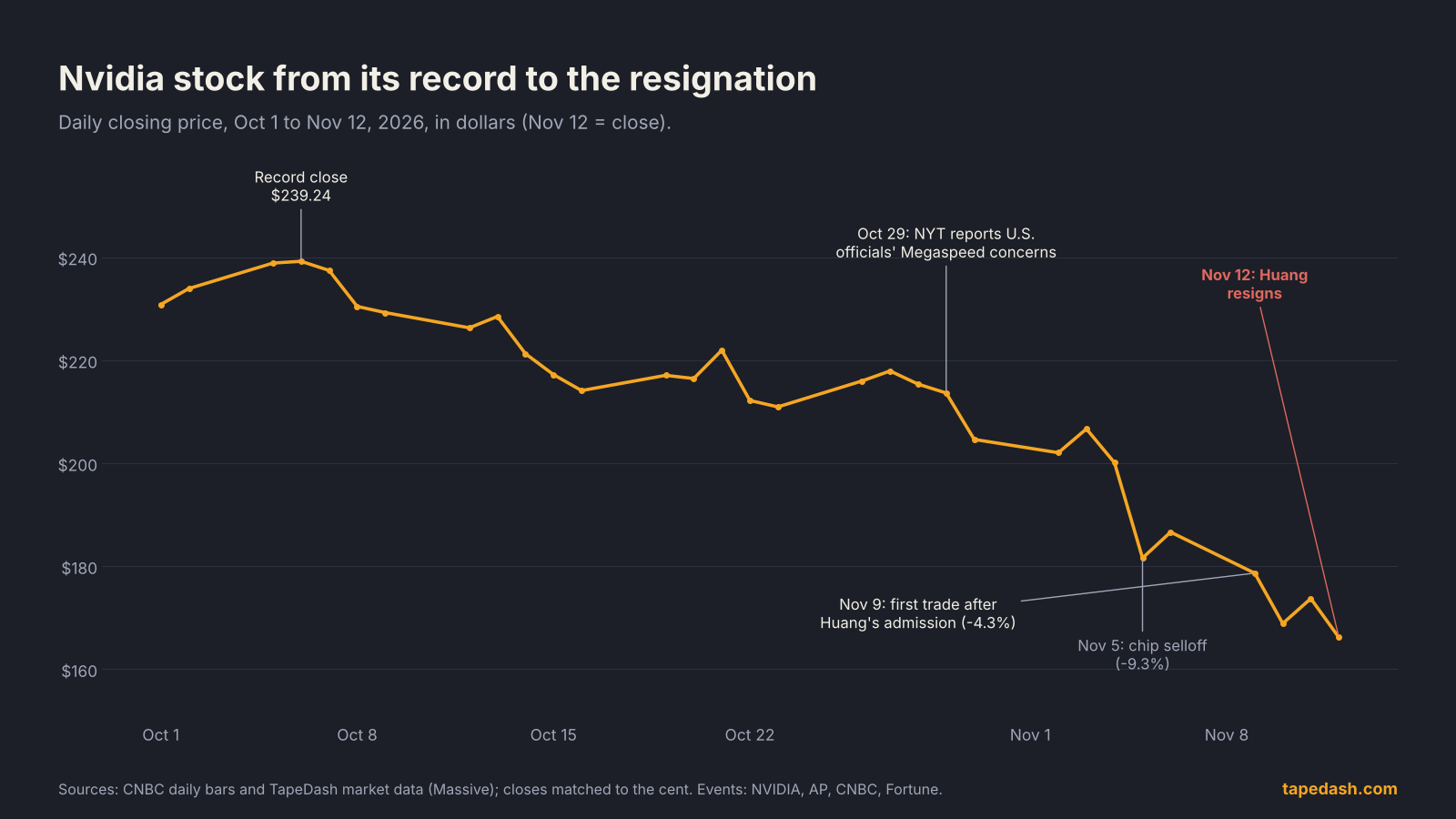
The stock followed. Nvidia reached a $1 trillion valuation in 2023, passed $2 trillion in early 2024, and passed Microsoft and Apple to become the world’s most valuable company in June 2024, around $3.3 trillion. It split its shares 10-for-1 in June 2024. It survived a record one-day loss in January 2025, when the low-cost Chinese DeepSeek model raised doubts about how many chips AI would need, then became the first company to pass $4 trillion in July 2025 and $5 trillion in October 2025 (Wikipedia: Nvidia, Yahoo Finance). The stock’s record close came on October 6, 2026, at $239.24 a share (CNBC and TapeDash market data).
China: the market Nvidia kept losing
The other thread that runs through this story is China. U.S. export controls announced in October 2022 limited the sale of advanced AI chips to China, which had been one of Nvidia’s biggest markets. Nvidia redesigned chips to fit the rules, the rules were tightened, and it redesigned again. In April 2025 sales of its China-specific H20 chip were restricted as well, and Nvidia began giving guidance that assumes no data center compute revenue from China at all (CNBC, Yahoo Finance). Licenses for the newer H200 chip were later granted, but CNBC reports Beijing has not approved large-scale imports.
Huang was the company’s lead voice on China policy, in public and in Washington. That matters for what came next, because the scandal that ended his tenure is, underneath the personal headlines, a story about whether restricted chips reached China through Southeast Asian customers.
What happened to Jensen Huang: the investigation, day by day
Here is the sequence as reported, with each step confirmed by at least two outlets or a company filing.
| Date (2026) | What happened |
|---|---|
| Oct. 29 | The New York Times reports U.S. officials believed Huang had a close relationship with Alice Huang (no relation), an executive tied to Megaspeed, a Singapore data center company and major Nvidia customer, and that U.S. intelligence had concluded she was gathering information for China’s Ministry of State Security. China calls the claim a smear. |
| Nov. 8 (Sun.) | Huang tells employees he was unfaithful to his wife and supports a review. Nvidia’s board opens an independent investigation overseen by independent directors, saying it has no reason to believe national security or Nvidia secrets were compromised. |
| Nov. 9 (Mon.) | NVDA falls 4.3% to $178.67 in the first session after the news. |
| Nov. 10 (Tue.) | The independent directors hire Joon H. Kim, a former acting U.S. Attorney for the Southern District of New York, and the law firm Wachtell, Lipton, Rosen & Katz. NVDA falls another 5.5%. |
| Nov. 11 (Wed.) | Reports of a second relationship, with a Nvidia employee, and of a board meeting on Huang’s future. The board accepts his resignation that day, according to the 8-K. |
| Nov. 12 (Thu.) | Nvidia announces the CEO transition. |
Sources: AP via OPB, CNBC, Al Jazeera, The Next Web, Fortune, SEC 8-K; prices from CNBC and TapeDash market data.
I’m going to stay out of the personal side beyond what the company itself disclosed. For a shareholder, the relevant questions are business questions, and there are three of them.
What is Megaspeed, and why does it matter?
Megaspeed is a Singapore-based cloud and data center company that buys Nvidia chips and has described itself as a core partner of Nvidia’s cloud business in Asia-Pacific (Al Jazeera). It has been accused of passing restricted Nvidia chips to Chinese companies, which it denies, saying inspections found no violations. A U.S. Commerce Department inquiry into Megaspeed was reported by the Times to have moved to the Justice Department, and three House committees have asked for closed-door briefings on Nvidia’s relationship with the company (CNBC).
That is the part of the story that can outlast the resignation. If investigators find that significant volumes of restricted chips reached China through Nvidia customers, the consequences could include tighter export rules, chip-tracking requirements, or penalties. If they don’t, the issue fades. Either way, it is now out of Huang’s hands.
What did the board actually say?
The board’s statements have been narrow and consistent: an independent review, outside counsel, and “no reason to believe” secrets were compromised. Thursday’s release didn’t mention the investigation at all. It said operations, customer commitments and the product roadmap continue without interruption, and that the board thanked Huang for his contributions (NVIDIA). The 8-K lists no severance or separation terms for Huang.
Who is running Nvidia now?
Colette Kress joined Nvidia as CFO in September 2013 after nearly 25 years in finance at technology companies, including Cisco and Microsoft. She keeps the CFO job while serving as interim CEO. Harvey Jones, who has been on Nvidia’s board since 1993 and is a former CEO and executive chairman of Synopsys, becomes chair (NVIDIA, SEC 8-K). Until this week Nvidia had a lead independent director but no chair at all.
Why a CEO resignation hits Nvidia this hard: key-person risk explained
Most large companies are built so that no single executive is irreplaceable. Nvidia was built the other way. Huang had about 60 direct reports, the company has no chief operating officer, and Nvidia has operated without a chief compliance officer (Fortune). CNBC reports that Huang personally decided how scarce GPUs were allocated among customers, which neoclouds received Nvidia equity, and that some project-finance deals waited for his plane to land before terms were confirmed (CNBC). The board is also long-tenured: three directors, including Huang and Jones, had served since 1993 (The Next Web).
That structure produced speed. It also produced what finance people call key-person risk: the chance that a company’s value depends on one individual in a way that can’t be hedged. Nvidia’s own annual report lists succession as a risk factor. Huang owned about 3.6% of the company and, unlike some founder-CEOs, had no super-voting shares, so he never had the votes to keep his job if the board decided otherwise (Fortune, Al Jazeera).
How to read a founder-CEO exit as a trader
When I look at a sudden CEO departure, I separate three things, because the market tends to price them together on day one and then pull them apart over the following weeks.
The first is the business. Are customers still ordering? For Nvidia, the evidence through August says yes by a wide margin, and the board’s statement says the roadmap is unchanged. The next real data point is Tuesday’s report, and the most useful line in it may be the forward guidance and backlog commentary, not the quarter itself.
The second is the decision-making machine. A company run through one person can keep shipping products for months on momentum. What slows down is the stuff that needed the person: big partnerships, financing commitments, allocation calls in a supply-constrained market. Watch whether large deals announced under Huang get reaffirmed, delayed or renegotiated over the next quarter.
The third is the legal and regulatory tail: Megaspeed, export controls, any congressional hearings and shareholder lawsuits. These move slowly, rarely resolve on a schedule, and tend to cap valuation multiples while they’re open more than they crash the stock in a day.
The useful comparison is McDonald’s in 2019, which removed CEO Steve Easterbrook over a consensual relationship with an employee. The business was fine; the governance clean-up took years and ended with the company clawing back cash and equity from him (Fortune). The difference here is scale and concentration. McDonald’s was not a single point in the global AI supply chain.
How Nvidia stock reacted
Thursday’s tape told two stories. At the open, Nvidia traded as low as $148.80, down 14.3% from Wednesday’s close of $173.73. Buyers stepped in almost at once: by 10:20 AM the stock was back near $165, and it closed at $166.19, down 4.34%, a market value of about $4.0 trillion (CNBC; the close, the low and the prior close match TapeDash market data).
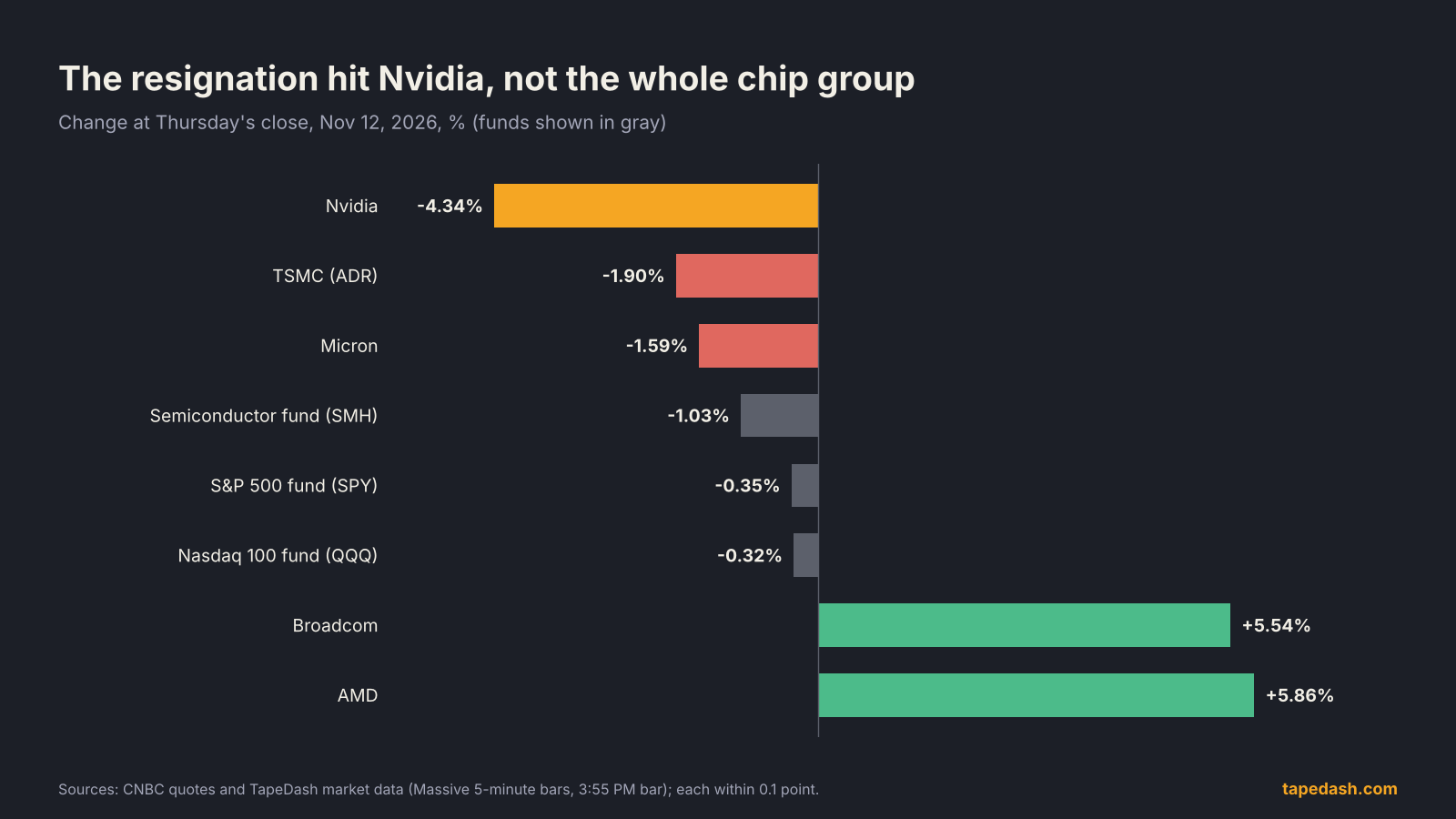
The rest of the chip group barely flinched. The semiconductor fund (SMH) fell 1.03%, TSMC 1.90% and Micron 1.59%, while AMD rose 5.86% and Broadcom 5.54%. The S&P 500 fund slipped 0.35%. One reasonable reading: the market treated this as a Nvidia governance problem, not a verdict on AI chip demand, and some money moved to the alternatives.
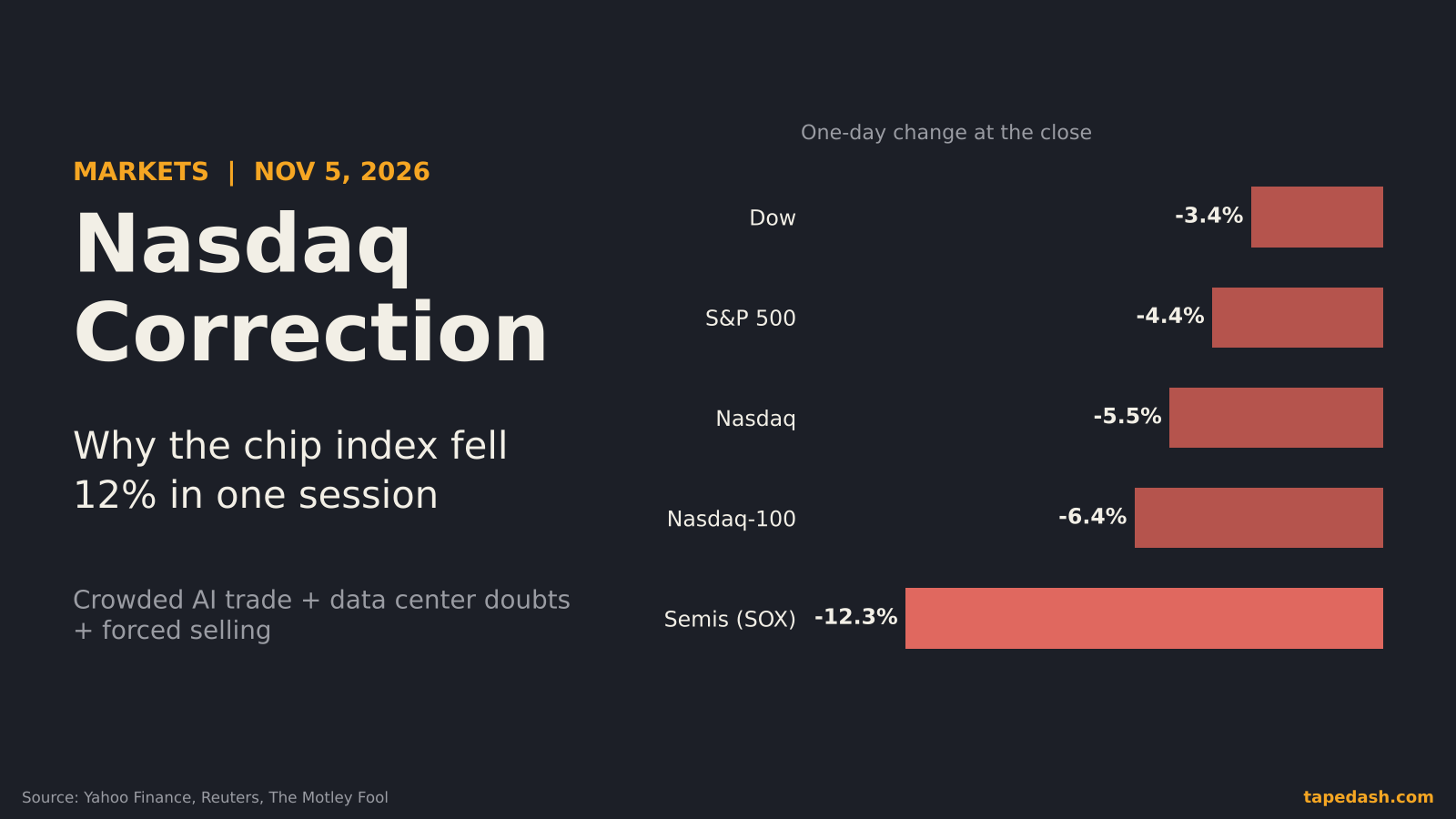
Some context matters. The stock was already in a slide before the first Times report. It closed at its record of $239.24 on October 6, fell through October, and dropped 9.3% on November 5 in a broad chip selloff that had nothing to do with Huang (we wrote about it in the Nasdaq correction post). CNBC notes the stock is on pace for a sixth straight weekly decline, which would be its longest losing streak since 2012 (CNBC). From the October 6 record to Thursday’s close, the stock is down about 30.5%.
Where Nvidia goes from here: three scenarios
Nobody knows how this plays out, including the board. What I can do is lay out the paths that matter for the stock and what would tell you which one you’re on.
| Scenario | What it looks like | What would confirm it |
|---|---|---|
| Steady handoff | Kress runs a stable interim period, Tuesday’s results and guidance hold up, and the board names a permanent CEO within months. The stock trades on earnings again. | Guidance at or above expectations, big customers reaffirming orders, no new findings from the review. |
| Long uncertainty | The search drags, deal-making slows, and the Megaspeed inquiries stay open. Revenue stays strong but the valuation multiple compresses. | Delayed partnership announcements, hedged language on the call, more congressional or federal action. |
| Regulatory hit | Investigators find meaningful chip diversion to China, leading to penalties or tighter controls that reach beyond China. | Formal charges or findings involving Nvidia customers, new export legislation, guidance cuts tied to compliance. |
Who could the permanent CEO be? The board says it will look inside and outside. Huang said repeatedly that he hoped his successor would come from within Nvidia, and Fortune notes the company has never named one (Fortune). An internal pick keeps continuity with engineers and customers. An outside pick with public-company governance experience might reassure investors and Washington more. My read is that the market will care less about the name than about whether the new structure spreads decisions that used to sit with one person, such as a chief operating officer, a dedicated compliance chief, or a board that clearly runs itself.
There is also a cost to the wider AI trade. Nvidia sits at the center of a web of customer financing and equity stakes, including the neocloud model we covered in our CoreWeave earnings piece. Huang was the person who made many of those commitments. Companies that depend on Nvidia allocation or Nvidia capital have a new counterparty to learn, at least for a while.
What to watch next
- Tuesday, Nov. 17, about 1:20 PM PT: Nvidia reports fiscal third-quarter results, as scheduled, with the conference call at 2 PM PT (NVIDIA, NVIDIA IR). Company guidance is $108.0 billion; analysts expect about $109 billion (CNBC, CNBC-e). It will be Kress’s first call as interim CEO. Listen for the fourth-quarter outlook, any mention of order changes, and how questions about the review are handled.
- The CEO search: any timeline, a search firm, or a named candidate.
- The board’s investigation: whether the review led by Joon Kim produces a public summary, and whether the board adds governance changes such as a COO or compliance chief.
- Megaspeed and Washington: the House committees’ requested briefings and any Justice Department action. New export rules would matter for every U.S. chipmaker, not only Nvidia.
- The chip group: whether Nvidia’s peers trade with it or against it. If the selling stays concentrated in Nvidia while suppliers hold, the market is pricing a company problem, not an AI-demand problem.
- Options pricing into Tuesday: the implied move on Nvidia options will show how much uncertainty traders are paying for; compare it with recent quarters.
How we’re tracking this on TapeDash
If you want to watch whether this stays a Nvidia story or turns into a sector story, these are the two things we’re watching on the desk. First, relative strength: Nvidia against the semiconductor fund and against its own suppliers and customers. The Terminal Preview heatmap shows that at a glance. Second, options positioning into Tuesday: large put and call trades, changes in implied volatility, and where open interest is stacking, which you can watch in the Live Scanner.
We’ll cover Tuesday’s results the same night in the free TapeDash Daily. If you want the full toolkit, the first 200 members lock Pro at $69.99 a month on their account, even if they cancel and come back later.
Jensen Huang resignation FAQ
Who is Nvidia’s CEO now?
Colette Kress, Nvidia’s chief financial officer since 2013, is interim CEO and remains CFO. The board is searching for a permanent CEO and will consider internal and external candidates. Harvey Jones is the new board chair.
Why did Jensen Huang resign?
Nvidia’s announcement did not give a reason. It followed reports that U.S. officials believed a Megaspeed executive he had a relationship with was gathering information for China, Huang’s Nov. 8 admission of infidelity, a board investigation led by outside counsel, and a second reported relationship with an employee. The board has said it has no reason to believe national security or Nvidia secrets were compromised.
When does Nvidia report earnings?
Tuesday, Nov. 17, 2026, at about 1:20 PM Pacific time, with the conference call at 2 PM Pacific. The date did not change with the CEO transition.
The one thing to remember
Nvidia spent 33 years as the clearest example of a founder-run company, and the founder’s judgment is a big part of why it went from $600 to the first $5 trillion valuation. The business he left behind is still growing faster than almost anything its size ever has. What changed this week is the structure around it. For the next few months, Nvidia’s stock will trade on two things: whether the numbers keep coming, and whether the board can show that the company no longer needs one person to say yes.
See it on the tape, not just in the headlines
TapeDash is the research desk for traders and investors: live options flow, dealer positioning, a real-time market scanner and trade alerts graded in public. Memberships open Black Friday, November 27, and the first 200 members lock Pro at $69.99 a month on their account, even if they cancel and come back later.
Join the waitlistClick through the terminalSee the track recordSources
- NVIDIA: NVIDIA Announces CEO Transition (Form 8-K, Exhibit 99.1, Nov 12, 2026)
- SEC: NVIDIA Corp Form 8-K, Item 5.02 (filed Nov 12, 2026)
- CNBC: Jensen Huang's exit from Nvidia raises questions about future of AI (Nov 12, 2026)
- CNBC: Huang affair with alleged Chinese spy complicates Nvidia China problem (Nov 10, 2026)
- Associated Press via OPB: Nvidia investigates whether CEO Jensen Huang was targeted by Chinese spy (Nov 9, 2026)
- Fortune: Nvidia's power built around Jensen Huang, and the scandal testing that formula (Nov 9, 2026)
- Al Jazeera: Nvidia shares slump amid investigation into CEO Jensen Huang (Nov 9, 2026)
- The Next Web: Nvidia board hires ex-prosecutor Joon Kim to investigate Jensen Huang (Nov 10, 2026)
- NVIDIA: Financial results for second quarter fiscal 2027 (Aug 26, 2026)
- NVIDIA: Financial results for fourth quarter and fiscal 2026
- NVIDIA: Financial results for fourth quarter and fiscal 2025
- NVIDIA: Financial results for fourth quarter and fiscal 2023
- Business Today: Nvidia posts record $216 billion annual revenue (Feb 26, 2026)
- Yahoo Finance: Nvidia, how the chipmaker evolved from a gaming startup to an AI giant
- Wikipedia: Nvidia
- Wikipedia: Jensen Huang
- Wikipedia: Jensen Huang spying scandal
- Dan's Data / dfarq: Nvidia's IPO on January 22, 1999
- NVIDIA: NVIDIA Sets Conference Call for Third Quarter Financial Results
- CNBC Türkiye (CNBC-e): Nvidia revenue could approach $109 billion (Nov 2, 2026)
- CNBC: NVDA quote page
This article is for educational and informational purposes only. It is not financial, investment, medical or legal advice, and it is not a recommendation to buy or sell any security. Figures come from the sources listed and were checked on the date of publication; markets change quickly. Options trading involves substantial risk of loss.