Deere Earnings Q4 2026: Why a Light 2027 Outlook Lifted the Stock
Deere guided 2027 profit well below Wall Street, and the stock still closed up about 4%. What the numbers say, why traders bought it and what to watch next.
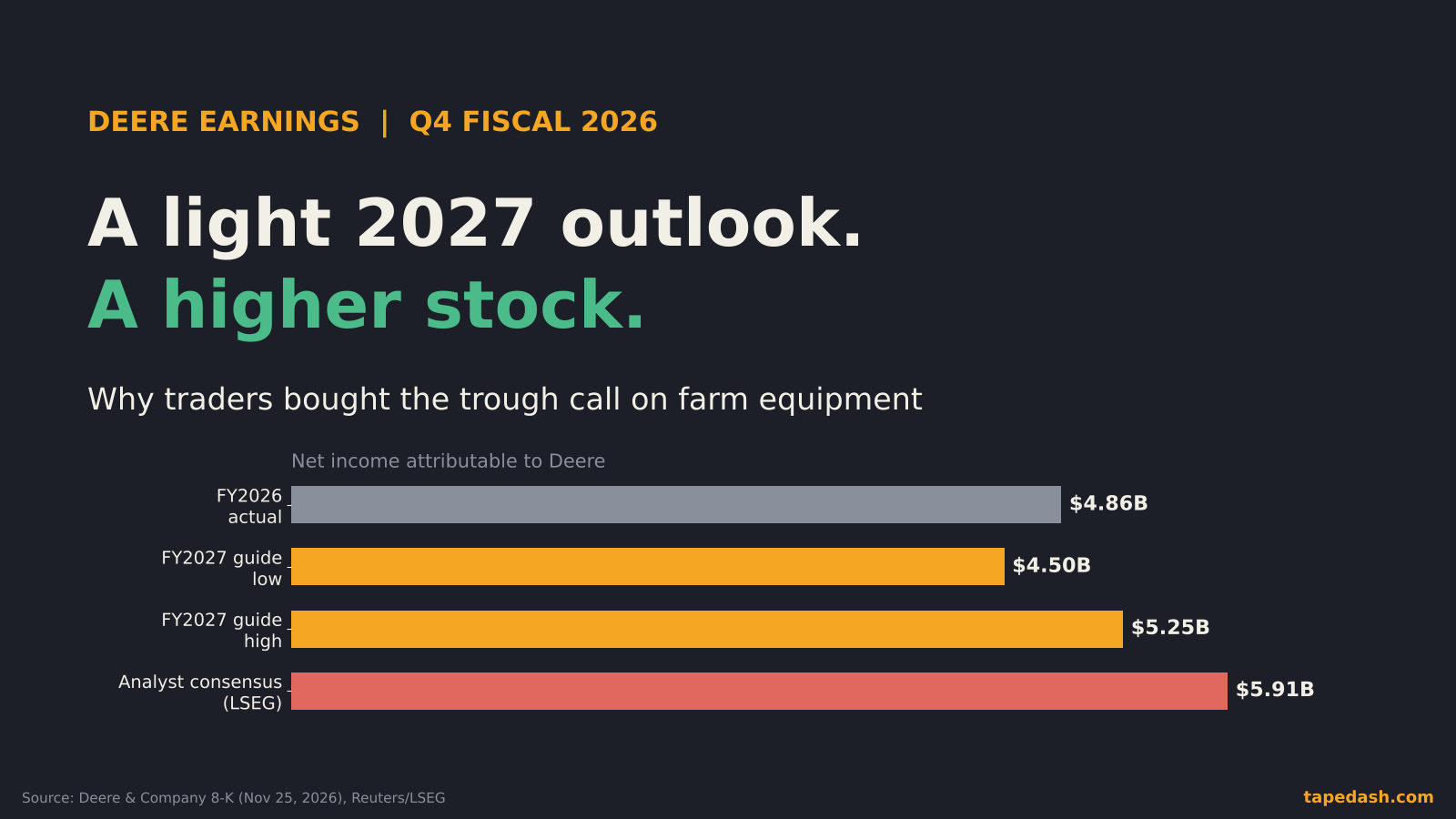
Deere & Company (DE) told Wall Street on Wednesday morning that it expects to earn $4.50 billion to $5.25 billion in fiscal 2027. Analysts had been looking for about $5.91 billion, according to LSEG data cited by Reuters, so even the top of the range came in well short (Deere 8-K, Reuters via SRN News). The stock fell before the open, somewhere between 4% and 6% depending on whose snapshot you read. By the close it was up about 4.4% (Quad Cities Business Journal, StockTitan).
Why did Deere stock rise on a weak outlook? Because the guide was light for a reason traders could live with, and the part of the report that matters most for the next two years pointed up. Deere forecast North American large agriculture industry sales up 5% to 15% in fiscal 2027, the first growth call for its most cyclical business after a hard year. Part of the profit gap is also a one-time, non-cash pension charge of $0.25 billion to $0.40 billion baked into the range. Strip that out and the midpoint sits roughly where fiscal 2026 ended.
That is the whole trade in two sentences. The rest of this piece walks through the quarter segment by segment, what the outlook actually says, how a guide-down turns into a rally, and the dates that will tell us whether Deere’s call on the bottom of the farm cycle holds up.
- Deere earned $1.051 billion, or $3.89 a share, in fiscal Q4, down from $1.065 billion and $3.93 a year earlier, on net sales and revenues of $12.115 billion.
- The fiscal 2027 net income outlook of $4.50 billion to $5.25 billion sits well below the roughly $5.91 billion analysts expected, and includes a $0.25 billion to $0.40 billion non-cash pension charge.
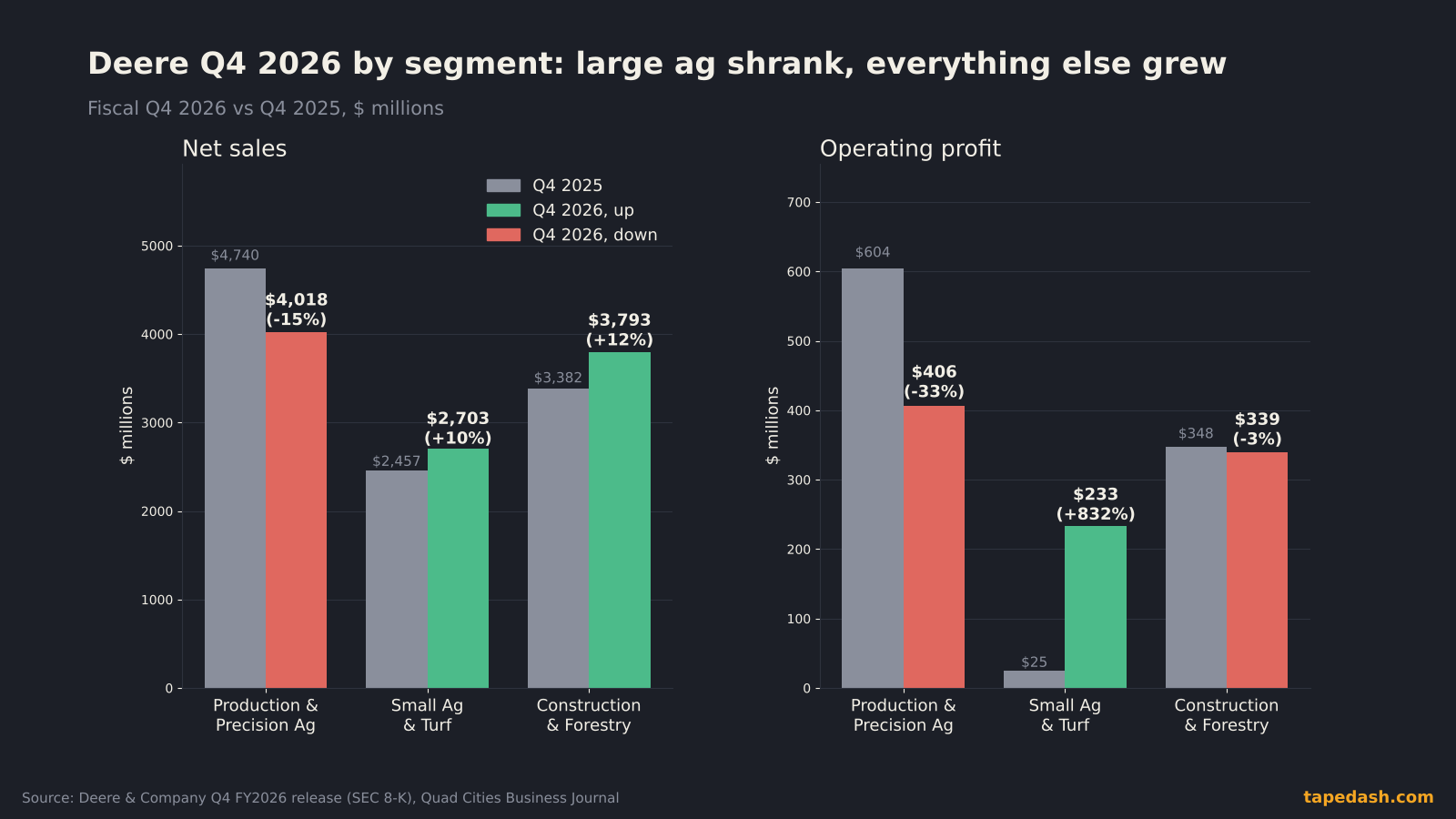
- Large ag (Production & Precision Agriculture) sales fell 15% in the quarter, while Small Ag & Turf rose 10% and Construction & Forestry rose 12%.
- Deere expects U.S. and Canada large ag industry sales to rise 5% to 15% next year, the clearest sign it thinks the cycle has bottomed.
- The stock reversed from a premarket drop to close up about 4.4% on a day when the Nasdaq swung from a roughly 4% loss to a small one.
Deere Q4 2026 earnings: the numbers against last year
Start with the headline figures, because they were close to flat. Net income attributable to Deere was $1.051 billion in the quarter that ended November 1, down 1% from $1.065 billion a year earlier. Diluted earnings per share were $3.89 against $3.93. Net sales and revenues slipped 2% to $12.115 billion from $12.394 billion (Deere 8-K, Quad Cities Business Journal).
Against expectations the picture split in two. Revenue cleared the roughly $10.4 billion consensus by a wide margin, while earnings per share came in a little under the Street’s estimate (Investing.com, Investing.com transcript). Be careful with that revenue beat. Consensus figures for Deere are often built on equipment sales alone, and the reported line includes financial services, so a gap that size says as much about definitions as it does about tractors. I don’t put much weight on it, and from the tape on Wednesday morning, neither did the market.
The finance arm deserves a line of its own. Financial Services revenue fell 11% and its net income dropped to $231 million from $293 million, on tighter financing spreads, a smaller average loan book and a higher provision for credit losses (Deere 8-K, Investing.com). A rising credit-loss provision at a farm lender is worth watching. It is not alarming at this size, but it is the first place stress among farmers and contractors would show up in Deere’s numbers.
Deere segment results: large ag shrank, everything else grew
The segment table is where this report gets interesting, because the three equipment businesses went in different directions.
Production & Precision Agriculture
This is Deere’s big-iron business: high-horsepower tractors, combines, sprayers and the precision technology bolted onto them. Net sales fell 15% to $4.018 billion and operating profit fell 33% to $406 million (Deere 8-K, Quad Cities Business Journal). Work out the margin from those two figures and you get about 10.1%, down from about 12.7% a year ago. Deere blamed lower shipment volumes and a weaker mix, partly offset by lower production costs.
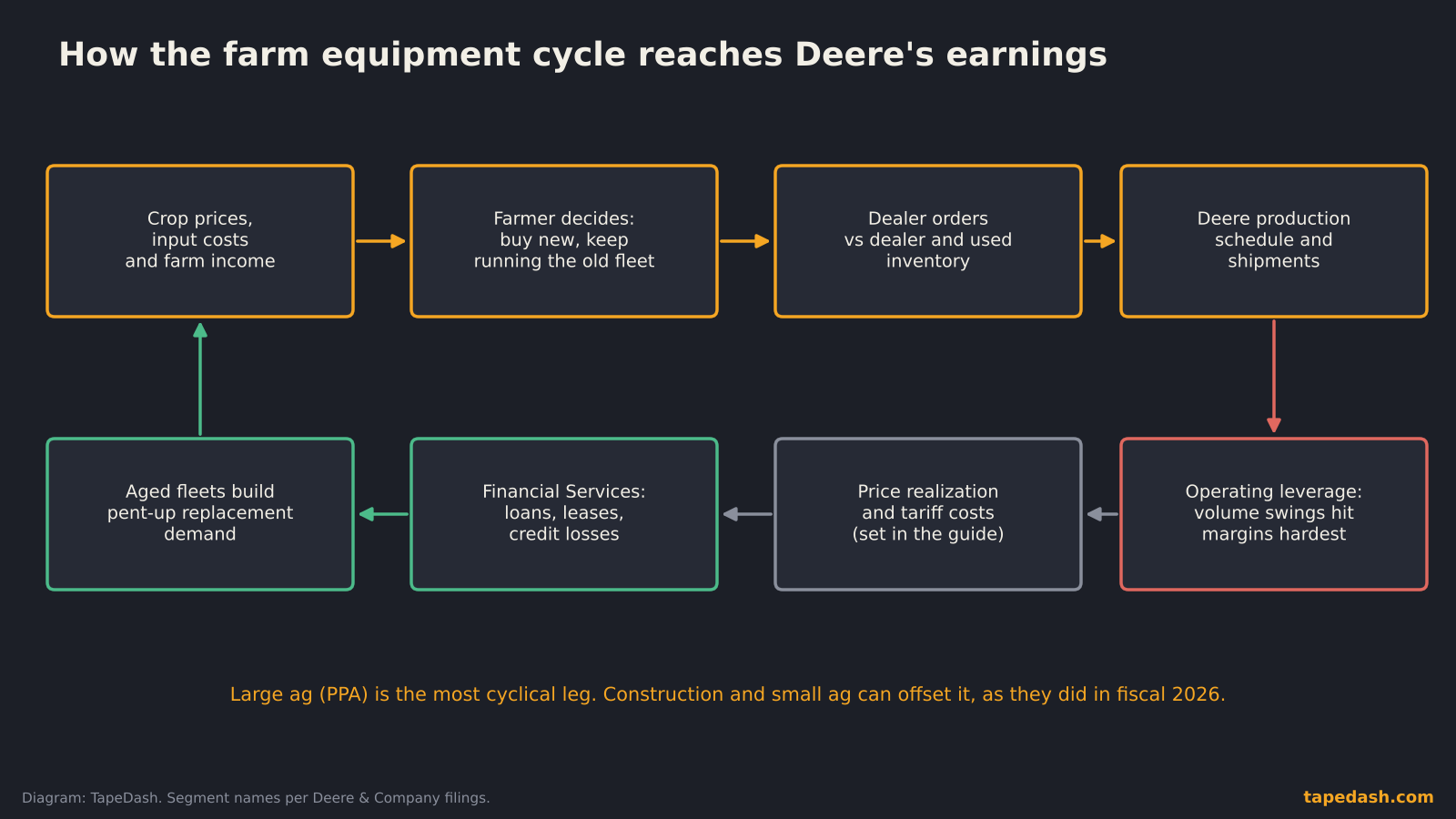
That pattern, sales down 15% and profit down a third, is operating leverage running in reverse. A factory built to make a certain number of combines still carries most of its costs when it makes fewer, so every lost unit takes more than its share of profit with it. The same math works the other way on the way up, which is why the outlook for this segment mattered so much on Wednesday.
Small Ag & Turf
Compact tractors, mowers, hay equipment and utility vehicles had a strong quarter. Net sales rose 10% to $2.703 billion and operating profit jumped to $233 million from just $25 million a year earlier (Deere 8-K, Investing.com). The year-ago quarter was unusually weak, so the percentage change looks absurd. The point is simpler: higher volumes, better pricing and lower warranty costs turned a breakeven business into a profitable one.
Construction & Forestry
Construction & Forestry sales rose 12% to $3.793 billion, but operating profit slipped 3% to $339 million (Deere 8-K, Quad Cities Business Journal). Deere pointed to higher production costs plus more spending on selling, administration and research. More revenue on less profit is the kind of line I’d want explained on the next call, because it is the segment Deere is leaning on to diversify away from crop prices.
Fiscal 2026 in one picture
Zoom out to the full year and you see why management keeps calling 2026 the trough. Net sales and revenues rose 4% to $47.704 billion, equipment operations net sales rose 6% to $41.292 billion, and net income fell 3% to $4.860 billion, or $17.95 a share against $18.50 (Deere 8-K, Investing.com).
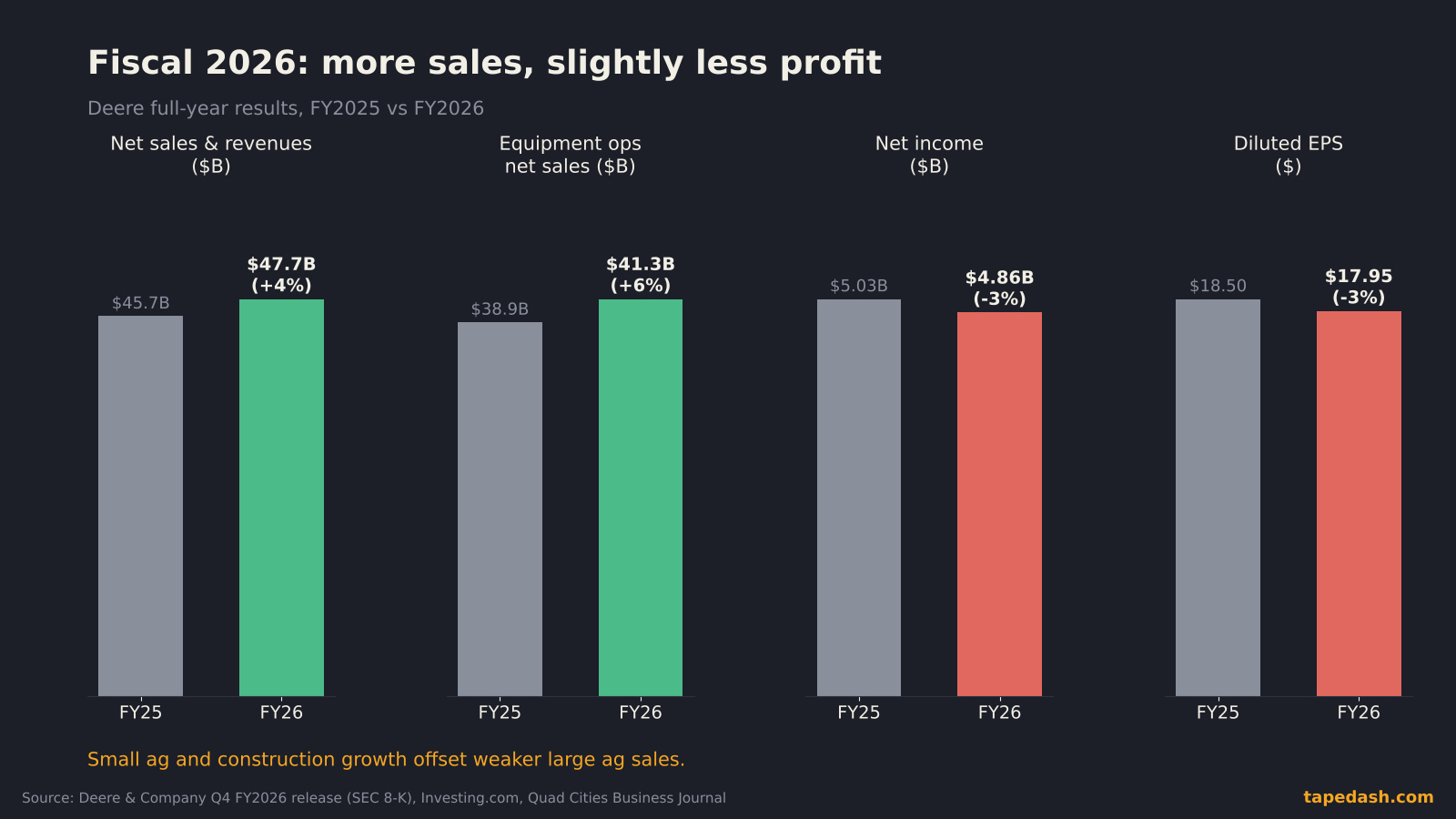
For a farm equipment maker, earning close to $5 billion in the year large ag shrank is the real headline. In past downturns this business gave back a much bigger share of its profit. Chairman and CEO John May made the same argument in the release, saying the results show the company is structurally stronger than at the same point in the last cycle (Deere 8-K, Quad Cities Business Journal). You can discount the corporate phrasing, but the numbers above back it up.
Deere’s fiscal 2027 outlook, line by line
Here is what Deere actually guided to. Net income of $4.50 billion to $5.25 billion, including the non-cash pension charge of $0.25 billion to $0.40 billion tied to a voluntary lump-sum offer to some U.S. salaried retirees. Financial Services net income of about $0.90 billion. Segment sales: Production & Precision Agriculture up 5% to 15%, Small Ag & Turf about flat, Construction & Forestry flat to up 10% (Deere 8-K, Investing.com).
The industry forecasts behind those numbers tell you where Deere sees demand coming from.
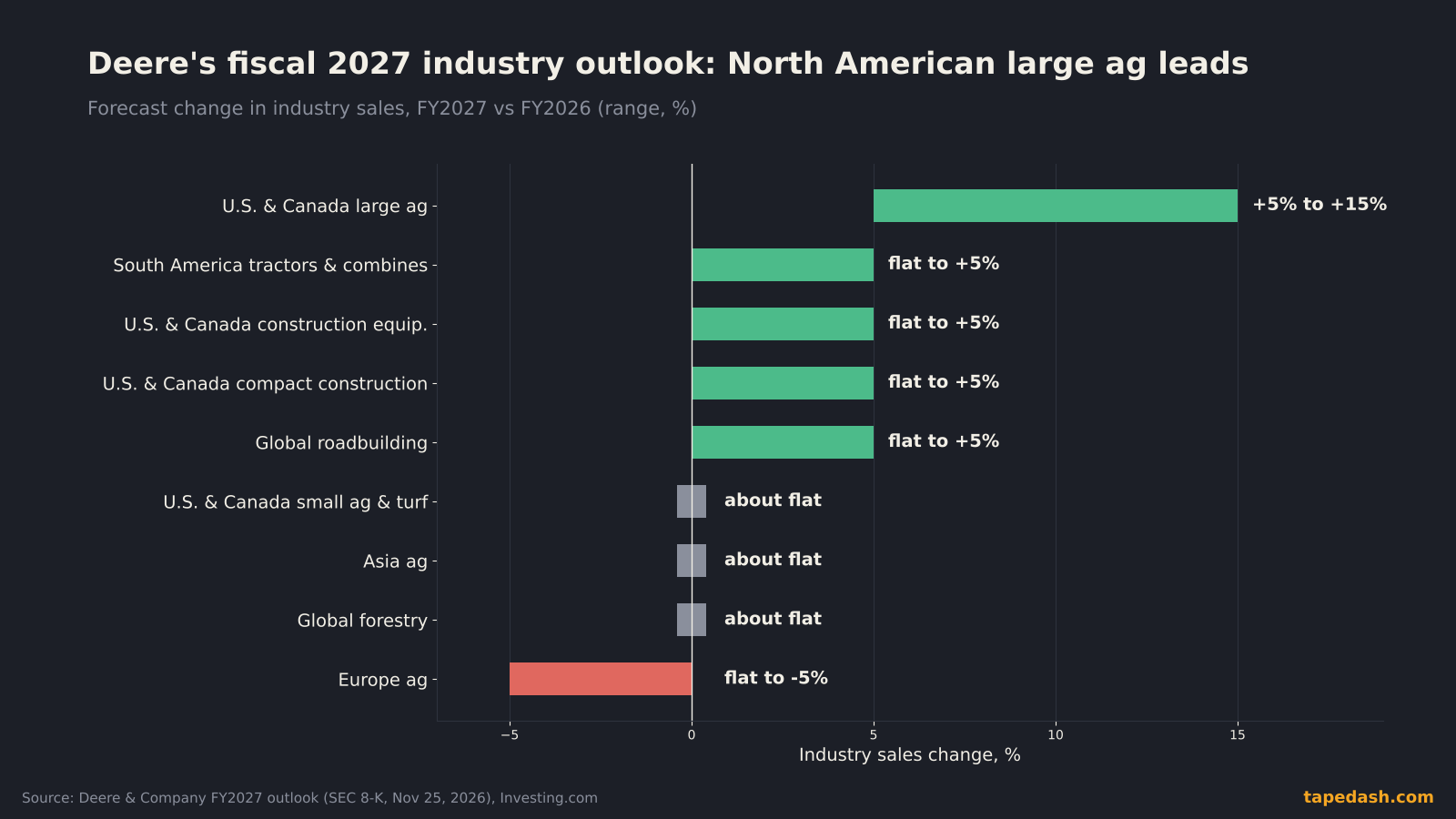
North America does all the heavy lifting. Deere sees U.S. and Canada large ag up 5% to 15%, South America flat to up 5%, Asia about flat, and Europe flat to down 5% (Deere 8-K, Investing.com). May described the turn as “early signs of improvement in large agriculture, led by North America,” and said the outlook reflects a wider-than-usual range of outcomes.
| Fiscal 2026 actual | Fiscal 2027 outlook | What it tells you | |
|---|---|---|---|
| Net income | $4.86 billion | $4.50 to $5.25 billion | Flat at the midpoint, before adding back the pension charge |
| One-time pension charge | None | $0.25 to $0.40 billion, non-cash | Explains part of the gap to consensus |
| Production & Precision Ag sales | Down for the year | Up 5% to 15% | The cyclical engine restarts |
| Small Ag & Turf sales | Up for the year | About flat | A strong year that Deere does not expect to repeat |
| Construction & Forestry sales | Up for the year | Flat to up 10% | Steady, with upside if building activity holds |
| Financial Services net income | $885 million | About $0.90 billion | Roughly unchanged |
| Analyst consensus for net income | About $5.91 billion (LSEG) | The bar the guide missed |
Two things stand out in that table. First, the range is wide, $750 million from top to bottom, and the bottom end would be a down year even after the pension charge. Deere is telling you it does not know yet how fast farmers will come back. Second, the pension charge doesn’t come close to closing the gap. Add back even the high end of it and the top of the range is still short of $5.91 billion. Analysts were too optimistic on timing, and that will show up as estimate cuts over the next week.
Why Deere stock rose after a weak guide
So why did a stock that missed the consensus for next year by a wide margin close up about 4.4%?
The first reason is positioning and expectations that never showed up in the consensus number. Published estimates are often stale. Analysts who expect a cut tend to wait for the company to make it, so the “real” bar on a name like Deere going into a cycle-trough report is usually lower than the printed one. When the stock gapped down in premarket trading, it was pricing a bad outcome. Once traders read past the headline and saw large ag guided to grow, the downside case looked overdone.
The second reason is that cyclical stocks trade on the direction of the cycle, not the level of earnings. Investors in Deere are not paying for fiscal 2027 profit. They are paying for the next upswing, and the single most important line in the release was the call that North American large ag grows next year. The 15% sales drop in the quarter matters less to a long-term holder than the sign that the drop is ending.
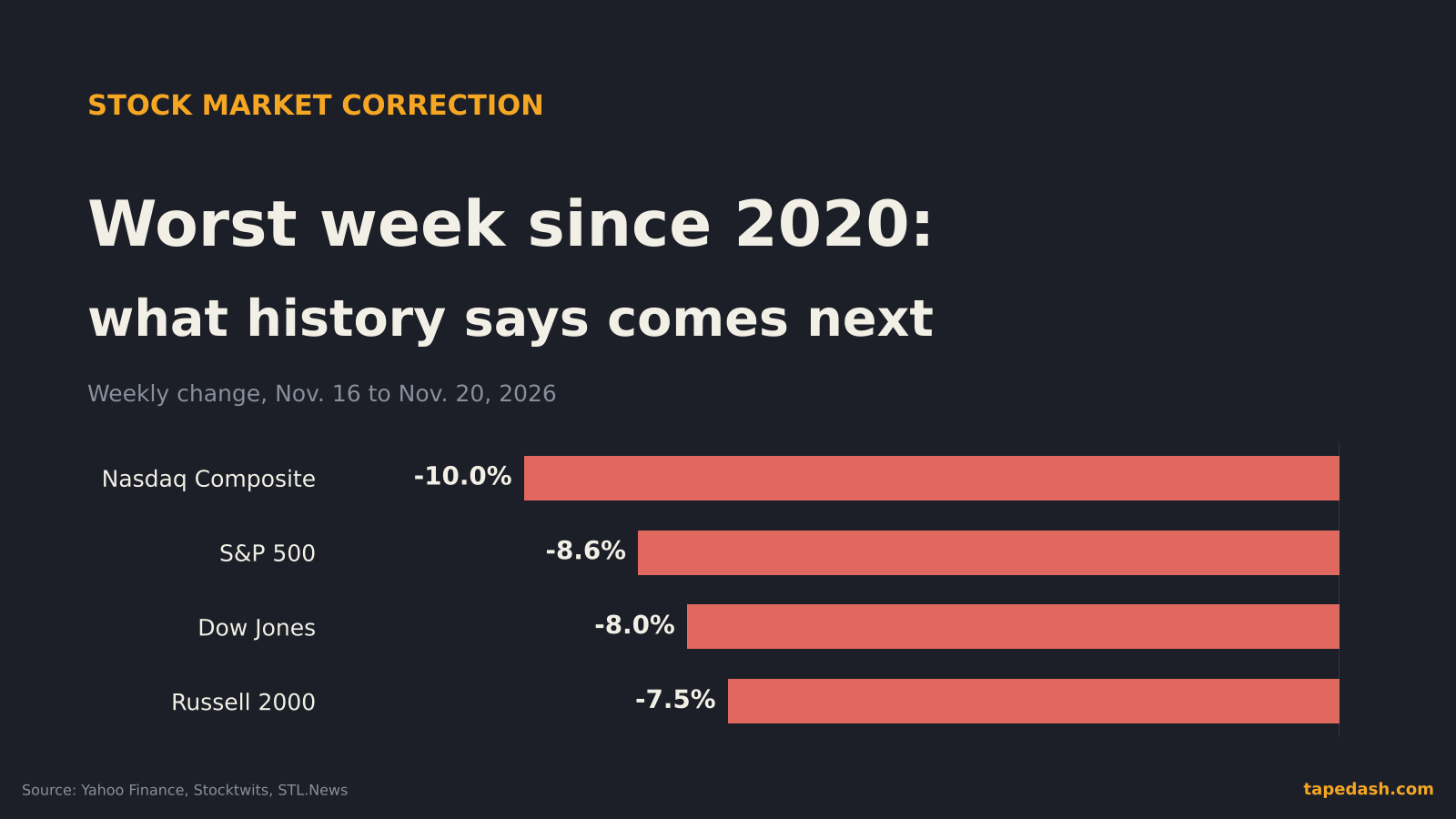
The third reason is the day itself. Wednesday was brutal early for tech. The Nasdaq Composite was down about 4% before lunch and the Invesco QQQ Trust (QQQ) hit a low around 11 a.m. down 4.38%, before both clawed back to finish down about 0.6% (The Motley Fool, StockTitan). The SPDR Dow Jones Industrial Average ETF (DIA) actually finished higher. Money leaving chip stocks needed somewhere to go, and an industrial with a clear cycle story and no AI-valuation question attached was an easy home for it. I wrote about that rotation in what the worst week since 2020 means for the stock market correction, and Wednesday looked like another chapter of it.
How to read a guide-down like a trader
Most retail traders read an earnings reaction backward. They see “guidance below estimates” in a headline and assume the stock should fall. Here is the checklist I run instead when a company guides below the Street.
Separate one-time items from the run rate. Deere’s pension charge is non-cash and one-off. It lowers reported profit without changing what the business earns from selling equipment. Always find the items like this before deciding how big a miss really is.
Find the line that drives the multiple. Every company has one number the market pays for. For Deere right now it is large ag volume in North America. For a software company it might be net new bookings. If that line improves while the headline misses, the stock can rally, and often does.
Compare the move to what options priced. Before every report, options prices imply an expected move, usually read from the at-the-money straddle for the nearest expiration. If a stock that was priced to move 5% either way opens down 5% and closes up 4%, the options market got the size of the move right and the direction wrong twice in one session. That tells you sellers were exhausted early. I covered how to read that expected move in how to read an earnings report like a trader.
Watch what happens on the second day. A gap that reverses in the first hour is a statement. A reversal that holds into the next session is a trend. With markets closed Thursday for Thanksgiving and only a half session Friday, closing at 1:00 p.m. ET (NYSE, StockTitan), the real test for Deere comes Monday, when full volume returns.
Check the estimate revisions. After a guide like this, analysts cut their fiscal 2027 numbers toward the company’s range over the following days. If the stock holds up while estimates fall, the market is telling you the cut was already in the price. That was the signal I’d want to see confirmed.
Who wins and who loses from Deere’s call on the farm cycle
If Deere is right that North American large ag has bottomed, the read-across goes beyond one stock. AGCO (AGCO) and CNH Industrial (CNH) sell into the same farmers and the same dealer networks, so a better large-ag order book helps them too, with a lag. Dealers and used-equipment prices are the first to feel it, because a farmer who decides to trade up sells the old machine on the way.
Construction is a different story. Deere’s construction forecasts are modest, flat to up 5% across most lines, which lines up with the cautious tone around housing and building activity. That leaves Caterpillar (CAT) and the rental companies trading more on infrastructure and data-center construction than on anything Deere said Wednesday.
The losers, if the call is wrong, are the bulls who bought the reversal. A farm recovery depends on crop prices, interest rates and trade, and all three are moving. On the same morning Deere reported, the U.S. Trade Representative put out proposed tariffs on goods from a long list of trading partners, and the October inflation report came in hot enough to keep rate-hike talk alive (The Motley Fool, StockTitan). Higher rates make equipment loans more expensive. Trade fights can hit crop export demand. Either one could push the large-ag recovery to the low end of Deere’s range.
What to watch next for Deere stock
Here are the dates and data points I’d put on the calendar.
Monday, November 30. The first full trading session after the holiday. Whether Deere holds Wednesday’s close on normal volume says more than anything in the first two days.
December 8 and 9. The Federal Reserve’s final policy meeting of the year (Federal Reserve). Farm equipment is bought on credit, so the rate path feeds straight into large-ag demand and into Deere’s own financing spreads.
USDA’s December crop and supply estimates. The monthly WASDE report resets the corn and soybean balance sheets that drive farm income expectations. A tighter balance sheet supports crop prices, which supports equipment demand.
Public comment on the proposed tariffs. The tariff proposals are proposals, with comment periods running into January. Any sign that trade partners retaliate against U.S. farm exports would hit the exact customers Deere is counting on.
Deere’s fiscal first-quarter report in February. This is when the outlook gets its first real check. Watch the large-ag order book and whether management narrows the $4.50 billion to $5.25 billion range, and in which direction.
How to track Deere and the farm cycle on TapeDash
If you want to watch whether Wednesday’s reversal turns into a trend, this is what we track. The Earnings Edge page shows how a stock has moved after past reports against what options priced in, so you can see whether Deere tends to drift after a reaction like this one or give it back. The earnings call summaries pull the guidance changes and segment commentary out of the call so you can compare them quarter to quarter without reading the transcript.
For the next few sessions I’d watch flow. The Live Scanner shows unusual options activity as it prints, and if large call buying in DE or the farm equipment names shows up on Monday, that is someone positioning for the recovery to stick. The Terminal Preview puts that flow next to dealer positioning, ratings and the macro calendar. If you’re new to reading flow, start with what options flow is and how to read it. The first 200 members lock Pro at $69.99 a month on their account, even if they cancel and come back later. If you’d rather start free, the TapeDash Daily covers moves like this one every morning.
Deere earnings FAQ
Did Deere beat or miss earnings in Q4 2026?
It was mixed. Revenue of $12.115 billion came in well above the roughly $10.4 billion consensus, while earnings per share of $3.89 came in a little below the Street’s estimate and below $3.93 a year earlier.
What is Deere’s fiscal 2027 guidance?
Deere expects net income of $4.50 billion to $5.25 billion in fiscal 2027, including a non-cash pension charge of $0.25 billion to $0.40 billion. Analysts had expected about $5.91 billion, according to LSEG data cited by Reuters.
Why did Deere stock go up after earnings?
The stock fell before the open, then reversed to close up about 4.4%. Traders focused on Deere’s forecast that North American large ag industry sales grow 5% to 15% next year, a sign the farm equipment cycle has bottomed, and on the one-time nature of the pension charge.
The one idea to remember
Cyclical stocks don’t trade on this year’s earnings. They trade on which way the cycle is turning. Deere guided to a flat-to-down year and still rallied, because the one line that mattered, North American large ag, turned up for the first time in this downturn. If you take one habit from Wednesday, make it this: when a guide disappoints, find the line the market actually pays for before you decide what the stock should do.
See it on the tape, not just in the headlines
TapeDash is a market research and data analytics platform for traders and investors: live options flow, dealer positioning, a real-time market scanner, stock ratings, and macro and earnings data in one terminal. Memberships open Black Friday, November 27, and the first 200 members lock Pro at $69.99 a month on their account, even if they cancel and come back later.
Join the waitlistClick through the terminalSee the track recordSources
- Deere & Company: Fourth quarter and fiscal 2026 results, Form 8-K Exhibit 99.1 (Nov 25, 2026)
- Reuters via SRN News: Deere forecasts 2027 profit below estimates as farm equipment recovery remains muted (Nov 25, 2026)
- Quad Cities Business Journal: Deere reports net income of $1.051B for fourth quarter (Nov 25, 2026)
- Investing.com: Deere Q4 2026 slides, revenue beats as cycle trough signals recovery (Nov 25, 2026)
- Investing.com: Earnings call transcript, Deere Q4 2026 revenue beats as EPS misses forecast (Nov 25, 2026)
- StockTitan: Stock Market Today Live, November 25, 2026 (Nov 25, 2026)
- The Motley Fool: Stock Market Today, Nov. 25, Nvidia slides 3.9% as the market considers hot PCE inflation data and new tariff proposals (Nov 25, 2026)
- The Motley Fool: Stock Market Midday, Nov. 25, Nasdaq plunges 4% as AI sell-off deepens (Nov 25, 2026)
- Federal Reserve: Meeting calendars and information
- NYSE: Holidays and trading hours
This article is for educational and informational purposes only. It is not financial, investment, medical or legal advice, and it is not a recommendation to buy or sell any security. Figures come from the sources listed and were checked on the date of publication; markets change quickly. Options trading involves substantial risk of loss.