Walmart Earnings Q3 2026: Why a Raised Outlook Met a Lower Stock
Walmart beat estimates, raised its outlook a third time and grew ads 25%, yet the stock slipped. What the numbers say and what traders watch next.
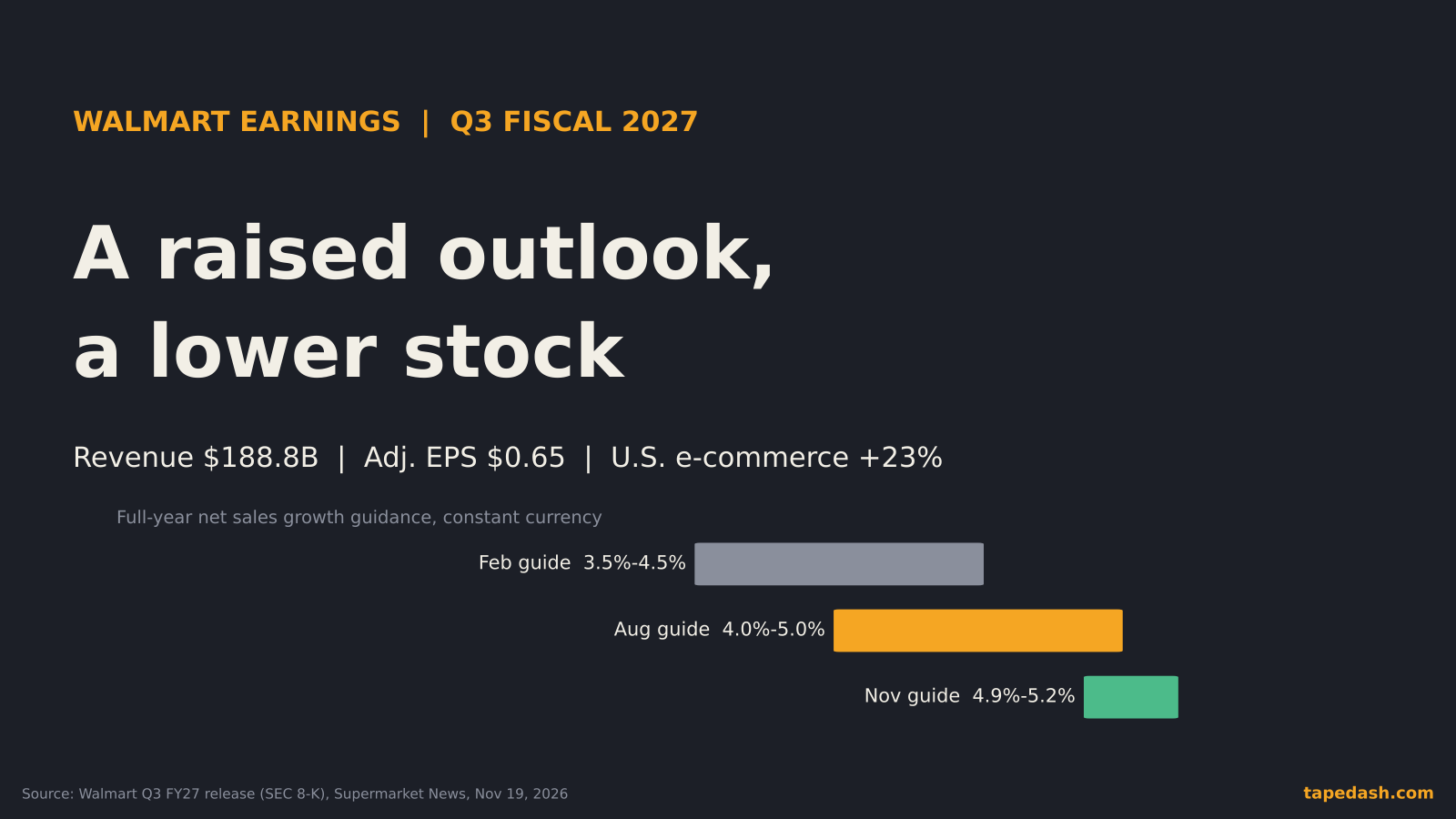
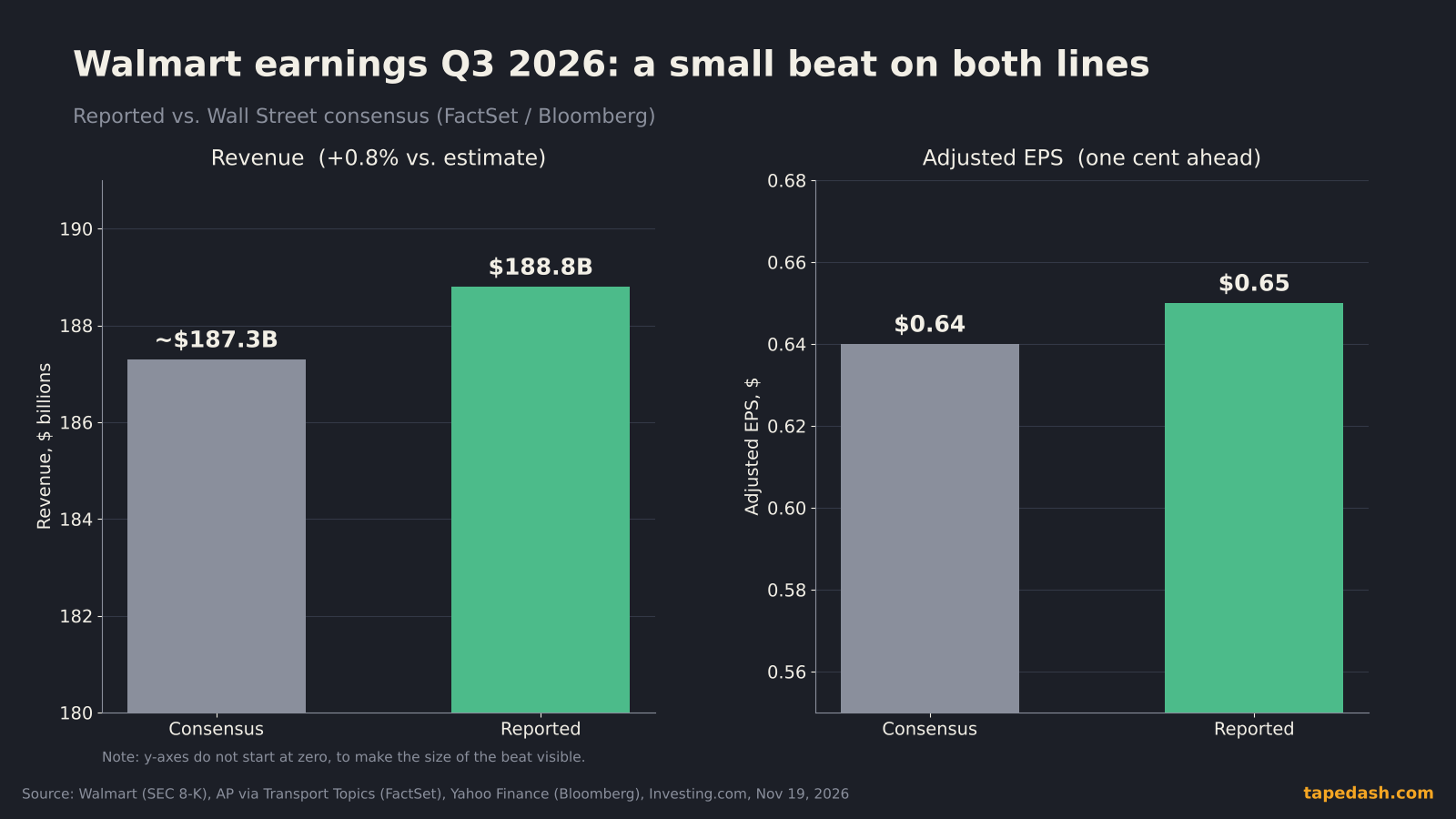
Walmart (WMT) reported its fiscal third quarter on Thursday morning and did almost everything a shareholder could ask. Revenue came in at $188.8 billion, up 5.2% from a year ago, and adjusted earnings were 65 cents a share against an estimate of 64 cents (Walmart 8-K, AP via Transport Topics). U.S. e-commerce grew 23%. Global advertising grew 25%. And for the third time this fiscal year, management raised its full-year outlook.
The stock went the other way. Shares traded down between 1% and 2% in the morning from Wednesday’s close of $127.36 (Investing.com, AP via Transport Topics), on a day when the broad market sold off hard (The Motley Fool).
So why did Walmart stock fall after a beat and a raise? Three reasons. The beat was small, about a penny on earnings and under 1% on revenue. The new guidance, while higher, came in more conservative than analysts were hoping for. And Walmart is priced like a company that has to beat by more than a penny. The quarter itself was good. The more interesting story is where the profit is now coming from, and that part matters for anyone who owns or trades this name.
- Walmart earned an adjusted 65 cents a share on $188.8 billion of revenue in fiscal Q3, both slightly ahead of consensus.
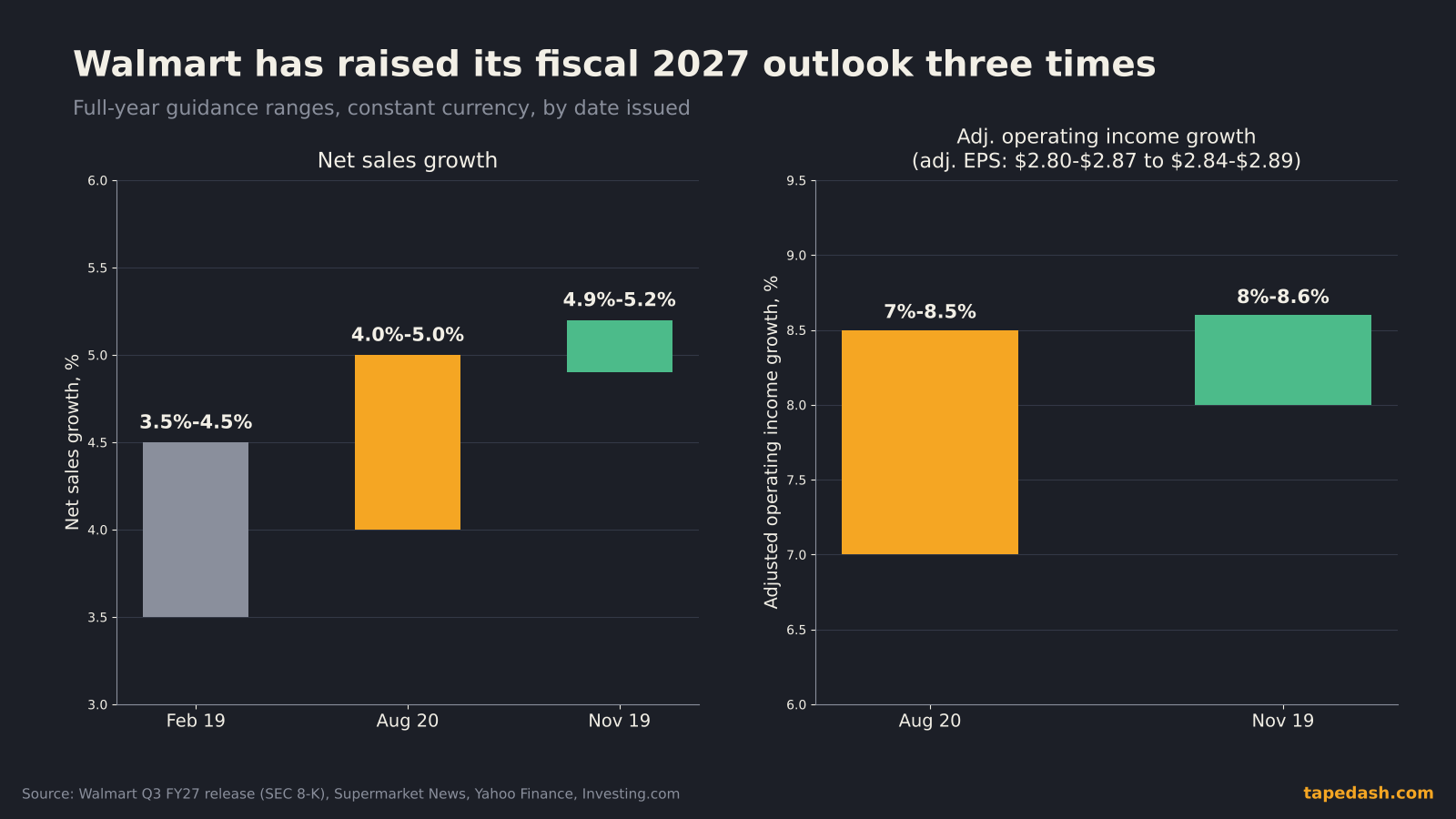
- Full-year guidance rose again: net sales growth of 4.9% to 5.2% and adjusted EPS of $2.84 to $2.89, up from $2.80 to $2.87.
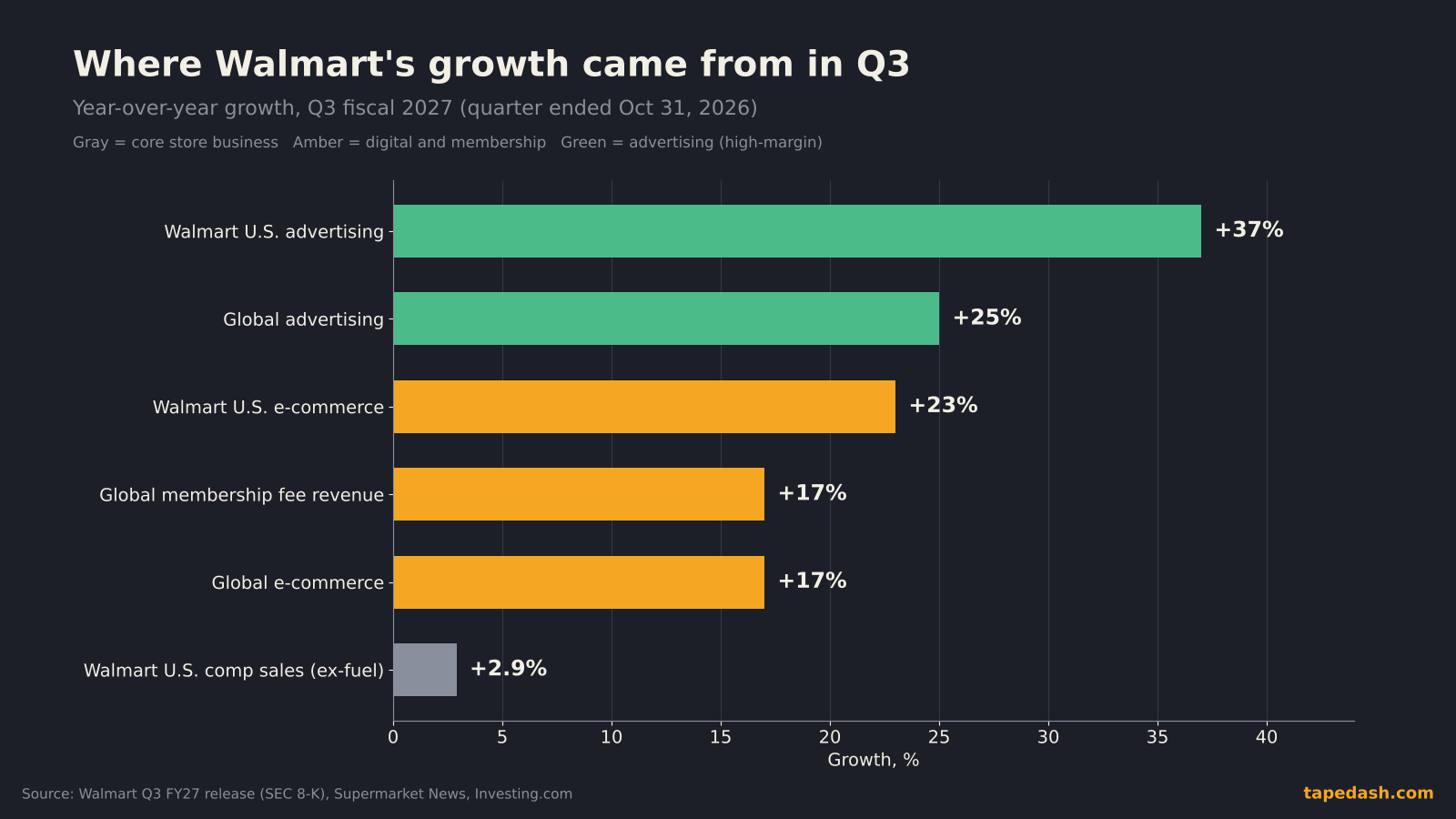
- The growth engine is digital. U.S. e-commerce rose 23%, global advertising 25% and membership fee revenue 17%, while U.S. comparable sales grew 2.9%.
- Shares slipped in morning trading because the beat was narrow and the stock already carries a premium multiple, not because the business weakened.
- Next tests: Thanksgiving week traffic, the Fed’s December 8 and 9 meeting and the fiscal Q4 report in February.
Walmart earnings Q3 2026: the numbers against expectations
Start with the scorecard, because that is what the first hour of trading reacts to.
Walmart’s quarter ran through October 31. Total revenue was $188.8 billion, up 5.2%, or 4.5% in constant currency (Walmart 8-K, Supermarket News). Wall Street was looking for roughly $187.3 billion, depending on whose consensus you use. FactSet had $187.38 billion and Bloomberg’s figure was $187.2 billion (AP via Transport Topics, Yahoo Finance). Call it a beat of a bit under 1%.
Adjusted EPS was 65 cents against 64 cents expected (Yahoo Finance, Investing.com). On a GAAP basis the company earned 62 cents, down from 77 cents a year ago (Walmart 8-K, AP via Transport Topics). Don’t let that GAAP line scare you. Walmart holds stakes in other companies, and the swings in those investments run through net income. The adjusted figure strips out a 3-cent loss on equity and other investments, which tells you more about how the stores performed.
Operating income rose 16%, or about $1.1 billion, though that headline was flattered by items in the year-ago quarter. In constant currency, adjusted operating income grew 5.5% (Walmart 8-K, Supermarket News). The gross profit rate improved 28 basis points, led by the U.S. business. Those two numbers together are the honest read: Walmart’s profits are growing faster than its sales, but not by a dramatic amount this quarter.
Here are the segment lines I care about, side by side.
| Metric, Q3 fiscal 2027 | Result | Why it matters |
|---|---|---|
| Total revenue | $188.8B, up 5.2% | Small beat against roughly $187.3B expected |
| Adjusted EPS | $0.65 | One cent ahead of consensus |
| Walmart U.S. comp sales (ex-fuel) | +2.9% | Up from last quarter, down from +4.5% a year ago |
| Walmart U.S. e-commerce | +23% | Store-fulfilled pickup and delivery leads |
| Global advertising | +25% | High-margin revenue that funds low prices |
| Global membership fee revenue | +17% | Recurring income, less tied to any one month’s sales |
| Sam’s Club U.S. comp sales (with fuel) | +9.7% | Fuel prices boosted the headline |
| Full-year adjusted EPS guide | $2.84 to $2.89 | Raised from $2.80 to $2.87 |
Sources for the table: Walmart 8-K, AP via Transport Topics, Supermarket News, Yahoo Finance, Investing.com.
Why Walmart stock fell after beating earnings
I see this pattern several times every earnings season, and it trips up newer traders every time. A company beats, raises, and the stock goes down. The explanation is almost never hidden in the report. It is in the gap between what happened and what was already in the price.
The beat was narrow
A one-cent EPS beat on a 64-cent estimate is about 1.6%. For a stock that trades on consistency, that is a pass, not a surprise. Investors who bought Walmart into the print were paying for a clean quarter, and they got a clean quarter. That kind of result tends to leave the stock where it was, and then the rest of the tape decides the direction.
The raise was smaller than hoped
Walmart lifted its full-year net sales growth range to 4.9% to 5.2%, from 4% to 5% in August. Adjusted operating income growth moved to 8% to 8.6% from 7% to 8.5%, and adjusted EPS to $2.84 to $2.89 from $2.80 to $2.87 (Walmart 8-K, Yahoo Finance). Read those ranges closely. The top of the EPS range moved by only 2 cents. A lot of the “raise” is the range narrowing as the year runs out, which is normal with one quarter left. The AP noted the outlook was more conservative than analysts expected (AP via Transport Topics).
The tape was against it
Thursday was an ugly day for stocks broadly, and the selling hit high-multiple names across sectors (The Motley Fool). Walmart is a defensive name, but these days it is a defensive name with a growth-stock valuation. When the market de-risks, premium multiples get trimmed first, and good news on the day doesn’t always change that. I’d be careful about reading too much into a one-day move in this kind of market.
Walmart e-commerce and advertising: where the profit is coming from
This is the part of the report I’d spend the most time on, because it explains why Walmart trades at the multiple it does.
The store business is growing at a steady, unspectacular pace. Walmart U.S. comparable sales, excluding fuel, rose 2.9% (Walmart 8-K, AP via Transport Topics). That is better than last quarter, but below the 4.5% pace of a year ago. Transactions and average ticket each contributed a little.
Around that core, the digital businesses are compounding fast. U.S. e-commerce rose 23% and global e-commerce 17%, led by pickup and delivery fulfilled from stores. Global advertising grew 25%, and U.S. advertising 37%. Global membership fee revenue rose 17% (Walmart 8-K, Supermarket News, Investing.com).
How the Walmart flywheel works
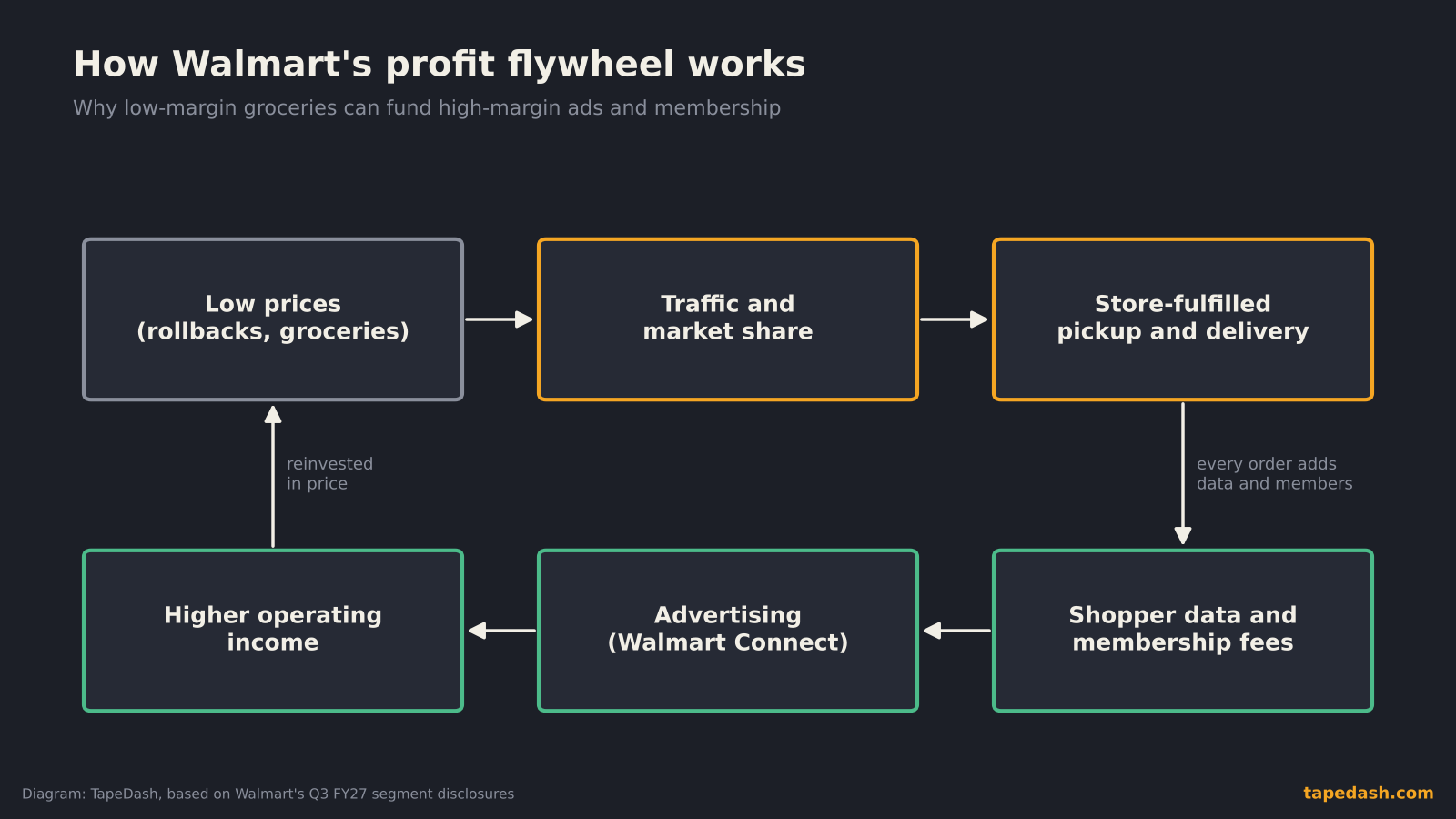
Here is why those percentages matter more than their dollar size. Groceries and household staples carry thin margins. Advertising and membership fees carry very high ones. When a brand pays Walmart Connect to put its cereal at the top of a search result, there is almost no cost of goods attached to that revenue. Same with a Walmart+ fee.
So the company can run low prices on the stuff people need every week, use those prices to pull in traffic and market share, fulfill a growing share of that traffic through stores as pickup and delivery orders, and then sell ads and memberships to the audience it built. Some of that high-margin profit goes back into price, which pulls in more traffic. That is the loop.
Walmart is pushing that loop harder. In the third quarter it launched a combined Walmart+ and Sam’s Club membership bundle at $120 a year (AP via Transport Topics, Yahoo Finance). CEO John Furner put the quarter this way: “We delivered strong results, growing our core business and gaining market share” (Walmart 8-K).
The comparison with Amazon (AMZN) is unavoidable. Amazon built a giant ad business on top of its marketplace years ago. Walmart is doing the same thing on top of a national store network that doubles as a warehouse system. The market is starting to price Walmart less like a grocer and more like a retail platform, and that is why a narrow beat doesn’t move the needle much. The valuation already assumes this loop keeps spinning.
Who is shopping at Walmart now
The other thread worth pulling is the shopper mix. Walmart says it is gaining customers across income groups, with the biggest share gains coming from higher-income households (AP via Transport Topics, BigGo Finance). That has been the story for a couple of years, and this quarter didn’t break it.
Why does it matter? Higher-income shoppers are more likely to pay for delivery, sign up for membership and respond to ads on the app. They make the digital half of the business work. If they keep trading down to Walmart for groceries and essentials, the flywheel above gets more fuel. If the economy improves enough that they drift back to other stores, Walmart would feel it first in e-commerce growth, not in store comps.
Price is still the weapon. Walmart used tariff refunds to temporarily cut prices on a large number of items earlier this year. It ended the third quarter with about 7,700 rollbacks in the U.S., down from more than 11,000 at the end of the second quarter (AP via Transport Topics, Investing.com). I wouldn’t read that drop as a retreat from pricing. Rollback counts move with the calendar and with vendor deals. But it is a number to track into the holidays.
Management also said it wants to keep prices low despite higher fuel costs (CNBC, Investing.com). Fuel hits Walmart twice: in the trucks that move goods to stores and in the delivery vans that carry orders to homes. It also showed up in the Sam’s Club numbers, where comp sales including fuel rose 9.7%, flattered by higher pump prices.
The headwinds inside the report
No quarter is clean, and a few items in this one deserve a flag.
Drug-price rules in health and wellness. Walmart U.S. comps took a net headwind of about 70 basis points from deflation in health and wellness, tied to the federal maximum fair price rules on certain Medicare drugs (Walmart 8-K, Supermarket News). That is a pharmacy revenue issue more than a profit issue, but it shaves the comp number investors look at first.
Sam’s Club margins. Sam’s Club sales were strong, yet its operating income fell. Management pointed to a comparison against a one-time benefit in the prior year, an inventory accounting charge, and the cost of the new membership bundle. Supermarket News reported the bundle will weigh on Sam’s Club operating income growth for a while (Supermarket News).
International timing. Walmart International’s online sales and ads were hit by the timing of Flipkart’s Big Billion Days sale in India, which moved part of that event into the fourth quarter (Walmart 8-K). That is a shift, not a loss, and it should help Q4.
None of these change the thesis. They do explain why the profit line wasn’t as strong as the e-commerce line.
How to read a retail earnings report like Walmart’s
If you only remember one section of this post, make it this one. Retail reports pack a lot of numbers, and most of them don’t move the stock. Here is the order I read them in. I’ve written a longer version in how to read an earnings report like a trader.
1. Comparable sales, with and without fuel. Comps strip out new stores and tell you whether existing stores are growing. Always check whether fuel is in or out. Sam’s Club this quarter is the textbook case: 9.7% with fuel looks great, but much of that is the price of gasoline.
2. Traffic versus ticket. A comp that comes from more trips (transactions) is healthier than one that comes from higher prices (ticket). More trips mean more share. Higher ticket can just mean inflation.
3. Margin direction. Gross margin tells you about pricing and mix. Operating expenses tell you about cost control. If gross margin rises but expenses rise faster, profit growth stalls.
4. The guide, and how it moved. Compare the new range with the old one, and look at whether the top end moved or just the bottom. A raised floor with an unchanged ceiling is a narrowing, not a real upgrade.
5. What the options market priced. Before the print, options on a stock like Walmart price an expected move. If the stock moves less than that, option buyers usually lose money even if they called the direction, because implied volatility collapses after the report. That is the IV crush effect I covered in IV crush: why options lose value after earnings. For the math behind the expected move itself, see implied volatility and the expected move. A morning move of 1% to 2% after a narrow beat is the kind of reaction where premium sellers usually do fine.
On the desk, steps four and five decide the trade. Steps one through three decide whether you want to own the stock in a year.
What to watch next for Walmart stock
The quarter is in the books. Here is what decides the next leg.
- Thanksgiving week, November 26 and Black Friday, November 27. Management said on the call it expects a strong holiday season (AP via Transport Topics, Investing.com). Watch traffic reports and app download rankings over the holiday weekend and Cyber Monday on November 30.
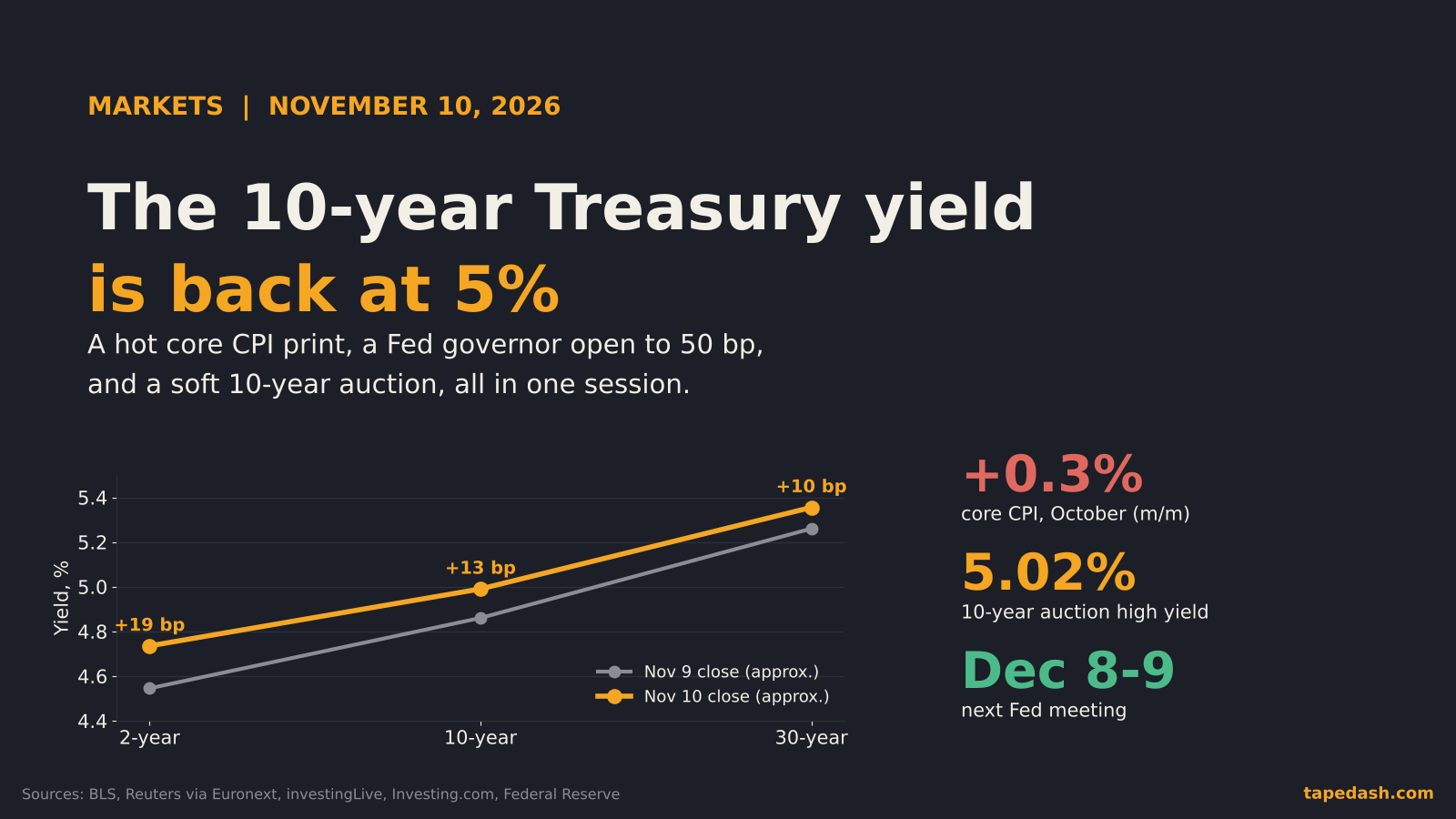
- December 8 and 9: the Fed meeting. With long-term yields high, rate expectations drive how much the market will pay for stable earnings (Fed Rate Calc, Federal Reserve). I covered the yield backdrop in 10-year Treasury yield hits 5% again.
- Peer reads. Costco (COST) reports monthly sales, and Target (TGT) is the cleanest comparison for share shifts in general merchandise. If Walmart keeps taking share, it should show up as softer traffic elsewhere.
- Fuel prices. Lower diesel would ease delivery costs. A renewed spike would pressure margins just as Walmart tries to hold prices.
- The fiscal Q4 report in February. That print will include the Flipkart timing benefit, the full holiday season and next year’s first guidance, which is usually where the bigger stock moves come from.
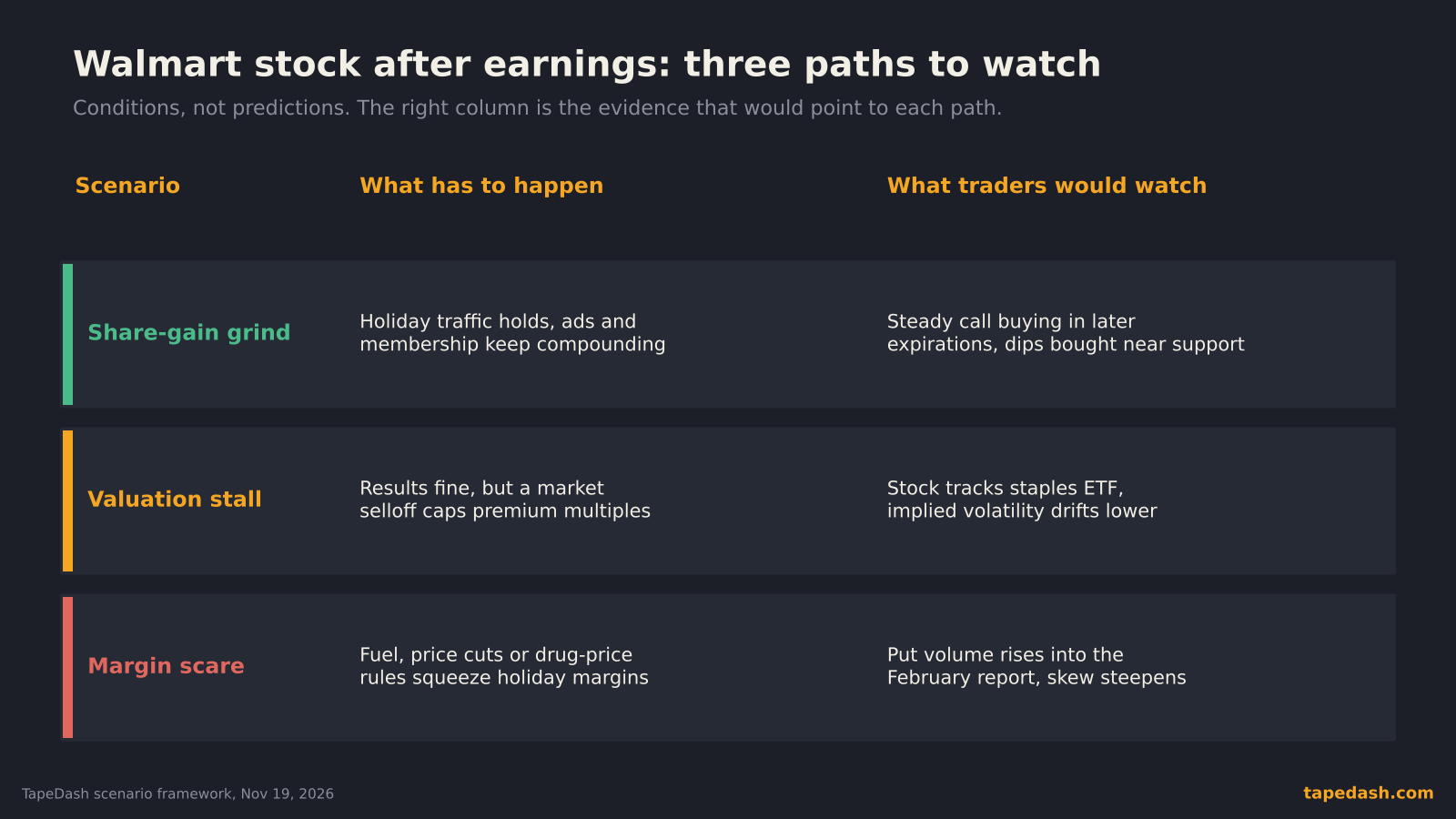
If holiday traffic holds and the digital lines keep compounding, the stock’s premium has support and dips are likely to draw buyers. If the broader market keeps de-rating expensive stocks, Walmart can trade sideways no matter how good its numbers are, and you’d expect it to move with the Consumer Staples Select Sector SPDR (XLP). If fuel or price investment squeezes holiday margins, the February guide becomes the risk event, and you’d likely see put buying build into it.
How to track Walmart and retail with TapeDash
If you want to watch whether institutions use this dip to buy Walmart or to trim it, the options tape is the fastest tell. Unusual Flow shows large, aggressive WMT trades as they print, so you can see whether money is going into calls in the December and January expirations or into protective puts ahead of February. Dealer Gamma shows where dealer hedging tends to dampen moves or speed them up, which matters for a heavily owned stock in a choppy market.
For the business side, Earnings Call Summaries pull out what management said about traffic, fuel, pricing and guidance, so you can compare Walmart’s language with Target’s and Costco’s without reading three transcripts. You can see it together in the Terminal Preview, or start with the free TapeDash Daily for a morning read on flow and the macro calendar. If you join now, the first 200 members lock Pro at $69.99 a month on their account, even if they cancel and come back later.
Walmart earnings FAQ
Did Walmart beat earnings in Q3 2026?
Yes, narrowly. Adjusted EPS was 65 cents against a 64-cent estimate, and revenue of $188.8 billion beat a consensus of about $187.3 billion.
Why did Walmart stock go down after earnings?
The beat was small, the raised guidance was more conservative than some analysts expected, and the stock already trades at a premium multiple. A broad market selloff on the same day added pressure.
What is Walmart’s guidance for fiscal 2027?
Walmart now expects net sales growth of 4.9% to 5.2% in constant currency and adjusted EPS of $2.84 to $2.89, up from $2.80 to $2.87 in August.
The one thing to remember
Walmart’s quarter was solid, and the stock’s dip says more about expectations and the market than about the business. The part that will matter a year from now is the mix: a store business growing around 3% wrapped in ad, membership and delivery businesses growing at 17% to 37%. As long as that gap holds, Walmart keeps turning low-margin groceries into high-margin profit, and that is the number I’d keep checking every quarter.
See it on the tape, not just in the headlines
TapeDash is a market research and data analytics platform for traders and investors: live options flow, dealer positioning, a real-time market scanner, stock ratings, and macro and earnings data in one terminal. Memberships open Black Friday, November 27, and the first 200 members lock Pro at $69.99 a month on their account, even if they cancel and come back later.
Join the waitlistClick through the terminalSee the track recordSources
- Walmart: Q3 fiscal 2027 earnings release, Form 8-K (Nov 19, 2026)
- AP via Transport Topics: Walmart raises outlook again after a solid quarter (Nov 19, 2026)
- Supermarket News: Walmart raises full-year outlook after strong third quarter (Nov 19, 2026)
- Yahoo Finance: Walmart beats Q3 earnings expectations, raises outlook again (Nov 19, 2026)
- Investing.com: Earnings call transcript, Walmart beats Q3 estimates but shares fall premarket (Nov 19, 2026)
- CNBC: Walmart hikes outlook as CEO says retailer aims to keep prices low despite fuel costs (Nov 19, 2026)
- BigGo Finance: Walmart raises full-year outlook as affluent shoppers gain share (Nov 19, 2026)
- The Motley Fool: Stock market today, Nov. 19 (Nov 19, 2026)
- Walmart: Walmart to host third quarter earnings call November 19, 2026
- Fed Rate Calc: FOMC meeting schedule, December 2026
- Federal Reserve: December 2026 calendar
This article is for educational and informational purposes only. It is not financial, investment, medical or legal advice, and it is not a recommendation to buy or sell any security. Figures come from the sources listed and were checked on the date of publication; markets change quickly. Options trading involves substantial risk of loss.