CoreWeave Earnings: Why a $132.5B Backlog Beat the Debt Fears
CoreWeave stock jumped 24.7% after Q3 earnings. How its $132.5B backlog, rising interest bill and GPU financing model fit together, and what to watch next.
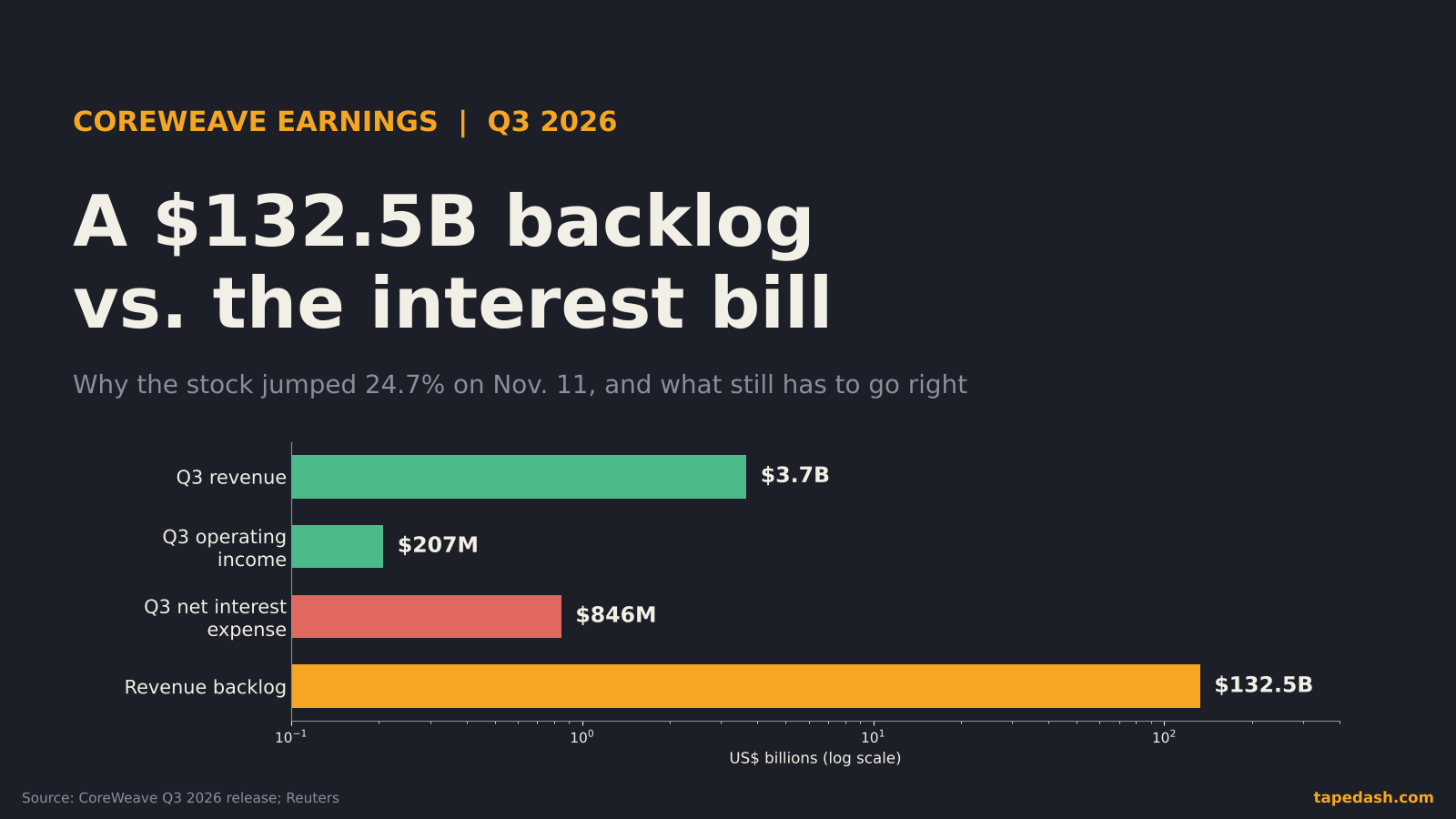
CoreWeave earnings did something on Wednesday that the AI trade badly needed: they turned a credit story back into a growth story, at least for a day. The GPU cloud company reported third-quarter revenue of $3.66 billion, up 168% from a year earlier, raised its 2026 outlook, and said its revenue backlog reached $132.5 billion (CoreWeave, TradingKey). CoreWeave stock closed up 24.71% at $60.77, its biggest one-day gain in more than three months (Reuters via MarketScreener, The Motley Fool).
So why did a company that lost $709 million in the quarter rally this hard? Because the market had been pricing a financing problem, and the report answered the financing question better than the bears expected. Going in, the shares had dropped more than 40% in a month and some of CoreWeave’s bonds yielded above 16%, a level usually reserved for companies the market thinks might struggle to refinance (TheStreet, Pomegra). Management came back with more contracted revenue, a plan to lean on customer prepayments instead of expensive unsecured debt, and a date for adjusted profitability.
The interest bill did not go away, though. Net interest expense was $846 million, four times the company’s $207 million operating income. That gap is the whole debate, and it is worth understanding even if you never trade CoreWeave, because the same model is being copied across the AI-infrastructure trade.
- CoreWeave reported Q3 revenue of $3.66 billion (up 168%), a $132.5 billion backlog, and raised 2026 revenue guidance to $13.0 to $13.3 billion. The stock closed up 24.71%.
- The bear case is debt, not demand. Net interest expense of $846 million was about four times operating income, and the company guided Q4 interest to $1.05 to $1.15 billion.
- The relief came from financing: about $9 billion in expected customer prepayments over three months, a pledge to raise less than $5 billion of new parent-level capital through 2027, and a target of positive adjusted net income in the first half of 2028.
- Backlog only becomes revenue when power comes online. CoreWeave has more than 1.7 GW active against more than 4.6 GW contracted.
- Next tests: NVIDIA earnings on November 17 and the Fed decision on December 9, which together set the price of AI demand and the price of money.
CoreWeave earnings Q3 2026: the numbers that mattered
The headline beat was real but not huge. Revenue of $3.66 billion came in a bit above the roughly $3.5 billion analysts had pencilled in (24/7 Wall St., Pomegra). What moved the stock was the guidance. CoreWeave now expects 2026 revenue of $13.0 billion to $13.3 billion and adjusted operating income of $1.275 billion to $1.375 billion. Wall Street had been at about $12.86 billion for revenue (LSEG) and $1.07 billion for adjusted operating income (Visible Alpha) (TheStreet, 24/7 Wall St.).
The company also said it expects to exit 2026 at an annualized revenue run rate of $20 billion to $21 billion (CoreWeave, Investing.com). Run rate is just the last month or quarter multiplied out to a year, so treat it as a speedometer reading, not a forecast. Still, it tells you how steep the ramp is into year-end.
Here is the year-over-year comparison, straight from the release.
| Metric | Q3 2025 | Q3 2026 | What it tells you |
|---|---|---|---|
| Revenue | $1.365B | $3.661B | Demand is not the problem |
| Operating income | $52M | $207M | Depreciation eats most of that EBITDA |
| Adjusted operating margin | 16% | 10% | New capacity costs money before it earns |
| Net interest expense | $310M | $846M | Debt grew faster than profit |
| Net loss | $110M | $709M | Financing cost is the swing factor |
| Revenue backlog | n/a | $132.5B | Up 138% from a year earlier |
Source: CoreWeave, Pomegra, TradingKey.
Read that table from top to bottom and you see the shape of the business. Add back depreciation and the quarter’s adjusted EBITDA was $2.26 billion, a 62% margin, which looks like a software company. The net line looks like a utility in the middle of a build. Both are true at the same time.
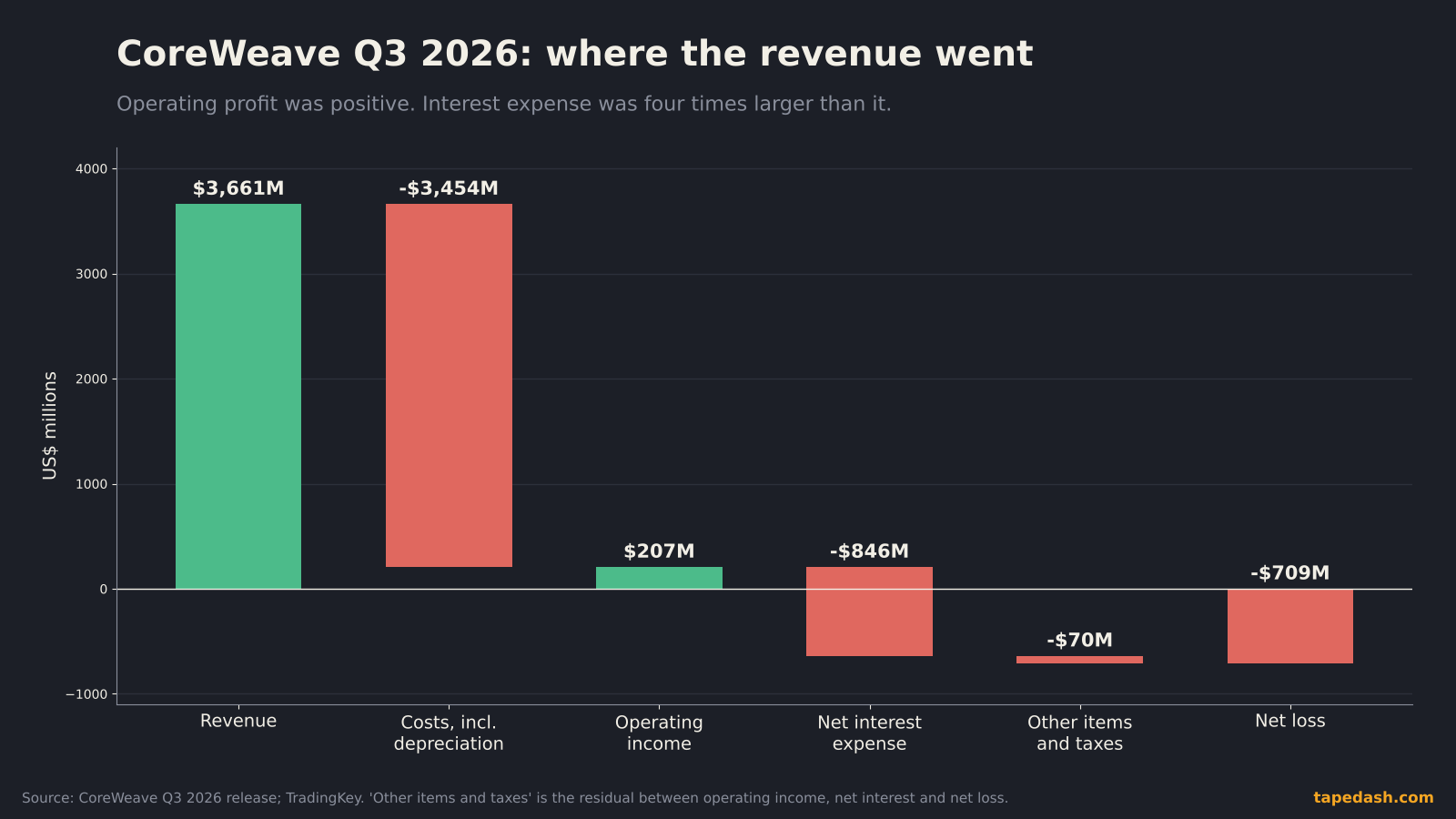
Why CoreWeave stock jumped 24.7% on a $709 million loss
Stocks move on changes in the story more than on the level of the numbers. A month ago, the story around CoreWeave was simple and ugly: it needs tens of billions of dollars a year to build data centers, its bonds were trading at distressed yields, and if the debt market shut, growth would stall. The stock fell more than 40% in that stretch (TheStreet, Pomegra).
Three things in the report chipped away at that story.
Customers are paying up front
CEO Michael Intrator pointed to about $9 billion in customer prepayments and deposits expected over the next three months (CoreWeave, 24/7 Wall St.). Prepayments are the cheapest money a capital-heavy company can get. They cost no interest, and they come from the customer who is going to use the capacity, which says something about how badly that customer wants it.
Less new money at the parent company
Management said it expects to raise less than $5 billion of incremental parent-level capital through 2027, and that it does not plan to tap the unsecured bond market at current yields (Investing.com, Pomegra). That matters for shareholders more than for bondholders. Parent-level capital is where dilution and the most expensive debt live. If most of the build can be funded by contract-backed loans and prepayments instead, the equity keeps more of the upside.
A profitability date
The company said it expects adjusted net income to turn positive in the first half of 2028 (Reuters via MarketScreener, Investing.com). Note the word “adjusted”. It strips out stock compensation and some other items, so GAAP profitability is a separate question. But a date gives credit analysts something to model, and a stock that had been priced on survival odds suddenly had a path to price on earnings again.
Add the setup, a heavily sold stock heading into a binary event, and you get a 24.71% day. I have watched this pattern play out on many crowded shorts: the report does not need to be great, it needs to be less bad than the positioning. When sellers are crowded on one side and the feared outcome does not show up, the covering does a lot of the lifting.
How CoreWeave’s backlog works, and why it is not cash yet
A $132.5 billion backlog sounds like money in the bank. It is closer to a signed lease on a building that has not been built. Backlog, in CoreWeave’s definition, is remaining performance obligations plus other committed amounts: contracted revenue the company will recognize as it delivers compute over the life of each deal (CoreWeave, TradingKey).
For that to turn into revenue, CoreWeave has to do three physical things: secure powered data center space, buy and install the GPUs and networking, and hand working clusters over on time. Each step costs money before a dollar of revenue arrives, which is why the 2026 capex guide is $37 billion to $39 billion, with the low end raised from $35 billion (CoreWeave, Investing.com).
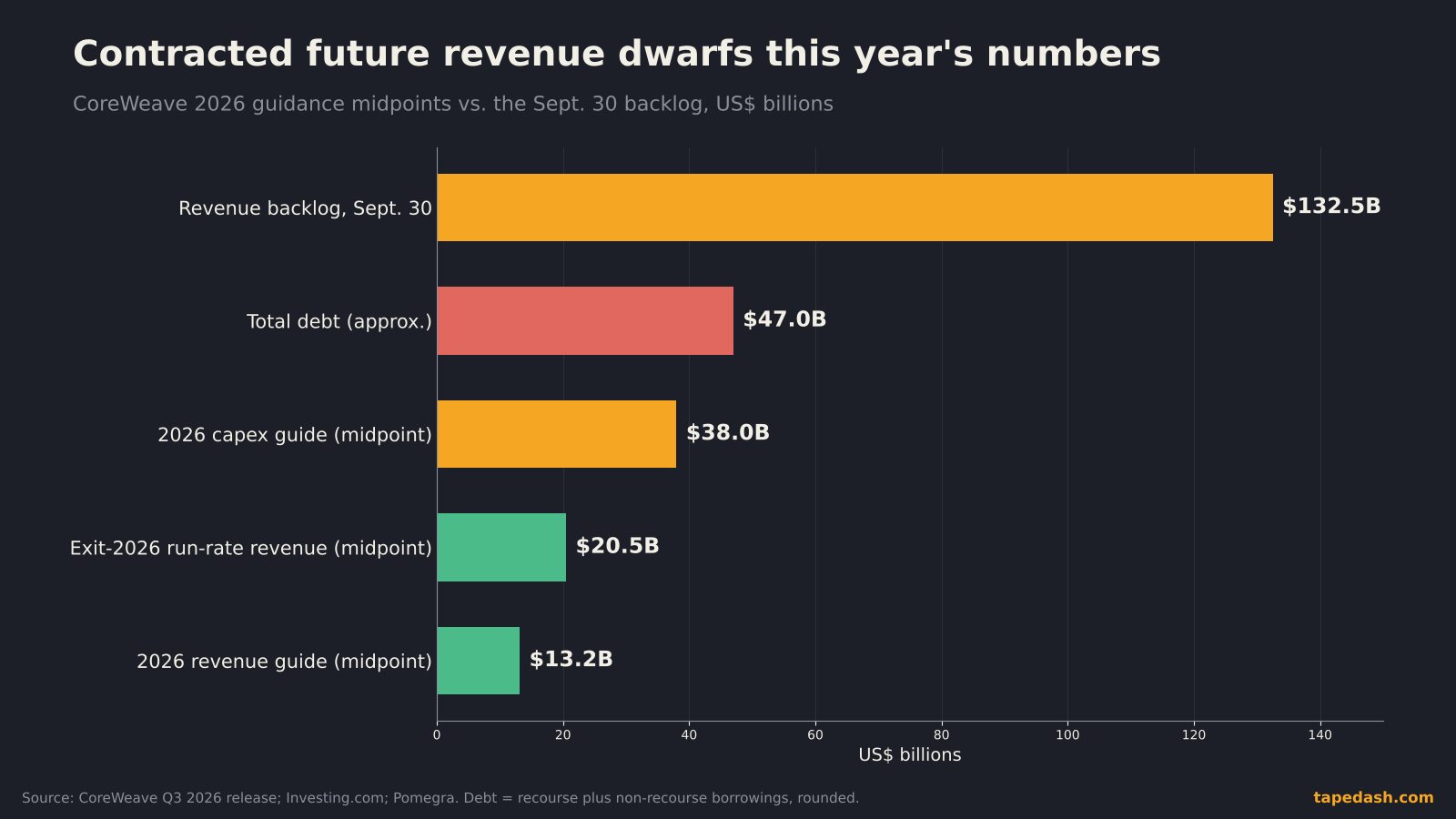
Put the numbers next to each other and the trade-off is plain. The backlog is roughly ten times 2026 revenue. Total borrowings are about $47 billion, combining recourse and non-recourse debt on the balance sheet (CoreWeave, Pomegra). The bull case says the contracts more than cover the debt. The bear case says contracts are only as good as the counterparties and the delivery schedule, and that any slip in either leaves the debt on the books with less revenue behind it.
Power is the real unit of capacity
In AI cloud, the binding constraint is often electricity, not chips. CoreWeave said it has more than 1.7 gigawatts of active power, roughly double where it started the year, and more than 4.6 GW contracted. It expects to finish 2026 above 1.85 GW active (CoreWeave, Pomegra).
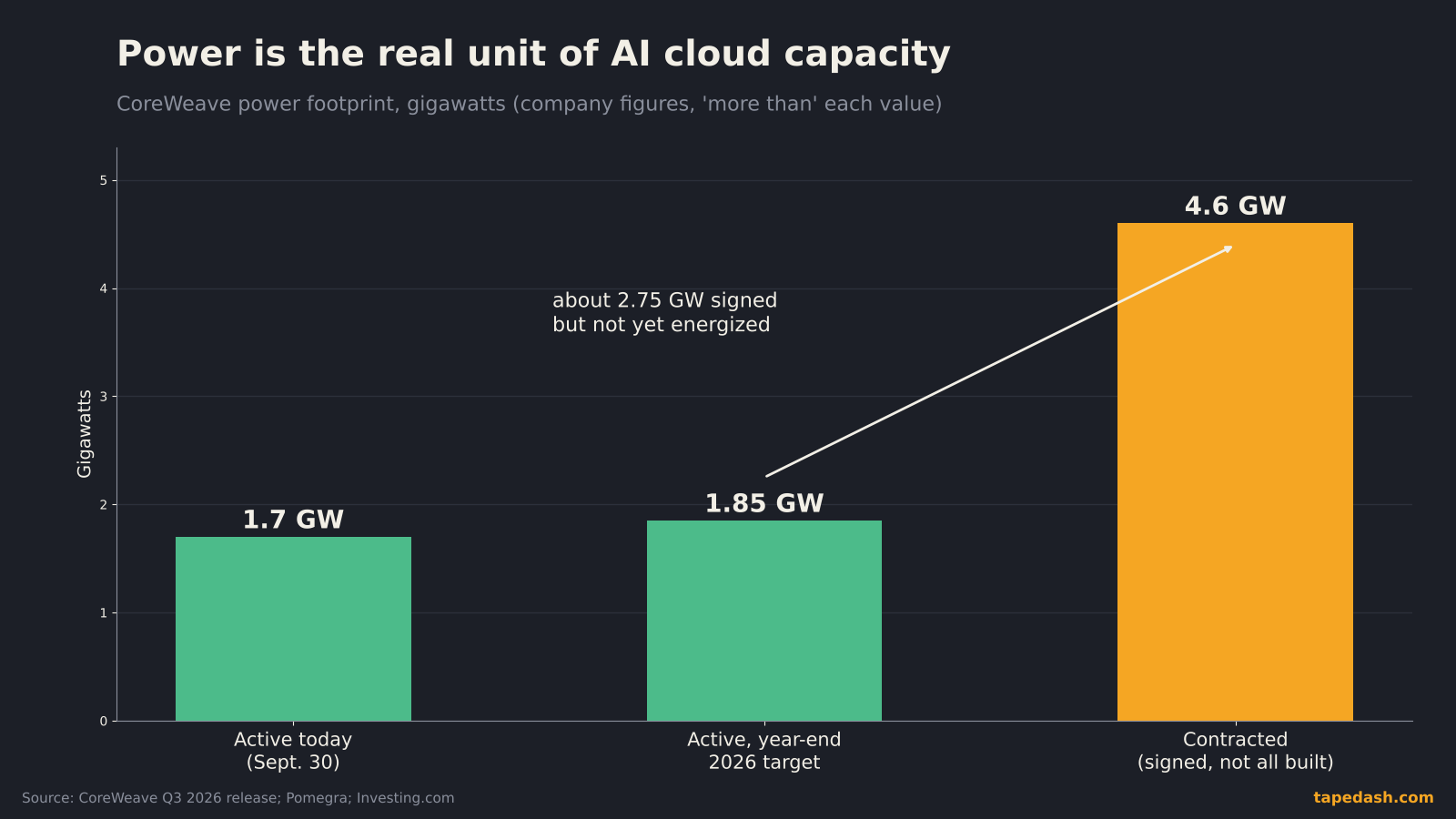
That leaves roughly 2.75 GW signed but not yet energized. When you hear about data center delays, transformer shortages or grid interconnection queues, this is the bar they hit. A quarter’s slip in energizing a big site pushes revenue out a quarter while the interest on the money already spent keeps running.
The CoreWeave debt question: interest vs operating income
Here is the cleanest way to frame the risk. In Q3, net interest expense was $846 million, up from $310 million a year earlier, while operating income was $207 million (CoreWeave, TradingKey). For Q4, management guided interest expense to $1.05 billion to $1.15 billion (Investing.com, Pomegra).
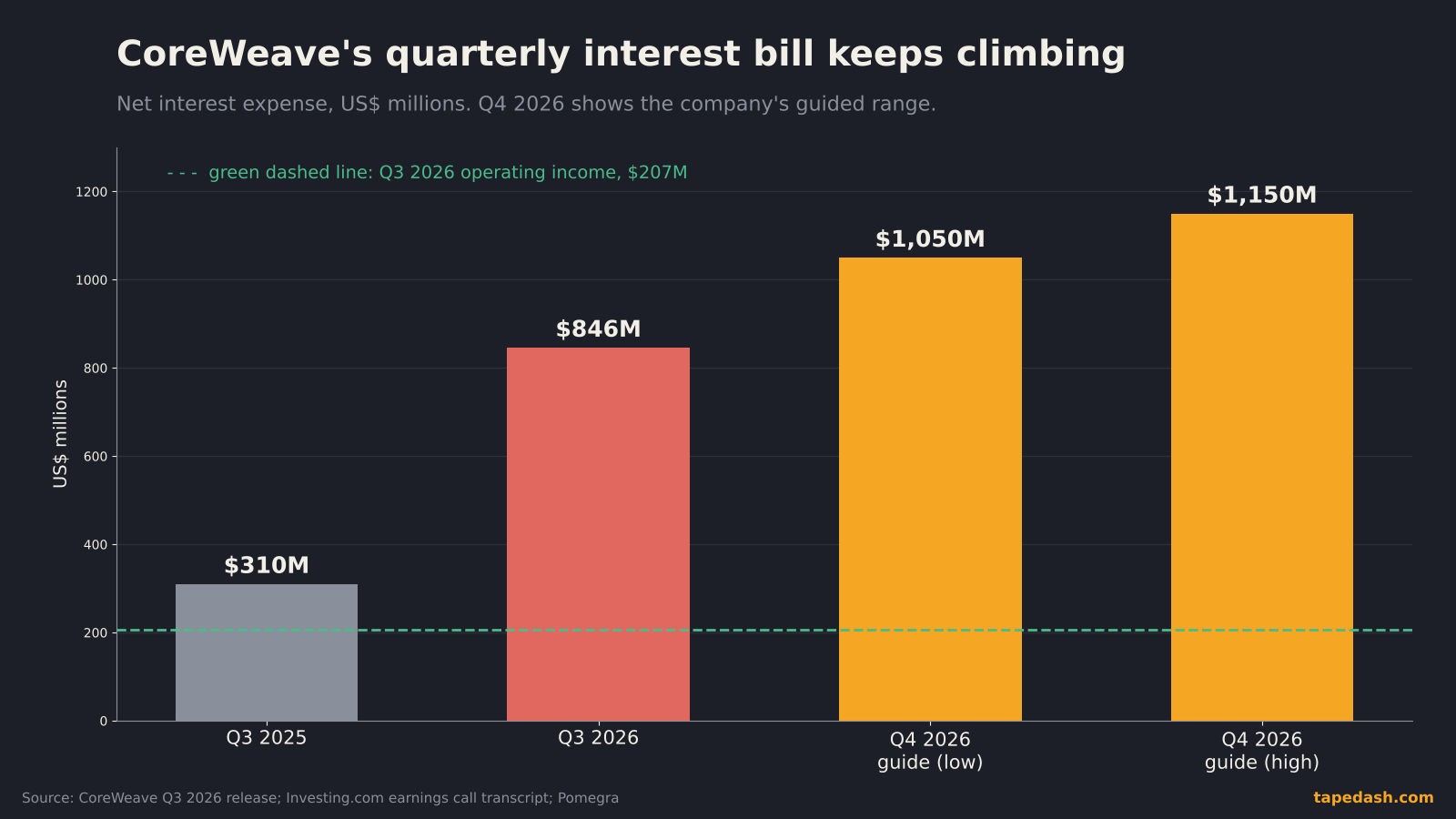
That is not automatically a crisis. Operating income is after depreciation, and depreciation on GPUs is huge and non-cash. EBITDA of $2.26 billion covered interest comfortably in the quarter. The problem is that depreciation is real in the economic sense: those GPUs wear out, or more precisely get outclassed, and must be replaced. If a chip earns less than its cost plus financing before the next generation makes it obsolete, the model loses money no matter what the EBITDA line says.
That is why one line on the call got so much attention. Management said rental pricing on older Ampere and Hopper GPUs rose 30% to 50% quarter over quarter (Investing.com, Pomegra). If older chips are getting more valuable, not less, then the depreciation worry eases and contract renewals become a source of profit. If that pricing reverses as newer systems flood in, the worry comes straight back. It is the single most important number for the bull case, and it is also the one most exposed to the supply cycle.
How AI neoclouds like CoreWeave finance a GPU cluster
“Neocloud” is the industry name for GPU-focused cloud providers that are not the big three hyperscalers. CoreWeave is the largest. Nebius and others follow similar playbooks. The financing loop matters more than the technology for understanding the stocks, so here it is in plain steps.
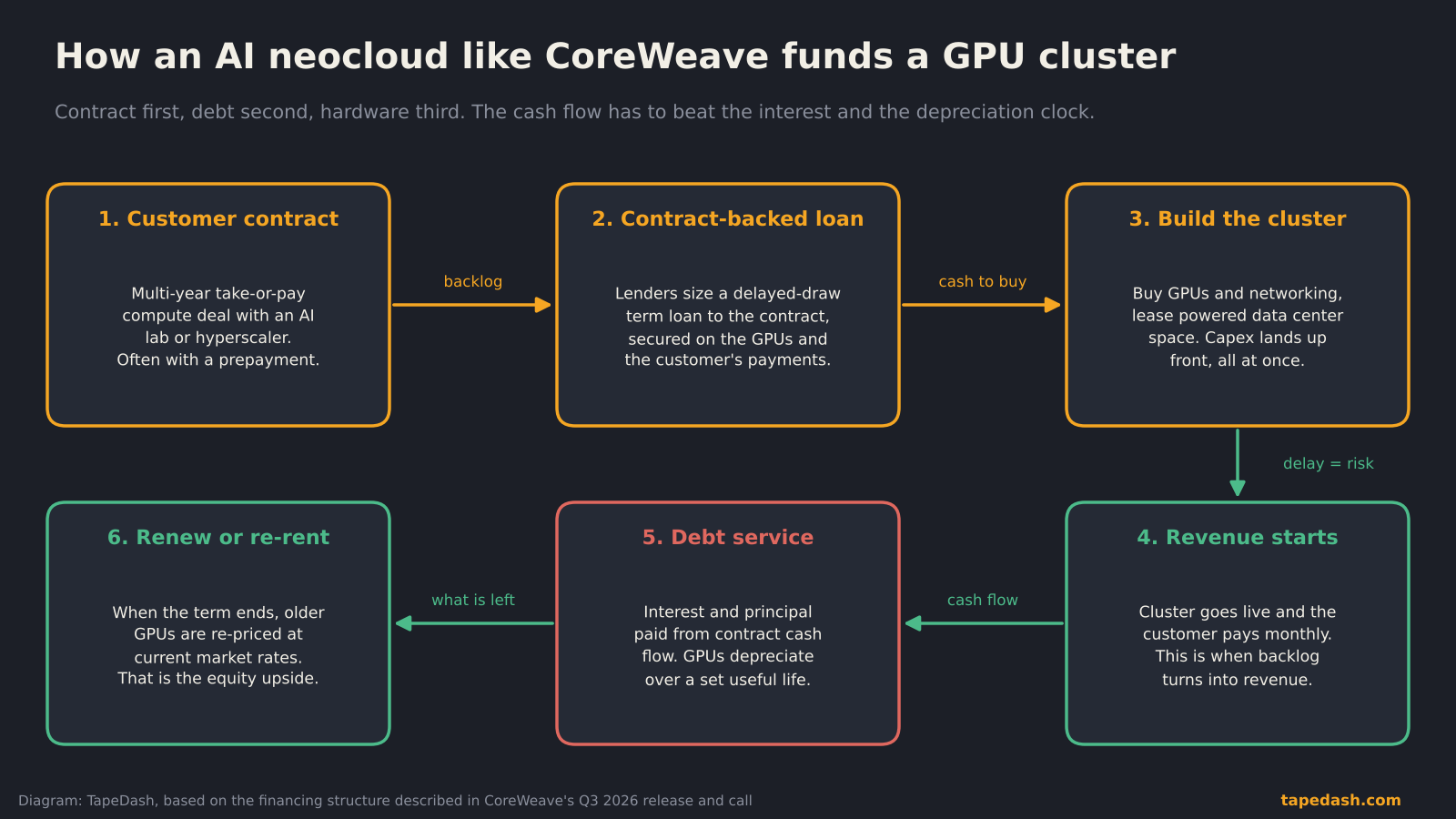
First, a customer signs a multi-year compute contract, often take-or-pay, sometimes with a prepayment. Second, lenders size a loan against that contract. CoreWeave’s version is the delayed-draw term loan, or DDTL; this quarter it closed a $2.6 billion DDTL facility aimed at shorter contracts and raised about $4.2 billion in convertible notes (CoreWeave, Pomegra). Third, the company buys the GPUs and leases powered space. Fourth, the cluster goes live and revenue starts. Fifth, contract cash flows pay the lenders. Sixth, when the contract ends, the hardware is re-rented at whatever the market will pay.
The structure is clever because most of the debt sits next to specific contracts and specific hardware, which makes it cheaper than unsecured corporate bonds. The weak points are the timing gap between steps three and four, the concentration of revenue in a small number of very large customers, and the price in step six. The 16% bond yields in early November were the market saying it did not trust the parent company to get through the gap. This week’s report argued that customers will fund more of the gap themselves.
If you want the bigger picture of where this capex comes from, our earlier explainer on how AI data center spending reaches chip stocks walks the money from hyperscaler budgets down to the suppliers.
Who won from CoreWeave earnings, and who is still exposed
The relief spread across the AI-infrastructure group. Nebius rose 15.4% and Oracle gained 8.83% (Reuters via MarketScreener, 24/7 Wall St., The Motley Fool). The Nasdaq Composite closed up 1.60% at 25,466.19, the S&P 500 added 1.31% to 7,619.38, and the Dow rose 0.49% to 52,486.49 (Reuters via MarketScreener, TheStreet).
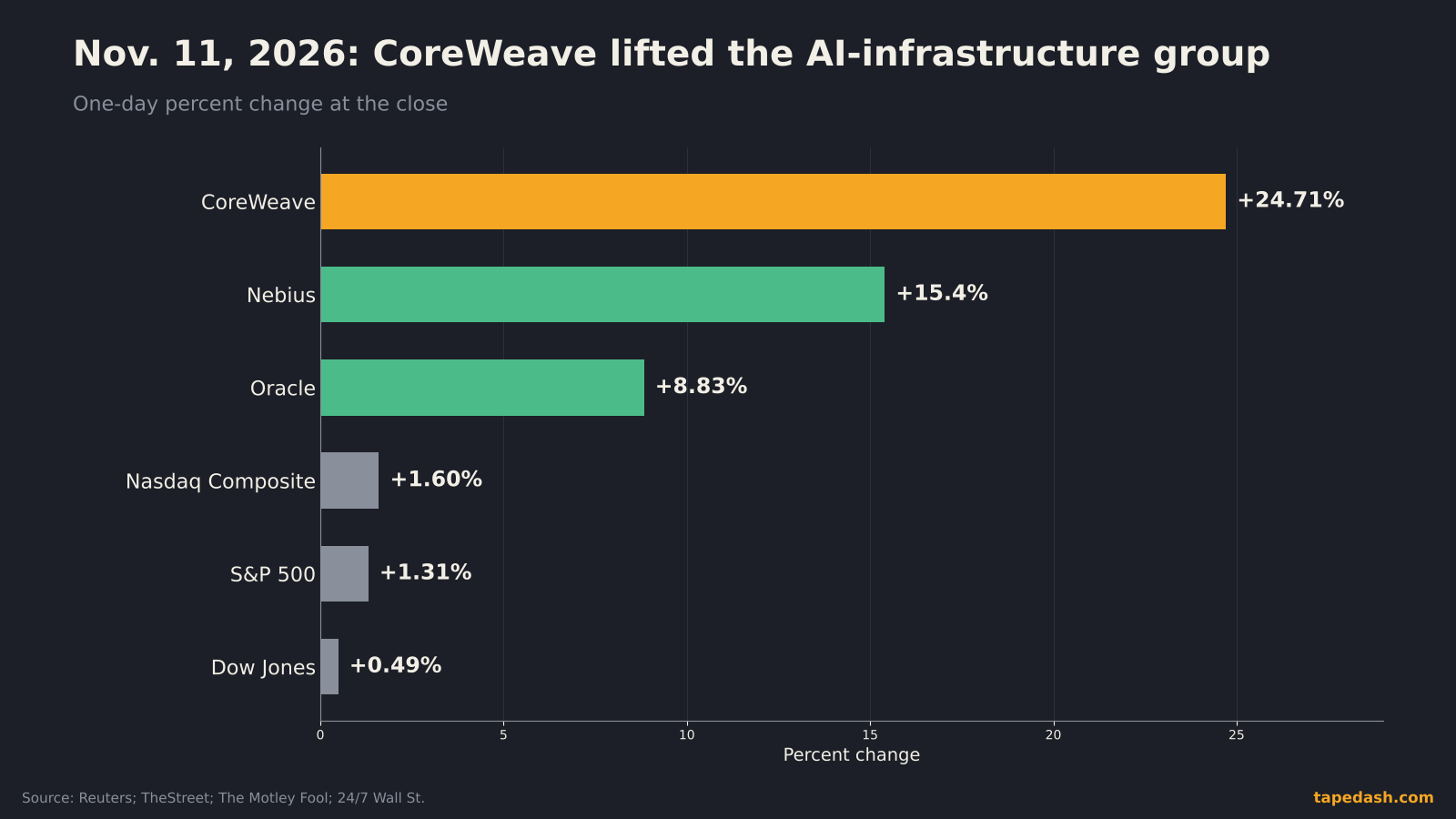
Look at the ranking. The bounce scaled with balance-sheet risk. CoreWeave, the most levered pure play, moved most. Nebius, another neocloud, came next. Oracle, which has been borrowing heavily for its own AI build, followed. The broad indexes barely moved by comparison. That tells me Wednesday was mostly a repricing of financing risk across the group, not a new view on AI demand. Demand was never the question; the company says it has roughly ten times more qualified demand than capacity through 2027 (Investing.com, Pomegra).
Who stays exposed? Anyone whose AI build depends on borrowing at today’s rates. The bond market was closed Wednesday for Veterans Day, but on Tuesday a hot CPI report had pushed Treasury yields sharply higher and moved the market toward a December Fed hike (Reuters via MarketScreener). We covered that move in the 10-year Treasury yield at 5%. For a company paying more than $1 billion a quarter in interest, the base rate shows up as a line item on the income statement.
How to read a neocloud earnings report like a trader
You will see more of these reports, from CoreWeave and from the companies copying it. Here is the checklist I use, in order.
1. Backlog growth versus revenue growth. Backlog rising faster than revenue means demand is outrunning delivery. Good for the long run, but it also means capex and debt will keep rising before revenue catches up. Backlog shrinking while revenue grows means the company is eating its pipeline.
2. Interest expense versus operating income. This is the coverage test. Until operating income clears interest, every quarter adds to the loss. Track the gap, not just the two numbers.
3. Active versus contracted power. The ratio tells you how much of the backlog is waiting on construction. A year-end active power miss is an early warning that revenue will slip.
4. Older-GPU pricing. If last-generation chips rent for more over time, the depreciation fear is overdone. If prices fall quickly when a new chip ships, the model is more fragile than the EBITDA margin suggests.
5. Where the new money comes from. Prepayments and contract-backed loans are the healthiest sources. New unsecured bonds at double-digit yields, or large equity sales, are the warning signs. CoreWeave also set up its first at-the-market equity program this quarter, so watch whether it gets used (CoreWeave).
6. The options market’s verdict. Going into a report like this, implied volatility was high because the outcome was binary. After the print, IV usually drops even if the stock rips. That is the IV crush effect, and it is why buying calls the day before can disappoint even when you are right on direction.
Scenarios: what could happen next for CoreWeave stock
I do not do price targets. I do think in scenarios, because that is how the market reprices these names.
| Scenario | What would have to happen | What traders will watch |
|---|---|---|
| Financing fears keep fading | Prepayments arrive on schedule, Q4 power hits 1.85 GW, bonds rally from distressed yields | Bond prices, IV falling, sector names following |
| Choppy middle | Execution on track but rates keep rising into the Fed, interest bill grows as guided | Treasury yields, Q4 interest within the $1.05 to $1.15B range |
| Fears return | A data center delay, a large customer pushes out delivery, or older-GPU pricing rolls over | Any delay headline, unsecured debt issuance, equity sales under the ATM program |
The first scenario needs things the company controls. The third can be triggered by things it does not, such as a grid delay or a large customer changing its plans. That asymmetry is why these stocks can drop 40% in a month and rise 25% in a day.
What to watch next for CoreWeave and AI infrastructure stocks
Tuesday, November 17: NVIDIA earnings. NVIDIA reports fiscal third-quarter results after the close, with a call at 5 p.m. ET (NVIDIA, eciks). NVIDIA is CoreWeave’s key supplier, and its data center commentary sets the tone for GPU supply, pricing and the next product cycle. A fast ramp of new systems is good for demand but raises the question of what happens to older-GPU rental rates.
December 8 and 9: the Fed decision. The FOMC meets on those two days, with the decision and press conference on December 9 (Federal Reserve, FedRateCalc). For a company with tens of billions of dollars of floating and new debt, a hike is a direct cost. A more hawkish path also lifts the yield investors demand on the next DDTL or convertible.
Through year-end: the delivery checklist. CoreWeave’s own markers are the roughly $9 billion of prepayments over the next three months, active power above 1.85 GW by December 31, and Q4 interest landing inside the guided range. Each one is a yes or no. Miss any of them and the financing debate restarts.
Ongoing: the bonds. The cleanest real-time read on the credit story is CoreWeave’s bond prices. If the 16%-plus yields from early November keep falling, the equity rally has support. If the bonds lag the stock, be careful: credit markets usually see trouble first.
How to track CoreWeave and the AI infrastructure trade on TapeDash
If you want to watch whether this rally holds, the useful signals are the ones that show positioning before price. In the TapeDash Live Scanner you can filter for unusual options activity in CoreWeave, Nebius, Oracle and the chip names together, and see whether traders are buying upside calls or paying up for downside puts after the gap. A rally backed by call buying and falling implied volatility behaves differently from one where puts stay bid.
The Terminal Preview shows implied volatility and the expected move around events like NVIDIA’s report on November 17, so you can see how much the options market thinks the AI group could move before the print instead of guessing. And if you would rather have this kind of read in your inbox each morning, the free TapeDash Daily covers the flow and the setups we are watching. For members, the first 200 members lock Pro at $69.99 a month on their account, even if they cancel and come back later.
CoreWeave earnings FAQ
Why did CoreWeave stock go up after earnings?
CoreWeave beat revenue estimates, raised its 2026 revenue and profit guidance, reported a $132.5 billion backlog, and eased worries about financing by pointing to about $9 billion in expected customer prepayments and limited new parent-level borrowing. The stock had fallen more than 40% in the prior month, so the relief was amplified by positioning.
Is CoreWeave profitable?
Not on a net basis yet. It reported a Q3 net loss of $709 million, mainly because interest expense of $846 million exceeded operating income of $207 million. Management expects adjusted net income to turn positive in the first half of 2028.
What is CoreWeave’s backlog?
Backlog is contracted future revenue, remaining performance obligations plus other committed amounts, that CoreWeave expects to recognize as it delivers computing capacity. It reached about $132.5 billion as of September 30, 2026, up 138% from a year earlier.
The one idea to remember
CoreWeave is a bet that contracted demand will turn into cash faster than interest piles up. Wednesday’s report shifted the odds on that bet, mostly by changing who pays for the build: more of it now comes from customers, less from expensive bonds. Watch the gap between operating income and interest expense, and watch the power that still has to be switched on. When those two lines move the right way, the stock does not need the AI story to get any better. It just needs the financing story to stop getting worse.
See it on the tape, not just in the headlines
TapeDash is the research desk for traders and investors: live options flow, dealer positioning, a real-time market scanner and trade alerts graded in public. Memberships open Black Friday, November 27, and the first 200 members lock Pro at $69.99 a month on their account, even if they cancel and come back later.
Join the waitlistClick through the terminalSee the track recordSources
- CoreWeave: CoreWeave Reports Strong Third Quarter 2026 Results (Nov 10, 2026)
- Reuters via MarketScreener: Stocks end higher as CoreWeave results ease AI spending worries (Nov 11, 2026)
- TheStreet: Stock market today, Nov. 11, 2026
- The Motley Fool: Stock market today, Nov. 11, Nasdaq surges as CoreWeave's rally reignites the AI trade
- 24/7 Wall St.: CoreWeave jumps as beat-and-raise quarter eases financing fears (Nov 11, 2026)
- Investing.com: Earnings call transcript, CoreWeave Q3 2026
- TradingKey: CoreWeave Q3 revenue surges 168% but capex soars (Nov 10, 2026)
- Pomegra: CoreWeave Q3 2026, stock jumps as backlog hits $132.5B (Nov 11, 2026)
- NVIDIA: NVIDIA Sets Conference Call for Third Quarter Financial Results
- eciks: NVIDIA to report fiscal 2027 Q3 results on Nov. 17
- Federal Reserve: December 2026 calendar
- FedRateCalc: FOMC meeting schedule, December 2026
This article is for educational and informational purposes only. It is not financial, investment, medical or legal advice, and it is not a recommendation to buy or sell any security. Figures come from the sources listed and were checked on the date of publication; markets change quickly. Options trading involves substantial risk of loss.