AMD Earnings Q3 2026: Why the $17 Billion Guide Matters More
AMD earnings beat as Data Center revenue jumped 97% to $8.5B. Why the $17B Q4 guide, the Helios rack ramp and gross margin matter more than the beat.
AMD reported third-quarter revenue of $13.4 billion after the bell on Tuesday, up 45% from a year ago, with Data Center sales up 97% to $8.5 billion, according to AMD’s earnings release and Stock Titan. Adjusted earnings came in at $2.09 a share against a consensus near $1.94, per StockStory and 24/7 Wall St.. The stock jumped in extended trading, as Investing.com and CNBC reported.
The beat is not the story. The guide is. AMD told investors to expect about $17 billion in fourth-quarter revenue, plus or minus 3%. That is roughly 27% more than it just reported and about 66% above the same quarter last year. Wall Street had been looking for something closer to $16.2 billion to $16.3 billion. When a company that size guides a single quarter up by more than a quarter, it is telling you a new product is shipping in volume. In AMD’s case that product is Helios, its rack-scale system built around the Instinct MI450 GPU and its next EPYC server CPU.
So what do AMD’s Q3 2026 earnings actually mean for the stock and for the chip trade? Short version: demand for AMD’s data center silicon is real and accelerating, and the next two quarters are a test of whether AMD can ship racks on schedule without giving up gross margin. Below I’ll walk through the numbers, the mechanism behind the guide, the one segment that is shrinking, and how I’d read the next report.
- AMD Q3 2026 revenue was $13.4 billion, up 45% year over year and above the high end of its own guidance. Adjusted EPS was $2.09 versus roughly $1.94 expected.
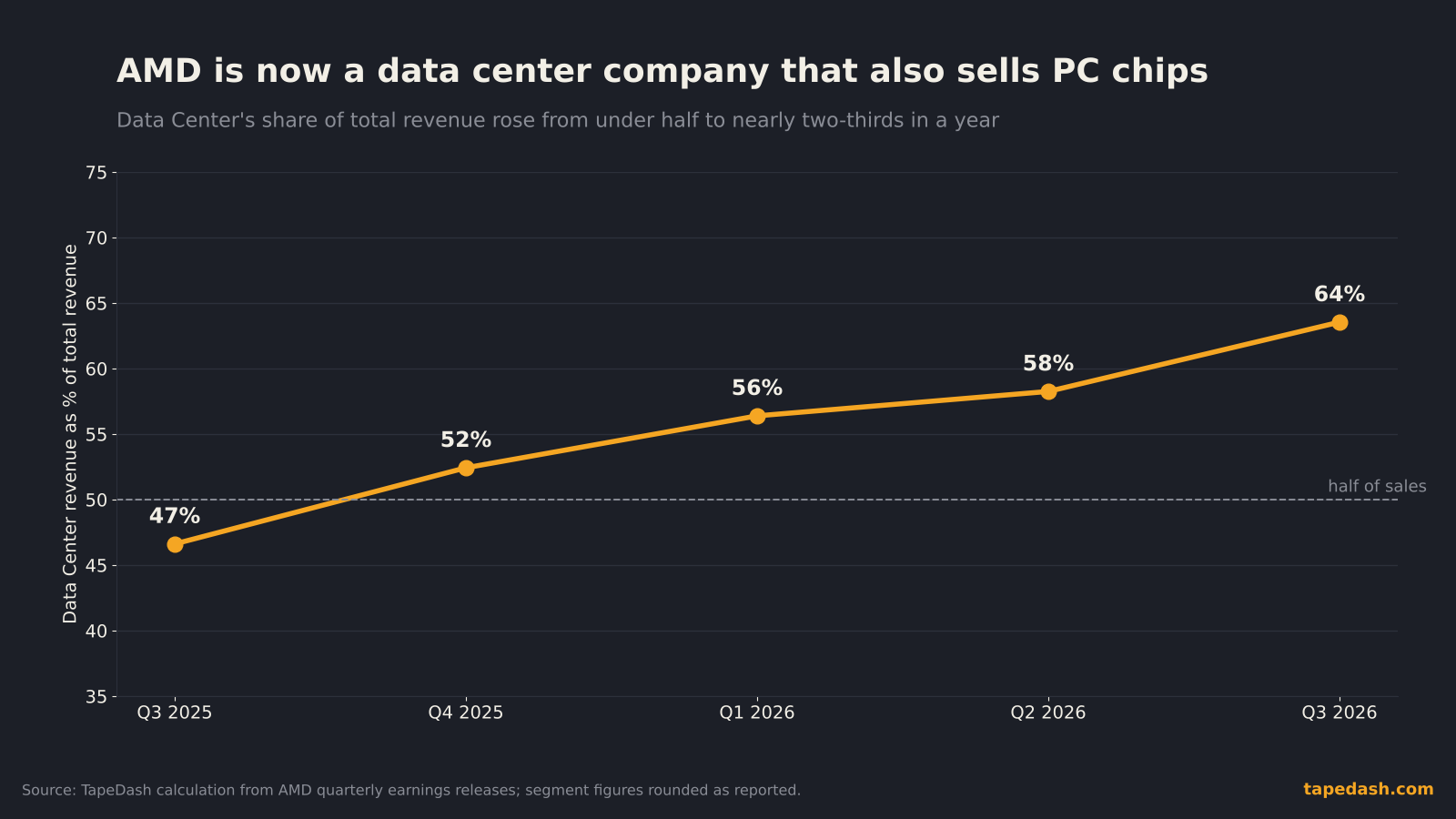
- Data Center revenue nearly doubled to $8.5 billion and is now close to two-thirds of total sales.
- The Q4 outlook of about $17 billion (plus or minus 3%) sits well above the roughly $16.2 billion to $16.3 billion consensus and implies about 27% sequential growth.
- Gaming fell 40% and non-GAAP gross margin is guided to about 55% for Q4, a touch below Q3’s 56%. Mix is the thing to watch.
- Next checkpoints: October CPI on Nov. 10, NVIDIA’s report expected around Nov. 18, and AMD’s own Q4 print in early 2027.
AMD Q3 2026 earnings: the numbers that matter
Start with the headline figures, then strip them down. Revenue of $13.4 billion compared with $9.2 billion a year earlier. Non-GAAP gross margin was 56%, up two points from 54% a year ago, and GAAP gross margin was 54%. GAAP diluted EPS was $1.46, and adjusted EPS of $2.09 was up 74% year over year. Both figures come from AMD’s release and match Stock Titan’s write-up.
Two things stand out to me. First, AMD beat its own guide. Back in August, the company had guided Q3 to about $13 billion, plus or minus $300 million, with a 56% non-GAAP gross margin, according to its second-quarter release and 24/7 Wall St.. It came in above the top of that range and held margin right where it said it would. That is execution, and execution is what the market pays for when a product ramp is in progress.
Second, earnings grew much faster than revenue. Revenue rose 45%; adjusted EPS rose 74%. That gap is operating leverage. Data Center chips carry richer margins than consumer parts, so as the mix tilts toward servers and accelerators, each extra dollar of revenue drops more to the bottom line. The CFO’s commentary in the release made the same point about scale in Data Center.
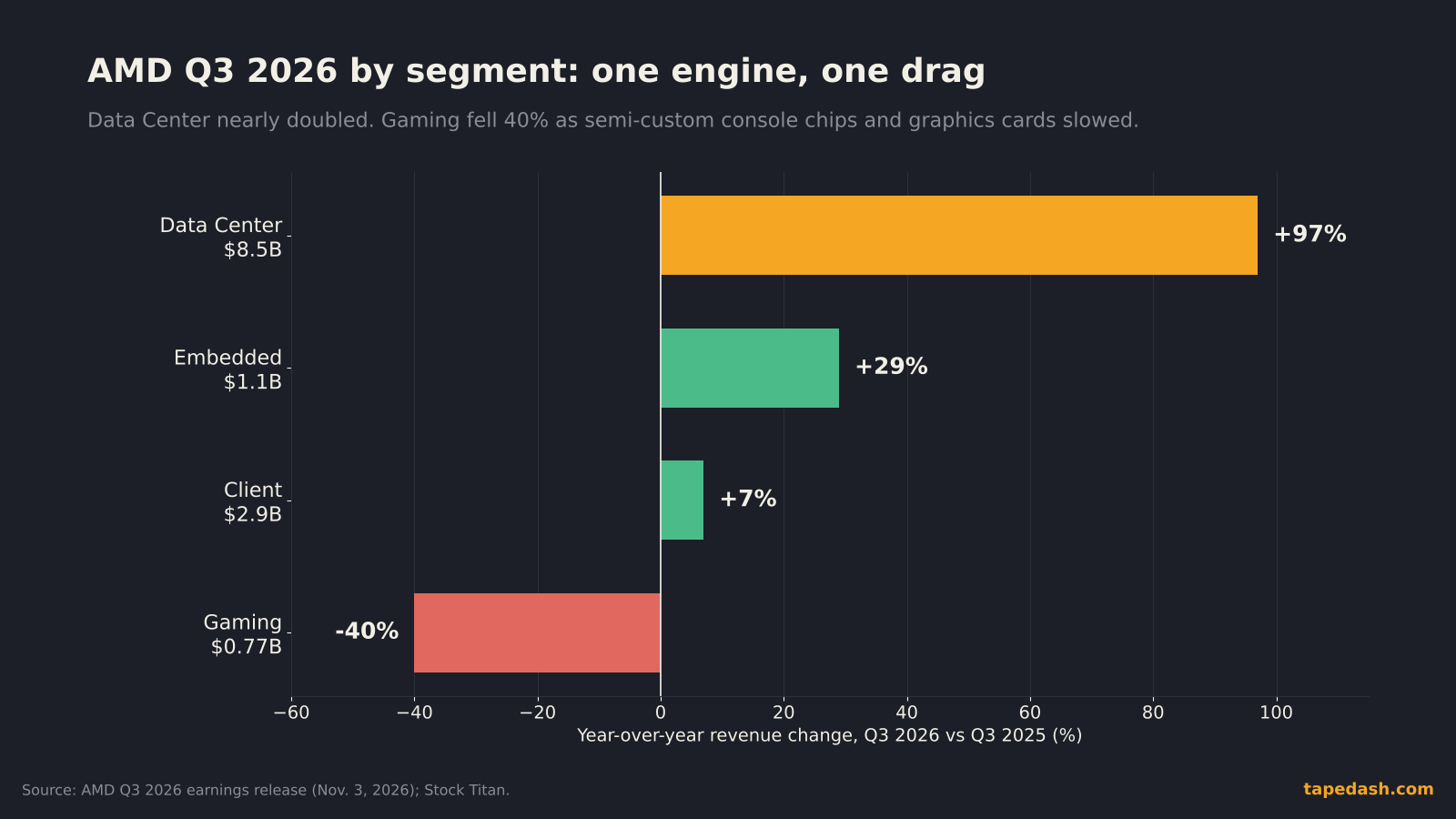
| AMD segment | Q3 2026 revenue | Q3 2025 revenue (implied) | Year-over-year change |
|---|---|---|---|
| Data Center | $8.5B | about $4.3B | +97% |
| Client | $2.9B | about $2.7B | +7% |
| Gaming | $773M | about $1.3B | -40% |
| Embedded | $1.1B | about $0.85B | +29% |
| Total | $13.4B | $9.2B | +45% |
The Q3 2025 column is backed out from the growth rates AMD reported, so treat it as rounded. The shape is the point: one segment is doing the heavy lifting.
Why AMD Data Center revenue nearly doubled
Data Center at AMD is two businesses sharing one line on the income statement. There are EPYC server CPUs, which have been taking share from Intel for years, and there are Instinct GPUs, the accelerators that compete with NVIDIA for AI training and inference. AMD credited both in its release: steady EPYC demand plus the launch of the Instinct MI450 Series.
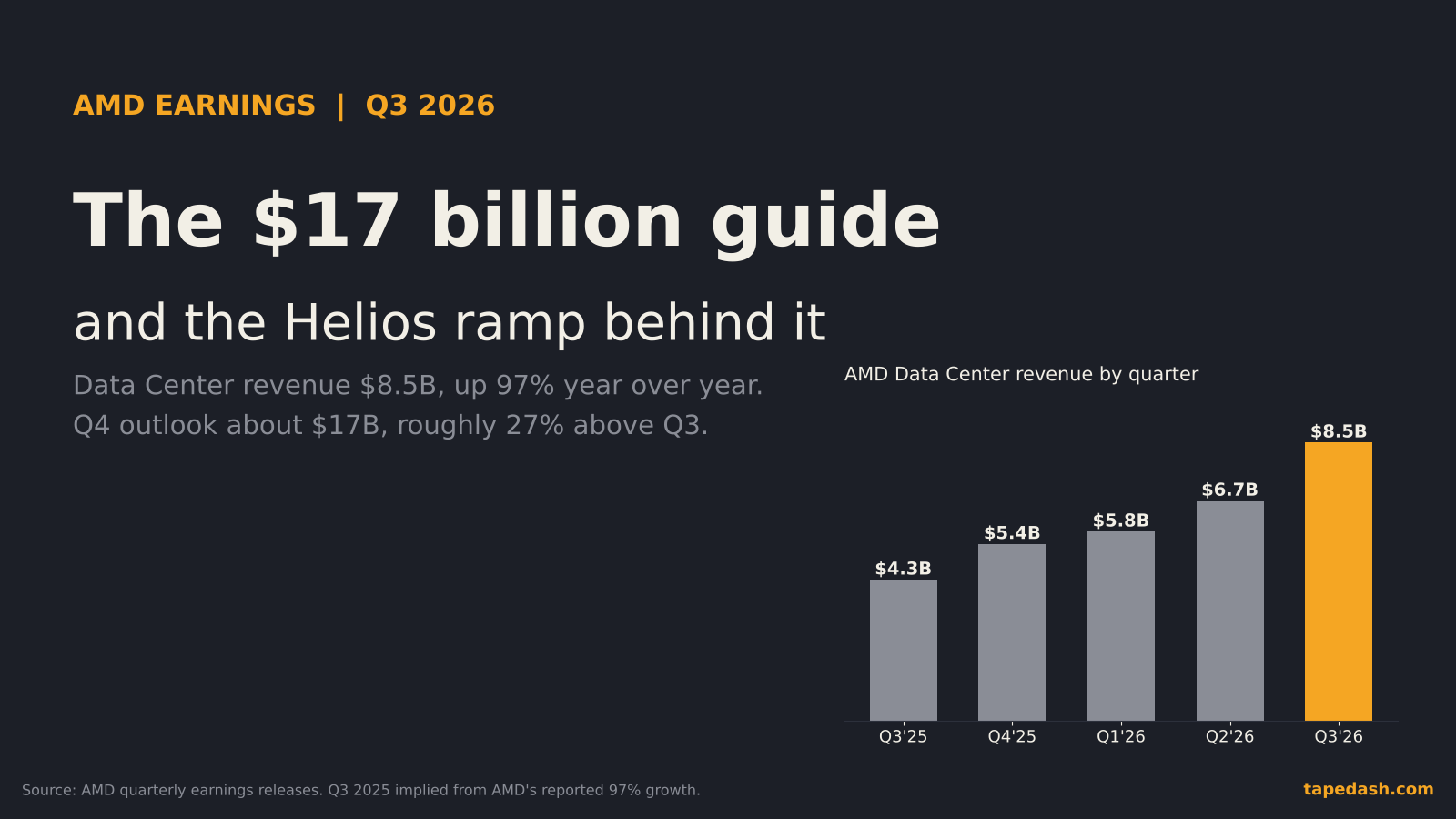
The trend over the last five quarters is steep. Data Center revenue went from about $4.3 billion in Q3 2025 to $5.4 billion in Q4 2025, then $5.8 billion in Q1 2026, $6.7 billion in Q2 and $8.5 billion now. Those figures come from AMD’s quarterly releases, cross-checked against Converge Digest, Jon Peddie Research, MetaTrader News and 24/7 Wall St.. The jump from Q2 to Q3 was about $1.8 billion in a single quarter, which is larger than the entire Gaming segment’s revenue.
What the customer list tells you
The release named Meta, Microsoft and Oracle Cloud Infrastructure among the customers already running workloads on the first Helios systems, and said HPE and Vultr will deploy Helios as well. I don’t read customer lists as revenue forecasts. I read them as a sign of how wide the base is. A GPU ramp that depends on one buyer is fragile. A ramp spread across several hyperscalers and a couple of smaller clouds is less likely to stall if one customer pauses.
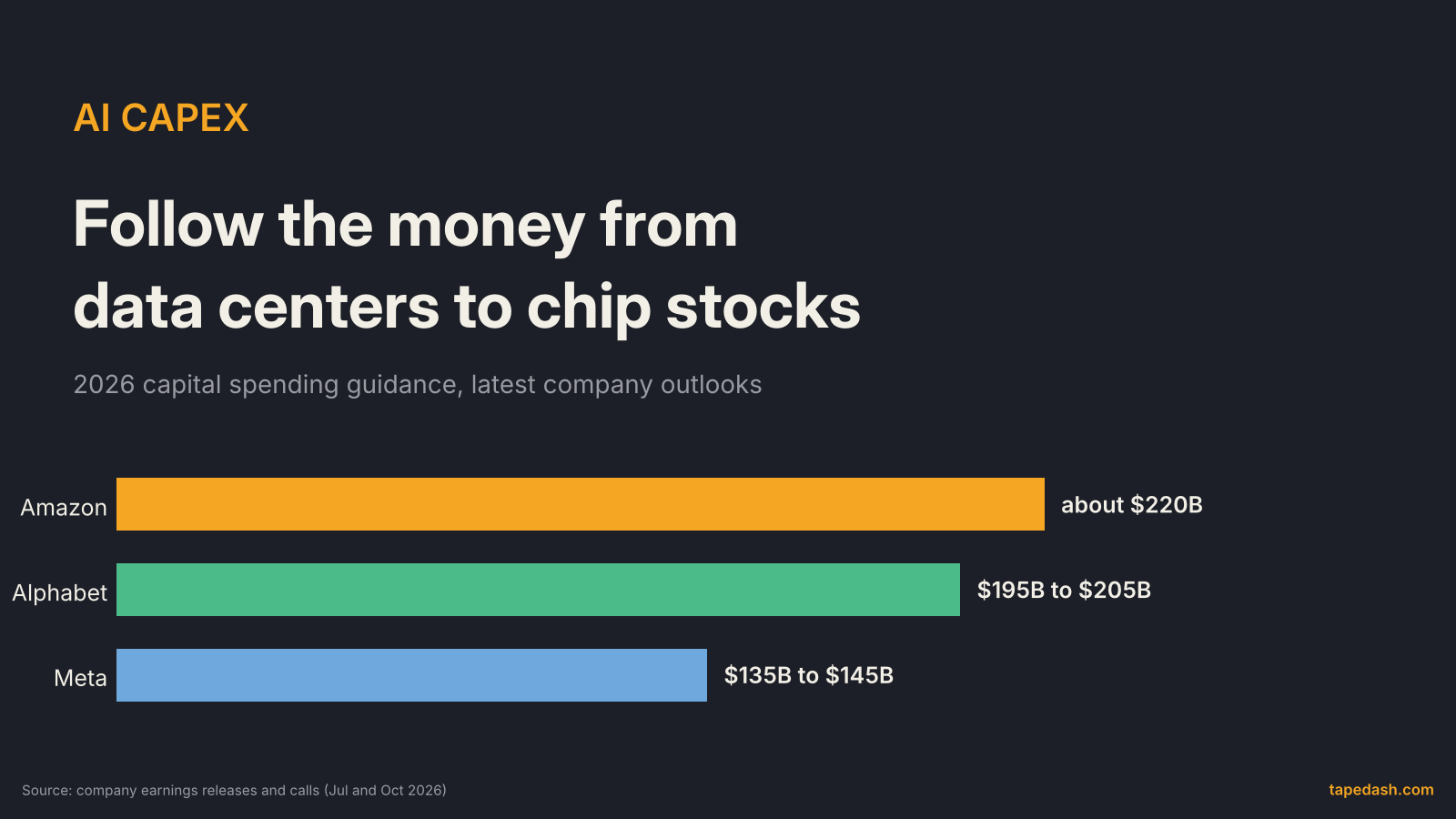
This also ties back to what we wrote last week on how AI capex reaches chip stocks. The cloud giants set data center budgets quarters in advance. AMD’s Q4 guide is, in effect, a read on how much of those budgets are being pointed at a second GPU supplier.
How the Helios rack ramp shows up in AMD’s revenue
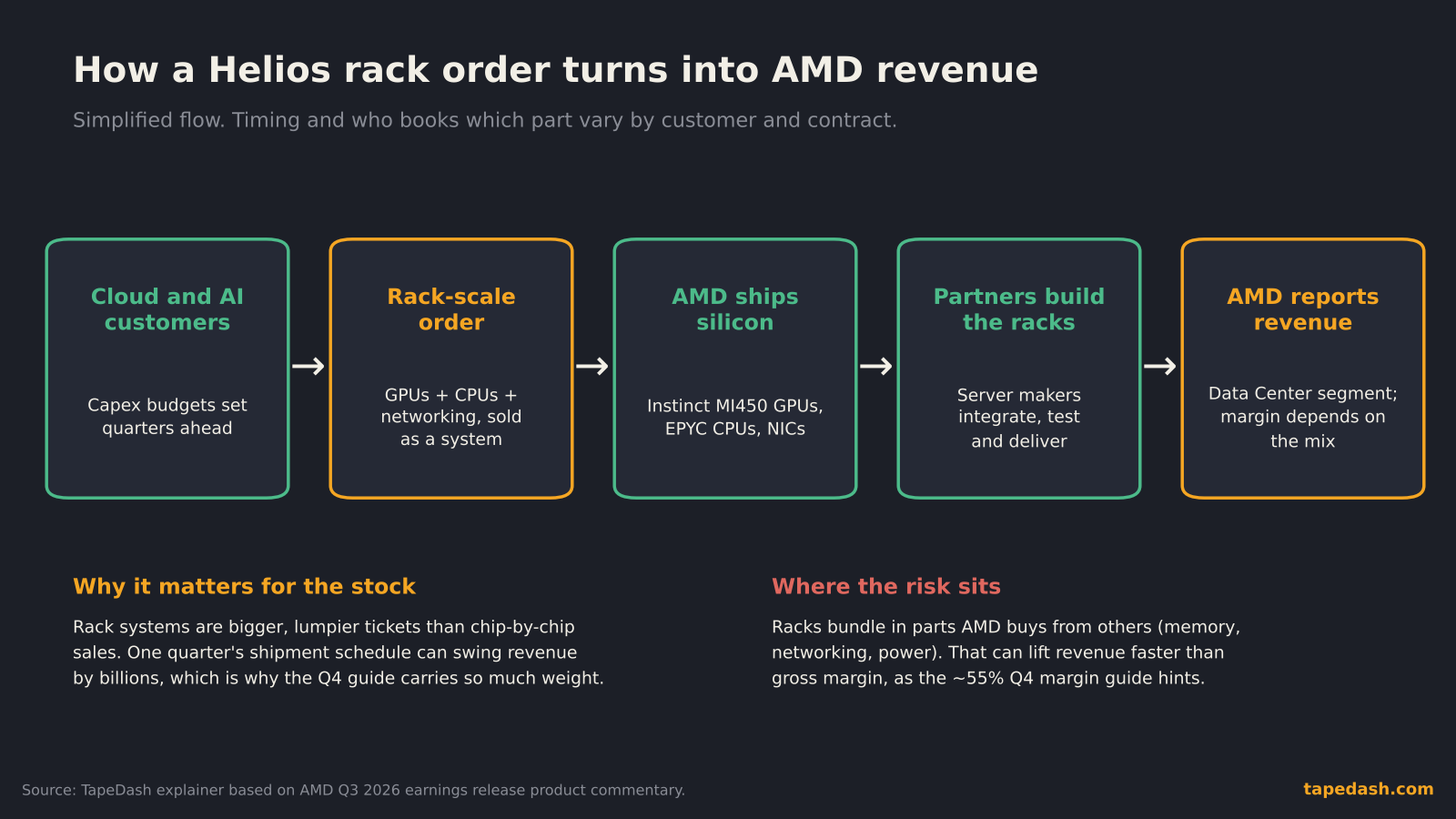
Here is the mechanism that makes this quarter different. For most of its history, AMD sold chips. A server maker bought EPYC processors, built servers, sold them to a cloud. With Helios, AMD is selling a full rack design: Instinct GPUs, EPYC CPUs and networking engineered to work as one system. Partners still assemble and deliver the hardware, but the unit of demand is the rack, not the chip.
That has three consequences for anyone trading the stock.
First, revenue gets lumpier. A rack is a much bigger ticket than a single processor, and delivery schedules for a few large customers can push billions of dollars from one quarter to the next. That is why the Q4 guide carries so much weight: it is AMD saying it has line of sight on those shipments.
Second, margin depends on what is inside the box. Racks include components AMD doesn’t make, such as memory and power and cooling hardware. Depending on how a deal is structured, some of that content can flow through AMD’s revenue at a thinner margin than its own silicon. AMD guided Q4 non-GAAP gross margin to about 55%, down from 56% in Q3, even as revenue jumps. That small step down is the first visible sign of the mix effect.
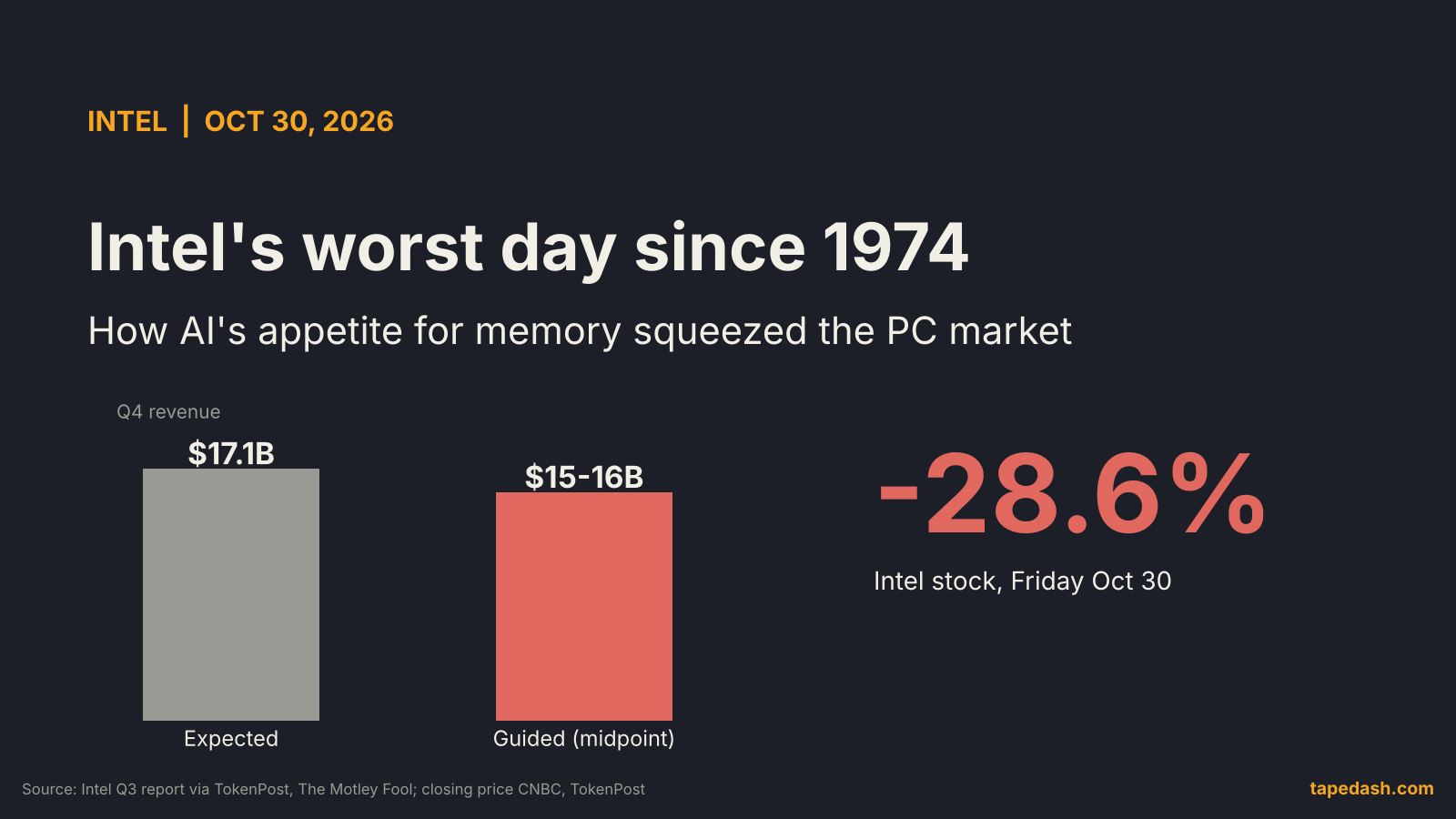
Third, timing risk moves upstream. If memory supply, power equipment or a partner’s assembly line slips, the rack slips, and so does the quarter. We covered the memory side of this squeeze in our Intel piece last week, and it hasn’t gone away.
Reading AMD’s Q4 2026 guidance
The Q4 outlook is about $17 billion, plus or minus 3%, so a range of roughly $16.5 billion to $17.5 billion. AMD said the midpoint implies about 66% growth from a year ago and about 27% growth from Q3. The consensus going in was around $16.29 billion according to StockStory and about $16.23 billion according to 24/7 Wall St.. Either way, the guide cleared the street by roughly $700 million to $800 million at the midpoint.
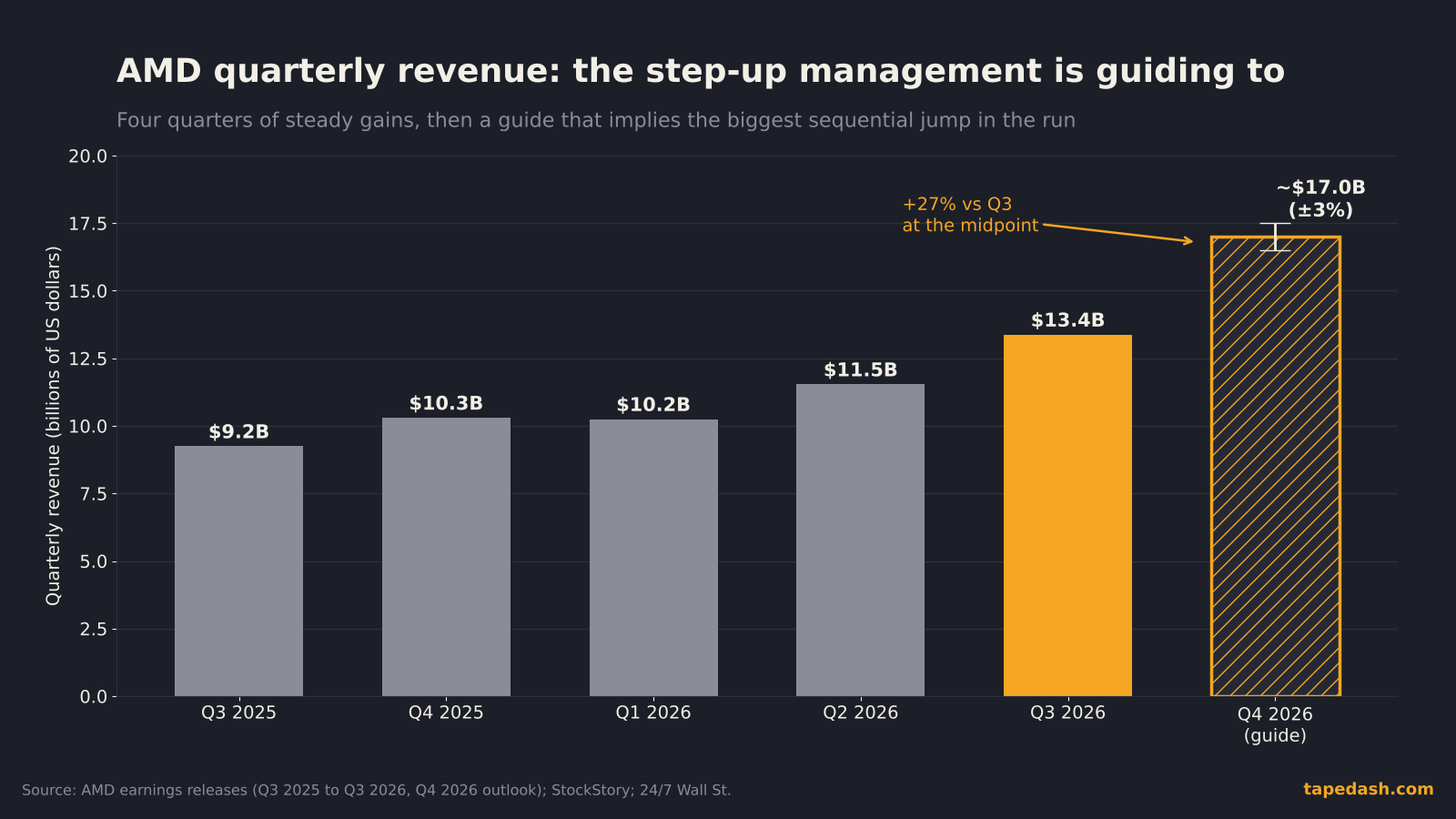
Put that in context. Q4 2025 revenue was $10.3 billion. Q1 2026 was about flat with that. Q2 added about $1.3 billion. Q3 added about $1.8 billion. Q4, if AMD hits the midpoint, adds about $3.6 billion. A company doesn’t guide like that on hope. It guides like that when product is built and customers have scheduled delivery.
Why gross margin is the tell
When I look at a guide like this, I check two numbers together: revenue and gross margin. Revenue tells you whether the product is selling. Gross margin tells you what the company is giving up to sell it. AMD is guiding revenue up 27% sequentially and margin down about a point. That is a reasonable trade at the start of a rack ramp. If margin keeps sliding as Helios grows, the debate shifts from “can AMD sell GPUs” to “can AMD sell GPUs profitably,” and those trade very differently.
The other half of the story is supply. The release talked about scaling production of Helios and “Venice,” AMD’s next-generation EPYC chip, through Q4. Any shortfall on either would show up first as a guide that lands in the bottom half of the range.
Who wins and who loses from AMD’s data center surge
The clearest winners are AMD’s manufacturing and assembly partners. Rack-scale systems need foundry capacity, advanced packaging, high-bandwidth memory, networking and the server makers who put it all together. When one GPU supplier ramps like this, the whole chain upstream of it gets more orders.
The cloud customers win too, in a quieter way. A credible second GPU supplier gives them pricing leverage and supply diversity. That is part of why big buyers are willing to put early racks into production even though the software ecosystem around AMD’s ROCm stack is younger than NVIDIA’s.
The pressure lands in a few places. NVIDIA still dominates the AI accelerator market, and AMD’s gain isn’t necessarily NVIDIA’s loss in a market that is still growing. But every quarter AMD ships at scale, the argument that there is only one viable supplier gets weaker. That matters for how investors price NVIDIA’s long-term margins.
Closer to home, AMD’s own consumer side is the drag. Gaming fell 40% to $773 million on lower semi-custom (console) and graphics card sales. Client grew 7%, a much slower pace than earlier in the year. With memory prices still high, PC makers face higher bills of materials, and that can cool unit demand into 2027. On a day when Apple’s stock fell after a softer margin forecast, per TheStreet and Stock Titan, that context is worth keeping in mind.
How to trade around AMD earnings: what the tape usually does next
I want to be careful here. I’m not going to tell you where AMD trades tomorrow. What I can do is describe the patterns we watch after a print like this.
The first is the overnight-to-open gap. After-hours moves on earnings are made in thin liquidity. The regular session the next morning is where institutions actually reposition. A stock that pops after hours on a guide raise and then holds its gap through the first hour of trading is telling you buyers with size agree. One that fades back toward the prior close is telling you the good news was already priced.
The second is implied volatility. Options on AMD carried rich implied volatility into the print, as they always do. Once the number is out, that premium deflates, which we covered in detail in IV crush and earnings options. If you held calls into the report, a correct direction call can still disappoint if the move is smaller than the expected move priced in.
The third is the peer read. AMD’s guide is a datapoint on AI spending as a whole, so watch how the rest of the chip complex trades the next morning. If AI chip peers, memory names and networking suppliers move with AMD, the market is reading this as an industry signal. If AMD moves alone, it is reading it as share gain.
A simple scenario map for the next report
Since the Q4 guide now anchors expectations, here is how I’d frame the outcomes when AMD reports again. It is a framing tool, not a forecast.
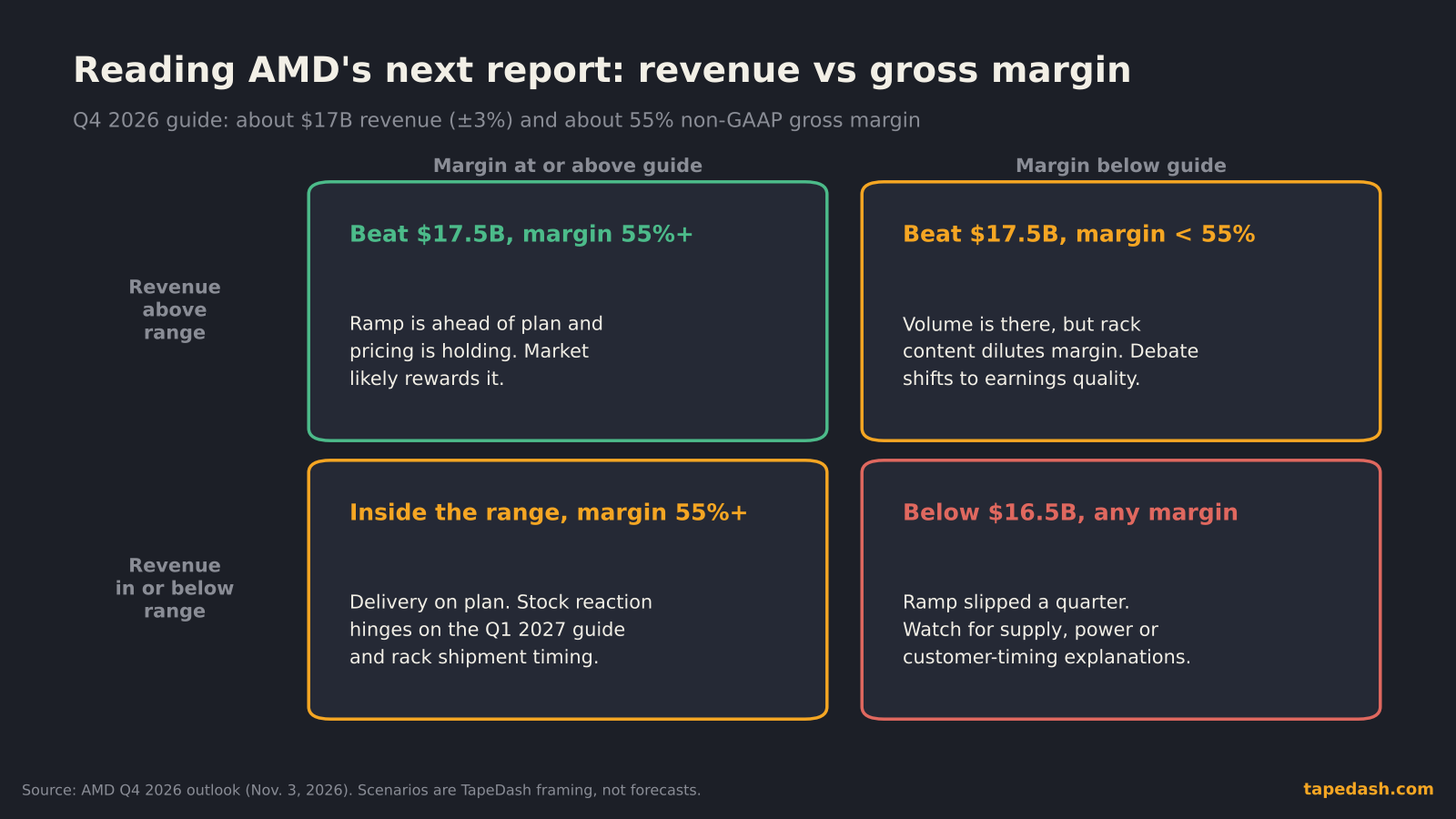
If revenue lands above $17.5 billion with margin at or above 55%, the ramp is ahead of plan and pricing is holding. If revenue is above the range but margin dips, volume is there and the argument becomes about earnings quality. If revenue lands inside the range, the stock’s reaction will mostly hinge on the Q1 2027 guide. And if revenue misses the range, the market will want a precise explanation: supply, power or customer timing.
What to watch next for AMD and chip stocks
A few dated checkpoints over the coming weeks.
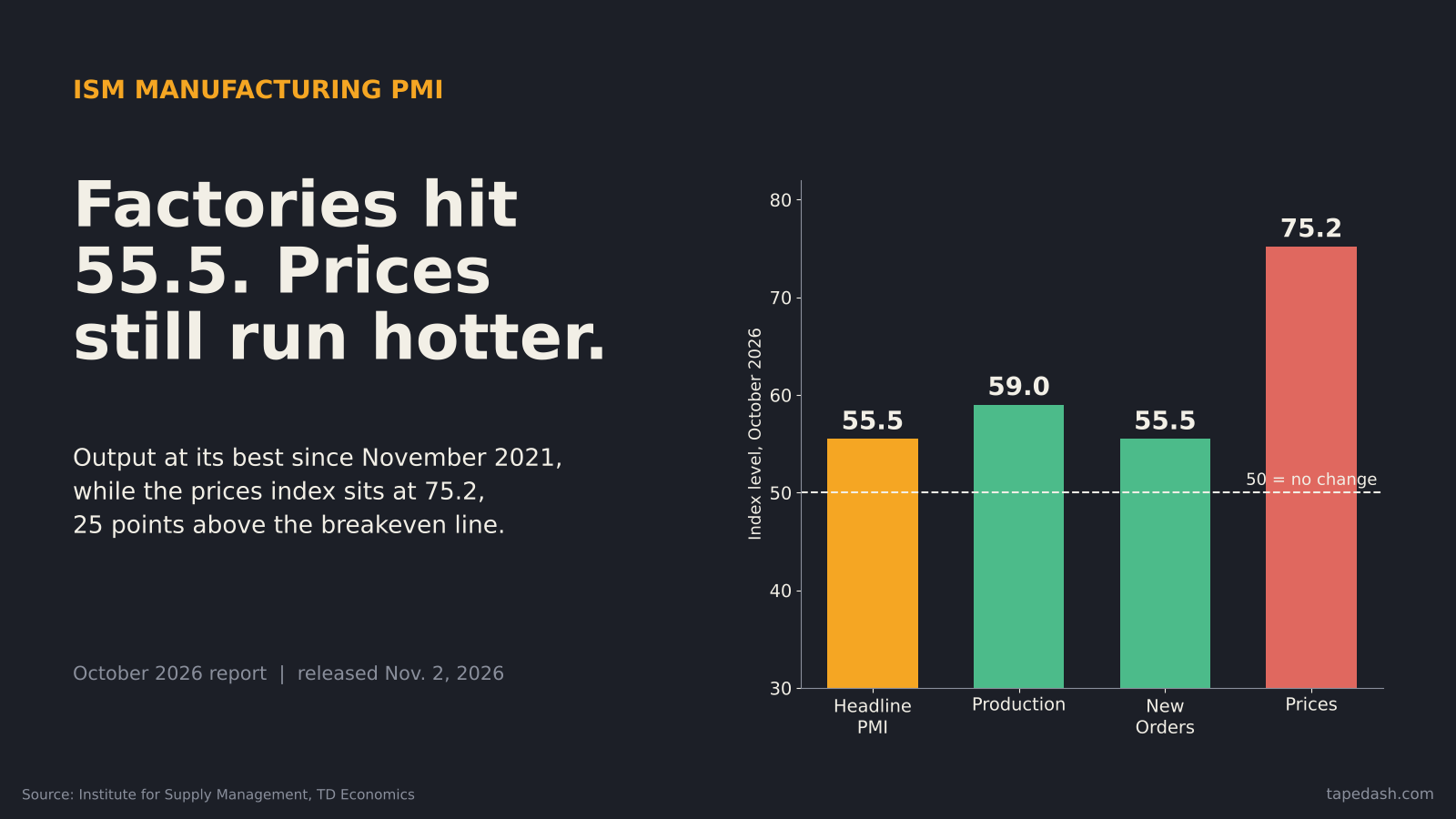
Nov. 10: October CPI. The Bureau of Labor Statistics releases the October consumer price index at 8:30 a.m. ET, per FinanceCalendar and Thrive in Markets. High-multiple growth stocks are sensitive to rate expectations, and Treasury yields have been high, so a hot print can hit chip stocks even when fundamentals are strong. Our guide on how to read the CPI report covers which lines matter.
Around Nov. 18: NVIDIA earnings. NVIDIA’s third-quarter fiscal 2027 report is expected on Nov. 18, according to FinanceCalendar and MarketBeat, though the company hadn’t confirmed the date when we checked. Its data center commentary is the best cross-check on whether AMD’s ramp is coming from a bigger pie or a bigger slice.
The Helios shipment cadence. Listen for partner and customer commentary over the next six weeks about racks entering production. Every confirmation reduces the risk to AMD’s Q4 range.
Gross margin trend. The Q4 guide of about 55% is the line to watch. One point of slippage is mix. Several points would be a pricing story.
AMD’s Q4 report in early 2027. AMD reported its last fourth quarter in early February. That report will include the Q1 2027 outlook, which is where you’ll learn whether the Helios ramp keeps compounding or plateaus.
How TapeDash helps you track this
If you want to watch whether the market keeps paying up for AMD’s data center story, the useful signals are positioning signals, not headlines. On the desk we watch three things after a print like this: whether large options blocks lean toward upside calls or protective puts in the days after earnings, whether sizable off-exchange prints show institutions adding or trimming, and whether the move spreads to other semiconductor names or stays isolated.
That is what the TapeDash Live Scanner is built for. You can filter unusual options activity and dark pool prints for AMD and its peers, see how today’s flow compares with the stock’s normal activity, and spot whether a gap is being bought or sold. The Terminal Preview shows how the pieces fit together, and our public track record shows how our signals have done, including the ones that didn’t work.
If you’d rather get a short read on moves like this in your inbox each morning, the free TapeDash Daily covers the setups we’re watching. And if you decide Pro is worth it, the first 200 members lock Pro at $69.99 a month on their account, even if they cancel and come back later.
FAQ: AMD Q3 2026 earnings
Did AMD beat earnings in Q3 2026?
Yes. Revenue of $13.4 billion topped the roughly $13.1 billion consensus, and adjusted EPS of $2.09 beat estimates near $1.94. Revenue also landed above the top of AMD’s own guidance range.
What is AMD’s guidance for Q4 2026?
About $17 billion in revenue, plus or minus 3%, and about 55% non-GAAP gross margin. At the midpoint, that is roughly 66% growth from a year earlier and 27% from Q3.
What is AMD Helios?
Helios is AMD’s rack-scale AI system. It combines Instinct MI450 Series GPUs, EPYC server CPUs and networking into one integrated design, so customers buy a full rack rather than individual chips. AMD says the first systems are already running workloads for major cloud customers.
The one thing to remember
The beat was nice. The $17 billion guide is the real disclosure, because it tells you Helios racks are moving from demos to deliveries. From here, AMD’s stock will be judged on two numbers at once: whether revenue keeps stepping up as racks ship, and whether gross margin holds near 55% while it does. Watch both, and you’ll understand the next AMD earnings report before the headlines do.
See it on the tape, not just in the headlines
TapeDash is the research desk for traders and investors: live options flow, dealer positioning, a real-time market scanner and trade alerts graded in public. Memberships open January 1, 2027, and the first 200 members lock Pro at $69.99 a month on their account, even if they cancel and come back later.
Join the waitlistClick through the terminalSee the track recordSources
- AMD via Yahoo Finance: AMD Reports Third Quarter 2026 Financial Results (Nov 3, 2026)
- Stock Titan: AMD Q3 earnings, revenue rises 45% to $13.4B (Nov 3, 2026)
- StockStory: AMD surprises with Q3 sales (Nov 3, 2026)
- 24/7 Wall St.: AMD Q3 earnings live coverage (Nov 3, 2026)
- Investing.com: AMD stock jumps after hours as results and guidance beat (Nov 3, 2026)
- CNBC: AMD posts Q3 beat, stock pops in extended trading (Nov 3, 2026)
- Stock Titan: Stock market today live, November 3, 2026
- TheStreet: Stock market today, Nov. 3, 2026
- AMD via Hartware: AMD Reports Second Quarter 2026 Financial Results (Aug 5, 2026)
- Jon Peddie Research: AMD first quarter 2026 results
- MetaTrader News: AMD Q1 earnings beat estimates
- AMD via Hartware: AMD Reports Fourth Quarter and Full Year 2025 Financial Results
- Converge Digest: AMD reports record Q4 and full year 2025 results
- FinanceCalendar: US CPI report, November 2026
- Thrive in Markets: CPI 2026 release dates
- FinanceCalendar: NVDA earnings, November 2026
- MarketBeat: NVIDIA Q3 fiscal 2027 earnings date
This article is for educational and informational purposes only. It is not financial, investment, medical or legal advice, and it is not a recommendation to buy or sell any security. Figures come from the sources listed and were checked on the date of publication; markets change quickly. Options trading involves substantial risk of loss.