CrowdStrike Zscaler Deal: Why the Buyer Fell 9% on a $44B Bet
CrowdStrike will buy Zscaler for $43.9 billion in stock. Why CRWD fell 9% on a record quarter, how the merger spread works and what must happen next.
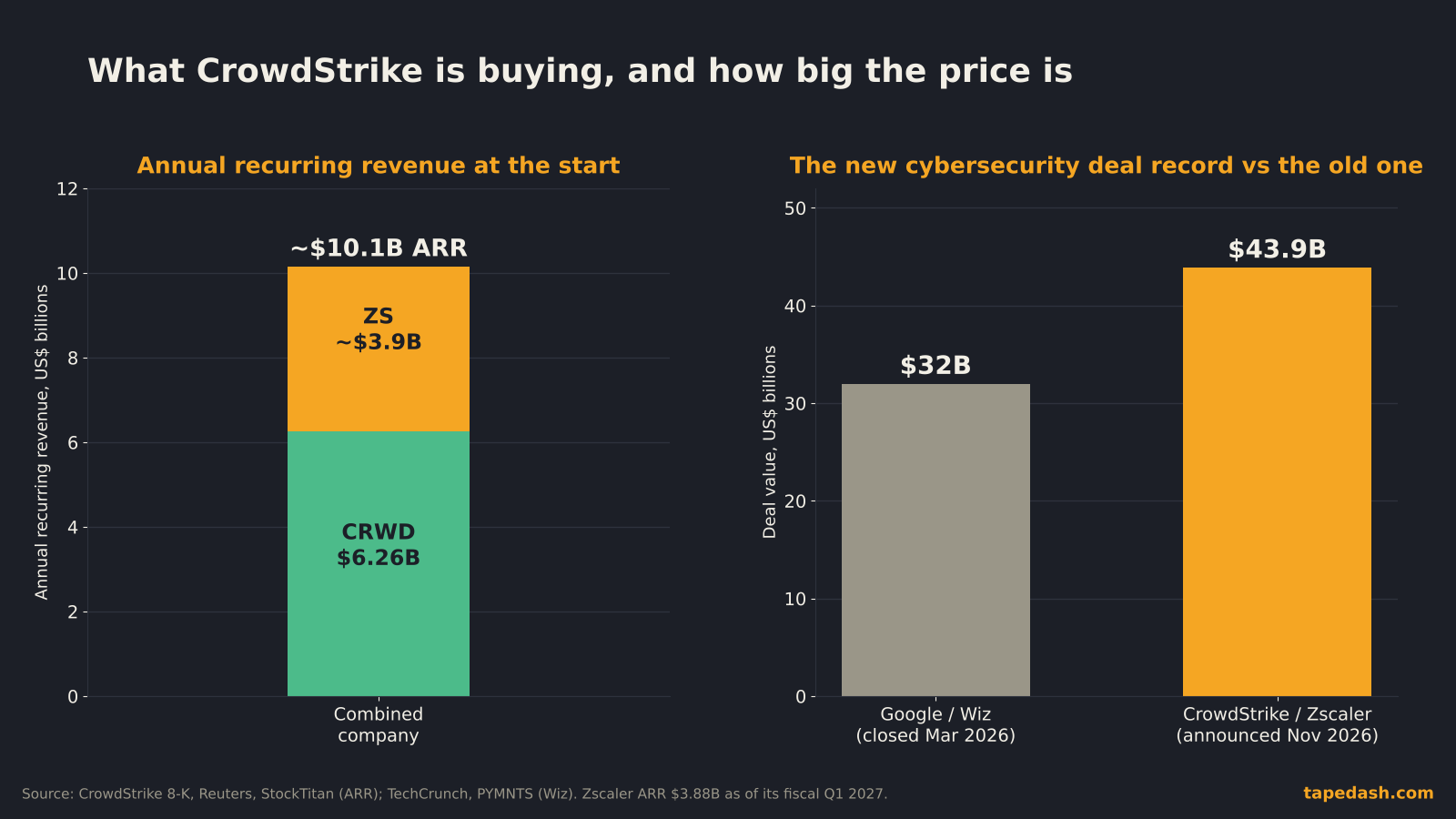
CrowdStrike (CRWD) announced on Monday morning that it will buy Zscaler (ZS) in an all-stock deal valued at about $43.9 billion. Zscaler holders get 1.135 CrowdStrike shares for each share they own, which worked out to about $260.41 a share on Friday’s prices, a premium of roughly 34% (CrowdStrike 8-K, Reuters). It is the largest cybersecurity acquisition on record, bigger than the $32 billion Google paid for Wiz earlier this year.
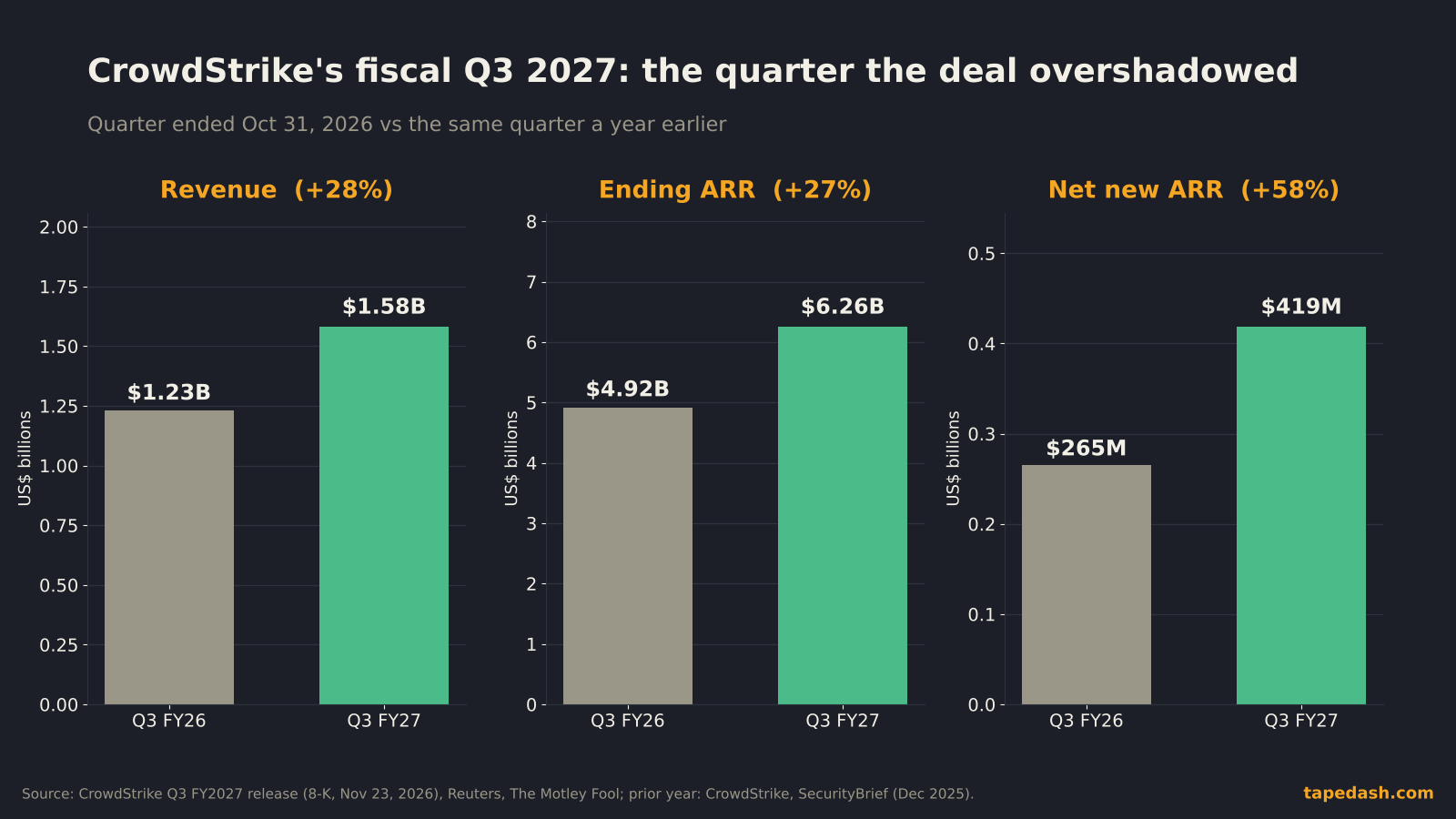
CrowdStrike reported its fiscal third quarter at the same time, and by most measures it was the best quarter the company has posted. Revenue rose 28% to $1.58 billion and net new annual recurring revenue hit a record $419 million (CrowdStrike Q3 release, The Motley Fool). The stock still closed down about 9%, on a day when the S&P 500 rallied more than 4% and the Nasdaq more than 6% (24/7 Wall St., The Motley Fool). Zscaler jumped about 18%.
So why did CrowdStrike stock fall on the deal? Because in an all-stock merger the buyer’s shareholders pay with ownership, not cash. They give up about 16% of the company, take on a long and uncertain antitrust process, and inherit the integration risk of joining two large platforms. The market priced that cost on day one. This piece walks through the terms, what the stock reaction is telling you, how the merger spread works, and what has to happen before Zscaler holders get their CrowdStrike shares.
- CrowdStrike is buying Zscaler for about $43.9 billion in stock at 1.135 CRWD shares per ZS share, about $260.41 a share on Friday’s prices and a 34% premium.
- CRWD fell about 9% and ZS rose about 18% on a day the broad market surged. Buyers often fall in big stock deals because their holders absorb dilution and execution risk.
- There is no collar. Zscaler’s price now tracks CrowdStrike’s, and at Monday’s close the offer was worth about $237, not $260.
- The gap between that implied value and Zscaler’s price, roughly 3.5%, is the merger arbitrage spread: the market’s discount for time and the risk the deal breaks.
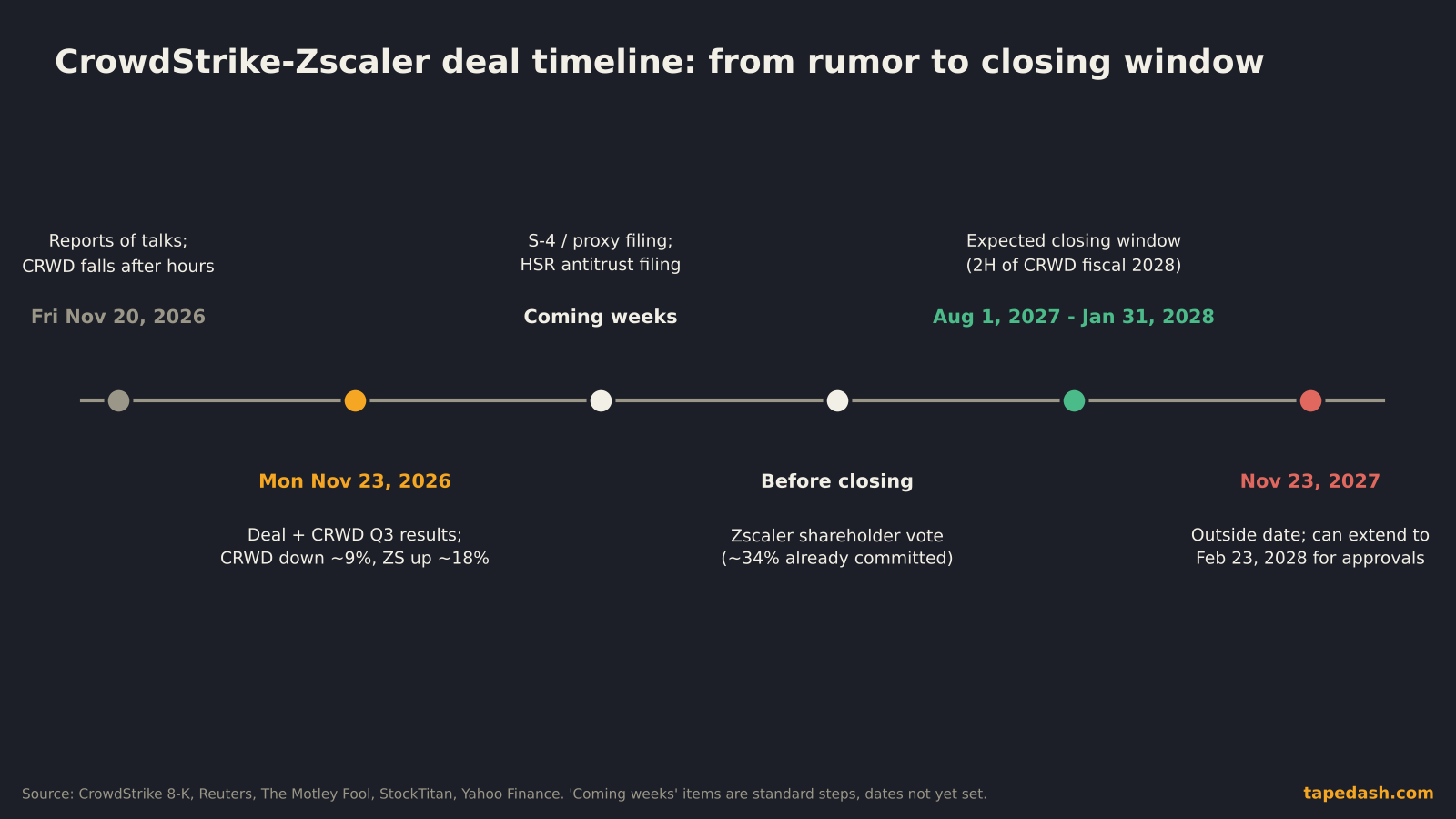
- Closing is expected between August 2027 and January 2028, after a Zscaler shareholder vote and antitrust reviews.
CrowdStrike Zscaler deal terms in plain English
Here is what CrowdStrike agreed to, using the company’s release and the Reuters and AP write-ups as cross-checks.
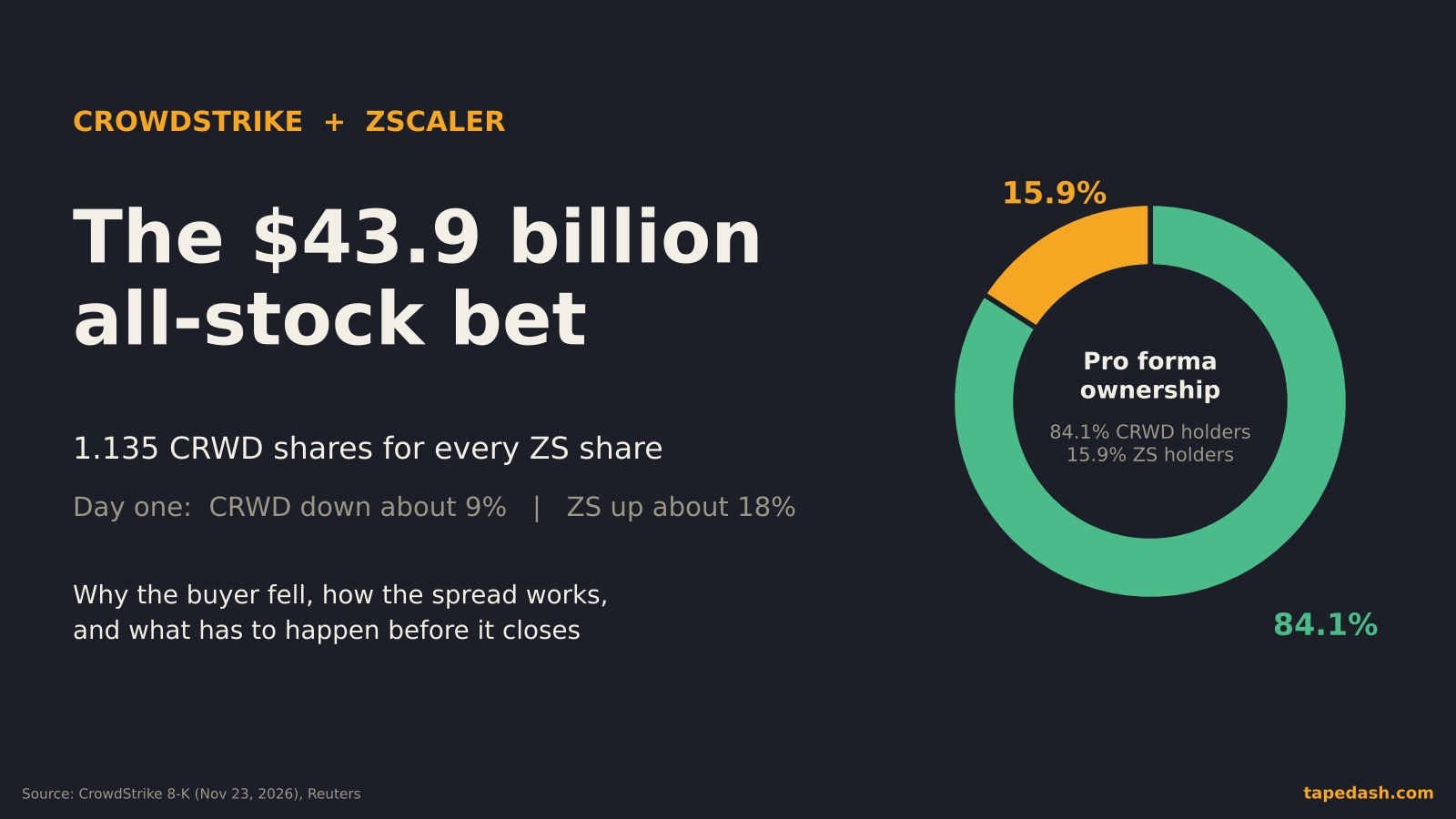
The price is fixed in shares, not dollars. Every Zscaler share converts into 1.135 CrowdStrike shares at closing. Using Friday’s CrowdStrike close of $229.44, that is about $260.41 per Zscaler share, against a Friday Zscaler close near $195 (CrowdStrike 8-K, StockTitan). After closing, current CrowdStrike holders would own about 84.1% of the combined company and former Zscaler holders about 15.9% (AP via Scripps, ASTIG).
Zscaler founder and CEO Jay Chaudhry will keep running the Zscaler business and join CrowdStrike’s board. He and his affiliates, who control about 34% of Zscaler’s shares, signed agreements to vote for the deal (CrowdStrike 8-K, The Motley Fool). That is a big head start on the shareholder vote. Zscaler would owe CrowdStrike a $1.4 billion termination fee if it walked away for a better offer (Reuters, StockTitan).
What CrowdStrike says it gets for the money
The pitch rests on four numbers. Zscaler brings about $3.9 billion of annual recurring revenue, which takes the combined company past $10 billion of ARR on day one. CrowdStrike says about 8,000 Zscaler customers don’t use CrowdStrike today, and it expects about $1 billion of annual revenue synergies within 30 months of closing (CrowdStrike 8-K, Reuters). It also targets about $500 million of annual cost savings within 18 to 24 months, mostly from data centers and suppliers (CrowdStrike 8-K, The Motley Fool).
The strategy is easy to state. CrowdStrike made its name protecting endpoints: laptops, servers, cloud workloads. Zscaler built its business sitting in the network path, inspecting traffic between users and the apps they reach, which the industry calls a zero trust or secure access service edge platform. Put them together and one vendor can see the device and the connection. That is the same consolidation story Palo Alto Networks (PANW) and Fortinet (FTNT) have been telling for years, and it is why large security buyers keep asking for fewer vendors.
Why CrowdStrike stock fell after a record quarter
Start with the quarter, because it was good, and the tape ignored it.
CrowdStrike’s revenue rose 28% to $1.58 billion, with subscription revenue up 29%. Adjusted earnings were 34 cents a share against the 31 cents analysts expected, per LSEG data cited by Reuters (Reuters, ASTIG). Ending ARR reached $6.26 billion, up 27%, and free cash flow was about $474 million (CrowdStrike Q3 release, StockTitan). Fourth-quarter revenue guidance of $1.638 billion to $1.644 billion came in above the Street’s average estimate (CrowdStrike Q3 release, Reuters).
The number that matters most to software investors is net new ARR, the recurring revenue added in the quarter. It was a record $419 million, up from $265 million a year earlier, which is growth of about 58% (CrowdStrike Q3 release, SecurityBrief). For a company this size, that is reacceleration. CrowdStrike moved its earnings call up to Monday so the results and the deal could be discussed together. In hindsight, the deal swallowed the quarter.
The real cost of paying in stock
When I look at a buyer’s reaction in a stock deal, I think about who pays. In a cash deal, the buyer spends money it already has or borrows. In an all-stock deal, existing holders pay by handing over a slice of every future dollar the company earns. Here, that slice is about 15.9%.
That only works for CrowdStrike holders if the combined company grows its value per share faster than CrowdStrike would have alone. The company says the deal adds to free cash flow per share right away, before any synergies (CrowdStrike 8-K, StockTitan). The market’s first answer was skepticism. Zscaler’s revenue grew about 20% last quarter, to $949.3 million (Reuters, StockTitan). That is a solid business. It is also slower than CrowdStrike’s 28%, so the blend dilutes the growth rate investors were paying a premium for.
There is a second layer. The deal leaked on Friday, and CrowdStrike already slid in after-hours trading when reports of talks came out (Yahoo Finance). Monday’s move confirmed it rather than reversing it. And it came on the day the market had its strongest session in well over a year, driven by the Nvidia (NVDA) rebound. A stock that falls 9% while the S&P 500 rises more than 4% is underperforming by about 13 points. That gap is the clearest read on how the market priced the deal.
Then there is merger arbitrage itself. Arb funds that want Zscaler exposure typically short CrowdStrike against it, which I’ll explain below. That short selling is mechanical, and it adds pressure to the buyer in the first days after any large stock deal.
How an all-stock merger works with no collar
Some stock deals come with a collar, a band that adjusts the exchange ratio if the buyer’s price moves too far. This one doesn’t have one. The ratio is fixed at 1.135 and does not rise to make up for a drop in CrowdStrike’s price (StockTitan, CrowdStrike 8-K).
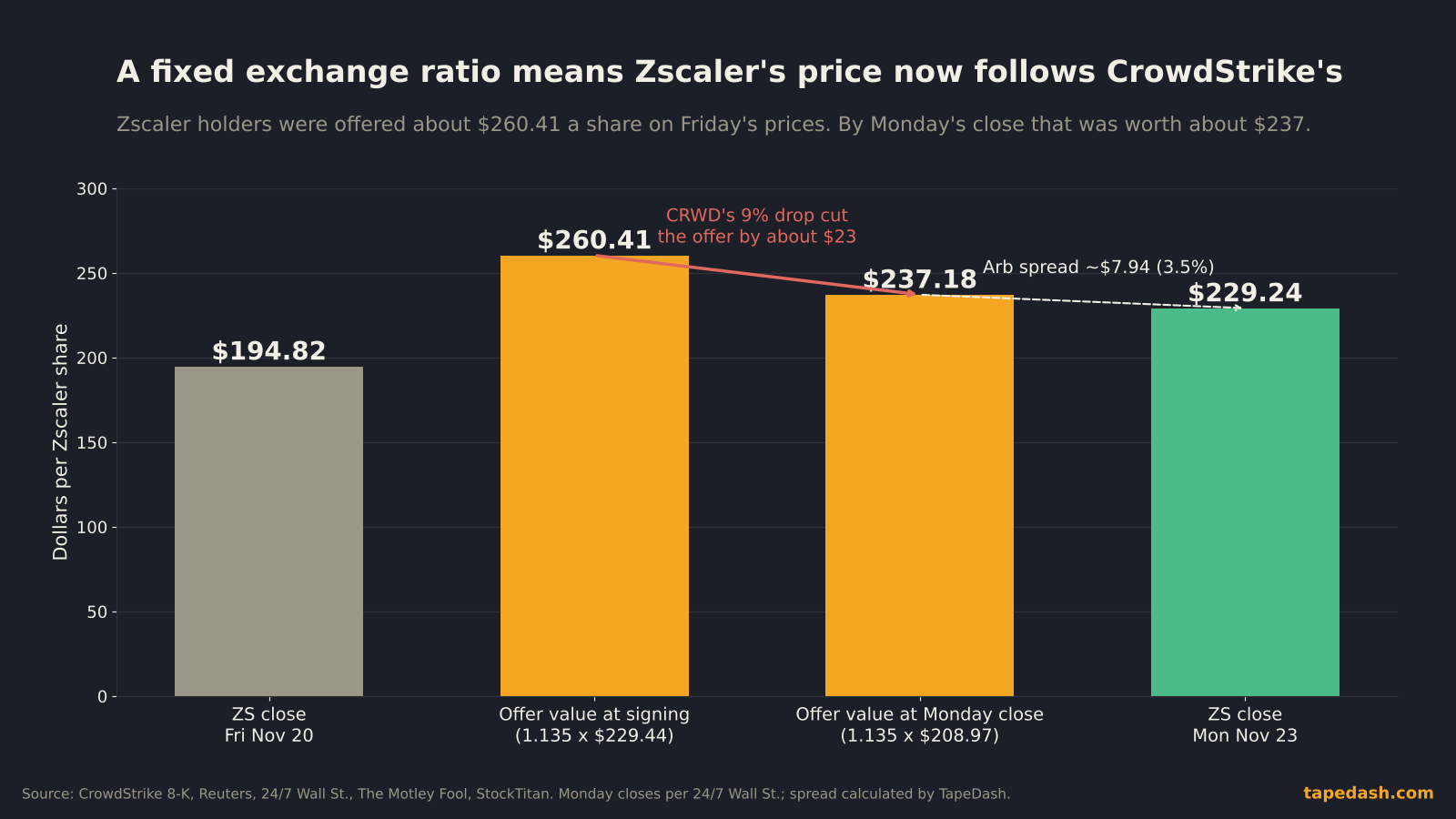
That has a direct consequence for Zscaler holders. The $260.41 headline value was a Friday number. CrowdStrike closed Monday at about $208.97, down about 9%, which makes 1.135 shares worth about $237.18 (24/7 Wall St., The Motley Fool). The buyer’s drop shaved roughly $23 a share off the offer before the ink was dry. From here on, a Zscaler holder is effectively holding a slightly discounted claim on CrowdStrike stock plus deal risk.
Merger arbitrage explained: how to read the Zscaler spread
This is the part I find most useful for traders, because the spread tells you what the market thinks of the deal in a single number.
Take Monday’s closes. Zscaler finished at about $229.24 (24/7 Wall St., The Motley Fool). The 1.135 CrowdStrike shares it converts into were worth about $237.18. The difference, about $7.94 or roughly 3.5% of Zscaler’s price, is the gross spread. The Motley Fool’s intraday math came out in the same neighborhood, about 3.5% (The Motley Fool).
The classic hedge
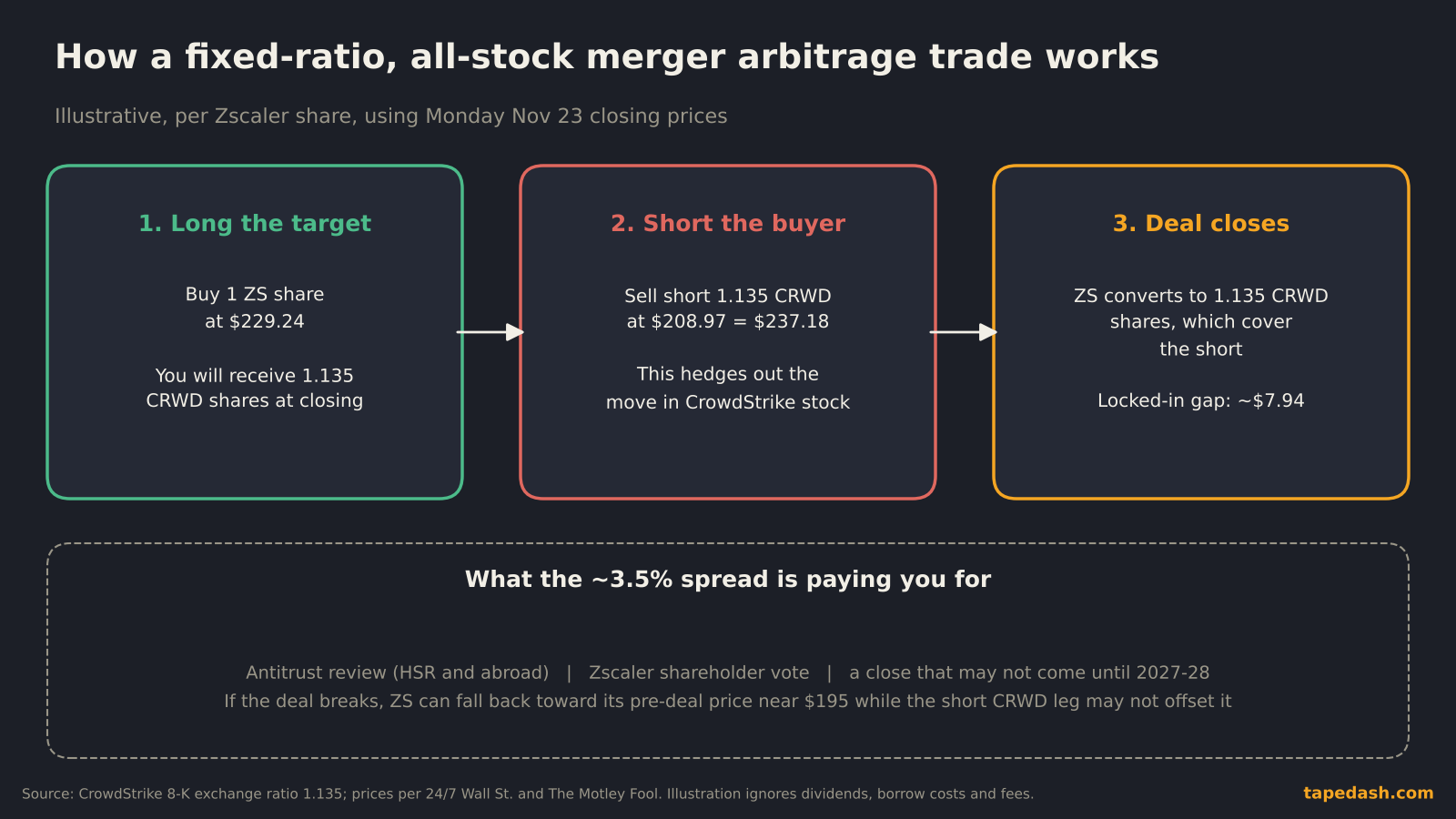
An arbitrageur buys one Zscaler share and sells short 1.135 CrowdStrike shares. If CrowdStrike rises or falls from there, both legs move together, so the trade is hedged against the stock. If the deal closes, the Zscaler share turns into exactly the CrowdStrike shares needed to cover the short, and the arb keeps the spread (less borrowing costs, fees and any dividend adjustments).
What the spread is really pricing
A 3.5% spread can look like free money. It isn’t. Three things eat into it.
Time. The companies expect to close in the second half of CrowdStrike’s fiscal 2028, which runs from August 1, 2027 to January 31, 2028 (The Motley Fool, StockTitan). Spread a 3.5% return over 9 to 14 months and the annualized figure is modest, roughly in line with short-term Treasury yields. That tells you the market sees this as a fairly likely deal, not a sure thing and not a long shot.
Break risk. If regulators block the deal, Zscaler can drift back toward where it traded before the news, near $195, while the short CrowdStrike leg may not make up the difference. That downside is several times the upside. One detail matters here: StockTitan’s read of the merger agreement says CrowdStrike owes no fee if regulators kill the deal (StockTitan). Zscaler holders carry that risk without a consolation prize.
Timing slippage. The outside date is November 23, 2027, and it can be pushed to February 23, 2028 if only antitrust or foreign-investment approvals remain (The Motley Fool, StockTitan). Every extra month lowers the annualized return.
How to use the spread as a signal
You don’t need to run an arb book to use this. Track the spread the way you’d track a credit spread. If it narrows toward 1% to 2% as filings clear, the market is gaining confidence. If it widens sharply on a headline, someone knows or fears something about the antitrust review. A sudden negative spread, with Zscaler trading above the implied value, usually means traders are betting on a competing bid. With the founder’s 34% already committed, that last scenario looks less likely than usual.
Options add a second lens. After a stock deal is announced, implied volatility on the target usually collapses toward the buyer’s, because the target now moves as a fraction of the buyer. If Zscaler’s implied vol stays well above what 1.135 times CrowdStrike’s implies, options traders are paying for a break scenario. I covered the mechanics of reading implied moves in implied volatility and the expected move.
Antitrust review: what has to happen before the CrowdStrike Zscaler deal closes
The deal needs Zscaler shareholder approval, a majority of all outstanding shares, and antitrust clearance in the U.S. and abroad (StockTitan, CrowdStrike 8-K). In the U.S., that runs through the Hart-Scott-Rodino process: both companies file, and the agencies get an initial waiting period to review. If they want more, they issue a “second request,” which can add many months (Federal Trade Commission).
The overlap question is the interesting one. CrowdStrike and Zscaler are mostly complementary: one owns the endpoint, the other the traffic path. Regulators tend to focus on horizontal overlap, where two direct rivals merge, so the core businesses don’t collide much on paper. But both sell into the same security budgets, both are building broader platforms, and a combined company with over $10 billion of ARR would be one of the largest pure security vendors in the world. Axel Rudolph, an analyst at IG Group, told Reuters it would be “premature to assume that regulators will necessarily try to block it” (Reuters). That is my read too. The more likely outcome is a long review rather than a fight, and the long timeline in the agreement says the lawyers expect the same.
Who wins and who loses in cybersecurity stocks
Zscaler holders got a 34% premium on paper and kept most of it, but they now own a CrowdStrike proxy with deal risk attached. Anyone who wanted pure Zscaler exposure no longer has it.
CrowdStrike holders are paying with dilution for a bigger platform and a larger addressable market, which the company puts at more than $185 billion of extra opportunity by 2029 (CrowdStrike 8-K, Reuters). Their payoff depends on cross-selling into those 8,000 Zscaler customers, and on not losing focus while two large engineering teams are combined.
Palo Alto Networks and Fortinet now face a rival that covers more of their ground. In the short run, a long integration can be an opening: competitors tend to pitch customers who worry about product roadmaps during a merger. In the long run, a combined CrowdStrike-Zscaler raises the bar for what a full platform has to include.
Smaller security names got a valuation reference point. When a 34% premium is paid for a company growing around 20%, the market starts asking who’s next. That kind of speculation can lift a whole group for a while, and it fades just as fast if no second deal shows up.
Here is how the main pieces compare:
| CrowdStrike (CRWD) | Zscaler (ZS) | Combined (pro forma) | |
|---|---|---|---|
| Core business | Endpoint, cloud and identity protection | Zero trust network access, secure web gateway | Device plus network path |
| Annual recurring revenue | $6.26B, up 27% | About $3.9B | Over $10B |
| Latest quarterly revenue growth | 28% | About 20% | Blended, lower than CRWD alone |
| Ownership after close | About 84.1% | About 15.9% | 100% |
| Day-one stock reaction (Nov 23) | Down about 9% | Up about 18% |
What to watch next for CRWD and ZS stock
This week. The PCE inflation report comes out on Wednesday, November 25, ahead of the Thanksgiving holiday (24/7 Wall St., Kiplinger). Markets are closed Thursday and close early on Friday. High-multiple software stocks like CrowdStrike are sensitive to rates, so a hot print can hit the stock for reasons that have nothing to do with the deal, and Zscaler will follow it through the exchange ratio.
The spread. Watch the gap between Zscaler and 1.135 times CrowdStrike every day for the next couple of weeks. A stable spread in the 3% to 4% range means the market is settling in for a long review. A widening spread is the early warning.
The filings. The S-4 registration statement and proxy will lay out how the deal came together, whether other bidders were involved, and the bankers’ fairness analysis. The HSR filing starts the antitrust clock. Neither has a public date yet.
Zscaler’s own numbers. Zscaler pulled its full-year outlook because of the deal (StockTitan). Its quarterly reports still matter, because a weak quarter during the review would make CrowdStrike holders even less happy with the price.
CrowdStrike’s next report, its fiscal fourth quarter, is the first full test of whether the net new ARR acceleration holds while management is also planning an integration. For a framework on reading that print, see how to read an earnings report like a trader.
How to track the CrowdStrike Zscaler deal on TapeDash
If you want to watch whether this spread holds and whether the buyer finds a floor, here is what we track. The Terminal Preview puts CRWD and ZS side by side with price, volume and options data, so you can see in one glance whether Zscaler is still moving at roughly 1.135 times CrowdStrike or starting to drift. The options flow view shows whether big traders are buying Zscaler puts as break protection or selling CrowdStrike calls against arb positions; the options flow tools section of Every TapeDash tool, explained covers how we classify those trades. If you are new to reading flow, how to read options flow is the place to start.
The Live Scanner is useful for the second-order trade: unusual volume and volatility in other security names when the market starts hunting for the next target. We also run dealer positioning on the large-cap names, which matters for CrowdStrike in particular after a 9% gap, since heavy put open interest below the price can make the stock more volatile on the next leg down. For founding members, the first 200 members lock Pro at $69.99 a month on their account, even if they cancel and come back later. If you’d rather start with a daily read of the tape, the free TapeDash Daily covers moves like this one each morning.
CrowdStrike Zscaler deal FAQ
How much will Zscaler shareholders get from CrowdStrike?
Each Zscaler share converts into 1.135 CrowdStrike shares at closing. The dollar value moves with CrowdStrike’s stock. It was about $260.41 on Friday’s prices and about $237 at Monday’s close. There is no collar, so a lower CrowdStrike price means a lower payout.
When will the CrowdStrike Zscaler deal close?
The companies expect closing in the second half of CrowdStrike’s fiscal 2028, between August 1, 2027 and January 31, 2028. It needs a Zscaler shareholder vote and antitrust approvals first.
Why did CrowdStrike stock drop if earnings were strong?
Because the deal dominated the day. CrowdStrike holders give up about 15.9% of the company, take on integration risk and face a long regulatory review. Arbitrage funds shorting CrowdStrike to hedge Zscaler purchases added mechanical selling.
The one thing to remember
In an all-stock deal, the headline price is a snapshot, not a promise. CrowdStrike’s offer was worth about $23 less per Zscaler share by Monday’s close than it was on Friday, and the 3.5% spread left over is the market’s honest estimate of the time and risk between here and closing. Watch that spread. It will tell you what the market thinks of this deal long before the regulators do.
See it on the tape, not just in the headlines
TapeDash is a market research and data analytics platform for traders and investors: live options flow, dealer positioning, a real-time market scanner, stock ratings, and macro and earnings data in one terminal. Memberships open Black Friday, November 27, and the first 200 members lock Pro at $69.99 a month on their account, even if they cancel and come back later.
Join the waitlistClick through the terminalSee the track recordSources
- CrowdStrike: CrowdStrike to acquire Zscaler, press release, Form 8-K (Nov 23, 2026)
- CrowdStrike: Third quarter fiscal 2027 financial results, Form 8-K (Nov 23, 2026)
- Reuters via Euronext: CrowdStrike snaps up Zscaler in $44 billion deal as cyber threats mount (Nov 23, 2026)
- AP via Scripps News: CrowdStrike to acquire Zscaler in a $44 billion deal (Nov 23, 2026)
- The Motley Fool: Zscaler stock surged on CrowdStrike's $43.9 billion buyout (Nov 23, 2026)
- The Motley Fool: Stock market today, Nov. 23, markets rebound from correction (Nov 23, 2026)
- 24/7 Wall St.: Dow, S&P 500 and Nasdaq surge as Nvidia leads a major AI rebound (Nov 23, 2026)
- StockTitan: Zscaler stock would become 1.135 CrowdStrike shares, with no price floor (Nov 23, 2026)
- Yahoo Finance: CrowdStrike's best quarter ever gets buried by $44 billion deal (Nov 23, 2026)
- ASTIG: CrowdStrike to buy Zscaler for about $44 billion, topping Google's Wiz deal (Nov 23, 2026)
- SecurityWeek: CrowdStrike to acquire Zscaler in $43.9 billion deal (Nov 23, 2026)
- SecurityBrief: CrowdStrike posts record revenue driven by AI cybersecurity demand (Dec 2025)
- TechCrunch: Google wraps up $32B acquisition of Wiz (Mar 11, 2026)
- PYMNTS: Google completes $32 billion purchase of cybersecurity firm Wiz (Mar 2026)
- Kiplinger: What to look out for in economic data this week (Nov 23-27)
- Federal Trade Commission: Premerger notification and the merger review process
This article is for educational and informational purposes only. It is not financial, investment, medical or legal advice, and it is not a recommendation to buy or sell any security. Figures come from the sources listed and were checked on the date of publication; markets change quickly. Options trading involves substantial risk of loss.