Nvidia Earnings Q3 2027: Why a $130B Guide Barely Moved the Stock
Nvidia earned $115.8B in revenue and guided to $130B, but the stock barely moved. The margin guide, the export rule and what traders watch next.
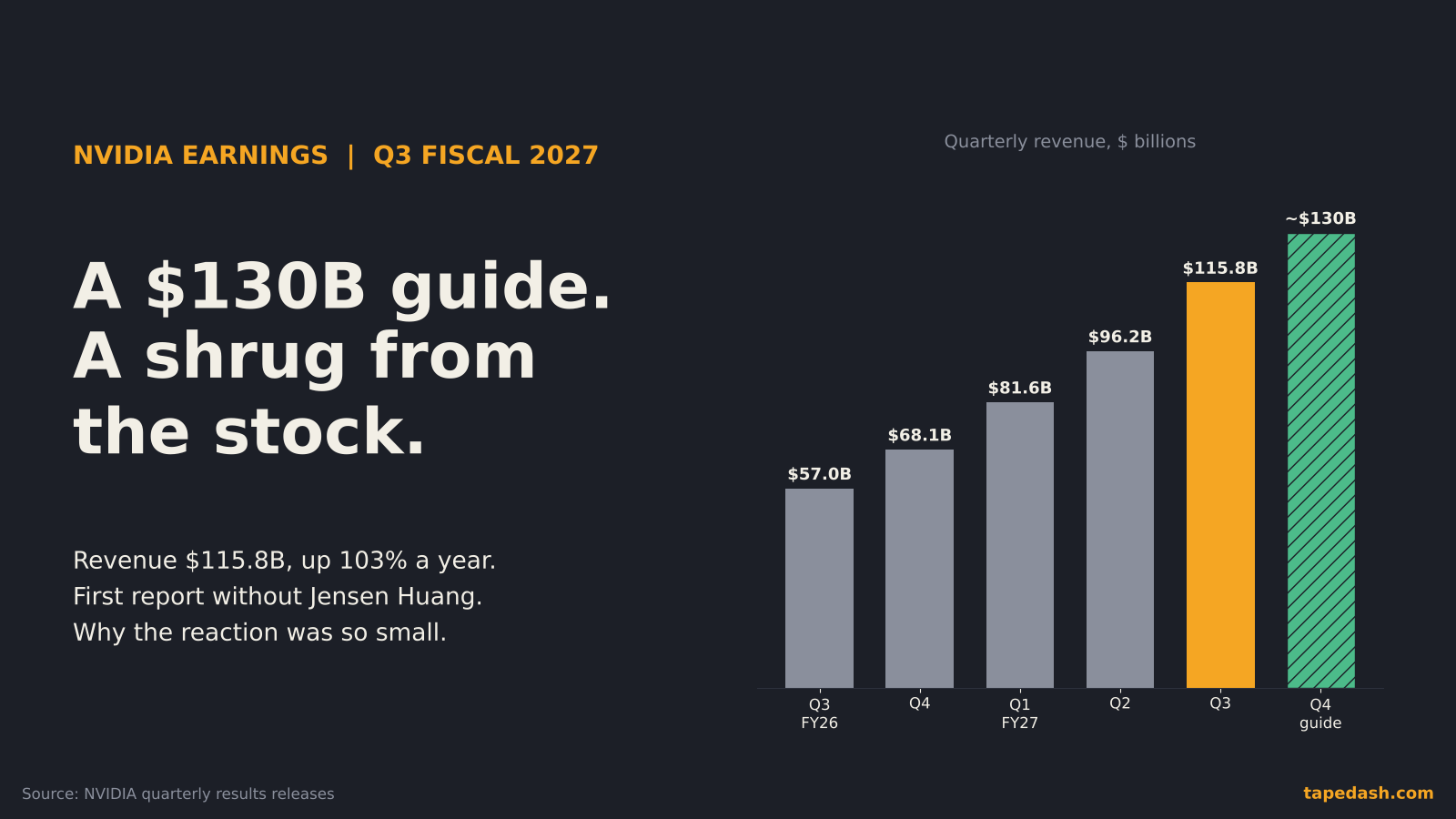
Nvidia just reported the kind of quarter that, two years ago, would have sent the stock up double digits. Revenue for the fiscal third quarter came in at $115.8 billion, up 103% from a year earlier, and the company guided the current quarter to $130 billion, plus or minus 3% (NVIDIA, CBS News). Data center revenue alone was $107.6 billion. Both the quarter and the outlook cleared Wall Street’s estimates.
The stock’s answer was polite. Shares rose roughly 2% to 3% in after-hours trading on Tuesday (Reuters via Investing.com, CBS News), after closing the regular session at $155.46, down less than half a percent, on a day the Dow lost about 849 points (The Motley Fool, Stock Titan). For a company that had just added about $19.6 billion of quarterly revenue in three months, that is a shrug.
So why did Nvidia stock barely move after earnings? Short answer: the beat was expected, the margin guide went the wrong way, and the biggest risks right now are not in the income statement. A new U.S. rule on remote access to AI chips also landed the day before. Here is how I read all of it, and what I am watching next.
- Nvidia’s fiscal Q3 revenue was $115.8 billion (up 103% a year), and data center revenue was $107.6 billion (up 110%). Both topped consensus.
- The fourth-quarter guide is $130 billion, plus or minus 3%, and it still assumes zero data center compute revenue from China.
- Gross margin is guided to 71% to 72%, down from 74.8%. That is the number that kept the after-hours move small.
- Policy now matters as much as the numbers: a new Commerce rule on remote chip access adds paperwork and delay for some overseas data center build-outs.
- The stock closed about 36% below its 52-week high. Positioning, not results, will likely decide the next few weeks.
Nvidia earnings Q3 2027: the numbers that matter
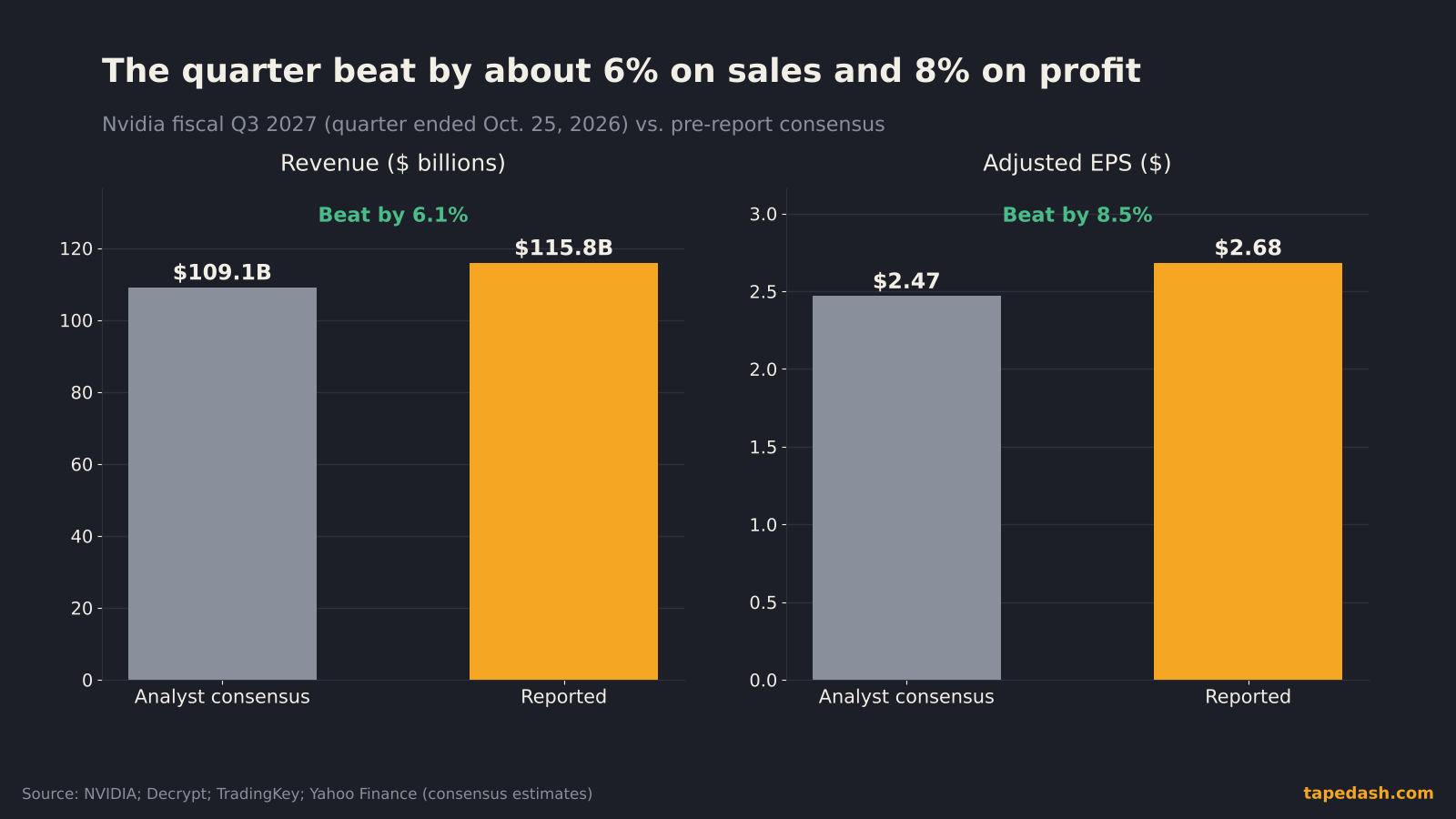
Start with the headline figures, because they are not in dispute. For the quarter ended October 25, Nvidia reported revenue of $115.8 billion, up 20% from the prior quarter and 103% from a year earlier (NVIDIA, TradingKey). Adjusted earnings per share were $2.68. Analysts had been looking for about $109.1 billion in revenue and $2.47 a share (Decrypt, TradingKey). That is a beat of about 6% on sales and about 8% on profit.
GAAP net income was $65.3 billion, up from $31.9 billion a year earlier (NVIDIA, CBS News). Put that next to revenue and you get a company keeping more than half of every dollar it sells as profit. That is a rare level of profitability at this size.
Data center is now almost the whole company
Nvidia’s reporting now splits revenue into two segments. Data center brought in $107.6 billion, up 21% from the prior quarter and 110% from a year ago. Edge computing, which holds the gaming PCs, workstations, cars and robots, was $8.2 billion, up 42% from a year ago (NVIDIA, TradingKey). Data center is roughly 93% of sales.
That concentration cuts both ways. It is why the numbers are so large, and it is why every headline about hyperscaler budgets, export rules or AI financing moves this stock. I wrote about the spending chain behind this in AI capex explained: how data center spending reaches chip stocks, and that framework is the right one for reading this quarter. Nvidia’s revenue is somebody else’s capital budget.
The Vera Rubin ramp has started
The other headline from the release is Vera Rubin, the next platform after Blackwell. Nvidia said Vera Rubin NVL72 systems are shipping and called it the fastest product ramp in its history, with racks running at several large cloud providers. Finance chief Colette Kress put it this way in the release: “Our momentum is real” (NVIDIA, Decrypt).
New platforms are good for revenue and messy for margins in their first quarters, which brings us to the part of the report that the stock cared about most.
Why Nvidia stock didn’t go up more after earnings
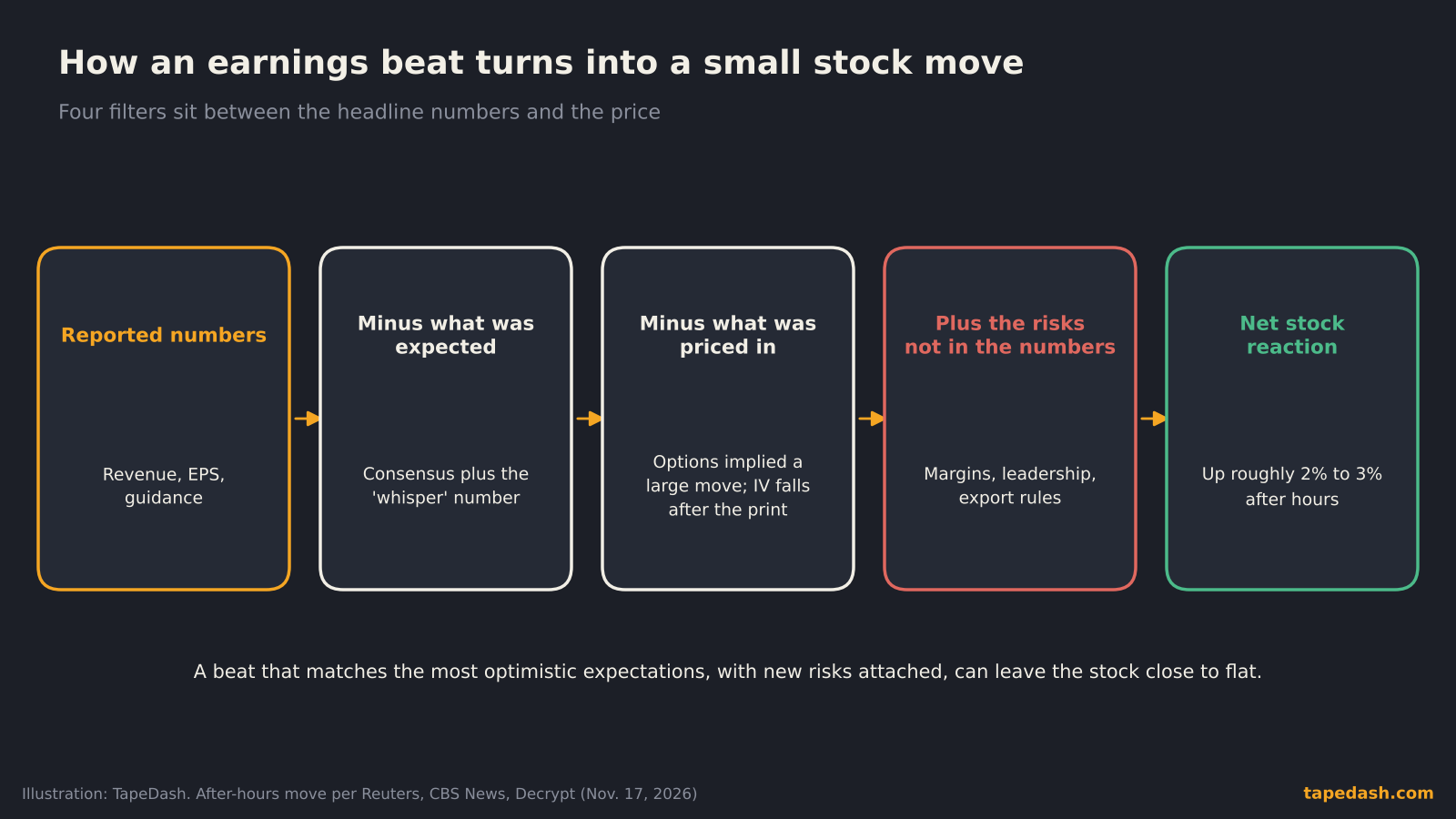
When a company beats and raises and the stock barely moves, there are usually three or four forces at work at once. On the desk I think of them as filters between the headline and the price.
Filter one: the beat was already the base case
Big funds don’t trade the published consensus, they trade the number they think Nvidia will actually print, which tends to sit above it. In August, Nvidia guided this quarter to $108 billion, plus or minus 2% (NVIDIA Q2 release, Il Sole 24 Ore). It delivered $115.8 billion. A beat of that size is impressive, and it is also roughly what the most bullish holders were hoping for. When the good outcome is priced in, the good outcome doesn’t pay much.
Filter two: options had priced a big move
Going into a report like this, options traders bid up implied volatility on near-dated contracts. That premium pays for the expected move. After the print, the uncertainty is gone and implied volatility drops hard. That is IV crush, and I covered the mechanics in IV crush: why options lose value after earnings. The practical point: if the stock’s move ends up smaller than the move options were priced for, call buyers who were right on direction can still lose money on the trade. A 2% to 3% after-hours pop after a beat this size is the kind of reaction where that happens.
Filter three: the gross margin guide
This is the line that tempered the reaction. Nvidia guided fourth-quarter GAAP and non-GAAP gross margin to 71% to 72%, down from 74.8% in the third quarter (NVIDIA, TradingKey). At the midpoint that is a drop of a bit more than three points.
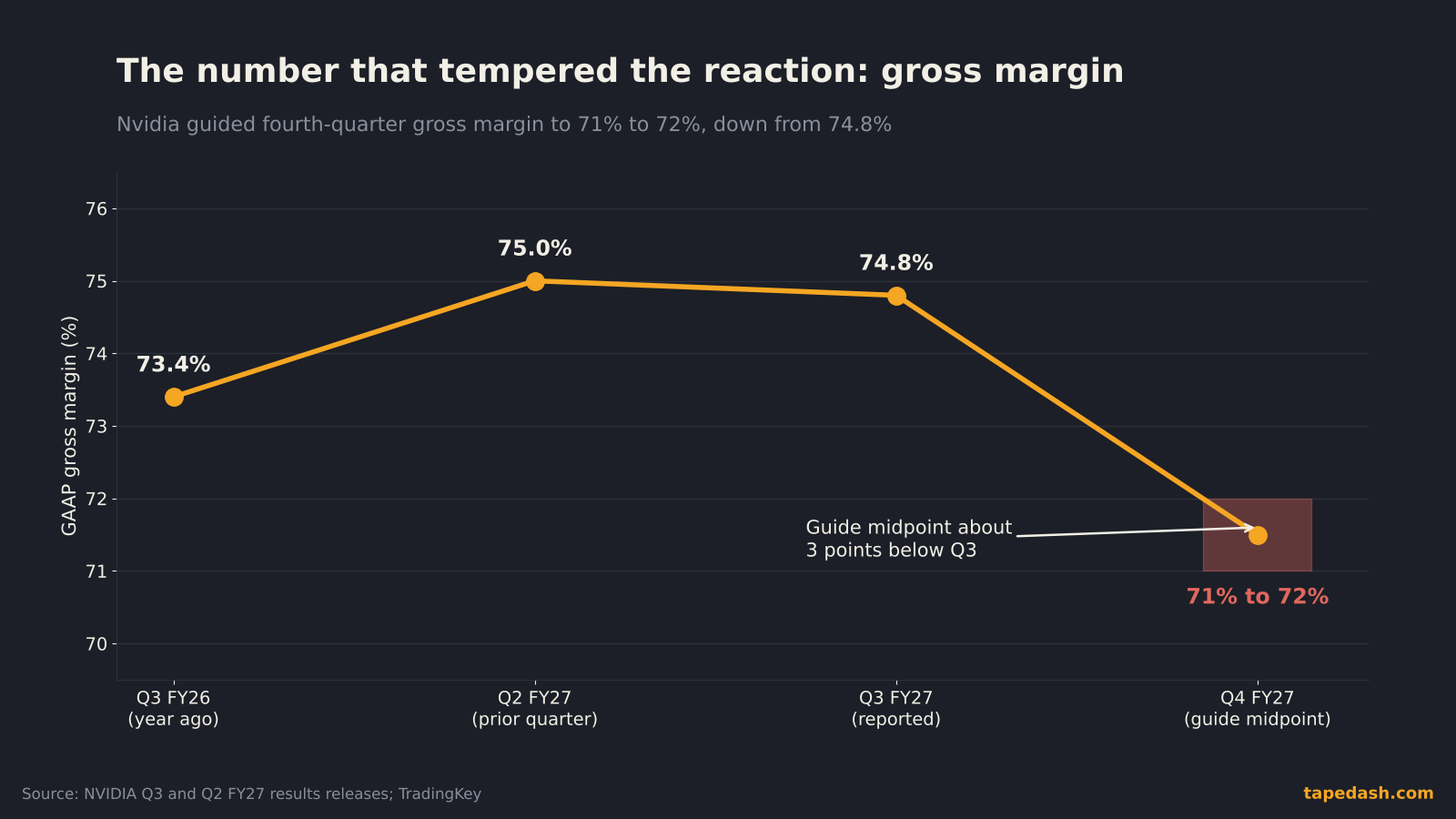
Three points sounds small. On a $130 billion quarter it is roughly $4 billion of gross profit. More important is what it signals. The bull case for Nvidia has always included the idea that it can charge whatever it wants because nobody else can supply this kind of system at scale. A margin step down, even a temporary one tied to a new product ramp, gives bears a crack to push on. If the call and the next quarter show margins recovering as Vera Rubin volume builds, this will look like noise. If not, it becomes the story of 2027.
Filter four: risks that are not in the numbers
Then there is everything outside the spreadsheet. The board has set up a new committee on national security and export control compliance (CBS News, Stock Titan), a sign of how much weight export rules now carry for the business.
A great quarter doesn’t resolve any of that. Markets apply a discount to uncertainty, and the size of that discount can matter more than a few billion dollars of revenue.
The China question and the new AI chip export rule
Nvidia’s fourth-quarter outlook assumes no data center compute revenue from China, the same assumption it made for the third quarter (NVIDIA, Reuters via Investing.com). That matters because it means the guide is not leaning on a market that could disappear again with one policy change. Any China revenue would be upside to the guide, not a hole in it.
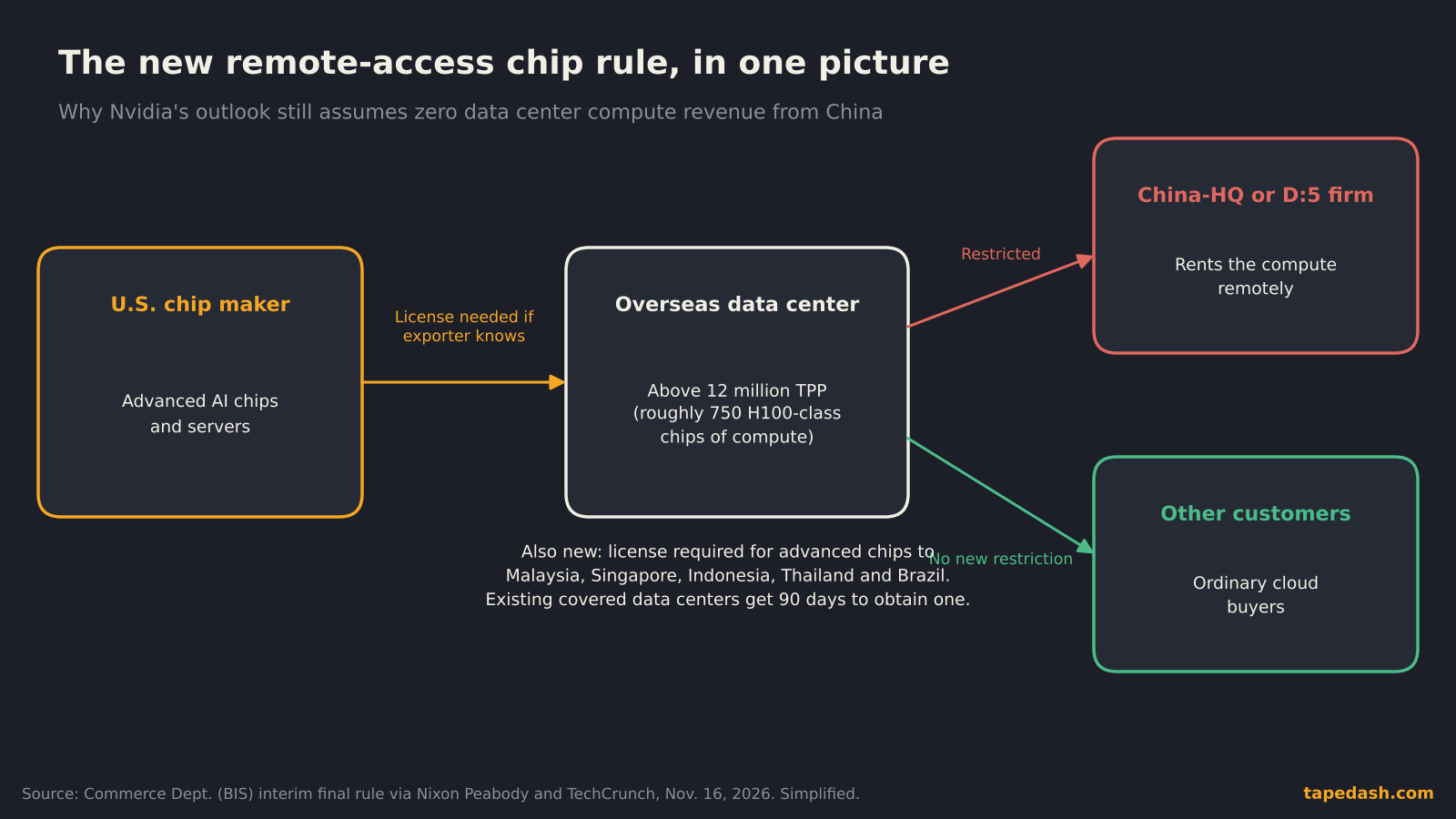
The policy backdrop shifted again on Monday. The Commerce Department’s Bureau of Industry and Security issued an interim final rule aimed at stopping companies in China and other restricted countries from renting advanced AI compute through overseas data centers (TechCrunch, Nixon Peabody).
How the rule works in plain English
Under the rule, a license is needed to export advanced AI chips and servers to a data center anywhere in the world when the exporter knows that facility provides more than 12 million units of total processing performance (TPP) to companies headquartered in China or other restricted countries. TechCrunch puts that threshold at roughly the compute of 750 H100 or H200 chips. Data centers already serving those customers get 90 days from the rule’s effective date to obtain a license (TechCrunch, Nixon Peabody).
The rule also adds license requirements for advanced chips headed to Malaysia, Singapore, Indonesia, Thailand and Brazil, with an exemption for U.S.-headquartered buyers, and it formally rescinds the January 2025 AI Diffusion Rule (TechCrunch, Nixon Peabody).
What it means for Nvidia’s numbers
Nvidia doesn’t break out sales by those five countries in its release, so there is no clean way to size the hit from the outside. The honest read is that it adds paperwork and delay to some Southeast Asian data center build-outs, and it gives customers there a reason to slow orders until licenses are in hand. Management said on the call that Nvidia will study the new controls (CBS News). If you hear about order timing shifting in that region over the next quarter, this rule is the first place to look.
Nvidia revenue growth by quarter: how we got here
It helps to step back and look at the run rate. A year ago, Nvidia’s quarterly revenue was $57.0 billion. It was $68.1 billion in the quarter ended January, $81.6 billion in the quarter ended April, $96.2 billion in the quarter ended July and $115.8 billion now (NVIDIA, Fortune, Techloy, Punjab Kesari).
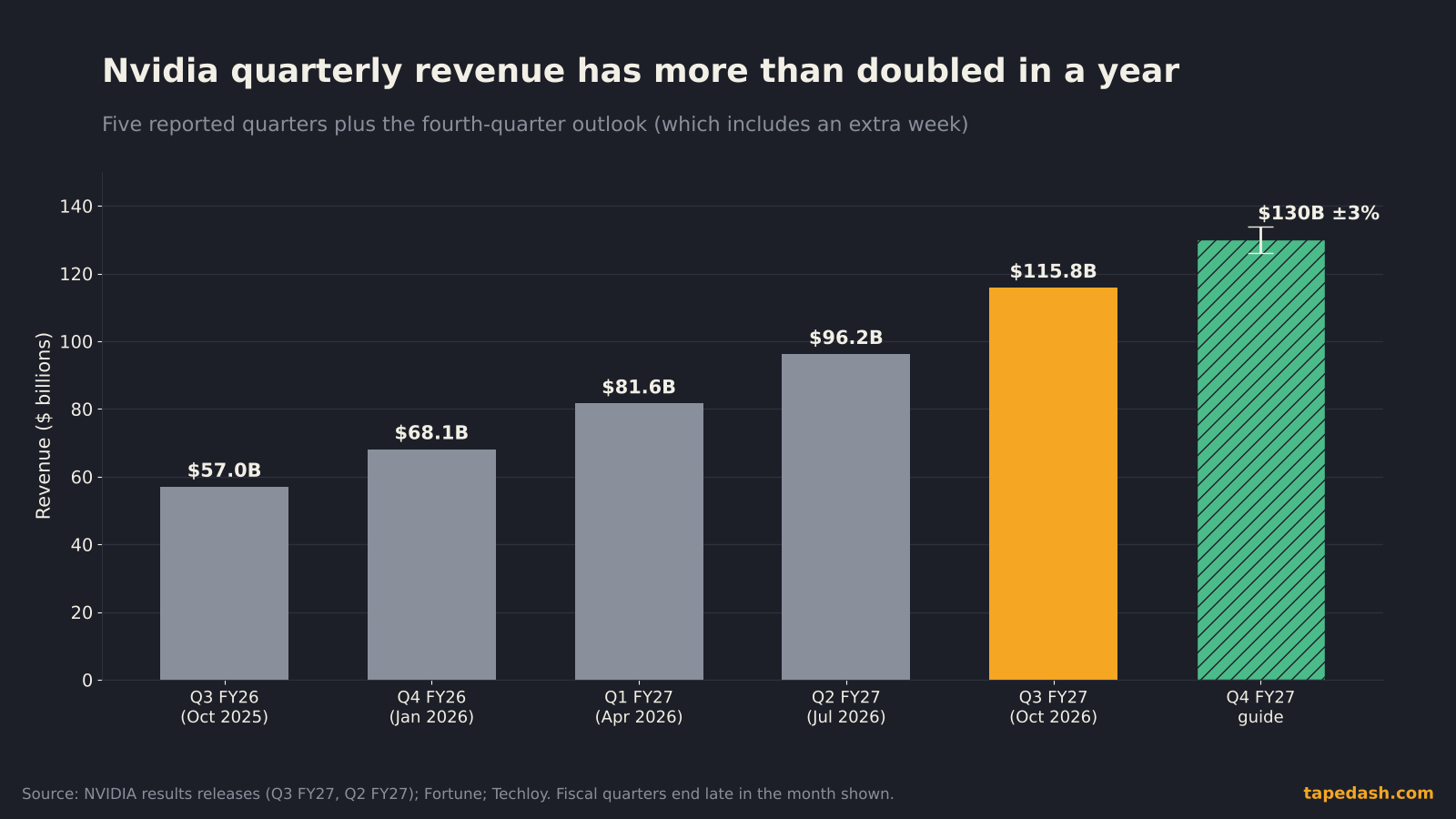
One detail matters for anyone comparing quarters: the fourth quarter of Nvidia’s fiscal 2027 includes an extra week (NVIDIA, Decrypt). That flatters the sequential growth rate a little. The $130 billion midpoint implies about 12% growth from the third quarter, and some of that is calendar, not demand.
Here is the same story in a table, with the margin line next to it:
| Quarter | Revenue | Data center revenue | GAAP gross margin |
|---|---|---|---|
| Q3 FY26 (ended Oct 2025) | $57.0B | not shown | 73.4% |
| Q2 FY27 (ended Jul 2026) | $96.2B | $89.0B | 75.0% |
| Q3 FY27 (ended Oct 2026) | $115.8B | $107.6B | 74.8% |
| Q4 FY27 guidance | $130.0B ± 3% | not guided | 71% to 72% |
Revenue is accelerating in dollar terms, margins have stopped rising, and the guide says they will dip. That combination is why the market is treating this as a strong quarter rather than a surprise.
How to read an Nvidia earnings reaction (and what not to do)
Most people look at the after-hours price and decide whether the report was good or bad. That price is thin, driven by a small slice of traders, and it often reverses by the next afternoon. Here is the process I use instead, and it works for any mega-cap report.
First, separate the print from the guide. The print tells you about the past three months. The guide, and especially the margin guide, tells you what the company expects to earn next. For Nvidia this time, the print was clean and the revenue guide was strong. The margin guide was the soft spot.
Second, compare the stock’s move to what the options market had priced. If the stock moves less than the implied move, sellers of volatility won and buyers lost, regardless of direction. That tells you the market was already leaning the right way. I go deeper on this in implied volatility and the expected move.
Third, watch the next regular session, not the after-hours tape. Look at whether the stock holds its gains after the first hour, whether volume is heavy, and what the options flow looks like. Big call buying in December and January expirations would say institutions are using the report to add. Heavy put buying, or calls being sold into strength, would say they are using it to reduce.
Fourth, check positioning. After a slide like the one Nvidia has had, dealers are often short gamma on the downside, which can make moves bigger in both directions. A stock that has sold off this hard can also bounce sharply on relief alone. Neither move tells you much about the business.
What to watch next for Nvidia stock
The stock closed Tuesday at $155.46, against a 52-week range of $148.80 to $243.37 (The Motley Fool, Decrypt). That puts it roughly 36% below the high. With that much damage already done, the next few weeks will be decided by how the market weighs the strong numbers against the open questions.
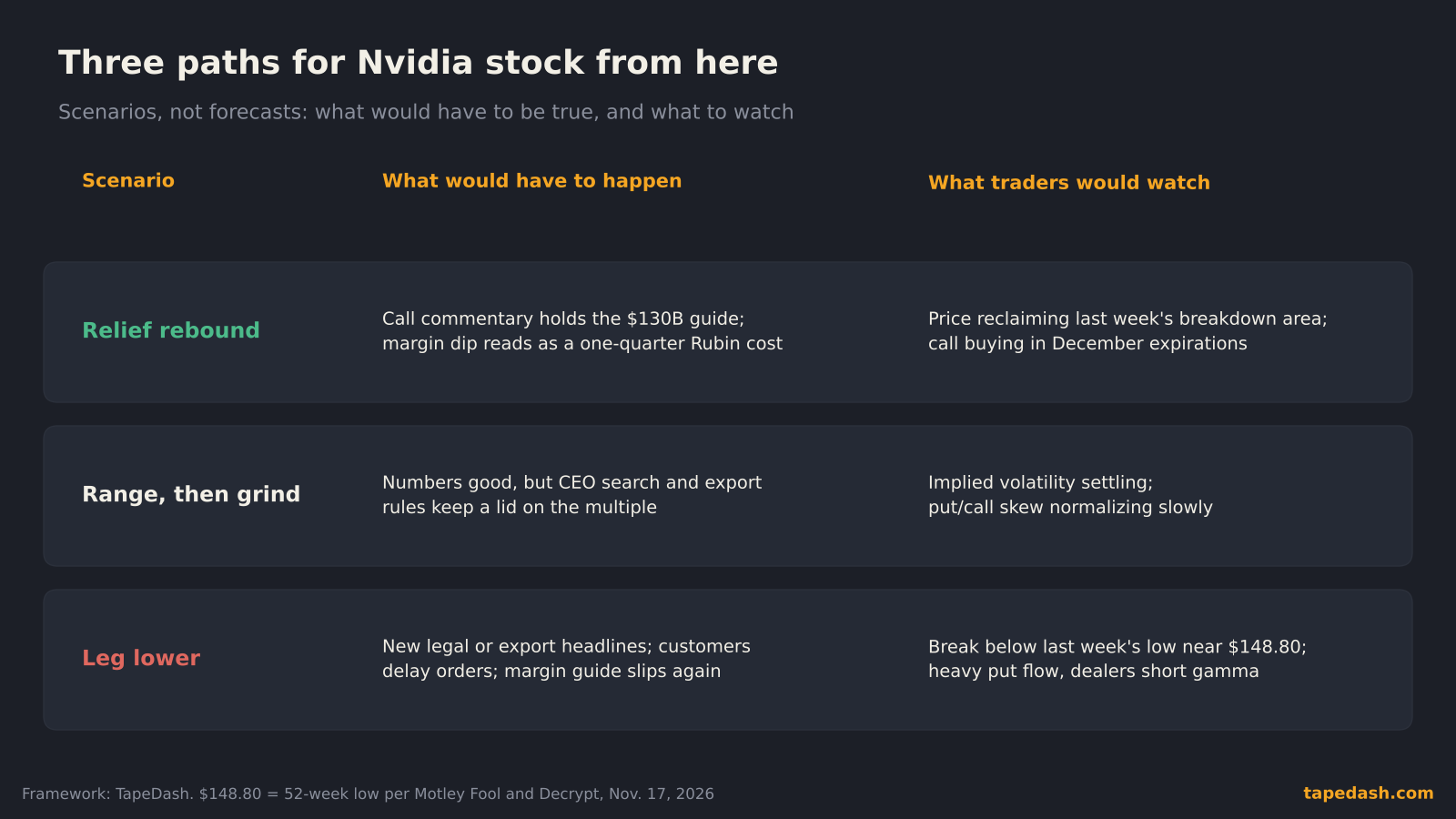
Here are the dates and events on my list:
- The call commentary, tonight and tomorrow. Listen for anything on Vera Rubin margins by quarter, customer concentration, and how management talks about fiscal 2028. In August, finance chief Colette Kress told investors to expect about 70% revenue growth in fiscal 2028 (CFO Dive, Investinglive). Any change to that number will move the stock more than tonight’s results.
- The export rule’s effective date. The 90-day licensing clock for existing data centers starts when the rule takes effect on Federal Register publication (Nixon Peabody, TechCrunch).
- December 2: dividend record date. Nvidia’s $0.25 dividend is payable December 23 to holders of record on December 2 (NVIDIA, Stock Titan). It is small. What matters more is the buyback: about $227.3 billion remains authorized.
- December 8 and 9: the Fed meeting. With long-term Treasury yields high and the next rate move still debated, the rate backdrop matters for every long-duration growth stock (Fed Rate Calc, Federal Reserve). I covered the yield move in 10-year Treasury yield hits 5% again.
- New detail from regulators. Any change to the export rule’s scope or timing is a stock-moving headline.
Frequently asked questions
Did Nvidia beat earnings in Q3 fiscal 2027?
Yes. Revenue was $115.8 billion against estimates of about $109.1 billion, and adjusted EPS was $2.68 against about $2.47. The fourth-quarter revenue guide of $130 billion, plus or minus 3%, also came in above what analysts expected.
Why did Nvidia stock only rise a little after earnings?
The beat was largely expected, options premium collapsed after the print, and the gross margin guide of 71% to 72% was lower than the 74.8% just reported. New export rules added a discount the numbers couldn’t remove.
Does Nvidia’s guidance include China?
No. The outlook assumes no data center compute revenue from China. Any approved China sales would be upside to the guide.
How to track this with TapeDash
If you want to watch whether the market buys this report or sells it, the first place I’d look is the options tape. Unusual Flow shows the large, aggressive NVDA trades as they hit, so you can see whether institutions are buying calls in December and January or loading puts into any bounce. Dealer Gamma shows where dealer hedging is likely to speed moves up or slow them down, which matters a lot for a stock that has fallen this far this fast.
For the business side, Earnings Call Summaries pulls out what management said about margins, supply and guidance, so you don’t need to sit through the full call to find the line that matters. You can see all of it together in the Terminal Preview, or get the free TapeDash Daily for a morning read on the flow and the macro calendar.
The one thing to remember
Nvidia’s business doubled its revenue in a year at a scale that has few precedents, and this quarter showed the demand is still there. The stock isn’t trading on that anymore. It is trading on margins and on where its chips are allowed to go. Watch those two, and the next move will make a lot more sense than tonight’s after-hours tape did.
See it on the tape, not just in the headlines
TapeDash is a market research and data analytics platform for traders and investors: live options flow, dealer positioning, a real-time market scanner, stock ratings, and macro and earnings data in one terminal. Memberships open Black Friday, November 27, and the first 200 members lock Pro at $69.99 a month on their account, even if they cancel and come back later.
Join the waitlistClick through the terminalSee the track recordSources
- NVIDIA: NVIDIA Announces Financial Results for Third Quarter Fiscal 2027 (Nov 17, 2026)
- Reuters via Investing.com: Nvidia earnings beat estimates; attention turns to call (Nov 17, 2026)
- CBS News: Nvidia records strong growth in first earnings report without Jensen Huang (Nov 17, 2026)
- Decrypt: Nvidia shares rise after earnings beat in first report since Jensen Huang's exit (Nov 17, 2026)
- TradingKey: Nvidia Q3 revenue surges 103%, next-quarter guidance reaches $130 billion (Nov 17, 2026)
- The Motley Fool: Stock market today, Nov. 17: Nvidia slides ahead of earnings (Nov 17, 2026)
- Yahoo Finance: Stock market today, Tuesday, November 17 (Nov 17, 2026)
- Stock Titan: Stock market today live, November 17, 2026 (Nov 17, 2026)
- TechCrunch: US tightens AI chip export controls to deter Chinese companies from accessing compute remotely (Nov 16, 2026)
- Nixon Peabody: BIS targets remote access to advanced chips through overseas data centers (Nov 16, 2026)
- NVIDIA: NVIDIA Announces Financial Results for Second Quarter Fiscal 2027 (Aug 2026)
- Punjab Kesari: NVIDIA reports record $81.6 billion first quarter revenue (May 2026)
- Fortune: Nvidia Q4 fiscal 2026 results (Feb 25, 2026)
- Techloy: Nvidia reports record $68.1 billion in Q4 revenue (Feb 2026)
- CFO Dive: Nvidia CFO predicts 70 percent revenue jump in fiscal 2028 (Aug 2026)
- Investinglive: Nvidia's stock does the limbo then the moonwalk on 2028 guidance (Aug 2026)
- Stock Titan: NVIDIA third quarter fiscal 2027 release (Nov 17, 2026)
- Il Sole 24 Ore: Nvidia revenue expected to reach $108 billion in the third quarter (Aug 2026)
- Fed Rate Calc: FOMC meeting schedule, December 2026
- Federal Reserve: December 2026 calendar
This article is for educational and informational purposes only. It is not financial, investment, medical or legal advice, and it is not a recommendation to buy or sell any security. Figures come from the sources listed and were checked on the date of publication; markets change quickly. Options trading involves substantial risk of loss.