AI Capex Explained: How Data Center Spending Reaches Chip Stocks
AI capex is the data center spending behind chip stocks. Follow hyperscaler guidance into GPUs, HBM, networking, power and foundries, and spot a slowdown.
AI capex is the money the largest cloud and internet companies spend on data centers: servers full of AI chips, the memory stacked on those chips, the switches and optics that connect them, and the power and cooling gear that keeps the whole building running. Every dollar of it eventually shows up as somebody’s revenue, and a large share of that somebody is the semiconductor industry. That is why chip stocks often move more on a hyperscaler’s capex line than on their own news.
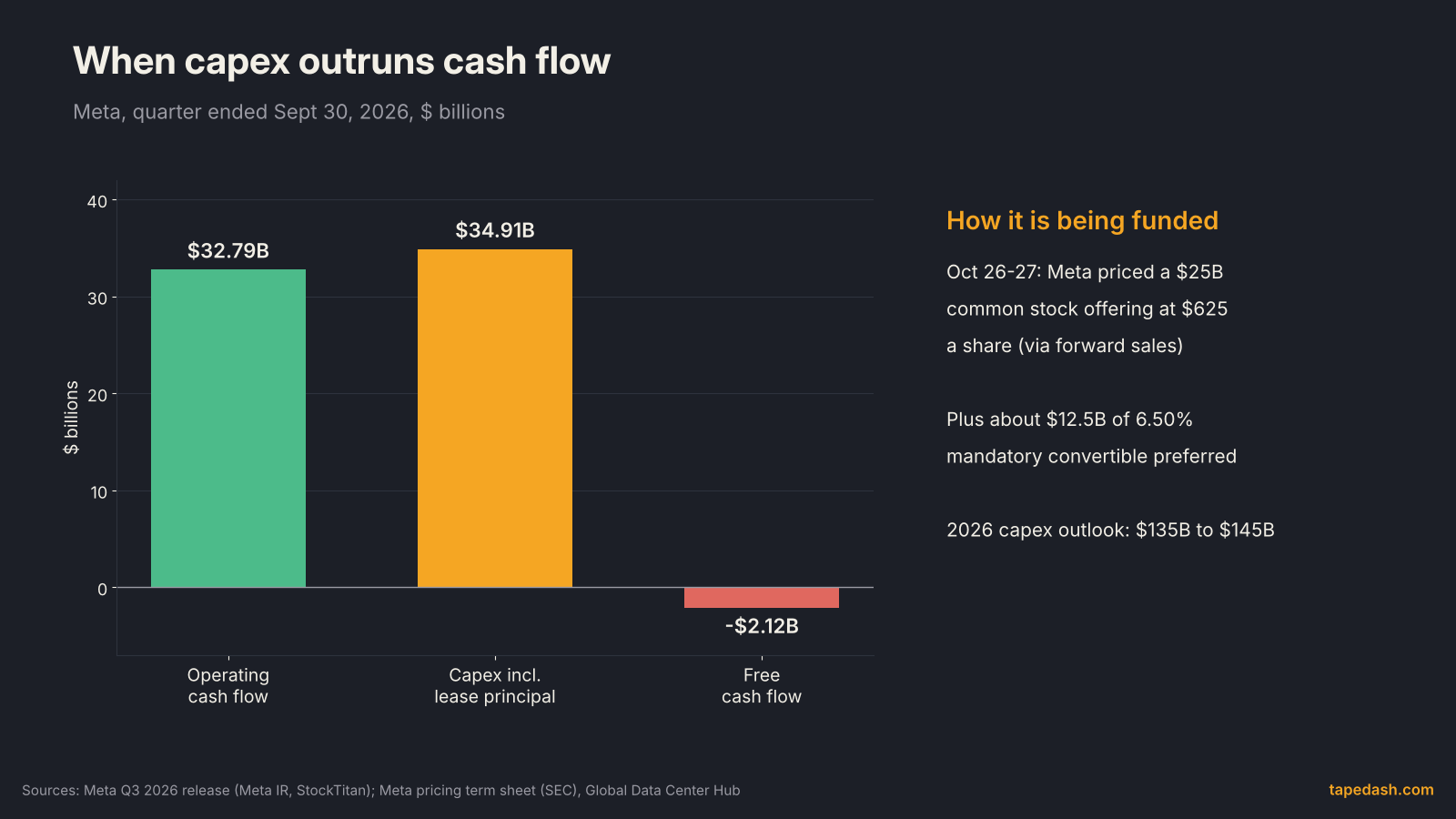
This week is a live example. Meta narrowed its 2026 capital spending outlook to $135 billion to $145 billion on October 21, then priced a $25 billion common stock offering plus about $12.5 billion of mandatory convertible preferred to help pay for it. Alphabet and Microsoft were scheduled to report after Wednesday’s close, with Amazon on Thursday. For anyone who owns NVIDIA, Micron, Broadcom or TSMC, the most important number in those reports is not on the supplier’s income statement. It is on the buyer’s cash flow statement.
Here is how the money moves, how to read capex guidance on an earnings call, what a real slowdown would look like, and which semiconductor stocks carry the most exposure.
- AI capex is hyperscaler spending on data centers. It reaches chip stocks through five channels: accelerators, memory (HBM), networking, power and cooling, and the foundry and packaging capacity underneath them.
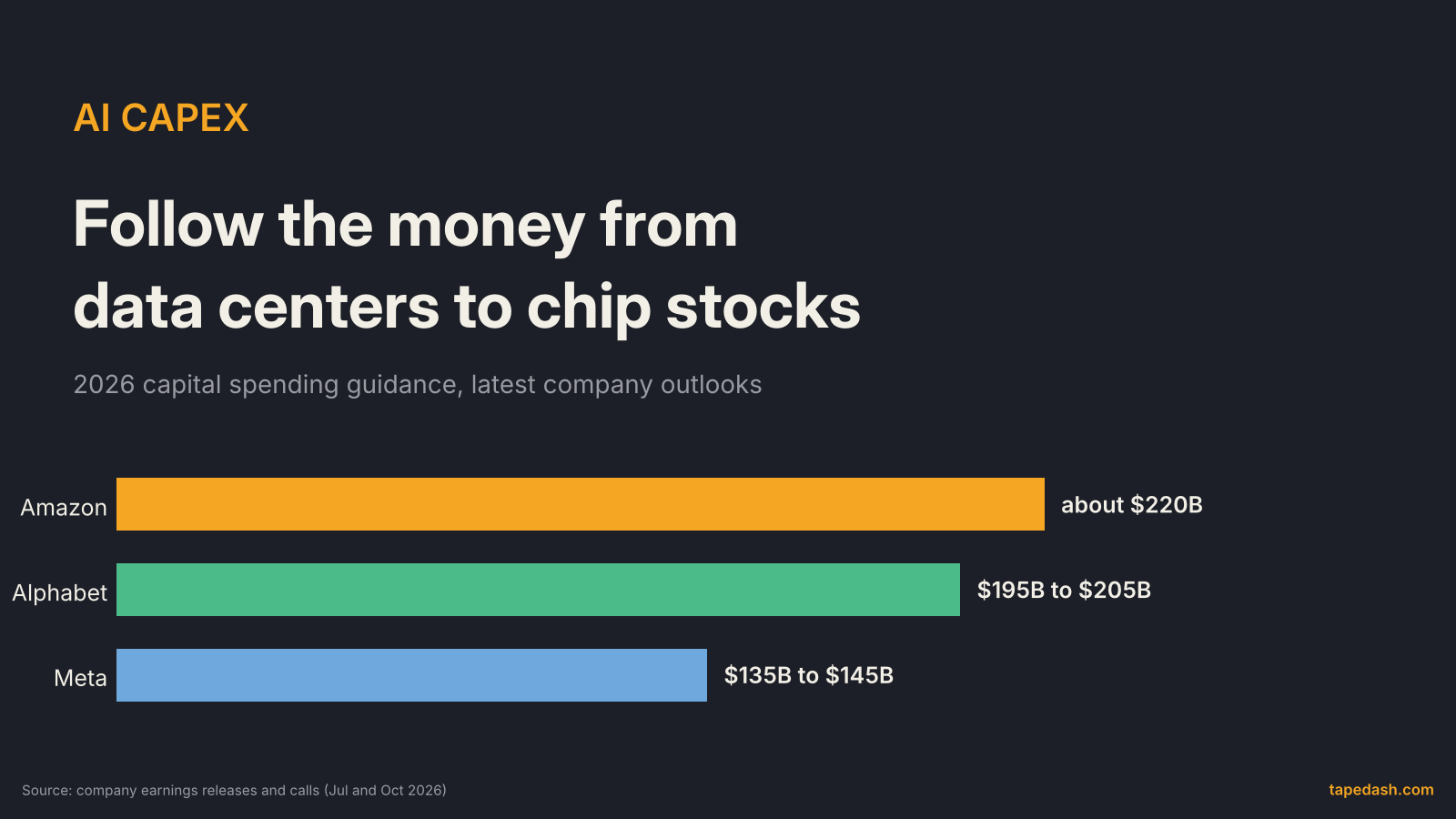
- The latest guidance still points up. Amazon raised 2026 cash capex to about $220 billion, Alphabet to $195 billion to $205 billion, and Meta narrowed to $135 billion to $145 billion. Microsoft guided its September quarter above $50 billion.
- Read the definition and the reason behind the number. Amazon said part of its raise came from higher memory prices, which is a price effect, not more servers.
- A slowdown usually shows up in language first: next-year capex described as flat, a mix shift away from chips, supplier guidance cuts, and financing strain.
- Exposure is not equal. Companies whose revenue is concentrated in data center sales have the most to gain and the most to lose when capex guidance changes.
What is AI capex, and why do semiconductor stocks trade on it?
Capital expenditures are spending on long-lived assets that get depreciated over time instead of expensed right away. For a hyperscaler, that means land, buildings, power infrastructure, and the servers and networking equipment that fill them. “AI capex” is the shorthand Wall Street uses for the part of that budget aimed at training and running AI models, which today is most of the growth.
Chip stocks trade on it for a simple reason: the hyperscalers are their biggest customers, and capex guidance is the closest thing to a purchase order the market gets to see. When Alphabet raises its full-year capex range by $15 billion, that money has to be spent somewhere, and a large part of it lands with accelerator makers, memory makers and the foundry that builds both. The supplier will not report that revenue for one or two quarters. The stock tends to price it the same evening.
The relationship runs both ways. In mid-October, chip stocks went through a long losing streak as investors worried about AI spending, rising rate expectations and memory competition, according to Stocktwits. Nothing in the suppliers’ own guidance had turned down. The market was pricing the risk that the buyers would.
The latest hyperscaler capex guidance, company by company
Here is where each of the four biggest spenders stood going into this week’s reports. One warning before the numbers: each company defines capex a little differently, so treat comparisons across companies as rough.
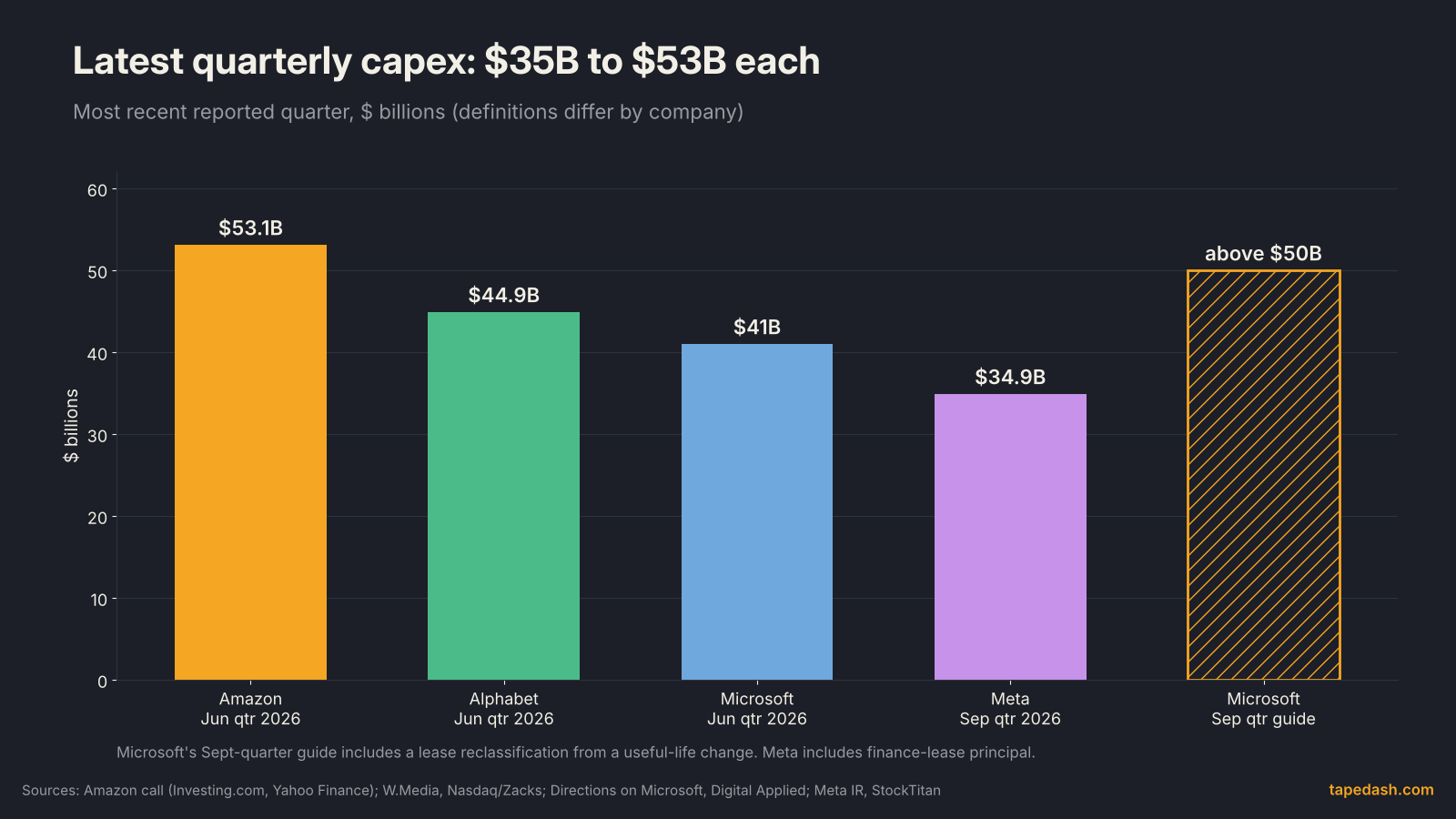
Amazon. On its July 30 call, Amazon said it now expects about $220 billion in 2026 cash capex, up from a prior estimate of about $200 billion. CEO Andy Jassy tied the increase to the higher cost of memory, per the call transcript and Yahoo Finance. June-quarter cash capex was $53.1 billion, and AWS revenue grew 36.7% to $42.2 billion.
Alphabet. On July 22, Alphabet raised its 2026 range to $195 billion to $205 billion from $180 billion to $190 billion, W.Media and Nasdaq reported. June-quarter capex was $44.9 billion. Google Cloud revenue reached $24.8 billion and its backlog rose to $514 billion. Management also said 2027 capex will increase significantly, according to the Motley Fool.
Microsoft. Microsoft’s fiscal year runs July to June, so it does not give a calendar 2026 number. It spent $41 billion in the June quarter, with roughly two-thirds going to short-lived assets such as CPUs and GPUs, and guided the September quarter above $50 billion, according to Directions on Microsoft and Digital Applied. That guide includes a lease reclassification from a change in the useful lives of data centers, so part of the jump is accounting. Management said fiscal 2027 capex will grow and that demand still exceeds supply.
Meta. Meta reported on October 21. September-quarter capex, including principal payments on finance leases, was $34.91 billion, and the 2026 range was narrowed to $135 billion to $145 billion from $130 billion to $145 billion, per Meta and StockTitan. On 2027, Meta said it is still building its budget but expects to keep investing aggressively.
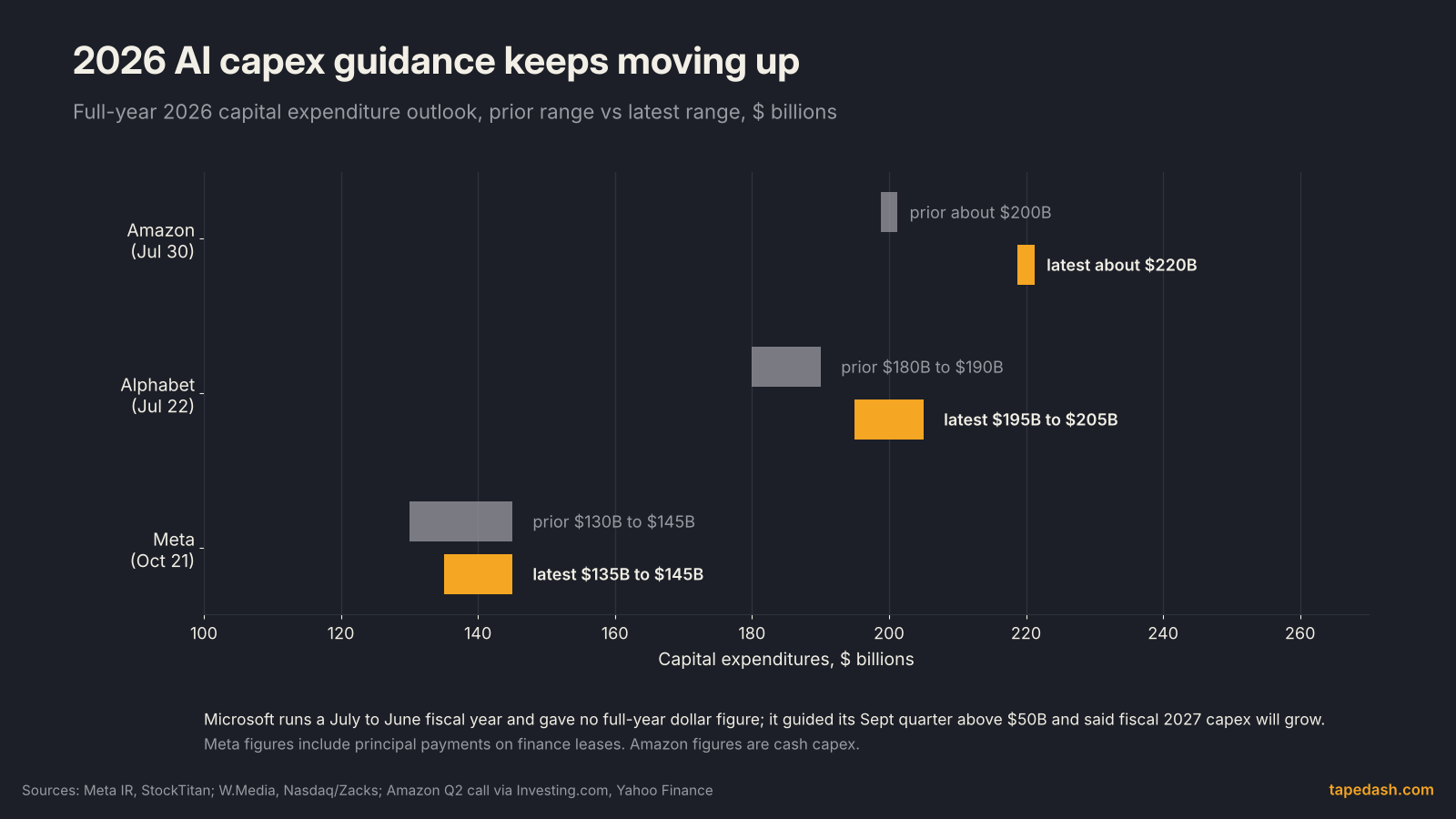
Add the three calendar-year guides together and Amazon, Alphabet and Meta alone point to roughly $550 billion to $570 billion of 2026 capex, before Microsoft. The quarterly view shows how steep the run rate is.
Follow the money: how AI capex reaches semiconductor stocks
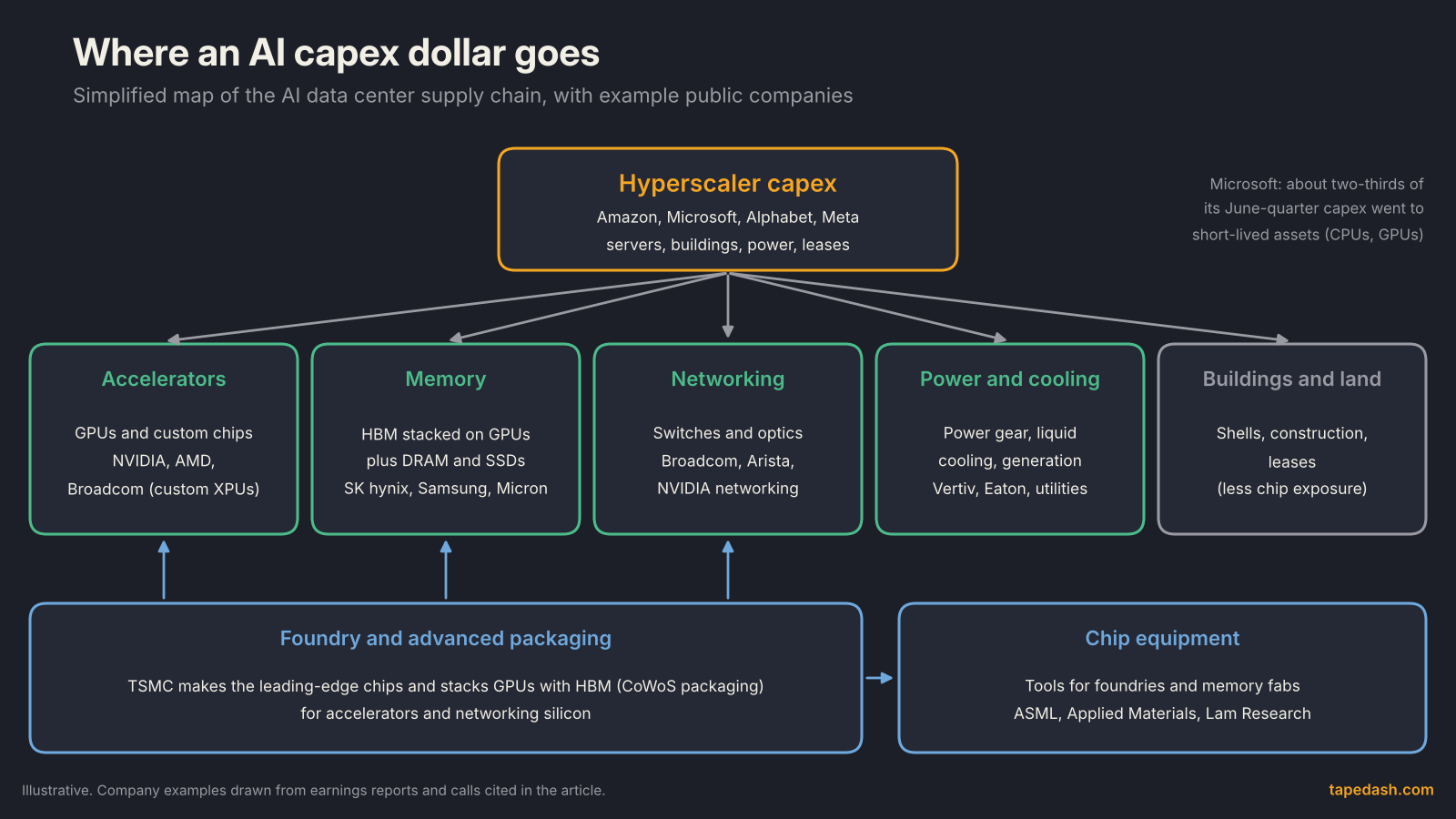
A hyperscaler does not write one check to “AI.” The budget splits into several buckets, and each one has its own set of public suppliers with different economics.
Accelerators: GPUs and custom chips
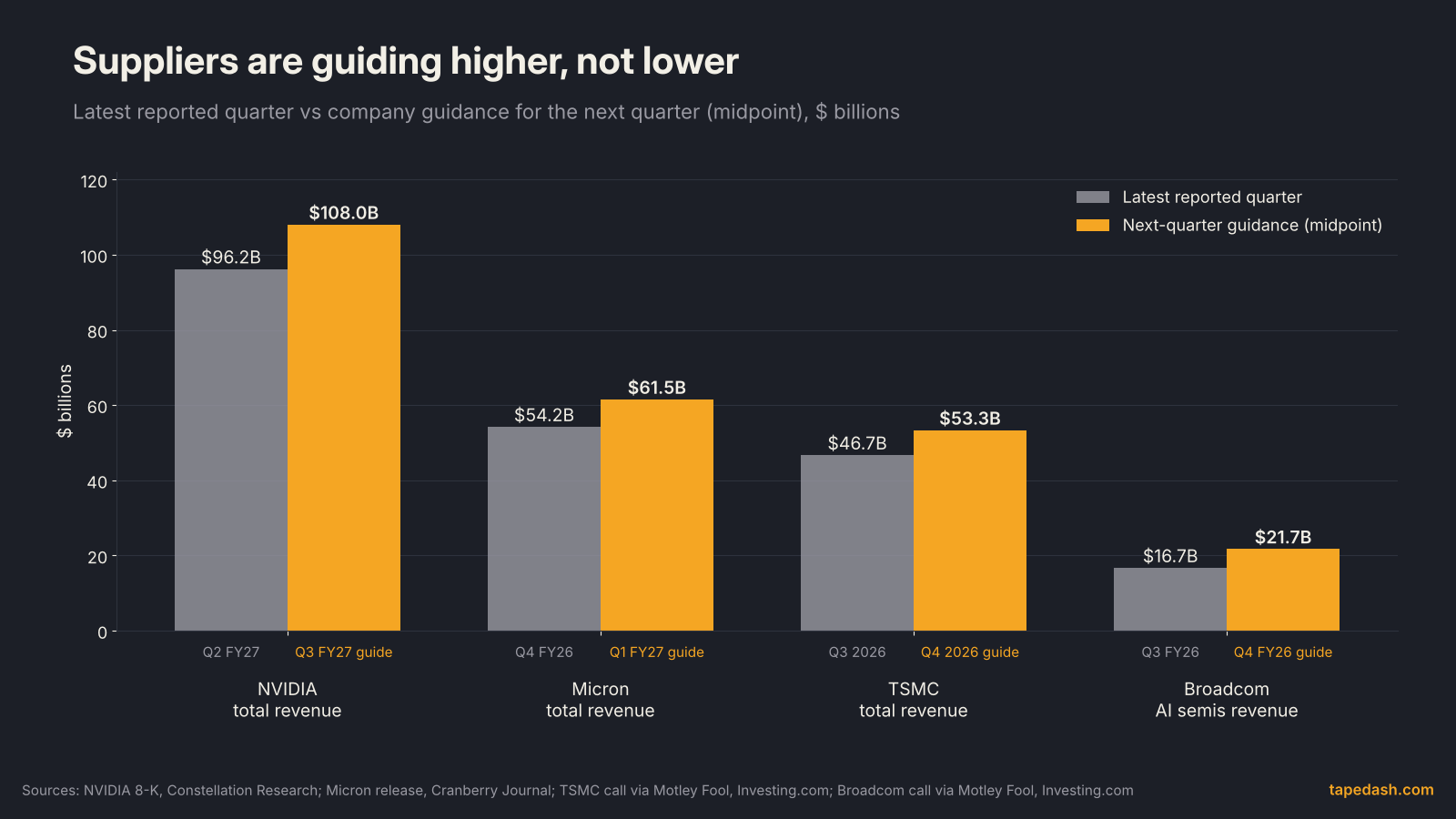
The biggest single slice goes to the processors that run AI workloads. NVIDIA’s GPUs dominate here, AMD competes with its own accelerators, and Broadcom designs custom chips (it calls them XPUs) for hyperscalers that want their own silicon. NVIDIA reported fiscal second-quarter revenue of $96.2 billion, of which $89.0 billion came from data center, and guided the next quarter to $108.0 billion, plus or minus 2%, per its filing and Constellation Research. At Broadcom, custom XPUs made up 73% of AI revenue last quarter.
Memory: HBM and the price of DRAM
Every modern AI accelerator sits next to stacks of high-bandwidth memory (HBM), and those stacks are expensive and hard to make. Three companies supply most of it: SK hynix, Samsung and Micron. Micron’s fiscal fourth quarter shows what a capex boom does to a memory maker: revenue of $54.23 billion, a non-GAAP gross margin of 87.0%, and guidance of $61.5 billion for the next quarter, per Micron’s release and Cranberry Journal. Micron also said it has agreements for the vast majority of its calendar 2027 HBM supply at significantly higher prices, per the call transcript.
This is the channel where capex and pricing feed each other. Amazon raised its capex budget partly because memory costs more. That raise is revenue for memory makers, and it is also a reminder that some capex growth is inflation in component prices rather than more units.
Networking: switches and optics
Thousands of accelerators only act like one computer if they can talk to each other fast. That makes networking a direct beneficiary. Broadcom reported AI semiconductor revenue of $16.7 billion last quarter, said AI networking revenue grew more than 2.5 times from a year earlier, and guided AI revenue to $21.7 billion for its fiscal fourth quarter, per transcripts from the Motley Fool and Investing.com. Arista and NVIDIA’s own networking business compete for the same budget.
Power and cooling
AI racks draw far more power and produce far more heat than ordinary servers, so electrical and thermal equipment is now a meaningful line in every data center budget. Vertiv, which makes both, reported this morning: September-quarter net sales of $4.31 billion, up 61%, organic orders more than double a year earlier, and full-year sales guidance raised by $650 million to a $14.65 billion midpoint, per its release and the call transcript. Orders matter more than sales here, because they show what customers are committing to 12 to 18 months out.
Foundry and advanced packaging
Underneath the accelerators and networking chips sits TSMC, which manufactures most leading-edge AI silicon and packages GPUs together with HBM. TSMC reported September-quarter revenue of $46.7 billion, with high-performance computing at 68% of the total, and guided the December quarter to $52.3 billion to $54.3 billion. It kept its 2026 capital budget at $60 billion to $64 billion and said 2026 to 2028 capex will be significantly higher than the prior three years, per transcripts from the Motley Fool and Investing.com. TSMC’s own capex then becomes revenue for the chip equipment makers one step further up the chain.
Here is the whole chain in one table.
| Layer | What the capex buys | Example public companies | Latest data point | Early warning sign |
|---|---|---|---|---|
| Accelerators | GPUs, custom AI chips | NVIDIA, AMD, Broadcom | NVIDIA guided $108.0B next quarter | Next-quarter guide below the prior quarter |
| Memory | HBM, DRAM, SSDs | SK hynix, Samsung, Micron | Micron guided $61.5B; most 2027 HBM contracted | Contract prices flatten or fall |
| Networking | Switches, optics | Broadcom, Arista | Broadcom AI networking up over 2.5x | Networking growth slows faster than compute |
| Power and cooling | Power gear, liquid cooling | Vertiv, Eaton | Vertiv organic orders more than doubled | Orders slow while sales still rise |
| Foundry and packaging | Leading-edge wafers, CoWoS | TSMC | 2026 capex $60B to $64B; HPC 68% of revenue | Capex budget cut or HPC share stalls |
How to read capex guidance on an earnings call
This is the part that pays off every quarter. When a hyperscaler reports, I read the capex section in the same order every time, and it takes about five minutes. If you want the broader routine for the rest of the report, our guide to reading an earnings report like a trader covers it.
1. Get the definition right. Cash capex, capex including finance leases, and “total investment” are different numbers. Meta includes principal on finance leases. Microsoft’s September-quarter guide includes a lease reclassification. A company can show a bigger number without buying more equipment, so compare each company only to its own history.
2. Note the direction and the reason for any revision. A raise driven by demand (“we are capacity constrained”) is a different signal from a raise driven by component prices. Amazon told you plainly that memory costs pushed its number up. For memory makers that is good news. For accelerator makers it is neutral, because the same dollars buy the same number of GPUs.
3. Listen for the mix. Short-lived assets (chips and servers) flow straight to semiconductor revenue. Long-lived assets (buildings, land, power hookups) flow to construction and electrical suppliers first and to chips later. Microsoft’s two-thirds short-lived split is the kind of detail that tells you how much of a capex dollar reaches chip stocks this year.
4. Find the next-year language. Analysts care more about next year than this year, because this year’s spending is mostly already ordered. Phrases like “increase significantly” (Alphabet on 2027) and “continue investing aggressively” (Meta) are the ones the chip sector trades on. “Moderate,” “disciplined,” or “flat” would be the opposite.
5. Check the demand evidence. Capex is only sustainable if revenue follows. Look at cloud growth and backlog: AWS growing 36.7%, Google Cloud’s backlog at $514 billion, and Microsoft saying demand still exceeds supply are the numbers that justify the spending.
6. Check how it is funded. This is the newest line on the checklist. Meta’s operating cash flow was $32.79 billion last quarter against $34.91 billion of capex including lease principal, leaving free cash flow at negative $2.12 billion, per Meta. Alphabet’s June-quarter free cash flow was also negative. When the spending outruns internal cash, the company has to borrow or sell stock, and the market starts asking about returns more loudly.
What would signal an AI capex slowdown
No single data point will tell you the cycle has turned. A real slowdown would show up as several of these at once, roughly in this order.
Softer next-year language. The first tell is usually a CFO describing next year’s capex as growing “at a slower rate” or “roughly in line,” rather than cutting outright. Chip stocks tend to react to the second derivative: slower growth in spending, not a decline.
A mix shift away from chips. If more of the budget goes to land and buildings for capacity that comes online years from now, near-term chip revenue gets less of each dollar.
Supplier guidance turning. When an accelerator or memory supplier guides its next quarter flat or down, that is the buyers’ plans showing up in actual orders. Watch for shorter lead times, easier availability and talk of customers “digesting” capacity.
Memory pricing rolling over. Memory is the most cyclical link. Micron said it has no line of sight to when DRAM supply and demand return to balance. When that sentence changes, memory stocks will likely move before anything else in the group.
Financing strain. Negative free cash flow, equity issuance and heavy borrowing are tolerable while cloud revenue grows fast. If cloud growth slows while funding needs keep rising, investors will push management to trim, and the trim lands on suppliers.
Revenue not keeping up. The cleanest long-run check is whether cloud and AI revenue growth keeps pace with depreciation from all this new equipment. That gap takes years to show, which is why the market tries to front-run it, as it did in mid-October.
Which semiconductor stocks are most exposed to AI capex
Exposure comes down to two things: how much of a company’s revenue comes from data center buyers, and how much its margins swing when volume or prices change.
Most exposed: accelerators and custom silicon. NVIDIA’s data center segment was $89.0 billion of $96.2 billion in revenue last quarter. Broadcom’s AI semiconductors were $16.7 billion of $29.6 billion. When nearly all the growth comes from a handful of hyperscaler customers, their capex guidance is close to your own guidance.
Most cyclical: memory. Memory makers carry two kinds of exposure at once, volume and price. That produced Micron’s 87% gross margin in a tight market. The same lever works in reverse when supply catches up, which is why memory stocks have historically had the largest swings in both directions.
High exposure, longer lag: power, cooling and networking. Vertiv’s orders show commitments 12 to 18 months ahead, so its stock trades on orders more than on sales. Networking spending scales with cluster size, so it rises and falls with the number and size of new AI clusters.
Diversified but still tied in: foundry and equipment. TSMC gets 68% of revenue from high-performance computing, but also sells into smartphones, cars and other devices. Equipment makers are furthest upstream. They depend on foundry and memory capex, which follows hyperscaler capex with a lag, so they tend to react later in both directions.
From an options seat, this exposure ranking matters around hyperscaler earnings. A capex surprise at Alphabet or Microsoft can move NVIDIA, Micron and Broadcom in after-hours trading as much as their own reports would. Before those prints, I check each supplier’s implied move to see whether the options market is pricing that sympathy risk or ignoring it.
What to watch next on AI capex
- Wednesday, October 28, after the close: Alphabet and Microsoft report, per Pepperstone, OANDA and Finviz. For Alphabet, watch for a change to the $195 billion to $205 billion range and any number on 2027. For Microsoft, compare actual September-quarter capex with the above-$50 billion guide.
- Thursday, October 29: Amazon reports, with its call at 5:00 PM ET, per Amazon. Listen for whether the roughly $220 billion figure moves, and how much of any change is memory pricing versus capacity.
- Late November: NVIDIA’s fiscal third-quarter report, measured against its $108.0 billion guide and, more importantly, its outlook for the quarter after.
- Wednesday, December 9, after the close: Broadcom’s fiscal fourth-quarter report, against its $21.7 billion AI revenue guide, per transcripts from the Motley Fool and Investing.com.
How to track AI capex moves in TapeDash
If you want to see how the market is pricing these reports in real time, this is what we watch. On hyperscaler earnings nights, the Live Scanner flags the sudden moves, gaps and unusual options flow that tend to hit chip stocks within minutes of a capex number. That is where you see whether Micron, Broadcom or Vertiv reacts more than the reporting company itself.
For the positioning side, Large Prints keeps the session’s biggest options trades in one place, and Flow Edge shows whether flow in a name has been building in one direction over several days. Leaning on both, you can tell the difference between a single call buyer and a sector-wide repositioning ahead of a report. Our guide on how to read options flow explains how to separate real bets from hedges. You can try all of it in the free Terminal Preview without an account, and the first 200 members lock Pro at $99 a month for as long as they stay.
AI capex FAQ
What does capex mean for tech companies?
Capex, short for capital expenditures, is spending on long-lived assets such as data centers, servers and network equipment. It sits on the cash flow statement and is depreciated over several years. For the largest cloud companies, most of the growth in capex is now tied to AI infrastructure.
Why do chip stocks move when Microsoft, Alphabet, Amazon or Meta report?
Those four are among the largest buyers of AI chips, memory and networking gear. Their capex guidance is an early read on future supplier revenue, so investors reprice suppliers on the hyperscaler’s numbers before the suppliers report.
Is AI capex slowing down?
Not on the latest company guidance. Amazon, Alphabet and Meta have all raised or narrowed upward their 2026 ranges, Microsoft said fiscal 2027 capex will grow, and the main suppliers guided their next quarters higher. The risks to watch are financing strain, memory pricing and softer next-year language.
The one idea to keep
AI capex is a chain, not a number. The guidance comes from four buyers, the dollars split across accelerators, memory, networking, power and foundry, and each link reacts on a different timetable. Read the definition, the reason for any revision, and the next-year language, and you will usually know what the chip sector is about to price before the suppliers report a single dollar of it.
See it on the tape, not just in the headlines
TapeDash is the research desk for traders and investors: live options flow, dealer positioning, a real-time market scanner and trade alerts graded in public. Memberships open January 1, 2027, and the first 200 members lock Pro at $99 a month for as long as they stay.
Join the waitlistClick through the terminalSee the track recordSources
- Meta: Meta Reports Third Quarter 2026 Results
- StockTitan: Meta Q3 2026 earnings release
- SEC: Meta Platforms pricing term sheet (Form FWP), October 26, 2026
- Global Data Center Hub: Meta Q3 2026 earnings, capex and equity raise
- W.Media: AI infrastructure demand pushes Alphabet's 2026 capex guidance to US$205 billion
- Nasdaq (Zacks): Alphabet-heavy ETFs as capex woes offset cloud strength
- Motley Fool: Alphabet will spend as much as $205 billion this year
- Investing.com: Amazon Q2 2026 earnings call transcript
- Yahoo Finance: Amazon raised its 2026 capex guide to $220 billion
- Directions on Microsoft: Expect capacity constraints, capex acceleration to continue
- Digital Applied: Microsoft FY26 Q4 earnings
- NVIDIA: Q2 fiscal 2027 results (Form 8-K exhibit)
- Constellation Research: Nvidia Q2 surge and outlook
- Micron: Record fiscal fourth-quarter and full-year 2026 results (Nasdaq)
- Cranberry Journal: Micron fiscal Q4 2026 results
- Investing.com: Micron Q4 2026 earnings call transcript
- Motley Fool: TSMC Q3 2026 earnings call transcript
- Investing.com: TSMC Q3 2026 earnings call transcript
- Motley Fool: Broadcom Q3 2026 earnings call transcript
- Investing.com: Broadcom Q3 2026 earnings call transcript
- StockTitan: Vertiv third quarter 2026 results
- Investing.com: Vertiv Q3 2026 earnings call transcript
- Pepperstone: Alphabet Q3 2026 earnings preview
- OANDA: Alphabet Q3 earnings preview
- Finviz: Microsoft announces quarterly earnings release date
- Amazon: Q3 2026 earnings date announcement
- Stocktwits: Chip stocks' losing streak in October 2026
This article is for educational and informational purposes only. It is not financial, investment, medical or legal advice, and it is not a recommendation to buy or sell any security. Figures come from the sources listed and were checked on the date of publication; markets change quickly. Options trading involves substantial risk of loss.