Intel Stock's Worst Day Since 1974: The PC Memory Squeeze Explained
Intel stock fell about 28.6% after a weak fourth-quarter outlook. How AI's demand for memory is squeezing PCs, and what to watch from AMD and Qualcomm next.
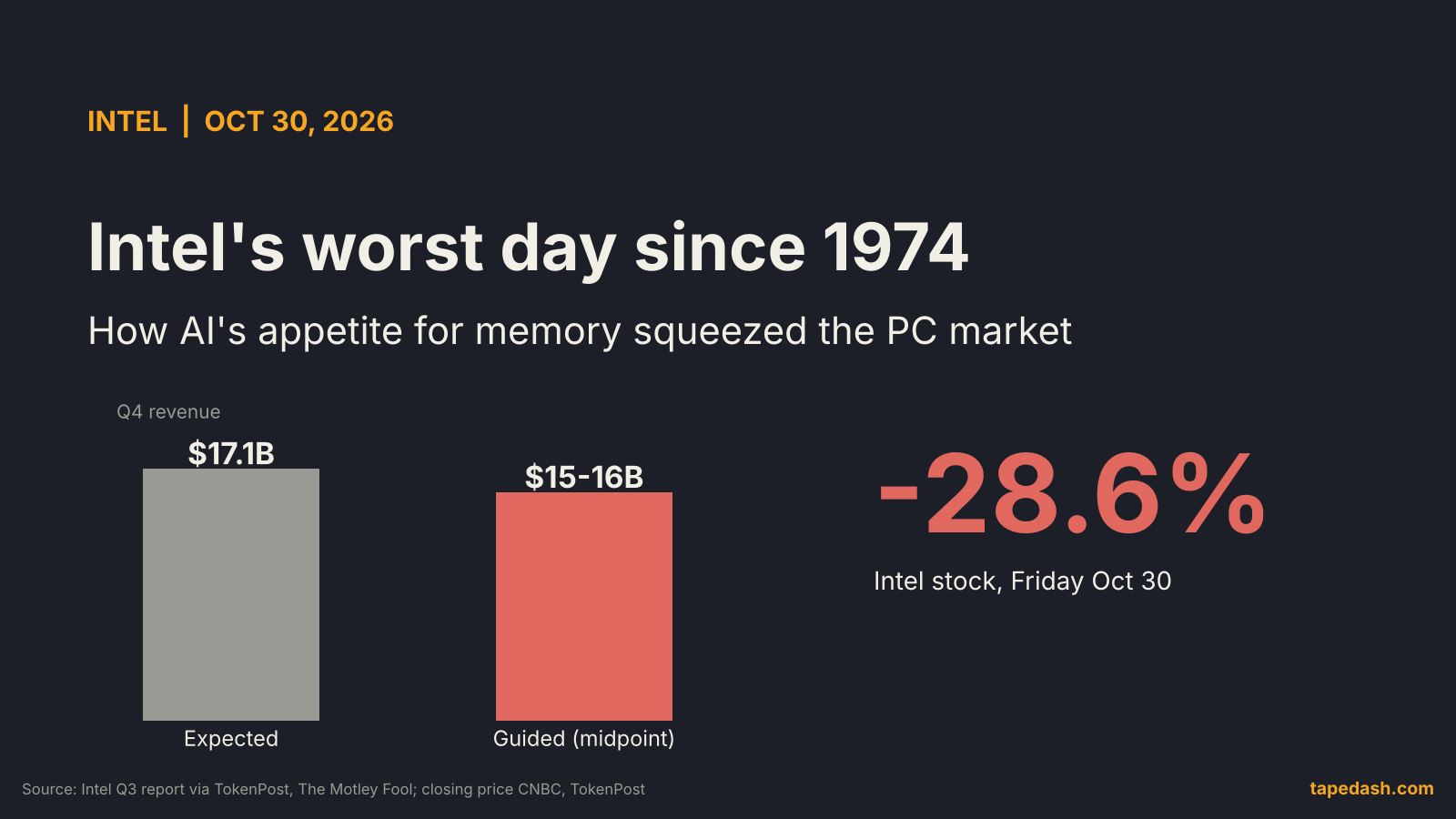
Intel stock fell about 28.6% on Friday, closing at $65.76, after the company forecast fourth-quarter revenue of $15 billion to $16 billion. Wall Street had expected about $17.1 billion. Yahoo Finance and FX Leaders both put it as Intel’s worst single day since 1974.
The odd part is that the quarter Intel had just finished was good. Revenue grew 21% to $16.5 billion and adjusted earnings beat estimates. The stock fell because of what comes next, and the reason behind the weak outlook is one of the stranger stories in tech right now: the AI boom is starving the PC market of memory.
This piece explains how that squeeze works, why Intel is the company most exposed to it, which companies are on the other side of the trade, and the specific reports next week that will show whether Friday’s selloff in chip stocks went too far.
- Intel guided fourth-quarter revenue to $15 billion to $16 billion against roughly $17.1 billion expected, and adjusted EPS to $0.25 against $0.43. The stock fell about 28.6%.
- The quarter itself was strong: revenue $16.5 billion, up 21%, with data center and AI revenue up 78% to $7.3 billion.
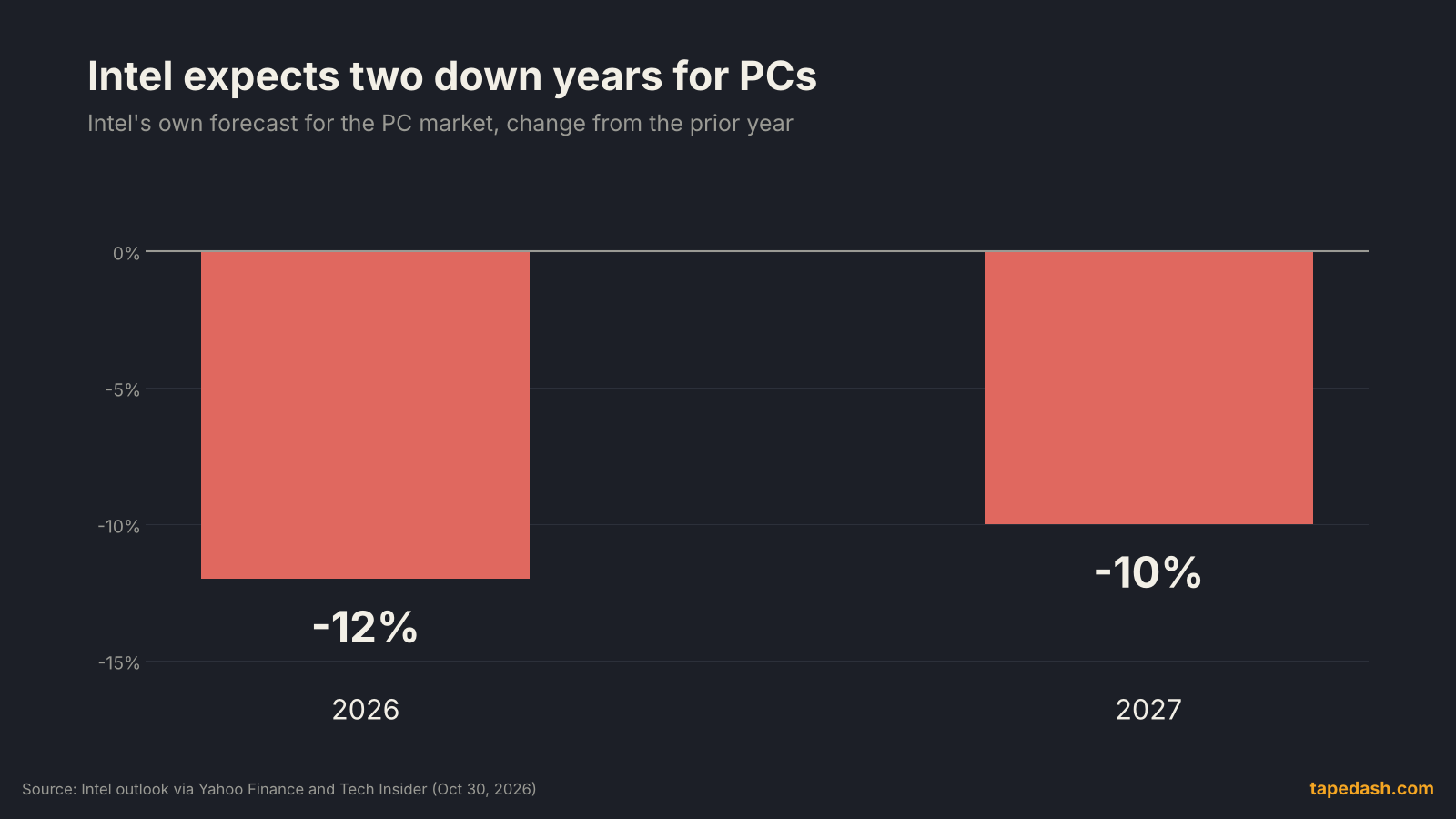
- The problem is PCs. Client computing revenue fell 5% to $8.1 billion, and Intel now expects the PC market to shrink about 12% in 2026 and 10% in 2027.
- The cause is memory. AI data centers are absorbing memory supply, ordinary PC memory is getting scarce and expensive, and PC makers are building fewer machines.
- Next tests: AMD on Tuesday and Qualcomm on Wednesday, both after the close.
Why Intel stock crashed: the fourth-quarter outlook
Start with the numbers that moved the stock. Intel told investors to expect fourth-quarter revenue between $15 billion and $16 billion. The consensus estimate was about $17.1 billion, according to The Motley Fool and TokenPost. Even the top of Intel’s range fell more than $1 billion short. On profit, the gap was wider in percentage terms: $0.25 of adjusted earnings per share against $0.43 expected.
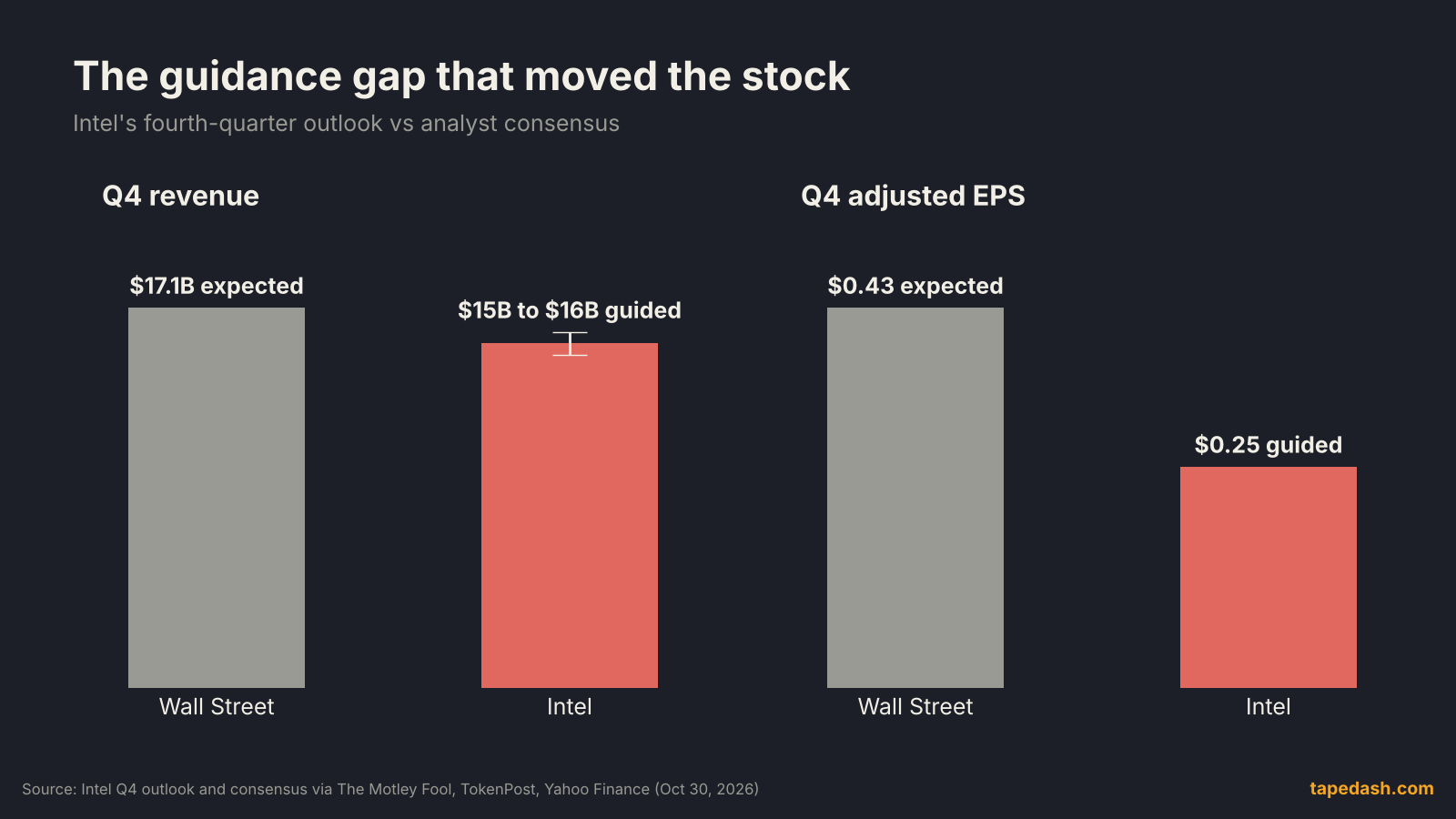
A guidance miss that size does two things at once. It cuts the next quarter’s numbers, and it makes analysts question every estimate after that, because it suggests the business is turning faster than anyone modeled. Bernstein’s Stacy Rasgon summed up the outlook in one word, quoted by Yahoo Finance: “terrible.”
The price action tells you how surprised the market was, and the selling did not stay with Intel. AMD fell about 11%, Broadcom 5.5% and Nvidia 4.2%, and the tech sector ETF (XLK) lost 4.9%.
Two Intels in one quarter
To understand why a strong quarter produced a crash, split Intel into its two biggest businesses.
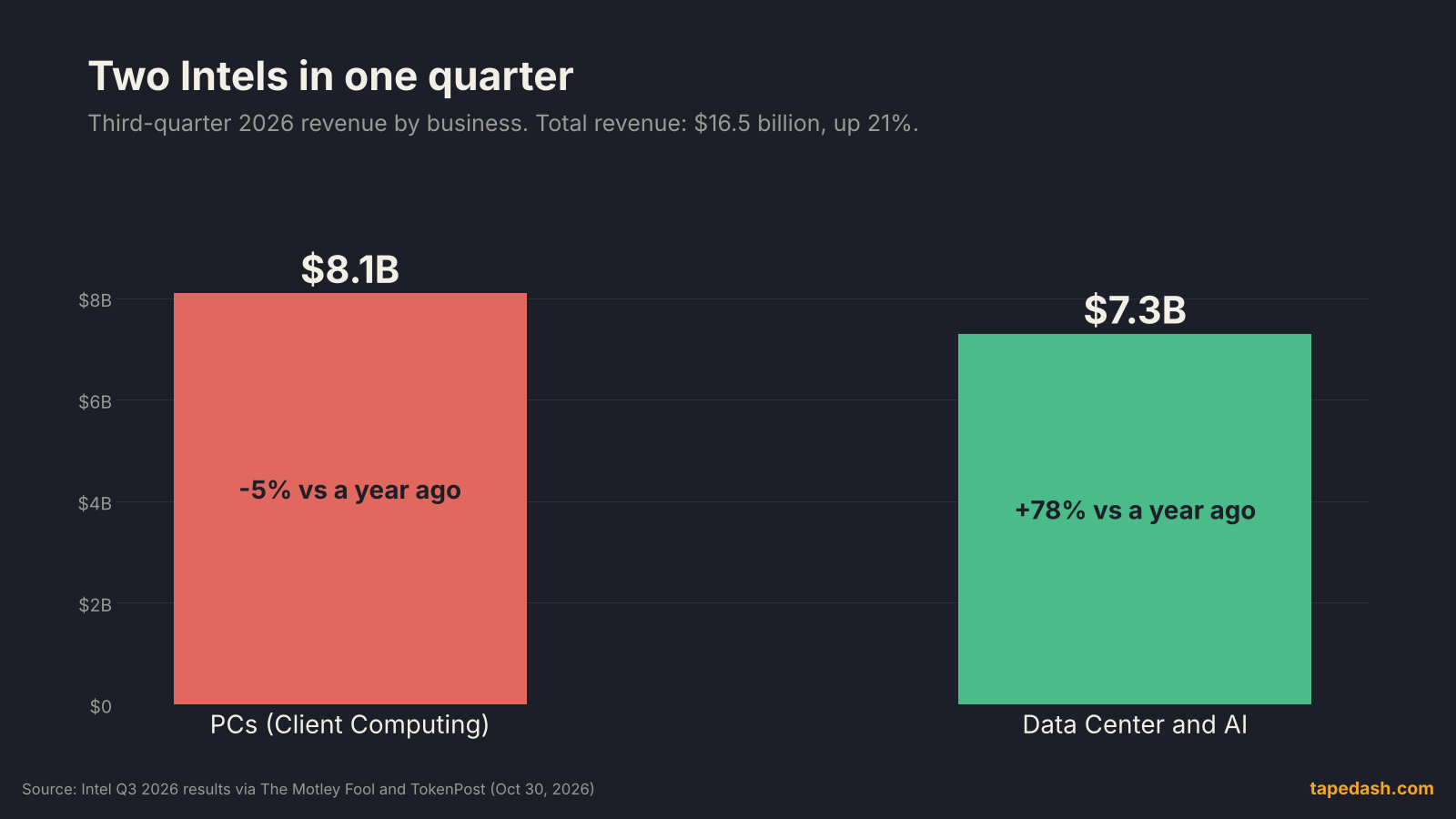
The data center and AI business brought in $7.3 billion in the third quarter, up 78% from a year earlier. That is the growth story investors have wanted from Intel for years. The client computing business, which sells processors for laptops and desktops, brought in $8.1 billion, down 5%. Both figures come from Intel’s report as covered by The Motley Fool and TokenPost.
PCs are still Intel’s single largest business, roughly half of revenue. So when management says the PC market is heading into a long downturn, it outweighs the good news in data centers. That is what happened on Thursday evening’s call.
What the company actually said
Intel now expects the PC market to shrink about 12% this year and about 10% next year, according to Yahoo Finance and Tech Insider. Chief Financial Officer David Zinsner put the timing plainly, as quoted by The Motley Fool: “We see the PC slowdown continuing at least through the first half of next year.”
There was also a one-off problem. An accident at Intel’s factory in Kiryat Gat, Israel, halted manufacturing there for about two weeks in mid-October, which will cut server chip output. That hurts, but it is temporary. The PC forecast is the part that changes the long-term math.
How Intel got here
Some context helps explain why investors reacted so harshly. For most of the PC era, Intel was the default answer: it designed the leading processors and made them in its own factories, ahead of everyone else. Over the past decade it lost that manufacturing lead to Taiwan Semiconductor, lost share in PCs and servers to AMD, and missed the first wave of AI accelerators to Nvidia.
The turnaround plan has two parts. The first is winning back processor share with better chips. The second is turning Intel’s factories into a foundry that makes chips for other companies, which takes years and enormous spending before it pays off. Chief executive Lip-Bu Tan has described rebuilding Intel as a multiyear effort, and investors had been willing to wait as long as the core businesses held up while the foundry got built.
That is why the PC forecast hit so hard. A turnaround needs cash, and the PC business is one of Intel’s largest sources of it. Two down years for PCs means less cash to fund the foundry, at the same time the Israel accident is disrupting production. The 78% growth in data centers is real, but investors had already priced in a lot of it. The PC news was not priced in at all.
The memory squeeze: how AI is hurting PC sales
Here is the chain of cause and effect, because it explains more than just Intel.
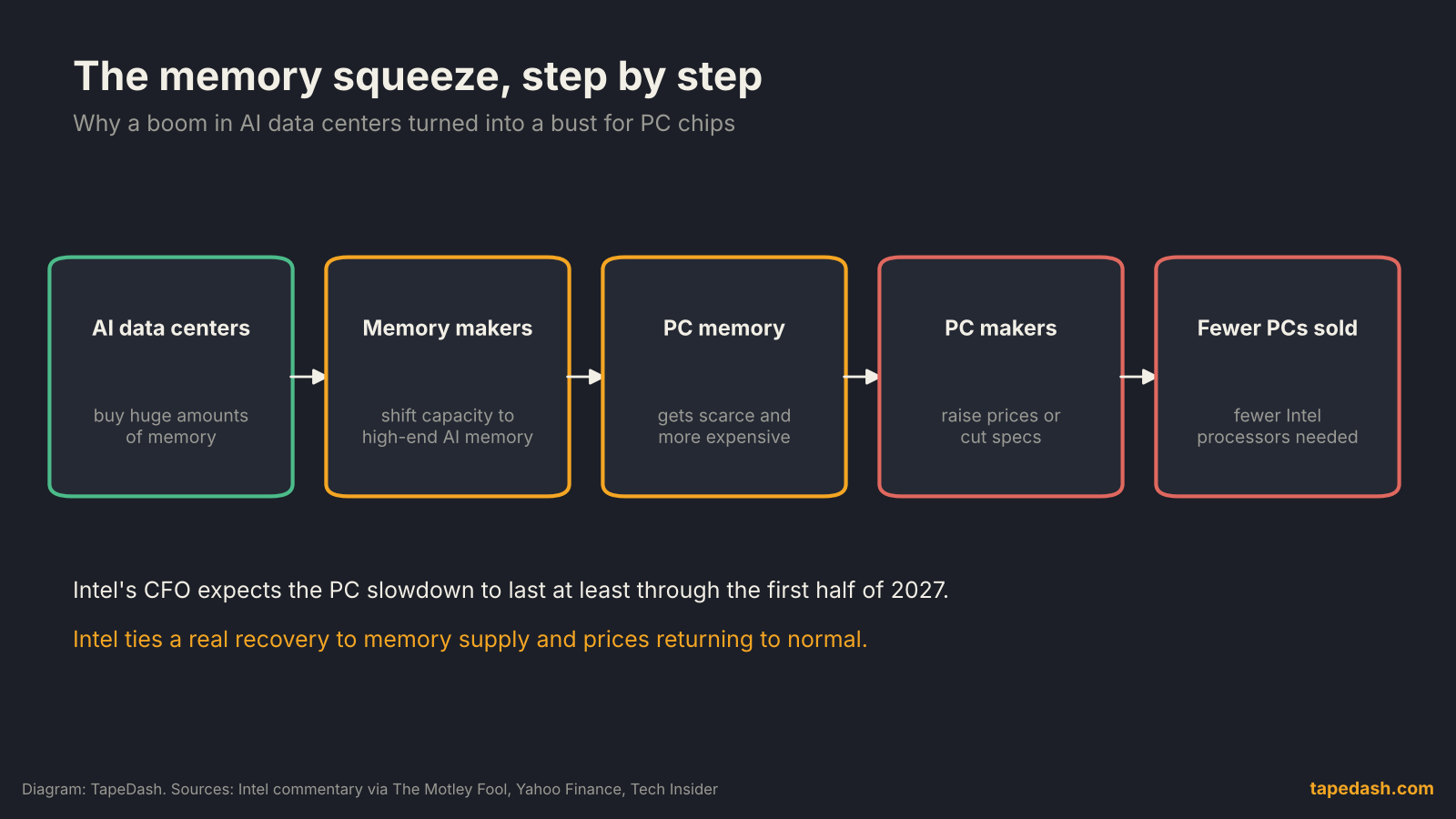
AI servers need enormous amounts of memory, especially the high-bandwidth kind stacked next to AI accelerators. Memory makers earn far more on that product, so they have been shifting factory capacity toward it. That leaves less capacity for the ordinary memory that goes into laptops and desktops, and its price has risen.
A PC maker facing pricier memory has two choices: raise the price of the machine or cut the specs. Either way, fewer people and companies buy. Intel’s chief executive said soaring memory prices are straining corporate IT budgets, according to The Motley Fool, and TokenPost reported that Intel expects higher memory and component costs to deepen in the fourth quarter and continue into 2027.
The result is perverse. The same AI build-out that is driving 78% growth in Intel’s data center business is shrinking its PC business. Intel ties a real PC recovery to memory supply and prices returning to normal, and it did not give a date for that.
Why memory cycles matter for traders
Memory is one of the most cyclical corners of the chip industry. When supply is short, prices rise quickly and memory makers’ profits jump. Makers then add capacity, and a couple of years later the shortage can turn into a glut, with prices falling just as fast. That rhythm has repeated for decades.
What makes this cycle unusual is the cause. Past memory shortages usually came from strong demand for phones and PCs. This one comes from AI servers pulling supply away from phones and PCs. So the usual pattern, where a hot memory market signals strong consumer electronics demand, is running backward: a tight memory market is now bad news for PC volumes. When you see memory prices in the headlines over the next year, read them as a signal for PC makers and PC chip suppliers, not just for the memory companies themselves.
If you want the other half of this story, our explainer on how AI capex reaches chip stocks follows the data center dollars into GPUs, memory and power.
Winners and losers from the memory squeeze
Not every chip stock is on the same side of this. Here is how the exposure breaks down, as a framework rather than a prediction.
| Group | Examples | Exposure to the memory squeeze |
|---|---|---|
| PC processor makers | Intel, AMD | Hurt: fewer PCs means fewer processors sold |
| PC and laptop makers | Dell, HP, Lenovo | Hurt twice: higher memory costs and weaker demand |
| Memory makers | Micron, SK Hynix, Samsung | Helped: tight supply supports prices |
| AI accelerator makers | Nvidia, Broadcom | Mostly indirect: PC weakness is not their core business |
| Phone chip makers | Qualcomm | Mixed: memory costs touch phones too, plus a small PC business |
Friday’s selling did not respect these differences much. Nvidia and Broadcom fell even though PCs are a small part of their business. That is common on a big warning day: traders sell the whole group first and sort it out later. Our piece on reading an earnings report like a trader covers why the first reaction is often the least informed one.
How to read Intel’s guidance yourself
A few habits help on days like Friday, whatever the company.
Compare the whole range to the estimate, not just the midpoint. Intel’s range was $15 billion to $16 billion. The fact that even the top was below the $17.1 billion consensus is what made this severe. When the top of a range clears the estimate, the market usually gives the company the benefit of the doubt.
Look for the reason, then ask whether it is temporary. Intel gave two reasons: the Israel factory accident and the PC market. The first is one-off. The second is a forecast of two down years. The market priced the second one.
Split the segments. A 21% growth quarter hid a shrinking core business. Read revenue by segment before you read the headline.
Watch what management says about timing. “At least through the first half of next year” tells you not to expect a quick fix. Words about duration often move a stock more than the numbers themselves.
Respect the options market after a crash. Implied volatility on a stock that just fell 28% is usually very high, so options are expensive in both directions. Our guide to IV crush after earnings explains how that premium deflates once the uncertainty settles.
What to watch next
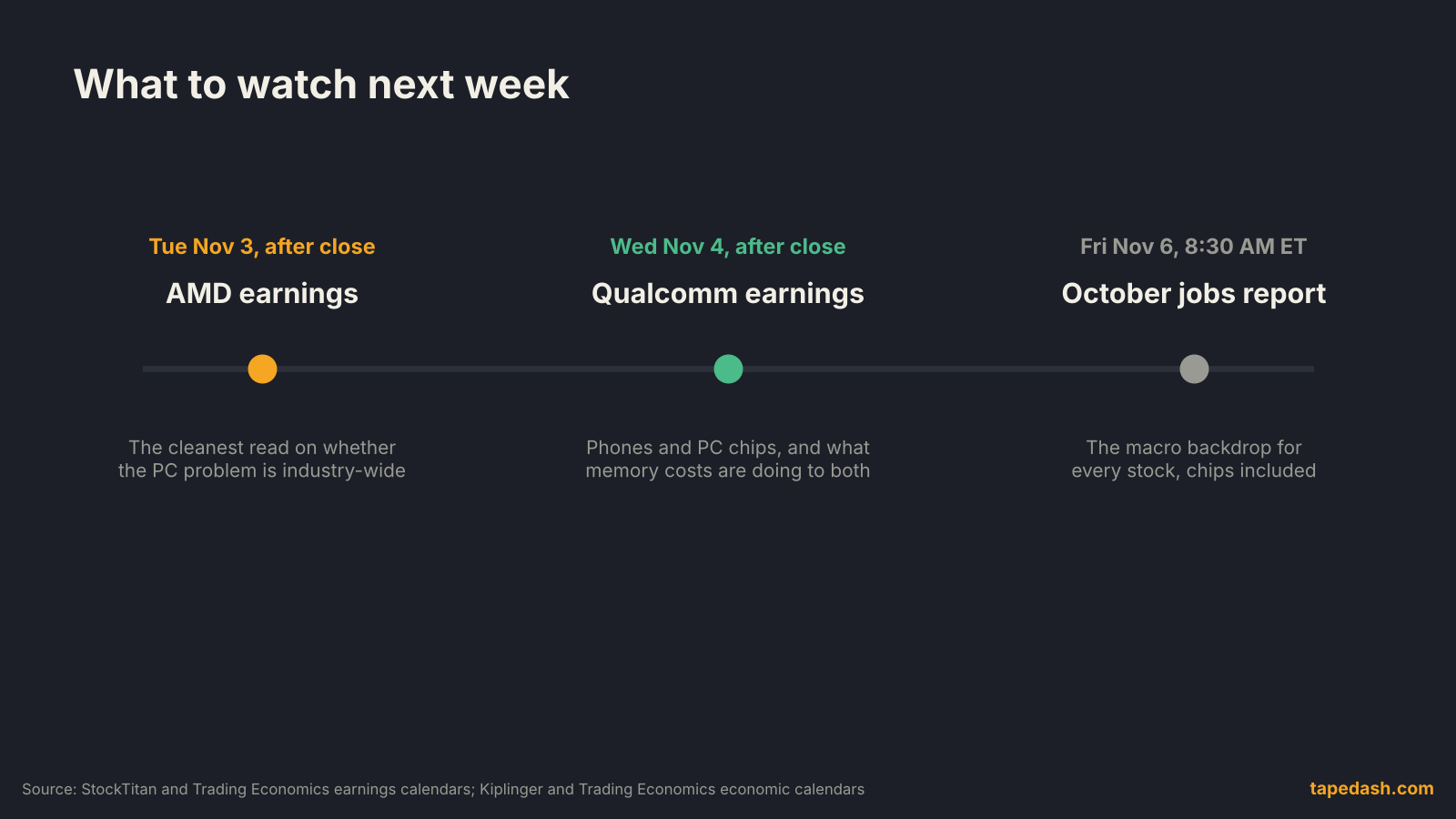
Tuesday, Nov 3, after the close: AMD. AMD sells PC processors too, so its outlook is the cleanest test of whether Intel’s warning is an industry problem or an Intel problem. The date is on both the StockTitan and Trading Economics calendars. AMD’s stock fell about 11% on Friday, so it goes in already marked down.
Wednesday, Nov 4, after the close: Qualcomm. Listen for what memory costs are doing to phone and PC demand.
Friday, Nov 6, 8:30 AM ET: the October jobs report, listed on the Kiplinger and Trading Economics calendars. It sets the backdrop for every stock, chips included.
Here is how I would frame AMD’s report. If AMD says its PC business is holding up, Friday’s sympathy selling in AMD looks overdone and the problem looks more specific to Intel. If AMD echoes the memory warning, expect the pressure on PC-related names to continue, with memory makers the likely relative winners.
How to track this on TapeDash
If you want to watch whether the memory squeeze spreads, this is what we track. The earnings calendar in the Terminal Preview shows the implied move for AMD and Qualcomm before they report, so you can see how much the options market expects. On report nights, the Live Scanner shows which chip names react first, which is often the quickest way to tell whether the market reads a report as company-specific or industry-wide.
On the flow side, Flow Signals and Large Prints show when big money is positioning in names like AMD, Micron and Intel ahead of these reports. Every trade alert we publish is graded in public on our track record, wins and losses included, and the free TapeDash Daily covers stories like this one each weekday evening. Memberships open soon, and the first 200 members lock Pro at $69.99 a month on their account, even if they cancel and come back later.
FAQ
Why did Intel stock drop so much?
Intel forecast fourth-quarter revenue of $15 billion to $16 billion against about $17.1 billion expected, and adjusted earnings of $0.25 a share against $0.43. It also said it expects the PC market to shrink in both 2026 and 2027. The stock fell about 28.6% on Friday, its worst day since 1974.
How are AI data centers hurting PC sales?
AI servers use huge amounts of memory, and memory makers have shifted capacity toward that higher-priced product. Ordinary PC memory has become scarcer and more expensive, so PC makers are raising prices or cutting specs, and fewer PCs are being sold.
Does Intel’s warning mean AMD will miss too?
Not necessarily. AMD also sells PC processors, so it faces the same market, but its mix of businesses is different. Its report on Tuesday, Nov 3, after the close is the clearest test of whether the PC weakness is industry-wide.
The one idea to keep
Intel’s crash was not about a bad quarter. It was about a forecast that the PC market will shrink for two years because AI data centers are absorbing the world’s memory supply. That makes this a story about the whole chain, not one company. Watch AMD on Tuesday: its answer on PCs will tell you whether Friday’s selling in chip stocks was a reasoned repricing or a reflex.
See it on the tape, not just in the headlines
TapeDash is the research desk for traders and investors: live options flow, dealer positioning, a real-time market scanner and trade alerts graded in public. Memberships open January 1, 2027, and the first 200 members lock Pro at $69.99 a month on their account, even if they cancel and come back later.
Join the waitlistClick through the terminalSee the track recordSources
- The Motley Fool: Why Intel stock crashed on Friday (Oct 30, 2026)
- TokenPost: Intel shares plunge 28.58% as fourth-quarter outlook misses estimates (Oct 30, 2026)
- Yahoo Finance: Intel stock plunges nearly 29%, its worst day since 1974 (Oct 30, 2026)
- Tech Insider: Intel plunges on $15B to $16B Q4 outlook (Oct 30, 2026)
- The Motley Fool: Stock market today, Oct. 30, Intel plunges nearly 29%
- FX Leaders: Intel after its worst day since 1974 (Oct 31, 2026)
- Reuters via Euronext: Intel on course for worst day ever triggers global chip rout (Oct 30, 2026)
- StockTitan: Stock market today live, Oct 30, 2026
- StockTitan: Earnings calendar, week of Nov 2, 2026
- Trading Economics: Economic calendar
- Kiplinger: This week's economic calendar
This article is for educational and informational purposes only. It is not financial, investment, medical or legal advice, and it is not a recommendation to buy or sell any security. Figures come from the sources listed and were checked on the date of publication; markets change quickly. Options trading involves substantial risk of loss.