OPEC+ December Output Hold: Why Hormuz Matters More Than Quotas
OPEC+ kept December oil output targets unchanged. Why quotas barely move prices while Hormuz is disrupted, and why the Nov. 29 call on 2027 matters more.
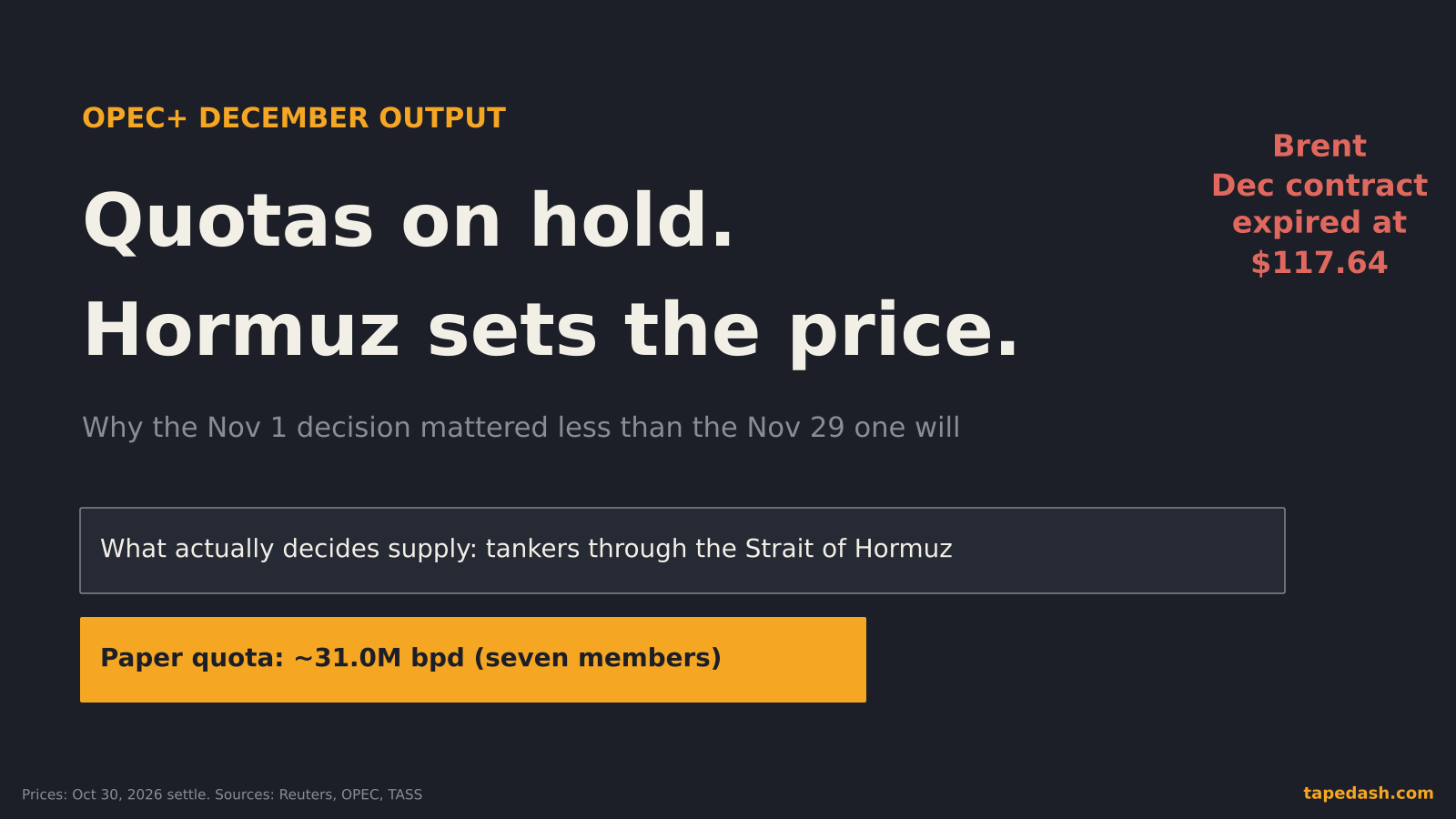
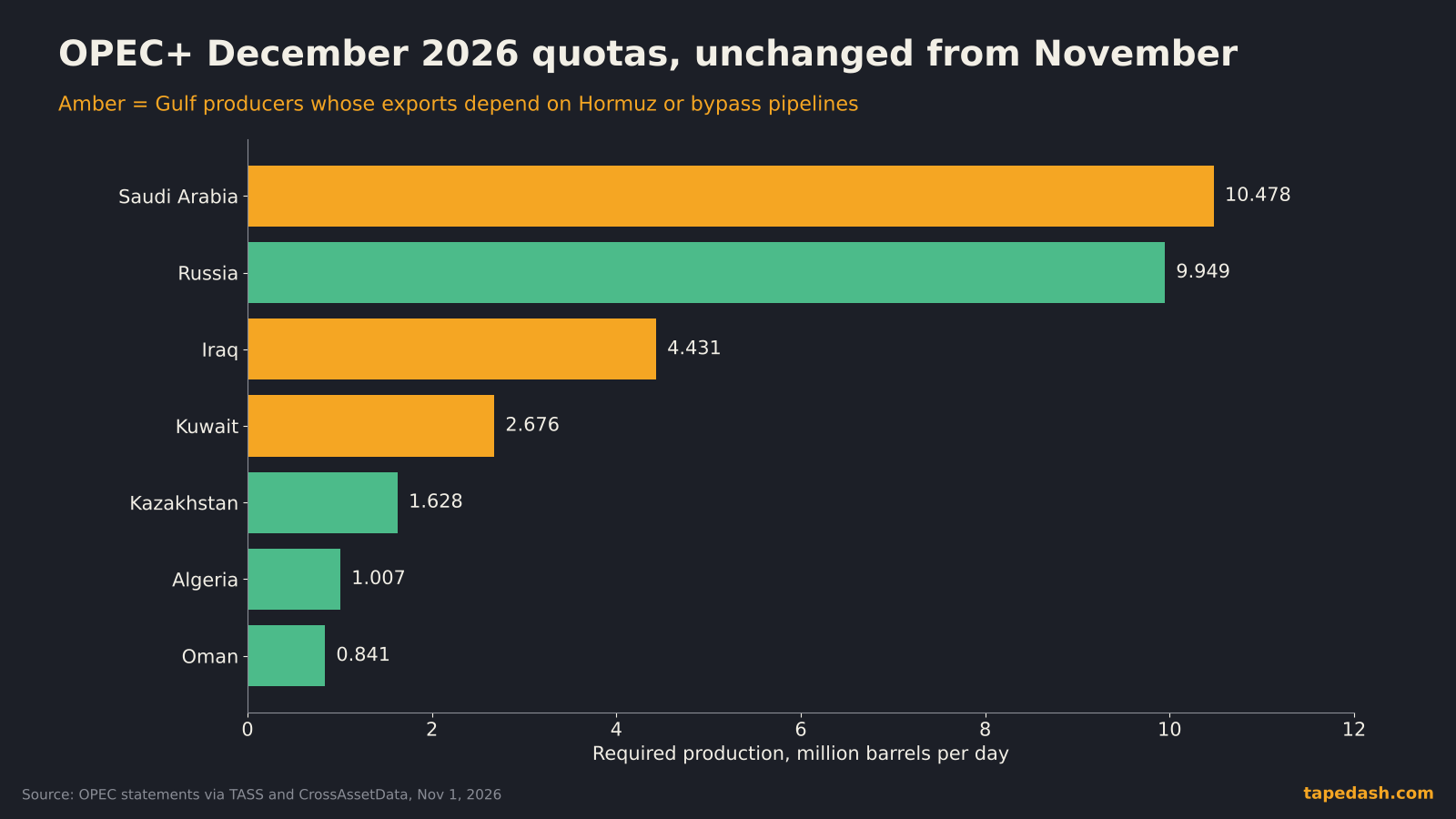
OPEC+ kept its December oil output targets unchanged on Sunday. The seven core members that make the monthly calls (Saudi Arabia, Russia, Iraq, Kuwait, Algeria, Kazakhstan and Oman) met online and held production at November levels, according to Reuters and TASS. That puts the combined target for the seven at roughly 31 million barrels per day, with Saudi Arabia’s share at 10.478 million.
The short answer to “what does the OPEC+ December output hold mean for oil prices” is: not much by itself. Brent’s December contract expired on Friday at $117.64 a barrel, the highest settle since April, and the market got there while most Gulf producers were pumping well below their targets. When the barrels can’t get out of the Gulf reliably, the ceiling on paper isn’t the thing that binds. The Strait of Hormuz is.
The decision that will matter is four weeks away. On November 29, all 21 OPEC+ members meet to set 2027 quotas, built on a capacity review the Iran war has already delayed. Rystad’s Jorge Leon called Sunday’s call “the easy one.” Below is why he’s right, how to read the oil market while quotas and physical supply are disconnected, and what to watch between now and that meeting.
- The seven core OPEC+ members held December 2026 quotas at November levels, about 31 million bpd combined. No further changes are expected before 2027.
- Brent’s expiring December contract settled at $117.64 on Oct. 30. January became the front month at $113.43, and WTI settled at $104.12.
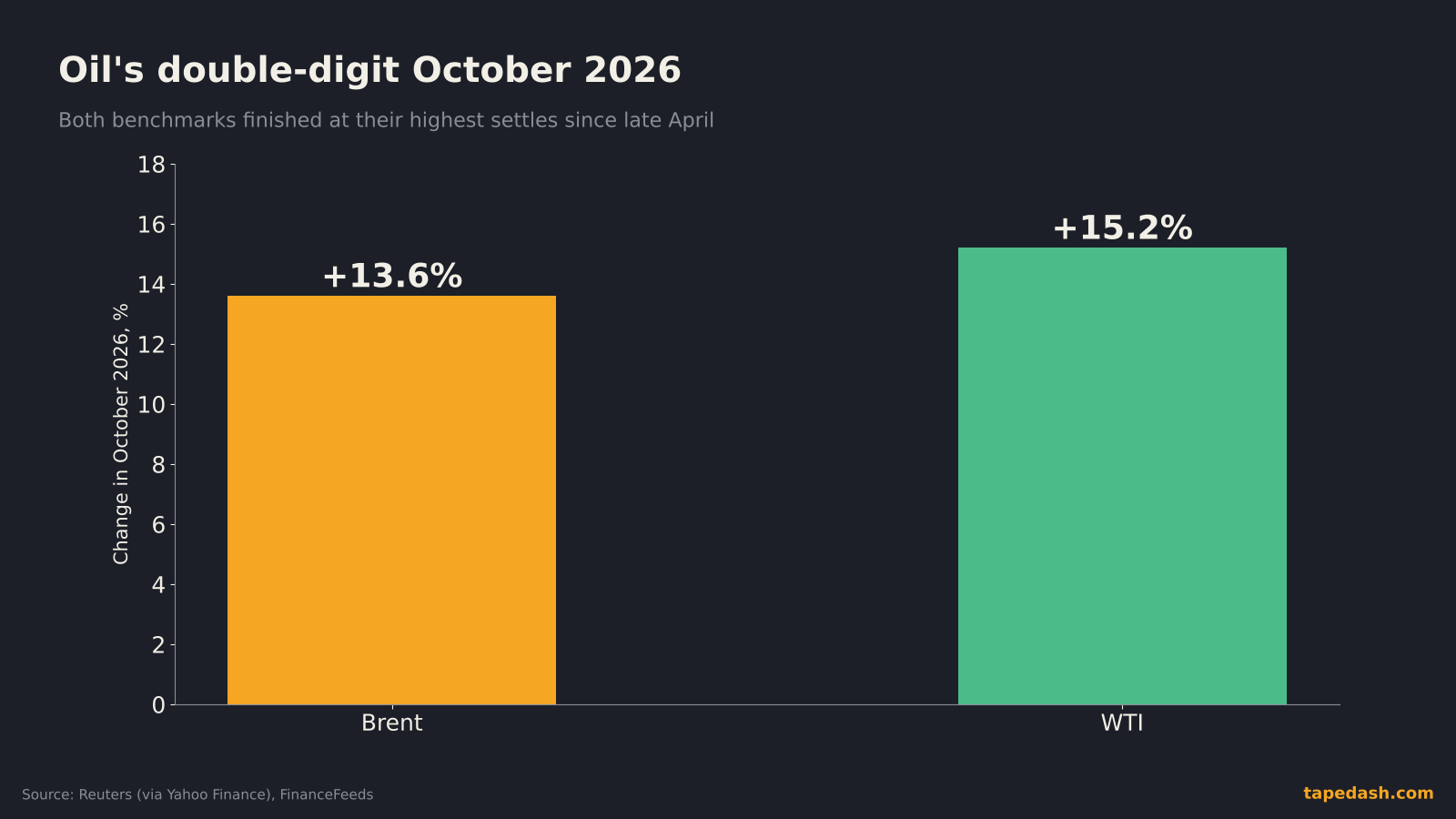
- Brent rose 13.6% in October and WTI 15.2%, the highest settles since late April.
- Gulf members are still producing well below target because of the Iran war, so the binding limit on supply is shipping through Hormuz, not the quota.
- The real test is Nov. 29, when all 21 members set 2027 quotas after a capacity review now due by mid-November.
What OPEC+ decided for December
The mechanics were simple. The same seven countries that announced extra voluntary cuts in April and November 2023 met virtually and agreed to keep December’s required production at the November level. They had already done the same for October and November. OPEC’s October 4 statement used nearly identical language, and the group said it would keep meeting monthly.
The per-country targets, as published by TASS and in the OPEC table reproduced by CrossAssetData, are Saudi Arabia at 10.478 million barrels per day, Russia at 9.949 million, Iraq at 4.431 million, Kuwait at 2.676 million, Kazakhstan at 1.628 million, Algeria at 1.007 million and Oman at 841,000.
Two pieces of background make this year’s meetings different from any in the past decade.
First, the group is smaller. The United Arab Emirates left OPEC in May and is no longer part of the monthly decisions, per Reuters and The National. The UAE was one of the few members with real spare capacity, and it was the member most vocal about wanting a bigger quota. Its exit removed a long-running argument from the room, but it also removed a large producer from the discipline the group depends on.
Second, the unwinding is mostly done. In September the seven finished phasing out a 1.65 million barrel-per-day cut first agreed in 2023. About 2 million bpd of older group-wide cuts still apply to most members through the end of 2026, according to Reuters and Daily Sabah. What happens to those cuts in January is the open question. That’s why nobody wanted to touch December.
Why OPEC+ quotas barely move oil prices right now
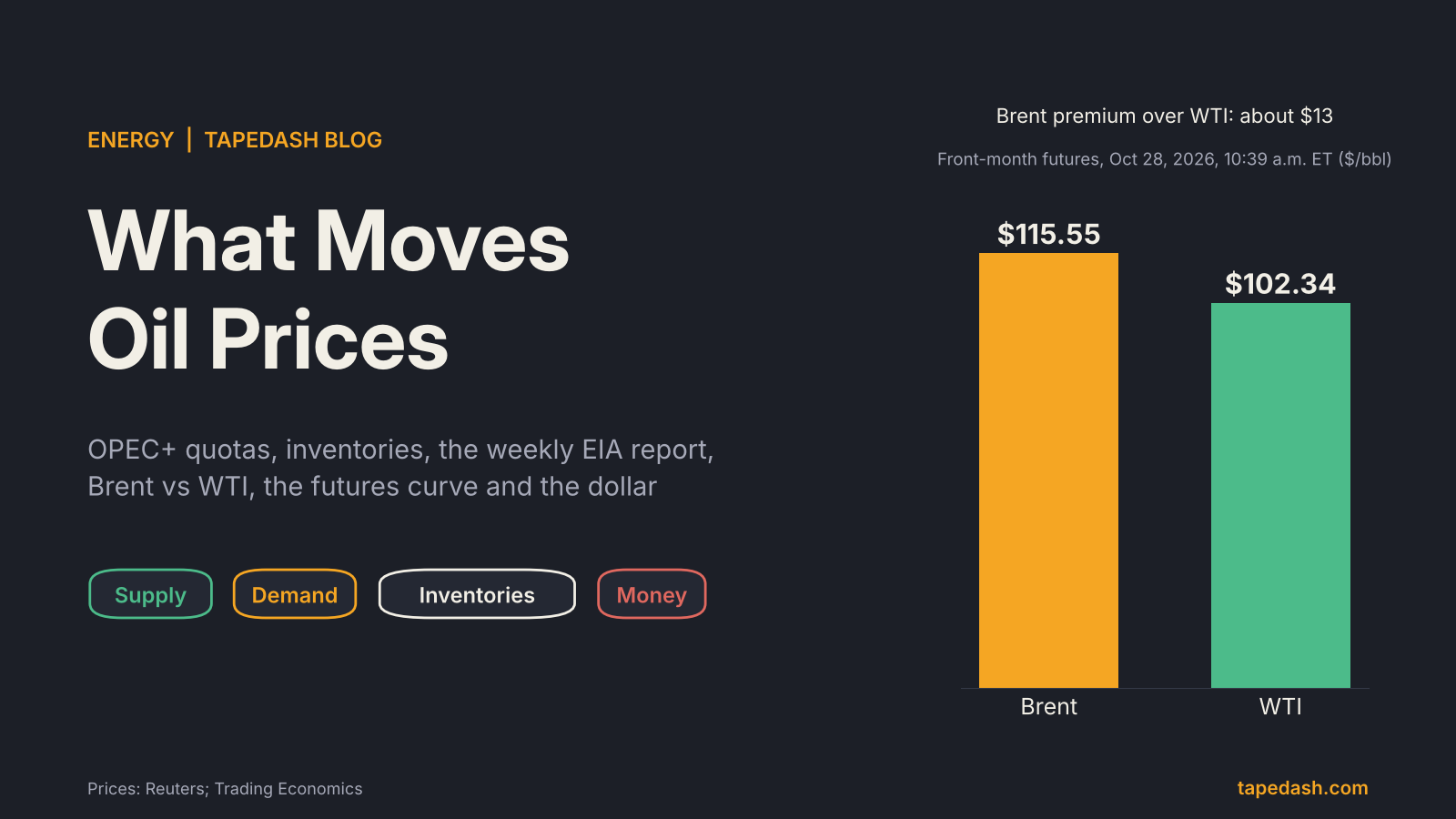
In a normal market, an OPEC+ quota is the binding constraint. Saudi Arabia can pump more than its target, so when the group raises the target, barrels follow within weeks, and traders price the change the moment it’s announced. I wrote about that standard playbook in What Moves Oil Prices, and most of the time it holds.
This year the chain broke at a different link. The Iran war, which began in February, has disrupted Gulf exports for months. Reuters reported on Sunday that Gulf members are increasing exports, but most are still pumping well below their targets. A quota is a ceiling. If you are already under the ceiling because your tankers can’t move safely, holding the ceiling steady changes nothing about how many barrels reach a refinery in December.
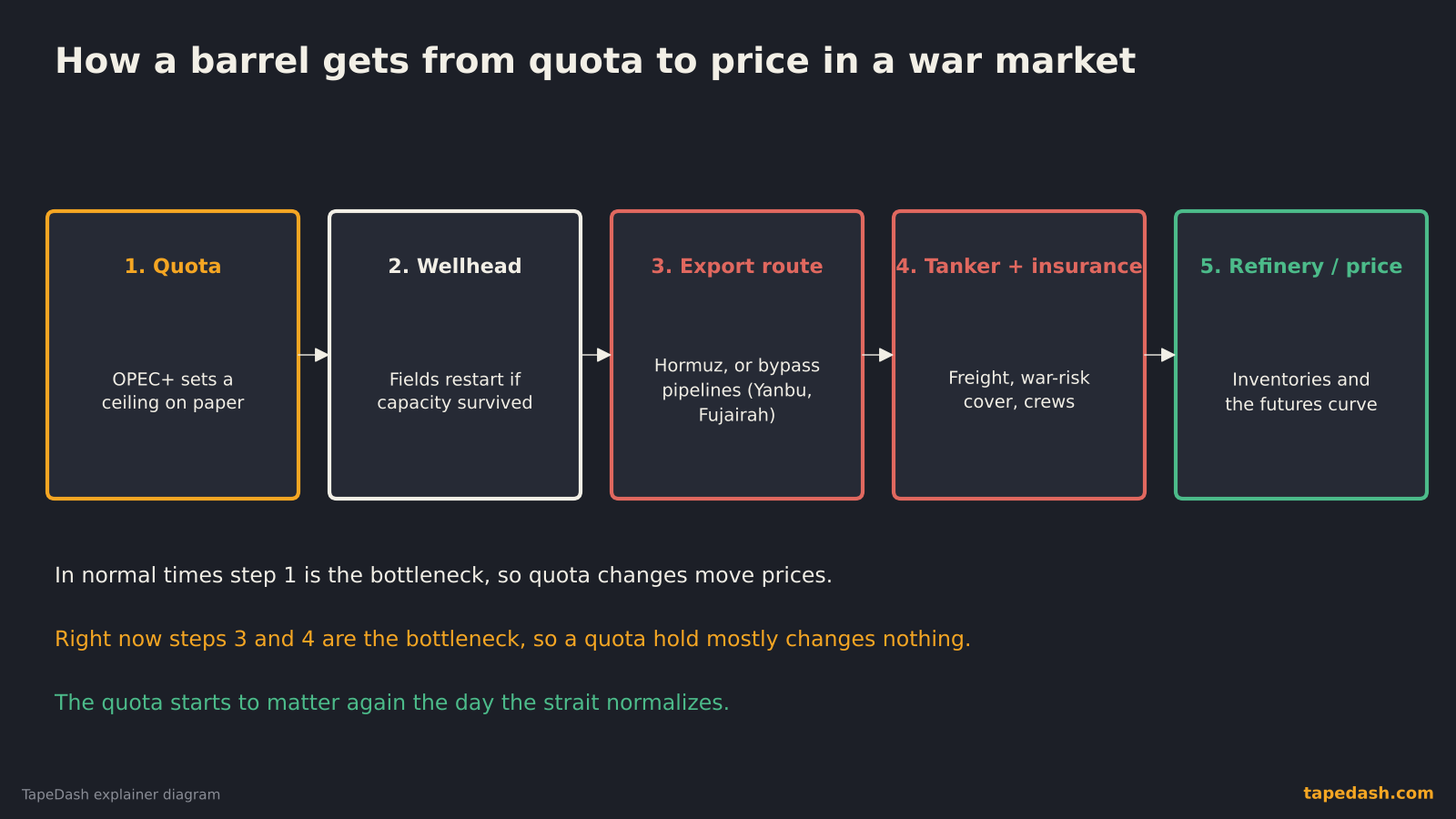
It helps to walk the barrel through each step.
Step one: the quota
This is the number OPEC+ publishes. It tells you the maximum a member has agreed to produce. It says nothing about whether the member can produce that much, or whether it can get the oil out.
Step two: the wellhead and capacity
Fields have to be running. War damage, staff evacuations and stalled expansion projects all eat into capacity. Reuters noted that the war has disrupted capacity expansion in the Middle East, which is the reason OPEC+ had to push back its capacity review.
Step three: the export route
For Saudi Arabia, Iraq and Kuwait, most crude historically left through the Strait of Hormuz. Saudi Arabia and the UAE have bypass pipelines to the Red Sea and the Gulf of Oman, and those have carried far more of the load this year, according to Al Jazeera’s reporting on Kpler data. Iraq and Kuwait have no such option.
Step four: the tanker, the crew and the insurance
Even when oil can be loaded, ship owners have to agree to sail, crews have to agree to go, and underwriters have to write war-risk cover at a price that makes the trip work. On Friday a tanker in the Strait was hit by explosive devices attached from a small boat, which Reuters described as the first known successful limpet-mine strike in the waterway since the war began. Every incident like that raises the cost of the next voyage.
Step five: inventories and the futures curve
Finally the barrel meets the price. Because the earlier steps have been leaking for months, inventories have been drawn down hard. Observed global oil stocks at the end of September were 509 million barrels below pre-war levels, according to IEA figures cited by both gCaptain and Al Jazeera. Thin inventories mean the market has less cushion against the next attack, which is why prices can rise even in weeks when flows improve.
So when someone asks why oil keeps climbing while OPEC+ does nothing, this is the answer. OPEC+ isn’t the one holding the valve.
How oil prices reacted: Brent, WTI and the October run
Here are the settles that set up Sunday’s meeting, each confirmed by at least two outlets (Reuters, The Nation and FinanceFeeds):
| Contract | Oct. 30 settle | Day change | October change |
|---|---|---|---|
| Brent, December 2026 (expired) | $117.64 | +$2.76 (+2.4%) | n/a |
| Brent, January 2027 (new front month) | $113.43 | +$2.63 | +13.6% for Brent |
| WTI, front month | $104.12 | +$2.12 (+2.08%) | +15.2% |
Both benchmarks posted double-digit gains for October, and Friday’s settles were the highest since late April. Reuters tied Friday’s jump to three things: the Hormuz limpet-mine strike, Houthi claims of attacks on Saudi energy sites, and traders bracing for possible escalation in the Iran war after the U.S. midterm elections on November 3.
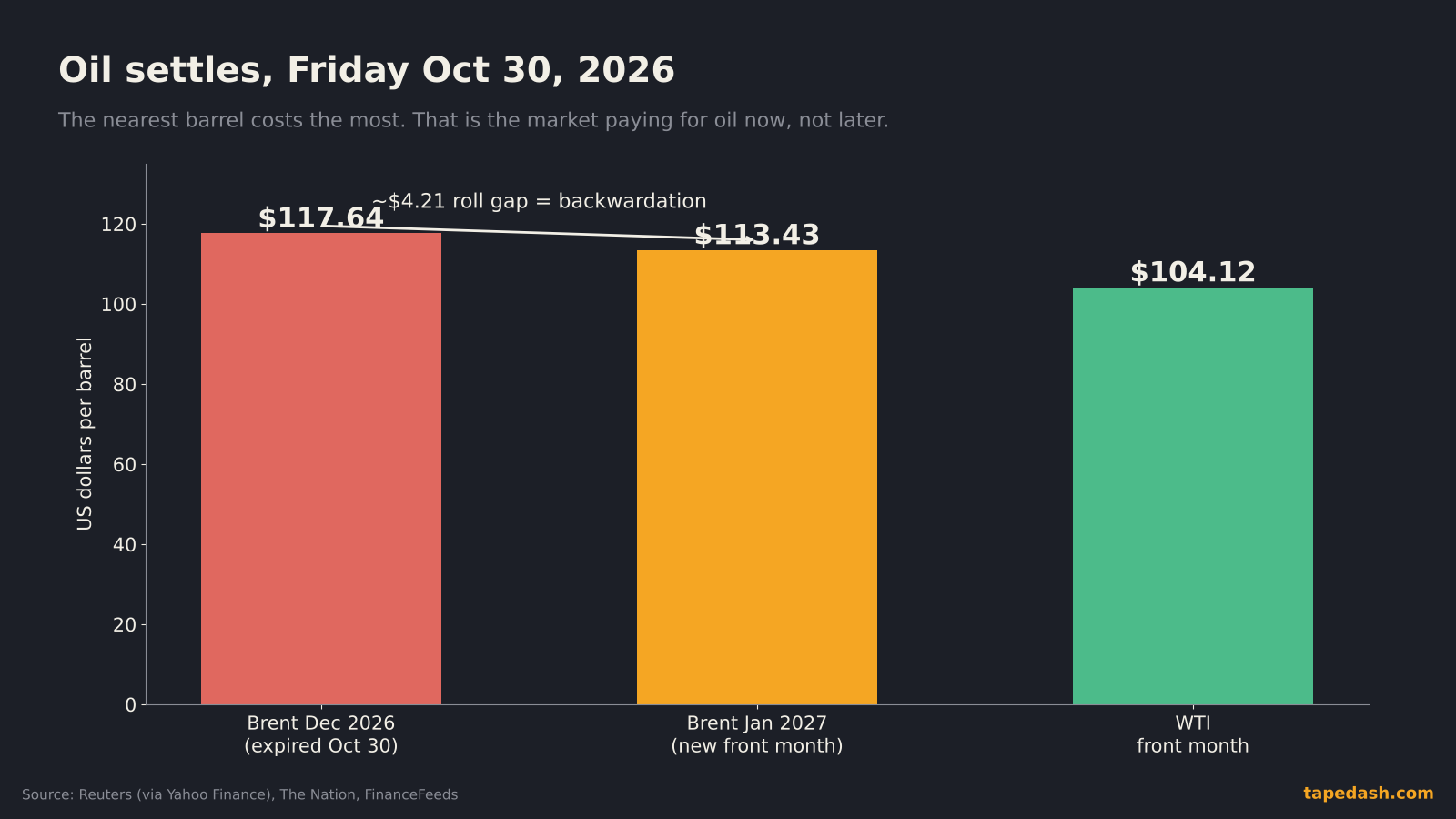
One detail trips people up every time a contract rolls. Some quote screens showed Brent “falling” from about $117 to about $113 over the weekend. It didn’t fall. The December contract expired, January became the benchmark, and January has been trading about $4 cheaper the whole time. That gap is the story in its own right, so it gets its own section.
How to read backwardation in the oil futures curve
Backwardation means near-dated futures cost more than later-dated ones. Friday’s settles show it clearly: December Brent at $117.64, January at $113.43, a gap of $4.21 between two contracts one month apart. Al Jazeera reported that Brent for delivery a year out was trading far lower still.
When I look at an oil curve, this is the first thing I check, because it tells you what the market is worried about.
A steep backwardation says the shortage is now. Refiners and traders will pay a premium to get a barrel this month rather than next, because inventories are thin and the next tanker might not arrive. It also says the market expects the problem to ease over time. The curve is pricing a war premium that decays.
Contango, the opposite shape, says there’s too much oil today. Storage fills up, near-dated barrels get cheap, and you get paid to hold oil for later. That’s the world forecasters are warning about for 2027 if Gulf flows normalize: the IEA and others see excess supply next year in that case, per Reuters.
Here is how I use the shape in practice.
If the front spread widens (December-January then January-February getting more expensive relative to later months), the physical market is tightening. That usually lines up with new attacks, falling inventories or slower tanker traffic, and it tends to show up in the spread before it shows up in the headline price.
If the front spread narrows while flat price holds up, the market is starting to believe in normalization but still carries a risk premium. That’s a fragile setup, because the premium can come out fast on a credible ceasefire headline.
If the curve flips toward contango, the war premium is gone and the conversation shifts back to OPEC+ policy, which is exactly when the November 29 decision would start to drive prices.
For options traders, backwardation and high implied volatility usually travel together in a supply shock. If you trade energy names around event days, the expected-move math from Implied Volatility and the Expected Move applies directly. The difference in oil is that the event (an attack, a ceasefire, a convoy announcement) often has no date on the calendar.
Who wins and who loses from oil above $100
High prices don’t help every producer equally. The table below sorts the main groups by how this particular shock hits them. It’s a framework, not a call on any stock.
| Group | Examples | Why this shock helps or hurts |
|---|---|---|
| Producers outside the Gulf | U.S. shale, Norway, Brazil, Canada | Full price, no Hormuz exposure. They benefit most. |
| Gulf producers with bypass routes | Saudi Arabia | Higher price per barrel, but fewer barrels and higher shipping costs |
| Gulf producers without bypass routes | Iraq, Kuwait | Price gains offset by barrels they can’t ship |
| Tanker owners | Crude carriers | Higher rates, but higher risk and insurance costs |
| Refiners | U.S. and European refiners | Mixed: higher crude costs, but product shortages can widen margins |
| Fuel-heavy consumers | Airlines, trucking, chemicals | Hurt: input costs rise faster than they can reprice |
| Importing economies | Japan, India, much of Europe | Hurt: higher import bills and pressure on currencies |
The row that matters for the November 29 meeting is the third one. Iraq and Kuwait have been pumping far below their targets for months. When OPEC+ sets 2027 baselines, the question is whether those baselines reflect what a member can produce in peacetime or what it has managed during the war. Members that look weak on this year’s numbers have every reason to argue for the former.
The Nov. 29 OPEC+ meeting and 2027 quotas
This is the meeting the market is waiting for. All 21 OPEC+ members gather on November 29, according to Reuters and TASS, and they are expected to set 2027 quotas.
Those quotas rest on a capacity review. The group has to finish an assessment of each member’s production capacity, which sets the 2027 baselines and governs how the remaining cuts get unwound. It was due in the fourth quarter, and because the war has disrupted capacity projects it is now expected by mid-November, per Reuters and Daily Sabah.
Leon called the 2027 decision an “extremely difficult call.” The difficulty is that OPEC+ has to set policy for two very different worlds at once.
In one, the war continues, Gulf exports stay impaired, and quotas remain mostly theoretical. The group can set generous baselines without adding real barrels, and it costs nothing.
In the other, Hormuz normalizes sometime in 2027. Shut-in Gulf production comes back on top of whatever supply the rest of the world added during the shock, and inventories rebuild. That’s the oversupply case the IEA has flagged. Generous baselines in that world turn into a price collapse.
Saxo Bank’s view, cited by Reuters and The Nation, is that crude trades between $70 and $90 a barrel after the conflict ends, against a pre-war range of $60 to $70. That range is a useful anchor for the curve. If you believe it, a large part of today’s price is war premium, and the 2027 quota decision determines how fast that premium can turn into a glut.
What to watch next for oil and OPEC+
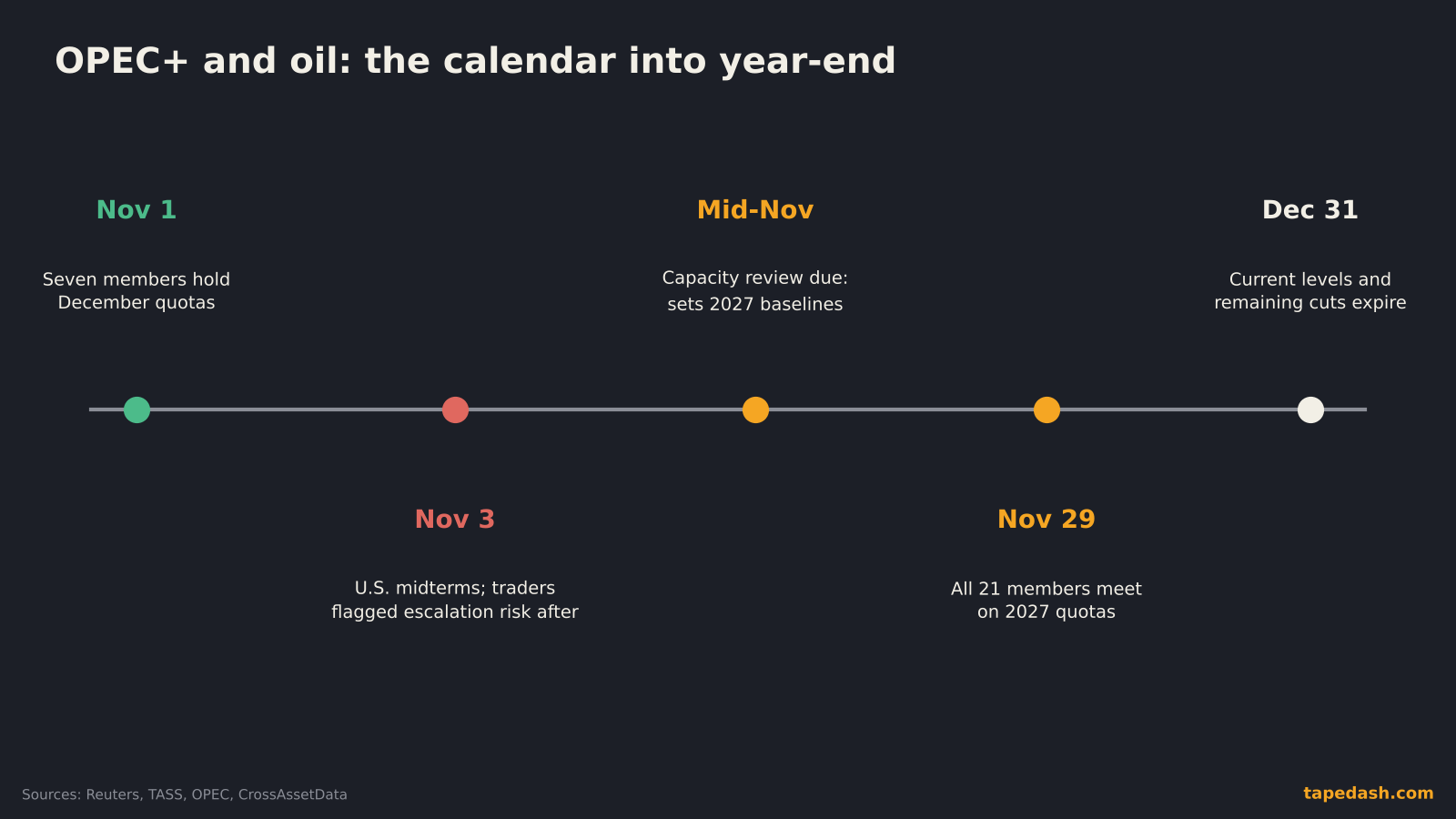
November 3, U.S. midterm elections. Reuters reported that traders were positioning for possible escalation in the Iran war after the vote. That’s a market expectation, not a forecast, and it cuts both ways. If the week after passes quietly, some of Friday’s premium could come out.
Mid-November, the capacity review. Watch which members’ capacity numbers get revised and by how much. Any leak about Iraq’s or Kuwait’s assessed capacity is a tell for how the 2027 fight will go.
November 29, the full OPEC+ meeting. The 2027 quotas and the plan for the roughly 2 million bpd of cuts that run through year-end. Watch whether the group sets baselines and then defers the actual increases, which is what OPEC+ usually does when the outlook is this uncertain.
December 31, current levels expire. Production levels and the remaining cuts are set through the end of 2026, per Reuters and CrossAssetData. Whatever the group decides on November 29 takes over from January.
Every week, Hormuz traffic and the Brent spread. Tanker-tracking reports and the gap between the first two Brent contracts are the most honest real-time read on whether supply is improving. A narrowing spread with steady flows is the early sign that the conversation is moving from war to quotas.
Frequently asked questions
Did OPEC+ raise oil output for December 2026?
No. The seven core members kept December production targets at November levels, about 31 million bpd combined, and are not expected to make further changes until 2027.
Why are oil prices so high if OPEC+ isn’t cutting?
Because supply is limited by the Iran war, not by quotas. Gulf producers are pumping below target, shipping through Hormuz is risky and expensive, and inventories are far below pre-war levels.
Why did Brent seem to drop from $117 to $113?
It didn’t drop. The December contract expired at $117.64 and the January contract, which was already about $4 cheaper, became the benchmark. That gap is backwardation.
How to track this on TapeDash
If you want to watch whether the oil premium builds or bleeds out between now and November 29, this is what we track. The Live Scanner flags unusual options activity and volume spikes across energy names, so you can see when traders start paying up for upside in producers or for downside in airlines and refiners before the headline arrives. In a market where the catalysts don’t come with a calendar date, seeing positioning change is often the first signal you get.
The Terminal Preview shows the flow and gamma views we use around event days, which is useful for the week of the midterms and again into the November 29 meeting. If you’d rather get the read without watching screens, the free TapeDash Daily covers the energy tape alongside the rest of the market each morning. If you decide to go further, the first 200 members lock Pro at $69.99 a month on their account, even if they cancel and come back later.
The one idea to keep
Sunday’s OPEC+ decision was a placeholder. While the Strait of Hormuz is the bottleneck, the quota is a ceiling almost nobody is hitting, and oil trades on tankers, inventories and war headlines. Watch the front of the Brent curve to see how tight the physical market really is, and treat November 29 as the date when OPEC+ gets its pricing power back, or shows how much of it it has lost.
See it on the tape, not just in the headlines
TapeDash is the research desk for traders and investors: live options flow, dealer positioning, a real-time market scanner and trade alerts graded in public. Memberships open January 1, 2027, and the first 200 members lock Pro at $69.99 a month on their account, even if they cancel and come back later.
Join the waitlistClick through the terminalSee the track recordSources
- Reuters via Lufkin Daily News: OPEC+ keeps December oil output targets steady ahead of tougher call for 2027 (Nov 1, 2026)
- Daily Sabah: OPEC+ keeps December output intact ahead of tougher call for 2027 (Nov 1, 2026)
- TASS: OPEC+ nations agree to keep production quotas for December at November level (Nov 1, 2026)
- CrossAssetData: OPEC+ holds November quotas while the Gulf pumps millions below
- OPEC: Seven OPEC+ countries reaffirm commitment to market stability (Oct 4, 2026)
- Reuters via Yahoo Finance: Oil jumps 2%, settles at 6-month highs on fears of escalation in Iran (Oct 30, 2026)
- The Nation: Brent ends October up 13.6% as Iran war risks unsettle markets (Oct 31, 2026)
- FinanceFeeds: Brent crude oil price at $113.43, OPEC+ meets Sunday (Oct 31, 2026)
- Al Jazeera: Oil flows are up as Iran war turmoil eases. Why do prices keep rising? (Oct 30, 2026)
- gCaptain: IEA moves to accelerate oil reserve releases as Hormuz crisis drags on (Oct 16, 2026)
- The National: No more quotas, UAE's exit from OPEC paves way for independent oil strategy
This article is for educational and informational purposes only. It is not financial, investment, medical or legal advice, and it is not a recommendation to buy or sell any security. Figures come from the sources listed and were checked on the date of publication; markets change quickly. Options trading involves substantial risk of loss.