Brazil Stocks Rally: Why a Banker as Finance Minister Lifted EWZ
Brazil stocks jumped 6% and EWZ rose 9.8% after Bradesco's chairman was named finance minister. Why markets cheered, and what has to happen next.
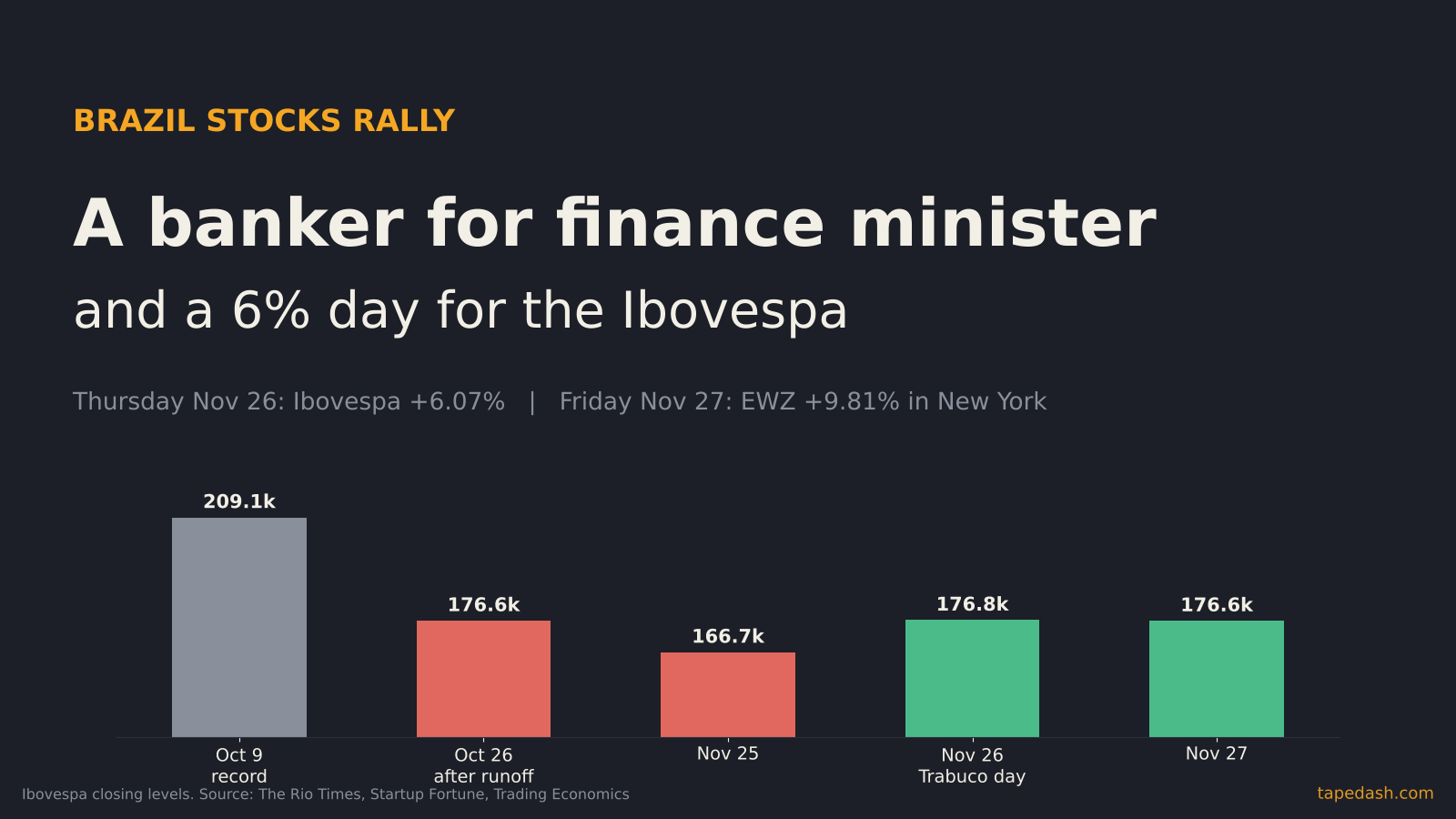
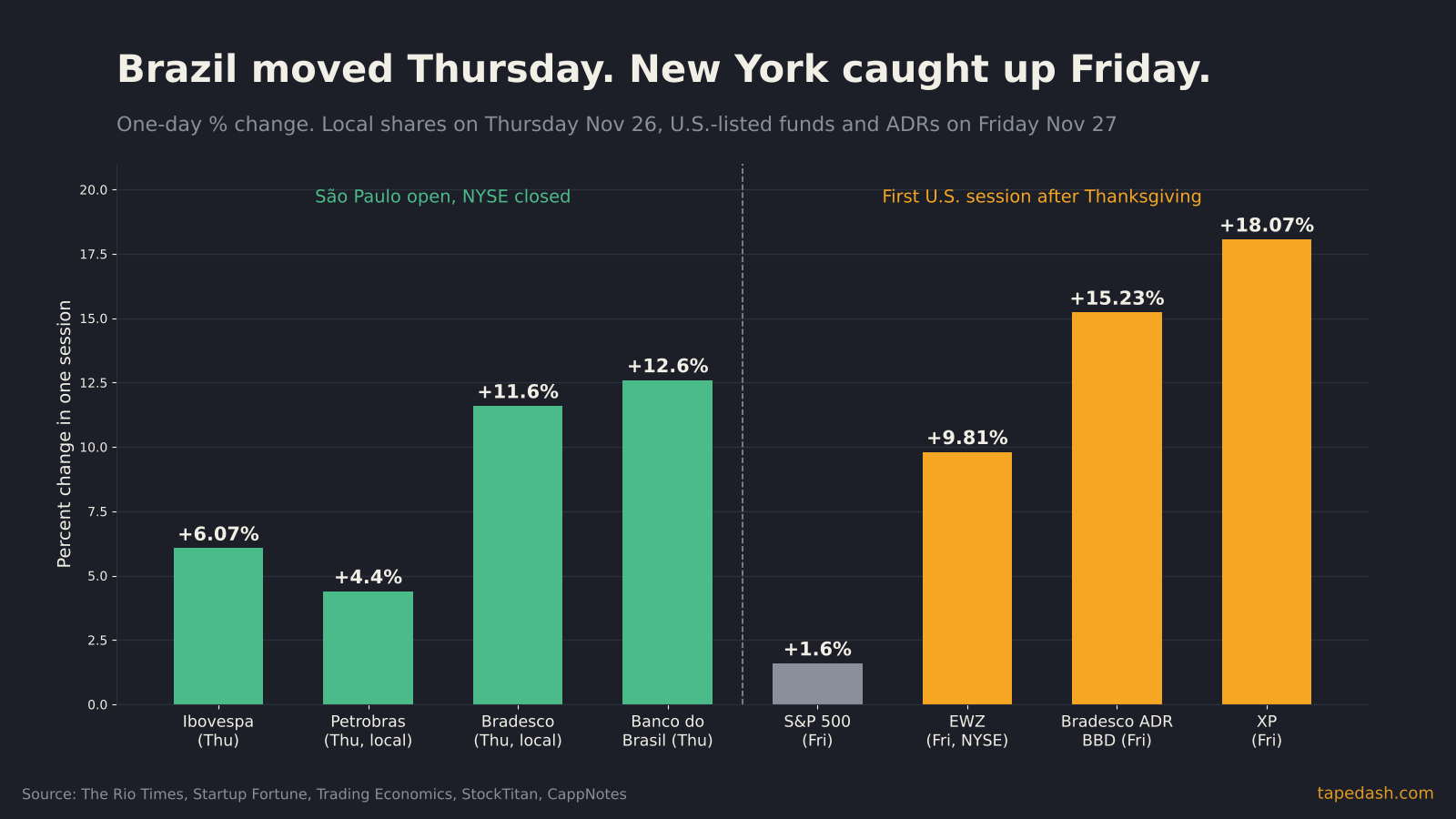
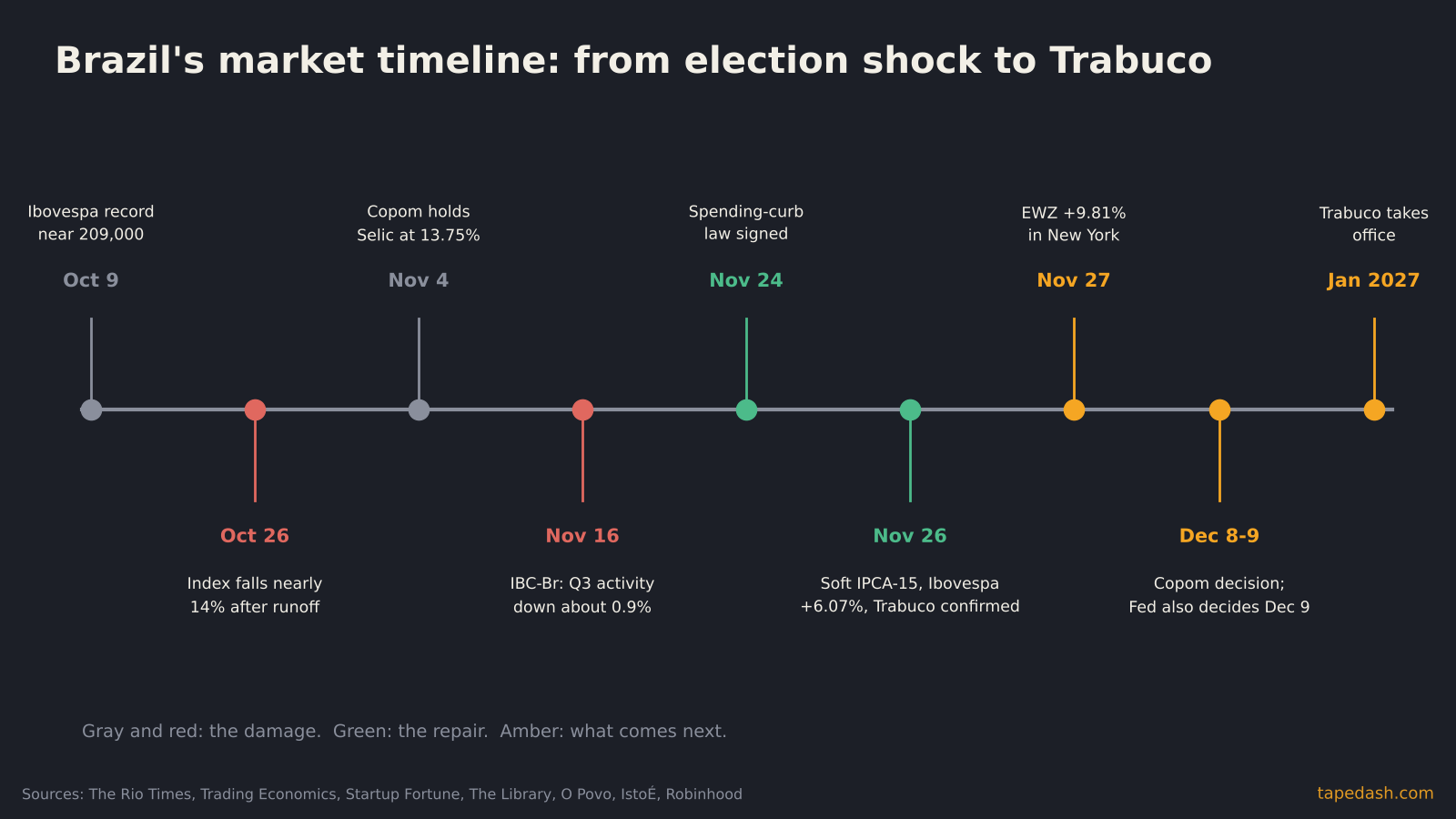
Brazil’s stock market had a huge day on Thursday. The Ibovespa rose 6.07% to about 176,800, led by the big banks, as word spread that Luiz Carlos Trabuco, the chairman of Bradesco (BBD), would become the country’s next finance minister (The Rio Times, Startup Fortune). The Presidency confirmed the pick that night, after São Paulo had closed. On Friday, with New York reopening after Thanksgiving, the iShares MSCI Brazil ETF (EWZ) jumped 9.81% in a half-day session (StockTitan, CappNotes).
The short answer to why Brazil stocks rallied: investors read a 75-year-old career banker at the Finance Ministry as a signal that the next government will take its budget seriously. That matters more in Brazil than almost anywhere, because the budget is the main thing standing between a 13.75% Selic rate and the rate cuts that would re-price every Brazilian stock. A month ago, the same market fell nearly 14% in one session after the presidential runoff. Thursday was the market deciding, at least for now, that the worst case it priced in October is less likely.
This piece covers why the pick moved markets so much, why EWZ jumped more than the Ibovespa, how to read the link between fiscal credibility and Brazilian interest rates, and the dates that will tell us whether the rally holds.
- The Ibovespa rose 6.07% on Thursday, Nov. 26, to about 176,800 as Bradesco chairman Luiz Carlos Trabuco was named finance minister. Banco do Brasil gained 12.6% and Bradesco 11.6%.
- EWZ rose 9.81% on Friday because U.S. markets were closed Thursday. It absorbed the local rally and a stronger real in one session. The Bradesco ADR (BBD) gained 15.23%.
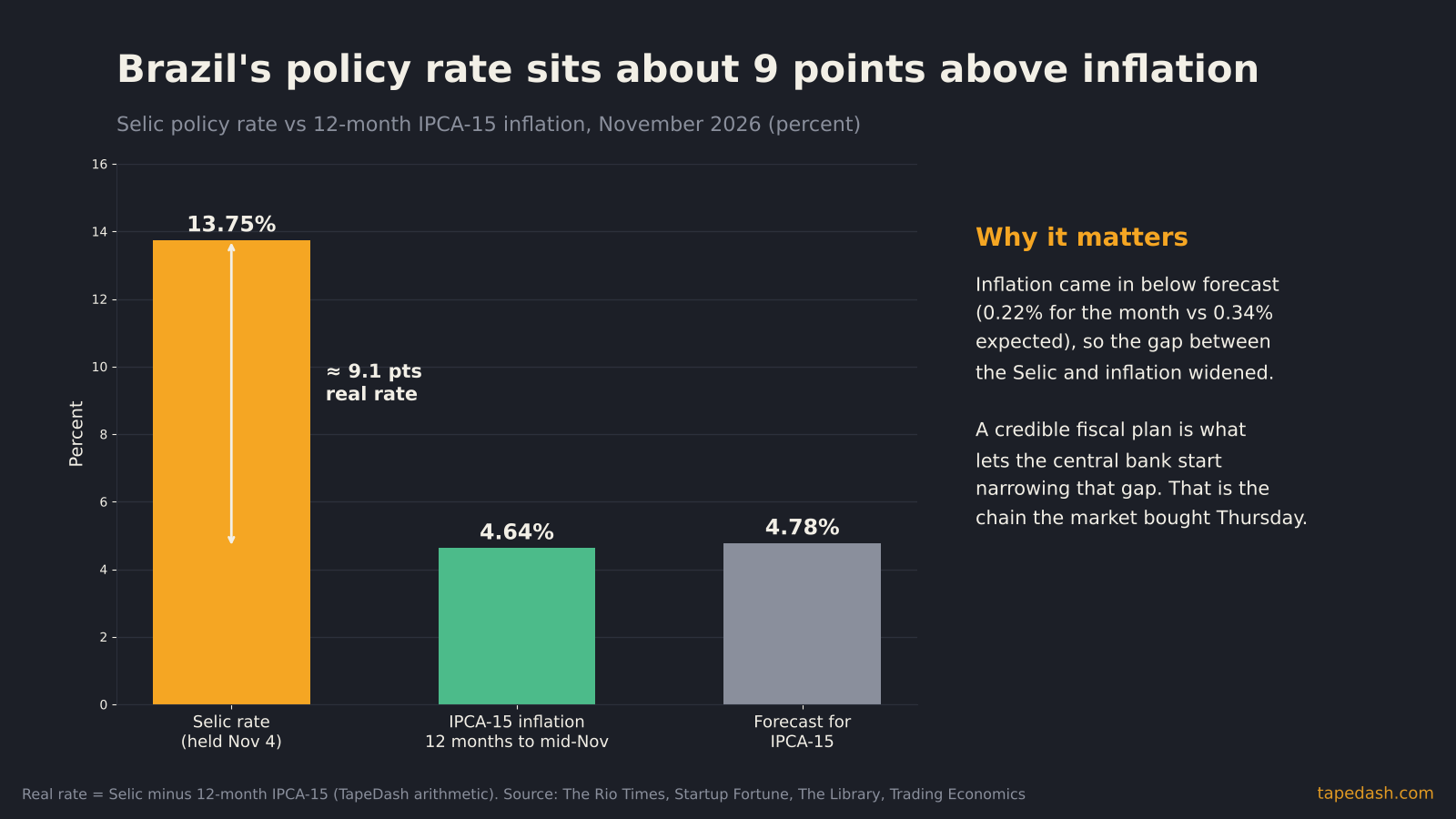
- The market is pricing a better fiscal path, not lower rates yet. The Selic sits at 13.75%, about 9 points above 12-month inflation, and the next Copom decision is Dec. 9.
- Even after the rally, the Ibovespa is about 15% below its Oct. 9 record. Friday’s flat local close, with exporters lower, shows how quickly the easy part of the move can fade.
Why Brazil stocks rallied on the finance minister pick
Start with what the market was afraid of. On Oct. 26, the first session after the presidential runoff, the Ibovespa fell nearly 14%. Bradesco lost more than a fifth of its value that day (Trading Economics, The Rio Times). That is not a normal election reaction. It was a market pricing a fourth Lula term with looser spending, a weaker real and higher interest rates for longer. The fear was about the budget.
The numbers behind that fear are real. Brazil’s nominal budget deficit, which includes interest payments, reached about 9.5% of GDP in the 12 months to September, and gross public debt is above 80% of GDP (LatinFinance, Startup Fortune). For a country paying double-digit rates on its debt, that is a loop: high rates make the deficit bigger, and a bigger deficit keeps rates high.
Into that setup walks a banker who spent his whole career inside one of Brazil’s largest private banks. Trabuco joined Bradesco as a teenage clerk, ran it as CEO from 2009 until 2018 and now chairs its board (Suno, Startup Fortune). He replaces Dario Durigan and takes office in January 2027, when the new term begins (The Library, Startup Fortune). In public comments he has backed a floating currency, inflation targeting and fiscal discipline.
BNP Paribas’s Brazil CEO, Ricardo Guimarães, said the invitation brought “a bit of serenity” (LatinFinance). That is about the right word. Nobody changed Brazil’s debt math on Thursday. What changed was the market’s guess about who will be in the room when the next budget gets written.
It was not only the minister
Timing helped. The same morning, Brazil’s mid-month inflation reading, the IPCA-15, rose 0.22% for November against a forecast of 0.34%. The 12-month rate fell to 4.64%, below the 4.78% economists expected (The Rio Times, The Library). Two days earlier, the government had signed a law tightening spending rules (The Library, Startup Fortune). And the economy had already cooled: the central bank’s activity index, the IBC-Br, fell about 0.9% in the third quarter (O Povo, IstoÉ).
Put those together and you get a story the market can trade: inflation is cooling, growth is soft, spending rules are tightening and a market-friendly minister is coming. Each piece alone is a modest positive. Arriving on the same day, after a month of pessimism, they produced a 6% index move.
Why the banks led the Ibovespa rally
When I look at a move like Thursday’s, the first thing I check is which stocks did the work. Here the answer is clear. Banco do Brasil rose 12.6% and Bradesco 11.6%, roughly double the index (The Rio Times, Trading Economics). Petrobras gained about 4.4%, closer to the index.
Banks are the purest bet on Brazil’s interest rate path, for three reasons. First, they own a lot of government bonds, and bond prices rise when the market expects lower rates. Second, lower rates mean fewer bad loans: Brazilian companies and households carry expensive debt, and every point off the Selic eases that burden. Third, the banks fell hardest in October, so they had the most fear to unwind. Bradesco had the extra kick of its own chairman getting the job, which some traders read as a vote of confidence in the bank’s management bench.
State-controlled Banco do Brasil is the interesting one. It carries political risk that the private banks do not, because the government can lean on it to lend for policy goals. A big move in Banco do Brasil tells you the market is pricing less fiscal interference on top of lower rates.
Friday told a different story. The Ibovespa rose more than 2% in early trade, then faded to close down 0.13% at about 176,573 (The Rio Times, Seeking Alpha, Trading Economics). Banks held small gains. Vale fell about 2.6% and Petrobras about 2%. That pattern makes sense once you look at the currency.
Why EWZ jumped more than the Ibovespa
This is the part that confused a lot of people on Friday, and it is a good lesson in how country ETFs work.
EWZ trades in New York, in dollars. On Thursday, U.S. markets were closed for Thanksgiving, but Brazil’s B3 exchange was open. So Thursday’s 6.07% local rally had nowhere to show up in EWZ until Friday morning. Before the U.S. open, EWZ was indicated up 12% to 13% (El Fondo, InvestNews). It closed up 9.81%.
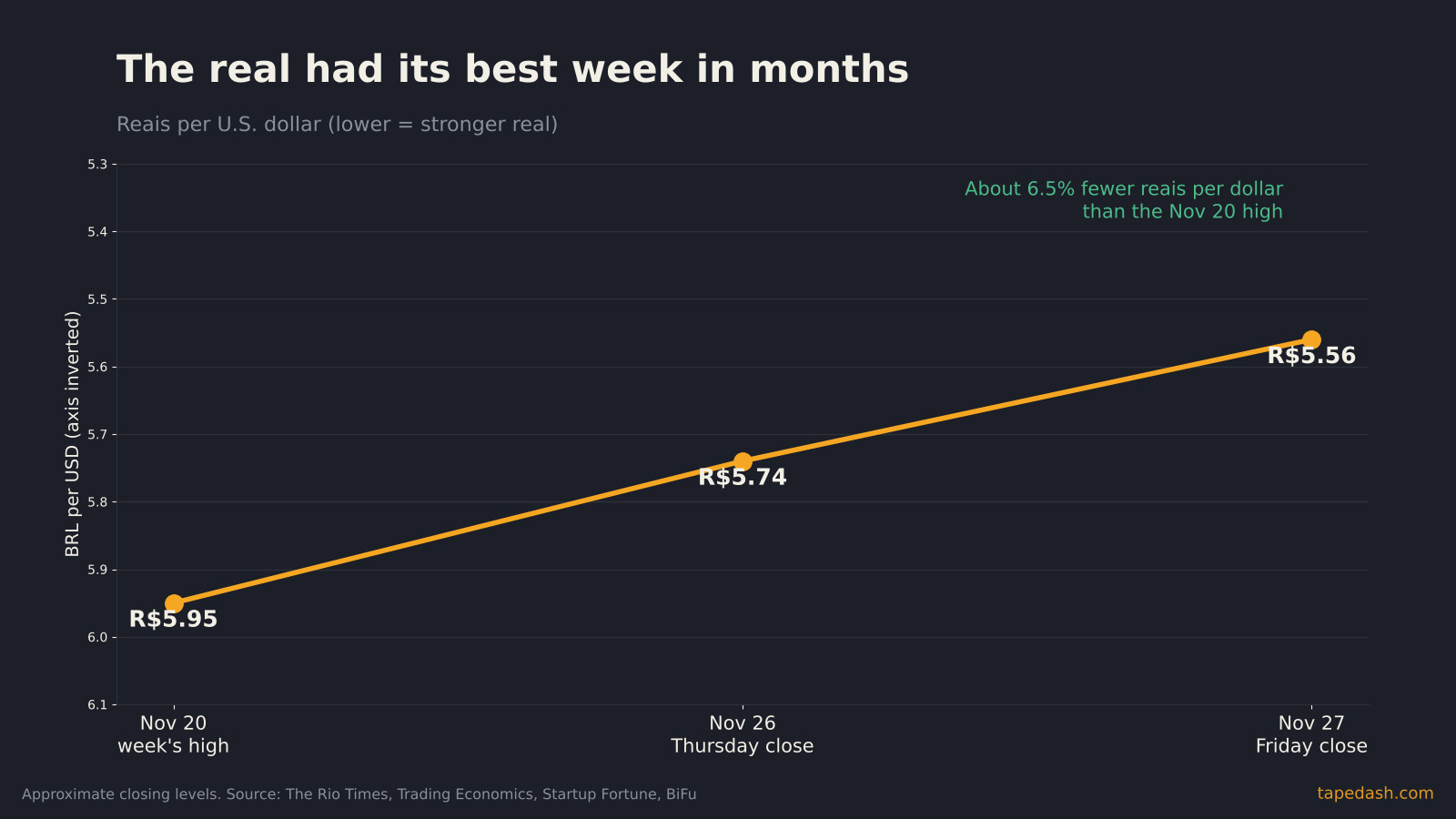
The second piece is the real. A U.S. investor in EWZ owns Brazilian stocks priced in reais. When the real strengthens, those same shares are worth more dollars. The dollar, which had touched about R$5.95 on Nov. 20, fell to roughly R$5.74 by Thursday’s close and to about R$5.56 on Friday (The Rio Times, Trading Economics, BiFu).
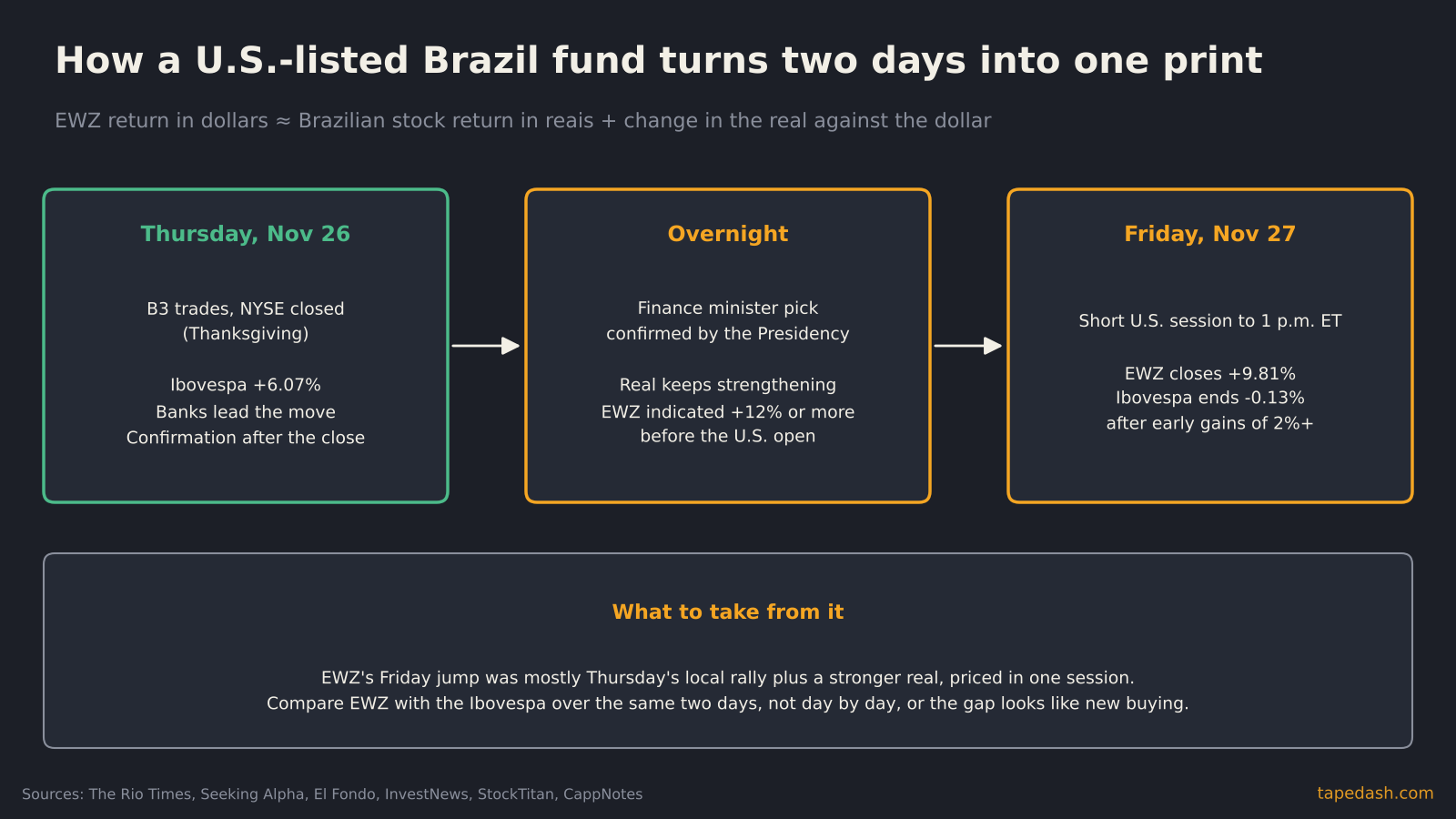
So EWZ’s Friday print was roughly Thursday’s local stock move plus two days of currency gains, compressed into a 3.5-hour session. U.S.-listed single names moved even more. The Bradesco ADR rose 15.23% and broker XP (XP) gained 18.07% (StockTitan, CappNotes).
The currency also explains Friday’s local split. A stronger real is good for banks and domestic retailers, but it hurts exporters like Vale and the pulp producers, who earn dollars and report in reais. That is why the Ibovespa could go flat while EWZ was up nearly 10%.
How to read a country ETF around a holiday
Here is the checklist I use when a country ETF makes a move that looks out of line:
- Check whether the home market traded while the U.S. was closed, or the other way around.
- Add the local index move and the currency move over the same window. That sum is your fair-value estimate for the ETF.
- Compare the ETF’s close with that estimate. If the ETF ran well past it, U.S. buyers are paying a premium, and that often fades. If it lagged, the local market may have more to give back.
On Friday, the local two-day move was about +6% and the real gained a few more percent. EWZ’s 9.81% sits in that range, which tells me Friday was mostly catch-up, not a fresh wave of U.S. buying. The same holiday mismatch showed up in reverse when Asian stocks crashed earlier this month, and the logic carries to any market that trades on different days than New York.
Brazil fiscal policy and interest rates: how the chain works
The whole rally rests on one chain of cause and effect. If you understand it, you can follow Brazil for the next year without reading every headline.
It goes like this. A credible budget lowers the risk premium investors demand on Brazilian government bonds. Lower long-term yields give the central bank room to cut the Selic without the real collapsing. Lower rates cut the interest bill, which shrinks the deficit, which lowers yields again. The loop that has been running against Brazil can run for it.
Today the Selic is 13.75%, held at the Nov. 4 meeting (Startup Fortune, Trading Economics). With 12-month IPCA-15 inflation at 4.64%, that leaves the policy rate roughly 9 points above inflation. That is an extremely tight setting. Real rates that high squeeze borrowers, keep credit expensive and slow the economy, which is what the third-quarter activity data shows.
Central banks in Brazil’s position watch long-term inflation expectations, and fiscal worries push those expectations up. A credible minister does not change the Copom’s mandate, but it can change the inputs. That is why the market moved before anything was cut: equity markets discount the path, not the next meeting.
There is a familiar risk here, and Brazilians remember it. In 2014, Trabuco turned down the same job when President Dilma Rousseff offered it, and Joaquim Levy, then at Bradesco’s asset management arm, took it instead (Gazeta do Povo, BiFu). Levy lasted about a year. The lesson the market took from that episode is that a respected minister only helps if the rest of the government backs his budget. Whether the governing coalition backs a second round of spending restraint is the tension to watch.
If you want the U.S. side of this rate story, I covered why the Fed is leaning toward a hike in our core PCE breakdown. A Fed that hikes while Brazil eventually cuts would narrow the gap between the two countries’ rates, which is the gap that keeps money flowing into the real. The same carry logic is explained in the yen carry trade explainer.
Who wins and who loses if the Brazil rally holds
| Scenario | What happens | Likely winners | Likely losers |
|---|---|---|---|
| Fiscal plan gains traction | Long yields fall, Copom signals cuts for 2027, the real stays firm | Banks (BBD, ITUB), brokers (XP), domestic retailers and homebuilders | Exporters on currency (VALE, pulp producers); short-real positions |
| Mixed signals | Minister talks discipline, Congress pushes back, Copom holds and stays cautious | Large, liquid names with dollar revenue (PBR, VALE) | High-debt domestic companies; the most rate-sensitive small caps |
| Plan stalls | Spending rises, the real weakens, rate-cut hopes fade | Exporters earning dollars | Banks give back the rally first, EWZ falls more than the local index on currency |
The pattern is consistent with the last two sessions: the rate-sensitive domestic names win when the fiscal story improves, and dollar earners act as the hedge.
What to watch next for Brazil stocks and the real
Dec. 8-9: Copom meeting. The decision comes Dec. 9 (The Library, Startup Fortune). Nobody expects a cut. What matters is the statement. If it credits the fiscal news or drops language about fiscal risk, the market will start pricing cuts for early 2027. If it repeats its warnings, the bank rally may need to rest.
Dec. 9: the Fed, same day. The U.S. rate decision also lands Dec. 9 (Federal Reserve, Robinhood). A Fed hike strengthens the dollar against most currencies, which would test the real’s new level. Watching both decisions on the same afternoon is a clean test of how much of the real’s gain is about Brazil and how much is about the dollar.
The rest of the cabinet. More cabinet names are expected before the new term starts. Picks for planning and the budget office matter almost as much as finance, because they decide whether Trabuco has allies at the table.
The first budget signal. The market will want a primary surplus target and a plan for mandatory spending in Trabuco’s first public remarks. Vague promises will not hold a 6% rally for long.
The real near R$5.50. If the dollar holds below the R$5.74 level it reached on Thursday, the fiscal story is being believed. A quick move back toward R$5.95 would say the rally was mostly short covering.
How to track the Brazil rally on TapeDash
If you want to watch whether money keeps flowing into Brazil or starts heading back out, U.S.-listed funds are the cleanest window from here. ETF Flows shows creations and redemptions in EWZ and other country funds, so you can see whether Friday’s jump came with new money or just repricing. A rally that pulls in fresh shares is sturdier than one that simply reprices existing ones. Unusual Flow shows large options trades in EWZ, BBD, ITUB and PBR as they print, which is the fastest way to tell new upside bets from traders buying puts to protect the gain.
For the macro side, Macro Pulse keeps the U.S. data and Fed path on one screen, which matters with the Fed and the Copom deciding on the same day. You can look around all of it in the Terminal Preview, or start with the free TapeDash Daily for a morning read on flows and the calendar. If you join now, the first 200 members lock Pro at $69.99 a month on their account, even if they cancel and come back later.
FAQ: Brazil stocks and the new finance minister
Who is Brazil’s new finance minister?
Luiz Carlos Trabuco, the chairman of Bradesco’s board and the bank’s CEO from 2009 to 2018. He takes office in January 2027, replacing Dario Durigan. He turned down the same job in 2014.
Why did EWZ rise almost 10% when the Ibovespa rose 6%?
U.S. markets were closed on Thanksgiving, so EWZ absorbed Thursday’s local rally on Friday. It also gained from a stronger real, because the fund’s Brazilian stocks are worth more in dollars when the real rises.
Will Brazil cut interest rates soon?
Not at the December meeting, based on current expectations. The case for cuts in 2027 rests on inflation staying soft and the new economic team delivering a budget the market believes. The Copom statement on Dec. 9 is the first clue.
The one thing to remember
Brazil stocks did not rally because anything got fixed on Thursday. They rallied because the market’s worst-case scenario, the one priced in after October’s 14% crash, got less likely. That is a real change, and banks and EWZ reflected it fast. Whether it lasts depends on something a single appointment cannot deliver: a budget that brings the Selic down. Watch the Copom statement, the real and the first numbers Trabuco puts on paper. Those will tell you whether this was a turning point or a relief bounce.
See it on the tape, not just in the headlines
TapeDash is a market research and data analytics platform for traders and investors: live options flow, dealer positioning, a real-time market scanner, stock ratings, and macro and earnings data in one terminal. Memberships are open. Founding spots (Pro at $69.99 a month, locked to your account) are open to everyone until Monday, November 30, at 11:59 PM ET. No waitlist needed.
Get startedClick through the terminalSee the track recordSources
- The Rio Times: Brazil stocks jump 6.07% on finance pick, market report (Nov 26, 2026)
- The Rio Times: Brazil stocks slip 0.13% as exporters fall, market report (Nov 27, 2026)
- Startup Fortune: Brazil stocks surge 6% before Lula confirms banker Trabuco for finance (Nov 26, 2026)
- LatinFinance: Brazil markets rally as Bradesco chairman accepts FinMin post (Nov 26, 2026)
- Seeking Alpha: Brazilian stocks surge as Bradesco chairman named finance minister (Nov 27, 2026)
- Trading Economics: Ibovespa quote and market news (Nov 27, 2026)
- The Library: Brazil markets closing report, Nov 26, 2026
- StockTitan: Stock market today, November 27, 2026 (Nov 27, 2026)
- CappNotes: Closing look, Friday, November 27, 2026
- El Fondo: Brazil ETF EWZ surges 12% as Trabuco named finance minister (Nov 27, 2026)
- InvestNews: Confirmacao de Trabuco na Fazenda, ETF de acoes brasileiras sobe quase 13% (Nov 27, 2026)
- BiFu: Brazil ETF leaps 13% as Lula picks banker for finance ministry (Nov 27, 2026)
- Investopedia via Yahoo Finance: Markets news, Nov. 27, 2026 (Nov 27, 2026)
- Trading Economics: Ibovespa plunges as Lula victory triggers broad selloff (Oct 26, 2026)
- The Rio Times: Brazil stocks plunge 13.88% after Lula win (Oct 26, 2026)
- Gazeta do Povo: Executivo do Bradesco recusa convite para a Fazenda (Nov 20, 2014)
- Suno: Luiz Carlos Trabuco profile
- O Povo: Atividade economica tem queda de 0,9% no terceiro trimestre (Nov 16, 2026)
- IstoE: Previa do PIB cai 0,86% no terceiro trimestre
- Federal Reserve: FOMC meeting calendars
- Robinhood: Fed rate decision in December 2026 (Dec 9, 2026 event)
This article is for educational and informational purposes only. It is not financial, investment, medical or legal advice, and it is not a recommendation to buy or sell any security. Figures come from the sources listed and were checked on the date of publication; markets change quickly. Options trading involves substantial risk of loss.