Asian Stocks Crash: Why Taiwan and Korea Took the AI Selloff Hardest
Taiwan fell 6.2% and Korea 5.2% as the AI chip selloff hit Asia. Why chip-heavy markets drop hardest, who sold, and the dates to watch next.
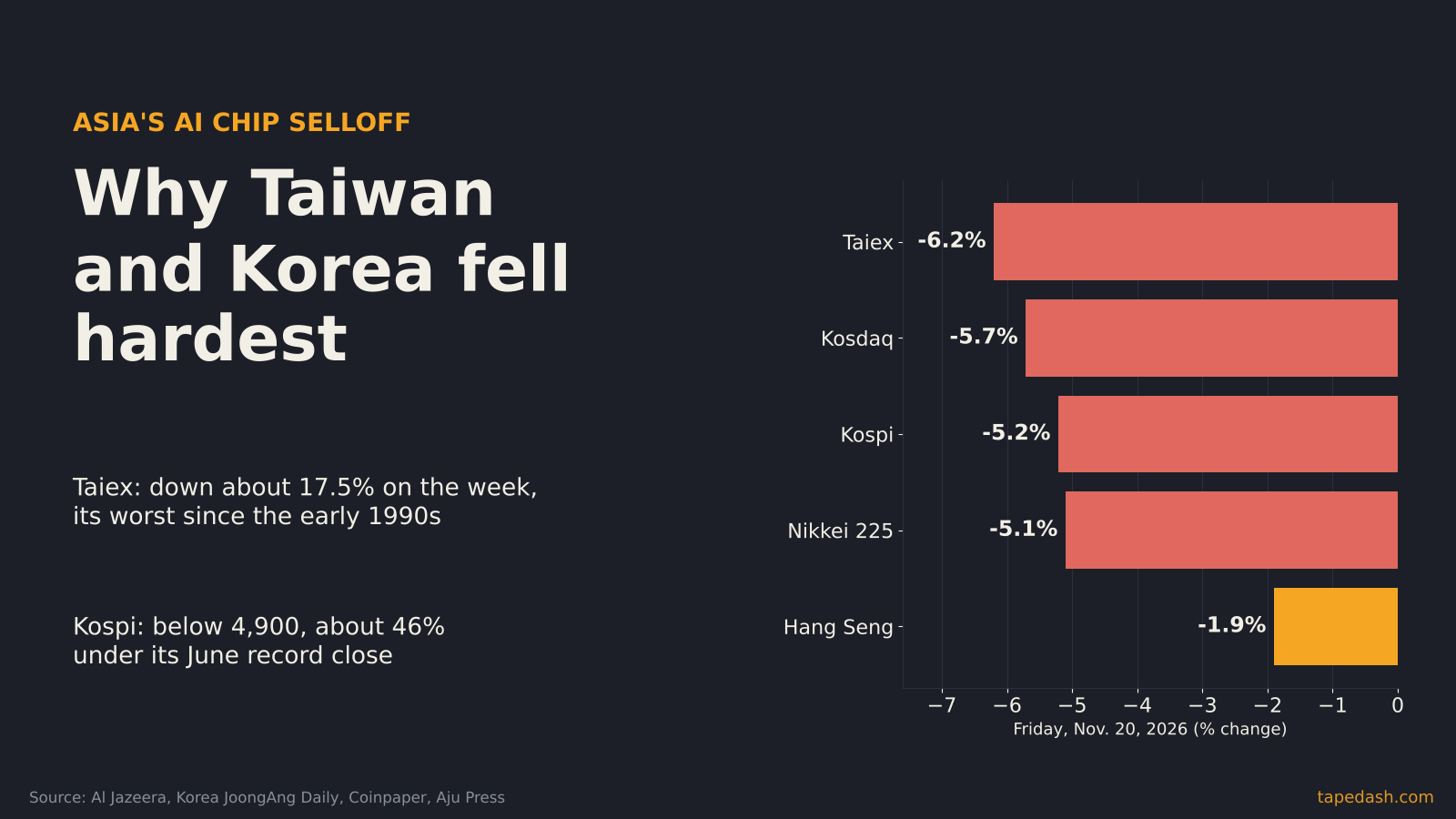
Asian stocks crashed on Friday. Taiwan’s Taiex fell about 6.2%, Korea’s Kospi dropped 5.21% to 4,869.96 and Japan’s Nikkei 225 lost 5.1% (Al Jazeera, Korea JoongAng Daily, Coinpaper). For Taiwan it capped a week in which the index lost roughly 17.5%, its worst stretch since the early 1990s (Trading and Investment News, Coinpaper). Hong Kong, by comparison, fell 1.9%.
So why did Taiwan and Korea get hit so much harder than everyone else? Because their stock markets are, to a degree most U.S. investors don’t appreciate, the AI chip trade. When Wall Street sold semiconductors on Thursday, the selling landed overnight on the handful of companies that make up most of Taiwan’s and Korea’s market value. Foreign funds sold them because they were the easiest things to sell, the local currency weakened, and Korea’s exchange had to pause program trading.
That’s the short answer. The longer one matters if you hold U.S. chip stocks, emerging market funds or anything priced on AI demand, because Asia is often where this trade breaks first and where it shows you whether the selling is done.
- Friday’s Asian stock crash hit chip-heavy markets hardest: the Taiex fell about 6.2%, the Kospi 5.21% and the Nikkei 225 5.1%, while the Hang Seng fell 1.9%.
- TSMC alone is more than 40% of Taiwan’s stock market value and tech is more than 70% of the Taiex, so the index trades like a semiconductor fund.
- In Korea, foreign investors sold about 1.1 trillion won of stocks and institutions about 951 billion won, while individuals bought about 1.6 trillion won.
- The selling started with Thursday’s U.S. chip slide, then fed on export-control news, Fed hike worries and doubts about AI spending returns.
- The next tests are U.S. PCE inflation on Nov. 25, the Bank of Korea’s rate decision on Nov. 26 and the Fed’s Dec. 8 and 9 meeting.
How bad was the Asian stock market crash on Friday
Start with the scoreboard, because the ranking tells you most of the story.
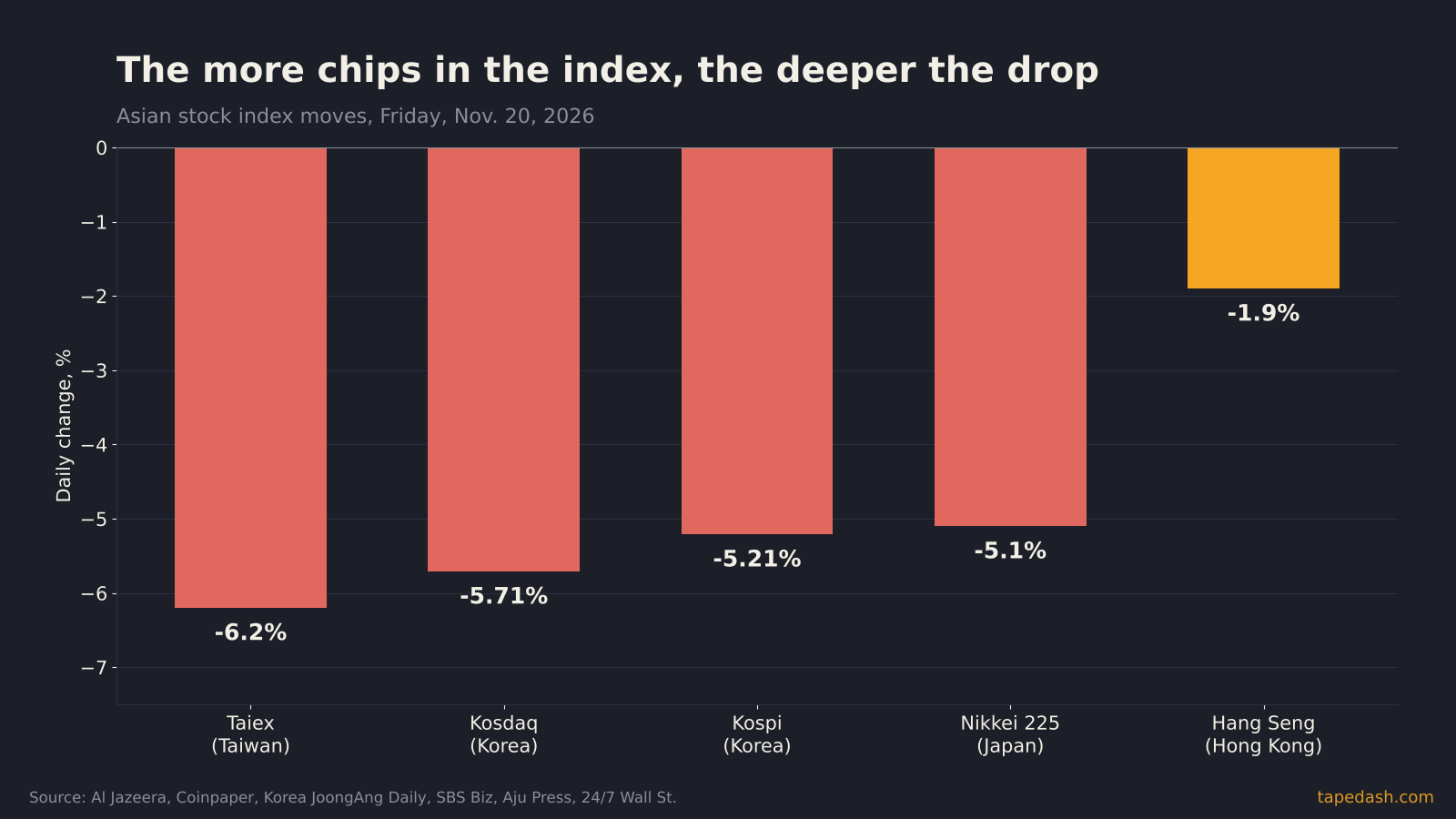
Korea’s numbers are the cleanest because several outlets reported the same exchange data. The Kospi closed at 4,869.96, down 267.93 points, and the tech-heavy Kosdaq fell 5.71% to 645.68 (Korea JoongAng Daily, IBTimes Australia). At its low, the Kospi was down 5.71% at 4,844.57 (Bloomingbit, IBTimes Australia). For the week it lost about 7.9% (IBTimes Australia, 24/7 Wall St.).
The two companies that drive it fell harder than the index. Samsung Electronics (KRX: 005930) closed down 7.01% at 183,100 won, and SK hynix (KRX: 000660) fell 5.92% to 1,113,000 won (SBS Biz, Aju Press).
A note on precision. The reports disagree on whether this is Taiwan’s worst week since 1990 or since 1991, and early intraday figures for the Taiex ranged from 6.2% to 6.7%. That’s normal when a market is moving this fast and wires report at different moments. I’m using the figures that more than one outlet gave for the close.
| Market | Friday move | What’s inside it | Why it fell this much |
|---|---|---|---|
| Taiex (Taiwan) | about -6.2% | TSMC is more than 40% of market value | Almost a pure chip index |
| Kospi (Korea) | -5.21% | Samsung and SK hynix dominate | Memory chips plus foreign selling |
| Kosdaq (Korea) | -5.71% | Smaller tech and biotech | High-beta names, retail-heavy |
| Nikkei 225 (Japan) | -5.1% | Chip equipment, SoftBank, exporters | AI-linked heavyweights |
| Hang Seng (Hong Kong) | -1.9% | Internet, banks, property | Far less exposed to AI hardware |
Why Taiwan’s stock market fell the most
The Taiex is the extreme case, and it’s worth understanding why, because the same structure exists in a milder form in many places, including the S&P 500.
Taiwan Semiconductor Manufacturing (TSM) accounts for more than 40% of Taiwan’s stock market value, and technology stocks make up more than 70% of the Taiex (Superpower Daily, Trading and Investment News, Startup Fortune). Put those together and the index is mostly a bet on the AI hardware supply chain: the foundry, the chip designers, the server assemblers and the packaging houses.
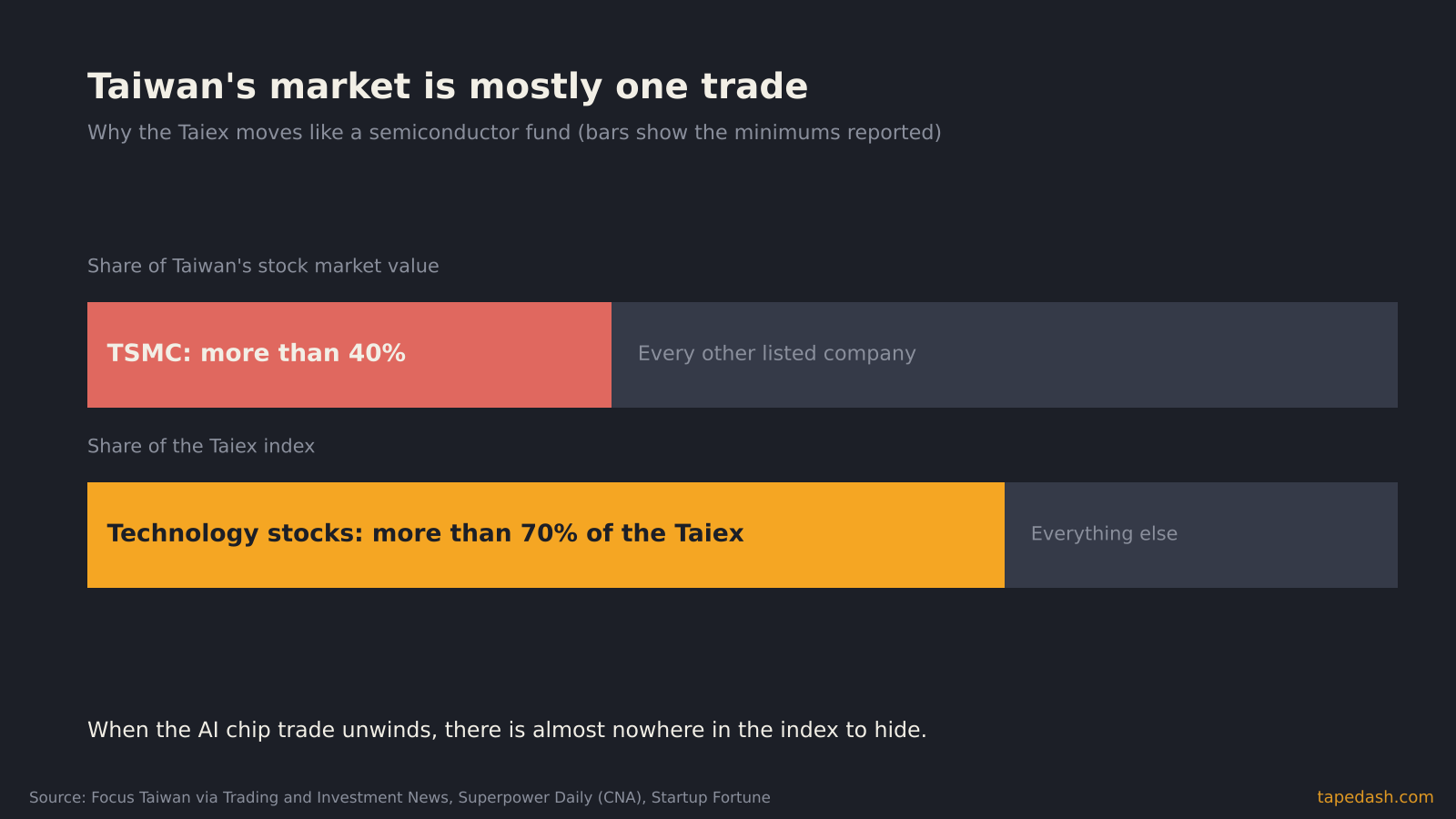
That concentration was a gift on the way up. It’s a trap on the way down. When a global fund manager decides to cut AI exposure, Taiwan isn’t a place to find something else to own. It’s the thing being sold.
Foreign investors did the selling
The data on who sold is clear. Foreign investors have been steady net sellers of Taiwan’s main board, and they sold NT$76.56 billion on Wednesday alone (Startup Fortune, Superpower Daily). Across three sessions this week, foreign net selling topped NT$180 billion, by both outlets’ tallies.
TSMC’s Taipei shares fell about 5% on Friday (Trading and Investment News, Coinpaper). On a stock that big, a 5% move by itself takes a couple of percentage points off the index.
Regulators tried short-selling curbs, and it didn’t stop the drop
Taiwan’s Financial Supervisory Commission tightened short-selling rules for the second time this month, with new curbs starting Friday morning, the same morning the index fell more than 6% (Trading and Investment News, Startup Fortune, Superpower Daily). This is the oldest lesson in market structure. Short sellers are rarely the main source of supply in a crash like this. Long holders who want out are. Banning one type of seller doesn’t create buyers.
Why the Kospi crashed below 4,900
Korea had a different setup with the same ending. The Kospi first topped 9,000 in June and closed at a record 9,063.84 on June 18, led by Samsung and SK hynix (The Star (Reuters), The Korea Times). Friday’s close leaves it about 46% below that record.
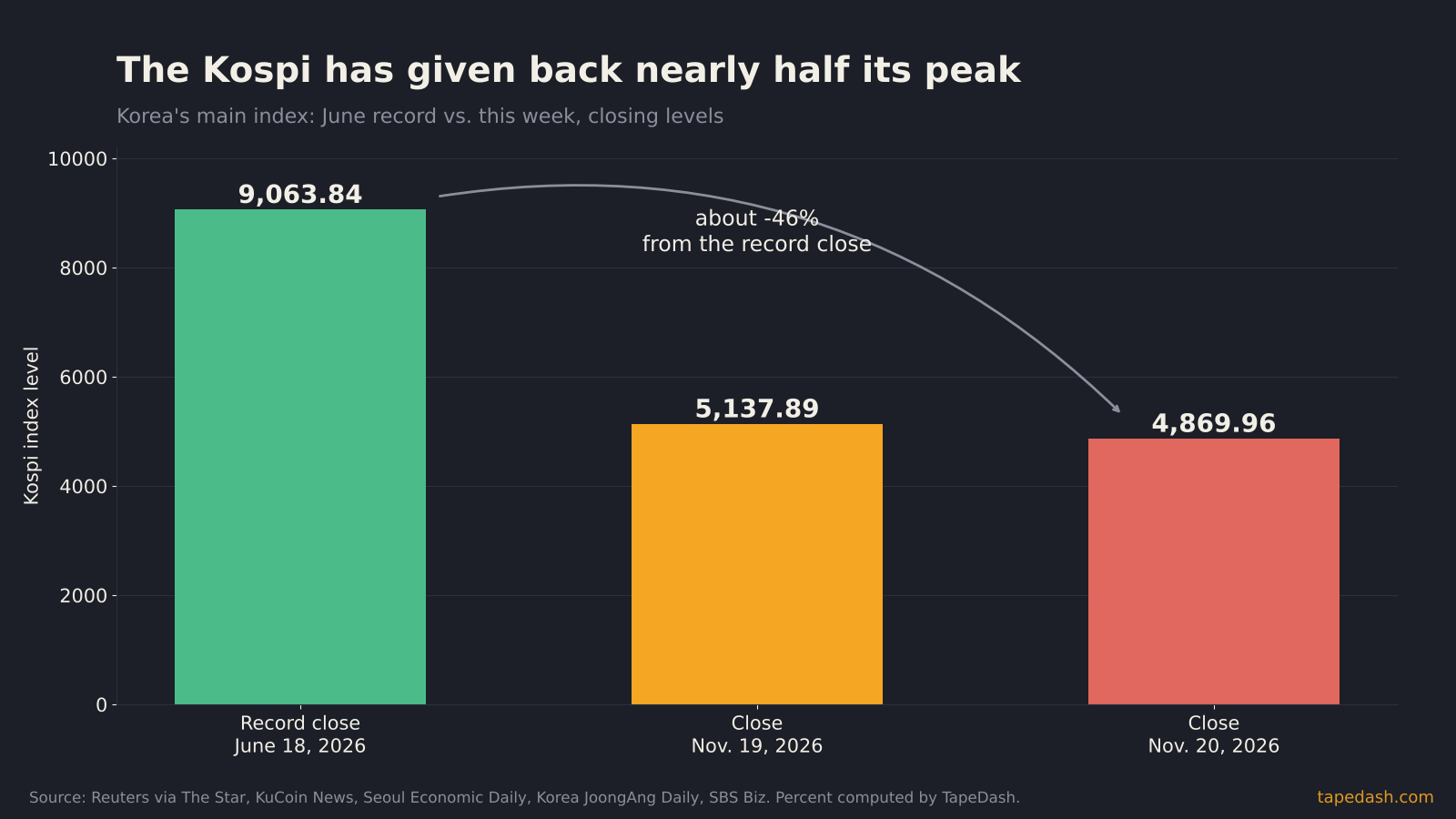
Thursday is worth a look too. The Kospi actually rose that day and closed at 5,137.89 (Seoul Economic Daily, IBTimes Australia). Korean markets close before New York opens, so Thursday’s U.S. chip selloff hadn’t happened yet when Seoul shut. All of it arrived at Friday’s open, which came in down about 4% before the selling picked up.
Who sold in Korea, and who bought
The flow data is where Korea gets interesting.
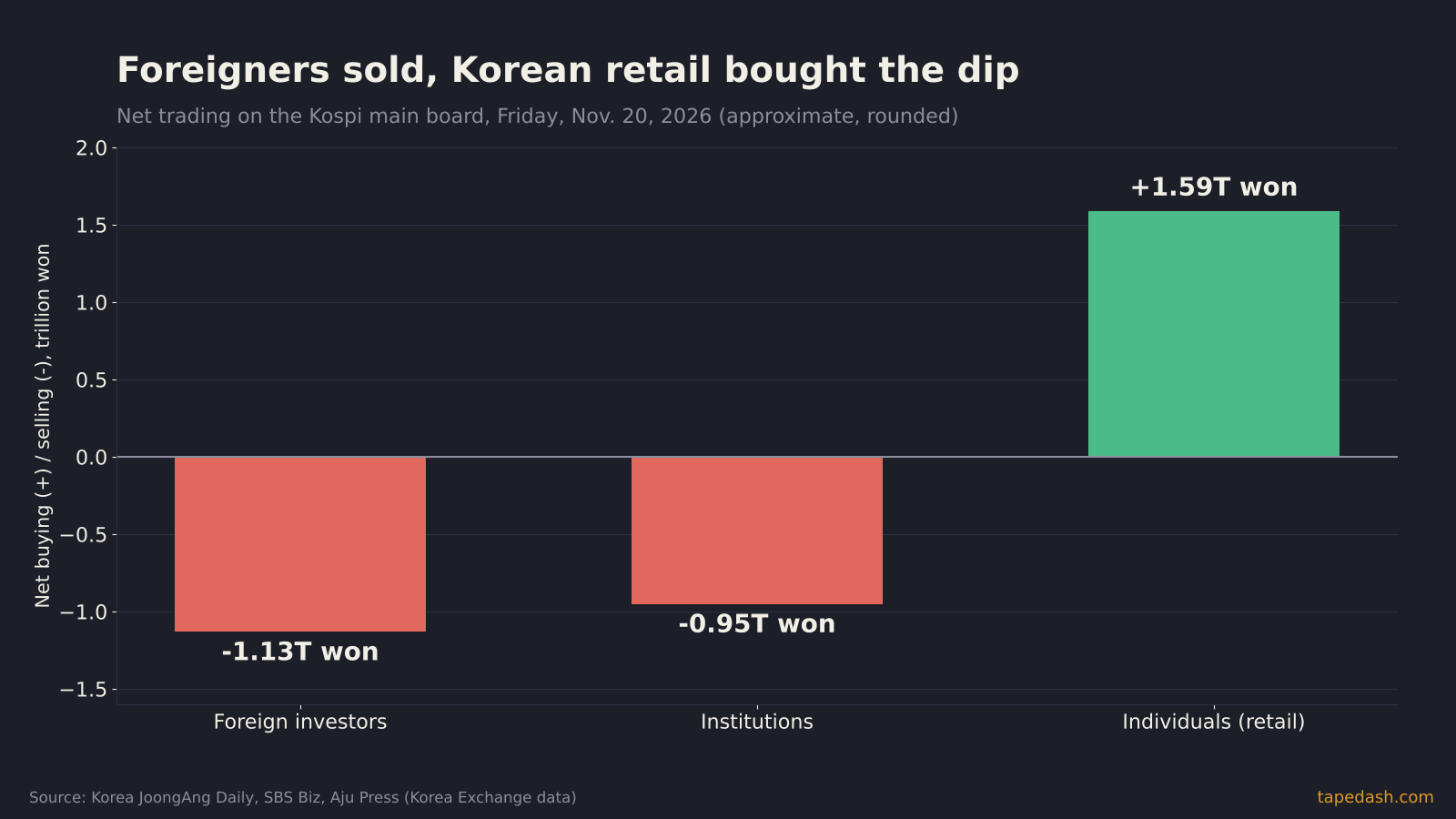
On the main board, foreign investors were net sellers of about 1.1 trillion won and institutions sold about 951 billion won, while individual investors bought about 1.6 trillion won (Korea JoongAng Daily, SBS Biz, Aju Press). That pattern, professionals out and retail in, shows up in almost every sharp Korean selloff. It doesn’t tell you the bottom is in. It tells you who now owns the supply.
The exchange also triggered “sidecars” on both the Kospi and the Kosdaq. A sidecar pauses program trading for five minutes when futures move 5% or more. The Kospi’s went off just before noon (IBTimes Australia, Aju Press). It’s a speed bump, not a floor, and selling picked back up once it was lifted (Bloomingbit).
The won weakened as foreigners sold, with the dollar at 1,336.2 won against 1,330.0 the day before (Korea JoongAng Daily, Aju Press). That’s a small move by won standards. The direction matters more than the size: a foreign fund selling Korean stocks has to sell won to bring the money home.
What caused the AI chip selloff in Asia
No single headline did this. It was several things landing in the same 24 hours on a market that was already nervous.
The U.S. chip slide on Thursday. The Dow fell 1,101 points, or 2.2%, and the Nasdaq Composite fell 2.3% (Yahoo Finance (Zacks), Seoul Economic Daily). The Philadelphia Semiconductor Index dropped 2.42% (SBS Biz, Bloomingbit). Advanced Micro Devices (AMD) fell 7.7%, Nvidia (NVDA) 3.3% and Micron Technology (MU) 2.1% (Yahoo Finance, Seoul Economic Daily).
The AMD export report. Part of AMD’s drop followed a report from Hunterbrook Media, which is affiliated with a short seller, saying newer AMD firmware had turned up in server products from a Chinese company on a U.S. trade blacklist (Aju Press, MoneyToday). The report did not establish a violation, and AMD has said it complies with the rules. For Asian chip stocks, though, the headline mattered more than the verdict.
Tighter U.S. export controls. The Commerce Department’s Bureau of Industry and Security added new license requirements aimed at stopping Chinese AI developers from remotely using top-end computing power in third countries (Al Jazeera, Korea JoongAng Daily). Korean outlets also cited a Financial Times report that Samsung and TSMC had halted some shipments to Chinese customers (Korea JoongAng Daily, SBS Biz).
Doubts about AI returns and leadership at Nvidia. Reuters’ Asia wrap listed concerns about AI valuations, profitability and rising debt, along with Jensen Huang’s departure from Nvidia, which led to crowded bets being unwound (The Standard, Trading and Investment News). I covered the Nvidia leadership story in Jensen Huang resigns as Nvidia CEO, and the spending side in AI capex explained.
Rates. Several Korean brokers pointed to worries about further Fed tightening (Korea JoongAng Daily, MoneyToday). Higher rates hurt long-duration growth stocks the most, and AI hardware is priced on earnings years out.
Then Friday in New York made it worse, with tech and chip stocks selling off again (The Motley Fool, StockTitan). That hands Asia a weak lead into Monday.
How a U.S. selloff spreads to Asian markets
This is the mechanism worth learning, because it repeats.
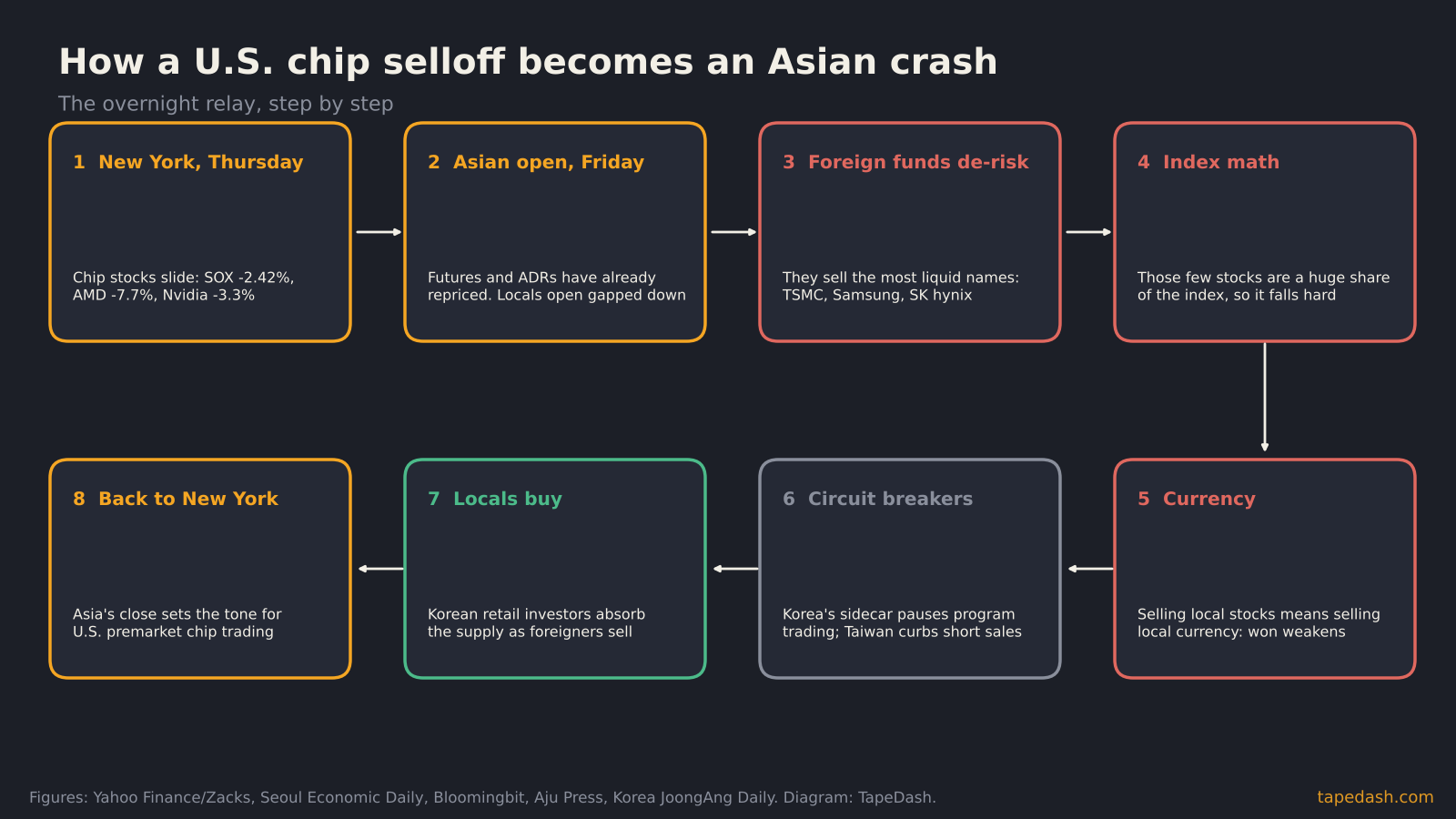
The relay runs on time zones. New York closes at 4 p.m. Eastern, which is early morning in Seoul and Taipei. By the time those markets open, U.S.-listed shares of the same companies and the index futures have already repriced. Local stocks open gapped down to catch up.
Then the index math kicks in. A global fund that wants less AI hardware exposure sells what’s big and liquid: TSMC, Samsung, SK hynix. Those are also the biggest weights in their home indexes, so the index falls more than the average stock. A falling currency raises the bar for foreign investors who are still holding, because they now lose on both the stock and the exchange rate. That can push another round of selling.
The relay also runs the other way. Asia’s close sets the tone for U.S. premarket trading in chip stocks. On Friday, TSMC’s U.S. shares were down about 4% before the New York open (24/7 Wall St.). If you trade U.S. semis, the Asian session is your early warning system. I wrote about a similar cross-border unwind in the yen carry trade explained.
How to read an Asian selloff like a trader
When a move like this hits, a few checks tell you more than the headline percentage. Here’s the order I use.
1. Compare the chip-heavy markets with the rest. If Taiwan and Korea fall 5% to 6% and Hong Kong falls 2%, the selling is about one theme. If everything falls the same amount, it’s a broad risk-off event, which is a different trade. Friday was clearly the first kind.
2. Watch the foreign flow numbers, not just prices. Korea and Taiwan publish daily net buying and selling by investor type. A selloff ends when foreign selling slows, not when retail buys more. Foreign selling in Taiwan that runs for weeks, not days, says this is a portfolio decision rather than a one-day panic.
3. Watch the currency. If the won and the Taiwan dollar stabilize while stocks are still falling, foreign selling is usually close to done. If the currencies keep sliding, money is still leaving.
4. Check how the U.S. proxies trade overnight. The iShares MSCI Taiwan ETF (EWT), the iShares MSCI South Korea ETF (EWY), the iShares MSCI Japan ETF (EWJ) and the VanEck Semiconductor ETF (SMH) trade during U.S. hours. They tell you where Asia is likely to open before it opens.
5. Treat policy fixes with skepticism. Short-selling curbs and sidecars change how fast prices move. They don’t change who wants to sell. Taiwan’s new curbs started the same morning as a 6% drop.
For a longer guide to telling a healthy market from a fragile one, see market breadth indicators. And if this rhymes with the U.S. chip drop earlier this month, it should; I broke that one down in Nasdaq correction: why the chip index fell 12% in one day.
Who wins and who loses from the chip selloff
The obvious losers are holders of concentrated AI hardware exposure: Taiwan and Korea index funds, semiconductor ETFs, and the suppliers whose earnings depend on data center orders. Korean retail investors, who bought heavily into the decline, are also exposed if foreign selling continues.
The less obvious point is that markets with little AI hardware fell much less. Hong Kong’s 1.9% drop is the clearest example in the region. That’s a reminder that “Asia” isn’t one trade. A fund that bought the region for diversification and got mostly Taiwan and Korea chip exposure found out this week what it actually owned.
Korea’s local analysts are split. Hanwha’s Ha Jang-kwon argued that prices are “already discounting about 60 percent of 2027 earnings estimates” and kept a buy-the-dip view, while Samsung Securities advised a cautious stance (Korea JoongAng Daily). Both can be right. Cheap stocks can get cheaper while the flows are still leaving.
What to watch next for Asian stocks
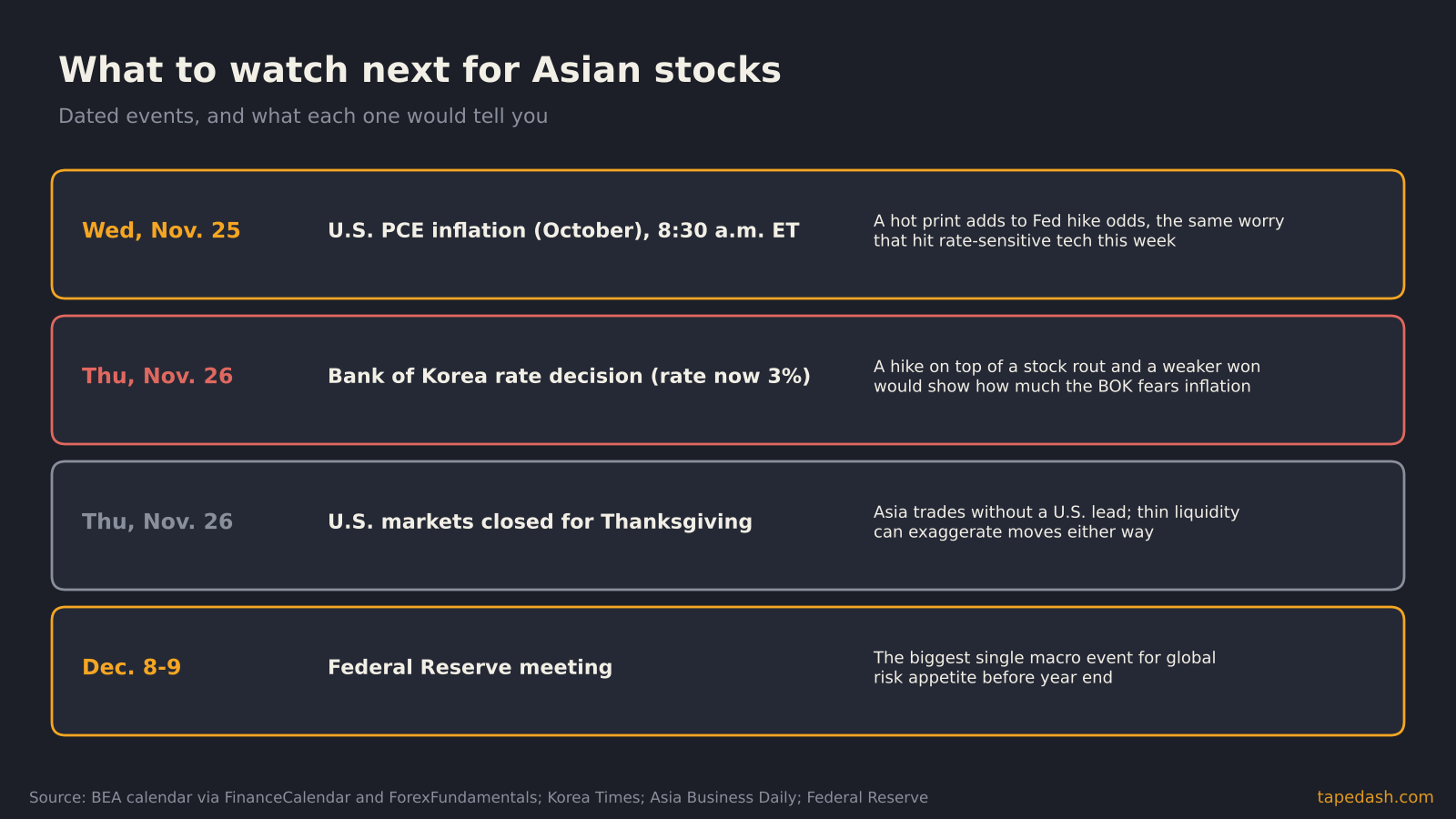
- Wednesday, Nov. 25, 8:30 a.m. ET: U.S. PCE inflation for October. A hot number adds to Fed hike odds, which is one of the pressures on long-duration tech (FinanceCalendar, ForexFundamentals).
- Thursday, Nov. 26: Bank of Korea rate decision. The base rate is 3%, and before this week’s selloff, many analysts expected a hike (The Korea Times, Asia Business Daily). If the BOK hikes into a stock rout, it’s telling you it fears inflation and a weak won more than a market drop. If it holds, traders will read that as a nod to financial stability.
- Thursday, Nov. 26: U.S. markets closed for Thanksgiving. Asia trades that day without a U.S. lead, and thin holiday trading can exaggerate moves either way.
- December 8 and 9: the Fed meeting. The biggest macro event for global risk appetite before year end (Federal Reserve, Fed Rate Calc).
Beyond the calendar, watch the daily foreign flow numbers out of Seoul and Taipei. Those will tell you whether this was a capitulation week or the middle of a longer exit.
How to track the Asian chip selloff with TapeDash
If you want to watch whether money keeps leaving Asian chips or starts coming back, the U.S.-listed ETFs are the cleanest window from here. ETF Flows shows creations and redemptions in funds like EWT, EWY and SMH, so you can see whether investors are pulling capital or adding during the drop. Unusual Flow shows large options trades as they print in TSM, NVDA, AMD and MU, which is the fastest way to tell protective put buying from fresh bets on a rebound.
For the macro side, Macro Pulse puts the PCE print, Fed odds and the dollar on one screen, which matters this week because rates and the currency are doing as much work as chip news. You can see it together in the Terminal Preview, or start with the free TapeDash Daily for a morning read on flows and the calendar. If you join now, the first 200 members lock Pro at $69.99 a month on their account, even if they cancel and come back later.
Asian stocks crash FAQ
Why did Asian stocks crash on Nov. 20, 2026?
A U.S. chip selloff on Thursday spread to Asia overnight, adding to worries about AI valuations, new U.S. export controls, a short seller’s report on AMD and possible Fed tightening. The selling was heaviest in markets dominated by chipmakers.
Why did Taiwan fall more than other Asian markets?
TSMC alone is more than 40% of Taiwan’s stock market value, and tech is more than 70% of the Taiex. When global funds cut AI hardware exposure, Taiwan has almost nothing in its index to offset the drop.
Who was selling Korean stocks?
Foreign investors and institutions. On Friday, foreigners sold about 1.1 trillion won and institutions about 951 billion won on the main board, while individual investors bought about 1.6 trillion won.
The one thing to remember
Know what your index actually holds. Taiwan and Korea didn’t fall harder because their economies changed on Friday. They fell harder because their stock markets are concentrated bets on AI chips, and when that trade unwinds, it unwinds there first and fastest. Watch the foreign flows and the currency. When those stop bleeding, the selling usually does too.
See it on the tape, not just in the headlines
TapeDash is a market research and data analytics platform for traders and investors: live options flow, dealer positioning, a real-time market scanner, stock ratings, and macro and earnings data in one terminal. Memberships open Black Friday, November 27, and the first 200 members lock Pro at $69.99 a month on their account, even if they cancel and come back later.
Join the waitlistClick through the terminalSee the track recordSources
- Al Jazeera: Asia's stock markets dive as AI bubble fears deepen (Nov 20, 2026)
- Korea JoongAng Daily: Chip slump rattles Kospi below 5,000, but analysts say buy the dip (Nov 20, 2026)
- SBS Biz: Samsung Electronics and SK Hynix fall as foreigners and institutions sell (Nov 20, 2026)
- Aju Press: KOSPI, Nikkei and TAIEX plunge as AI selloff sweeps Asia (Nov 20, 2026)
- Coinpaper: Asia faces worst market week since 2020 (Nov 20, 2026)
- 24/7 Wall St.: AMD and Taiwan Semiconductor slide after Asia's chip selloff (Nov 20, 2026)
- The Standard (Reuters): Chip selloff sends Taiwan toward worst week since 1990 (Nov 20, 2026)
- Trading and Investment News: Taiex loses 17.5% in worst week as short curbs start (Nov 20, 2026)
- Startup Fortune: Taiwan stocks head for their worst week since 1991 (Nov 20, 2026)
- Superpower Daily: Taiwan stocks fall more than 6%, heading for worst week since 1991 (Nov 20, 2026)
- IBTimes Australia: KOSPI crashes 5% below 4,900 as sidecar triggers (Nov 20, 2026)
- Seoul Economic Daily: Samsung, SK hynix tumble as KOSPI opens below 5,000 (Nov 20, 2026)
- Bloomingbit: Selling persists after sidecar lifted as Kospi breaks below 4,850 (Nov 20, 2026)
- MoneyToday: KOSPI breaks below 4,900 as investors seek rebound catalysts (Nov 20, 2026)
- Yahoo Finance (Zacks): Stock market news for Nov 20, 2026
- The Motley Fool: Stock market today, Nov. 20, stocks plunge as AI trade unwinds
- The Star (Reuters): South Korea's KOSPI index tops 9,000 as chipmakers hit records (Jun 18, 2026)
- The Korea Times: Kospi tops another historic milestone, 9,000 (Jun 18, 2026)
- The Korea Times: Fed's hawkish hold strengthens case for BOK's hike in November (Oct 29, 2026)
- Asia Business Daily: Final Monetary Policy Board meeting of the year (Nov 1, 2026)
- FinanceCalendar: US Personal Income and Outlays (PCE), Nov 25, 2026
- ForexFundamentals: US PCE Price Index, Nov 25, 2026
- Federal Reserve: December 2026 calendar
- Fed Rate Calc: FOMC meeting schedule, December 2026
- StockTitan: Stock market today live, November 20, 2026
This article is for educational and informational purposes only. It is not financial, investment, medical or legal advice, and it is not a recommendation to buy or sell any security. Figures come from the sources listed and were checked on the date of publication; markets change quickly. Options trading involves substantial risk of loss.