The Yen Carry Trade Explained: Why Japan Can Shake Global Markets
The yen carry trade explained: how cheap yen funds global bets, why the August 2024 unwind hit every market, and what the Bank of Japan means for it now.

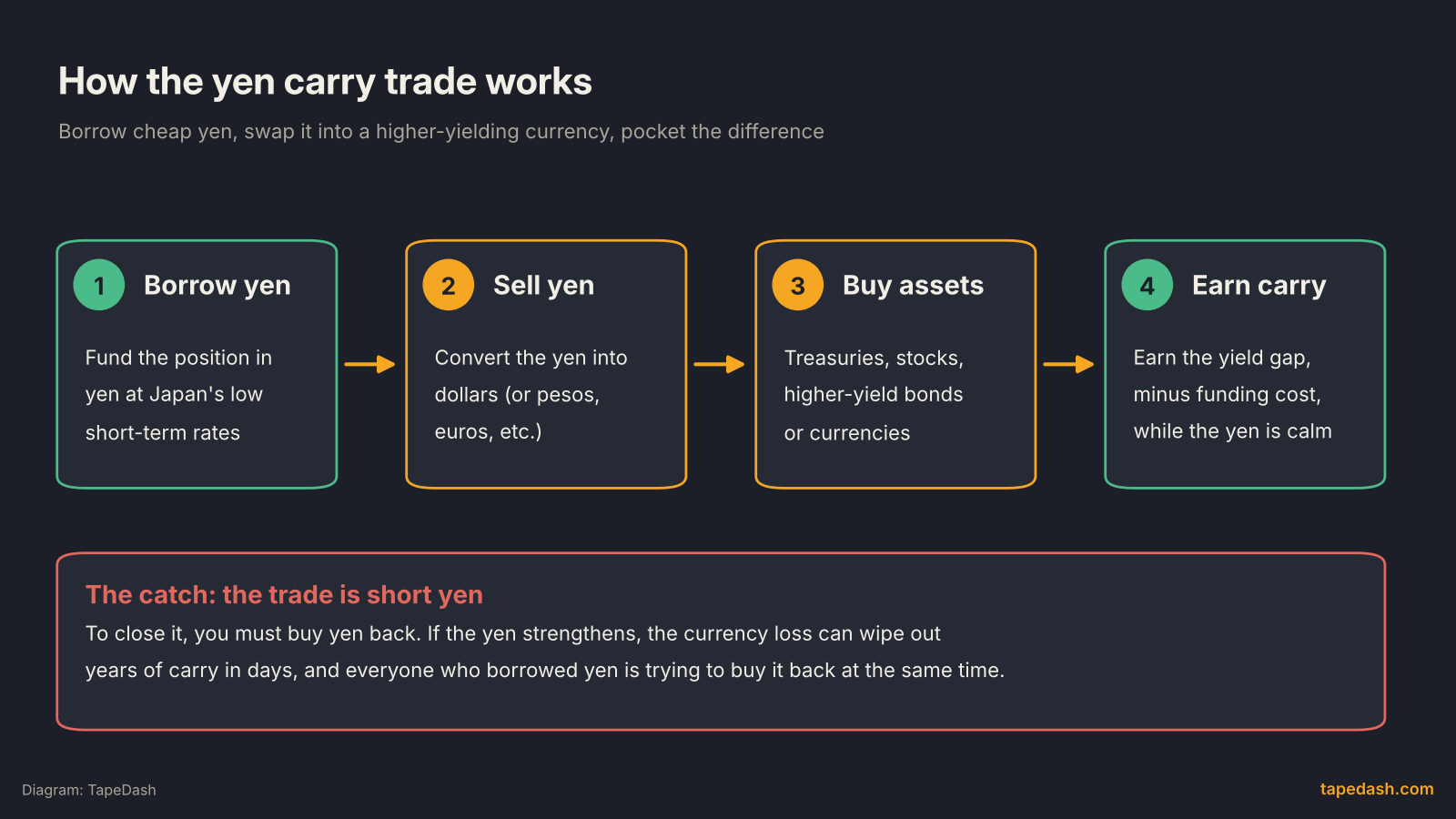
The yen carry trade is a simple bet with a dangerous tail. You borrow yen, where interest rates have been near zero for most of the last 30 years, swap it into dollars or another higher-yielding currency, and collect the difference in interest. It works quietly for years. Then the yen jumps, everyone who borrowed it tries to buy it back at once, and the selling spills into stocks, bonds and currencies that have nothing to do with Japan.
That is what happened on August 5, 2024. Japan’s Nikkei 225 fell 12.4%, its worst day since the 1987 crash, and Wall Street’s fear gauge, the VIX, spiked above 65 before the U.S. open. A week earlier the Bank of Japan had raised rates. Two days earlier a weak U.S. jobs report had traders betting on faster Fed cuts. The gap between U.S. and Japanese rates was shrinking from both ends, and the most crowded trade in currency markets came apart.
The reason this matters again now: the Bank of Japan has kept going. Its policy rate is 1.25%, the highest since 1995, and its next decision lands overnight Thursday, October 29, U.S. time. Here is how the trade works, how an unwind spreads, what August 2024 taught us, and the signals I watch to tell a calm carry market from a stressed one.
- A yen carry trade borrows yen at low rates and invests in higher-yielding assets abroad. The profit is the rate gap, and the risk is a sudden rise in the yen.
- In August 2024 the dollar fell from 161.96 yen on July 3 to about 142 on August 5, the Nikkei dropped 12.4% in a day and the VIX hit 65.73 intraday.
- The Bank of Japan has raised rates six times since March 2024, from -0.1% to 1.25%. The gap to the top of the Fed’s range is about 2.75 points, roughly half what it was in July 2024.
- Watch USD/JPY, the US-Japan rate gap, CFTC positioning in yen futures and cross-asset volatility. Stress shows up when several move at once.
- The next tests are the BOJ decisions on October 30 and December 18 (Tokyo time) and the Fed’s December 8 to 9 meeting.
What is the yen carry trade?
“Carry” is the return you earn just for holding a position, before any price change. In currency markets it means borrowing in a low-rate currency and lending, or investing, in a high-rate one. The Christian Science Monitor put it plainly in the week of the 2024 selloff: borrow cheaply in one currency to earn higher returns in another.
The yen has been the world’s favorite funding currency for a simple reason. Japan held its short-term rate at or near zero for most of the past two decades, and kept it at -0.1% until March 19, 2024. Borrowing yen cost next to nothing. Meanwhile the Federal Reserve held its benchmark at 5.25% to 5.50% through July 2024. A gap that wide, with low volatility on top, is the textbook setup.
Who runs the trade
It is not one trade. Hedge funds and CTAs do it directly in currency futures and forwards. Banks outside Japan lend yen to clients. Japanese households and pension funds do a slow-motion version by moving savings into foreign stocks and bonds. Plenty of investors are in it without calling it a carry trade at all: anyone financing a portfolio in yen, or anyone short yen through a currency position, owns the same risk.
A worked example (hypothetical)
Here are illustrative numbers, not a trade recommendation. Say a fund borrows ¥157 million at 1.25% and converts it at 157 yen per dollar, getting $1 million. It buys an asset yielding 4%. The carry is about 2.75% a year, or roughly $27,500.
Now say the yen strengthens to 142 per dollar, about the move seen in five weeks in 2024. Repaying ¥157 million now costs about $1.106 million. The currency loss is around $105,600, close to four years of carry, and that is before any loss on the asset itself. Add leverage and the math gets worse fast. That asymmetry, small steady gains and rare large losses, is why traders describe carry as “picking up pennies in front of a steamroller.”
Why the yen carry trade grew so large
Three things fed it. The first was the rate gap. Through 2023 and the first half of 2024, U.S. rates sat above 5% while Japan’s were near zero, and other markets, from Mexico to India, paid even more.
The second was a falling yen. When the funding currency keeps weakening, carry traders earn the interest gap and a currency gain on top. The dollar climbed to 161.96 yen on July 3, 2024, the weakest yen since December 1986, according to FXLeaders as well. A trade that pays you twice attracts a crowd.
The third was calm. Carry works best when volatility is low, because risk models let funds run bigger positions when prices barely move. That is also why the unwind is so violent: the same models that allowed the size demand it be cut when volatility jumps.
How big did it get? Nobody knows exactly. The Bank for International Settlements put a rough middle estimate of about ¥40 trillion, around $250 billion, on FX carry positions going into August 2024, and said that figure is probably understated because of data gaps, a point The Full FX also highlighted. Broader definitions that count every yen-funded investment run far higher.
How a carry trade unwind works
An unwind is a feedback loop. Something narrows the rate gap or raises the odds that it will narrow. The yen rises. Carry positions lose money on the currency leg. Losses trip risk limits and margin calls. To cut risk, funds sell what they bought, which can be U.S. tech stocks, emerging-market bonds or the Mexican peso, and buy yen to repay loans. That buying pushes the yen higher still, and the loop runs again.

Two features make it spread beyond currencies. First, the assets being sold are often the most crowded winners, so an unwind can look like a tech selloff or an emerging-market scare. Second, volatility itself is an input. When the VIX jumps, volatility-targeting funds cut exposure automatically, which adds selling that has nothing to do with Japan. The BIS described August 2024 as another case of volatility amplified by procyclical deleveraging and margin increases. If you want the mechanics of the fear gauge itself, our VIX explainer covers how it is built and what a spike like that means.
The loop usually breaks one of two ways. Either positioning gets cleared, meaning there are no more forced sellers, or policymakers signal that they will not add pressure. In 2024 it was both.
The August 2024 yen carry trade unwind, step by step
The timeline is short, which is the point.
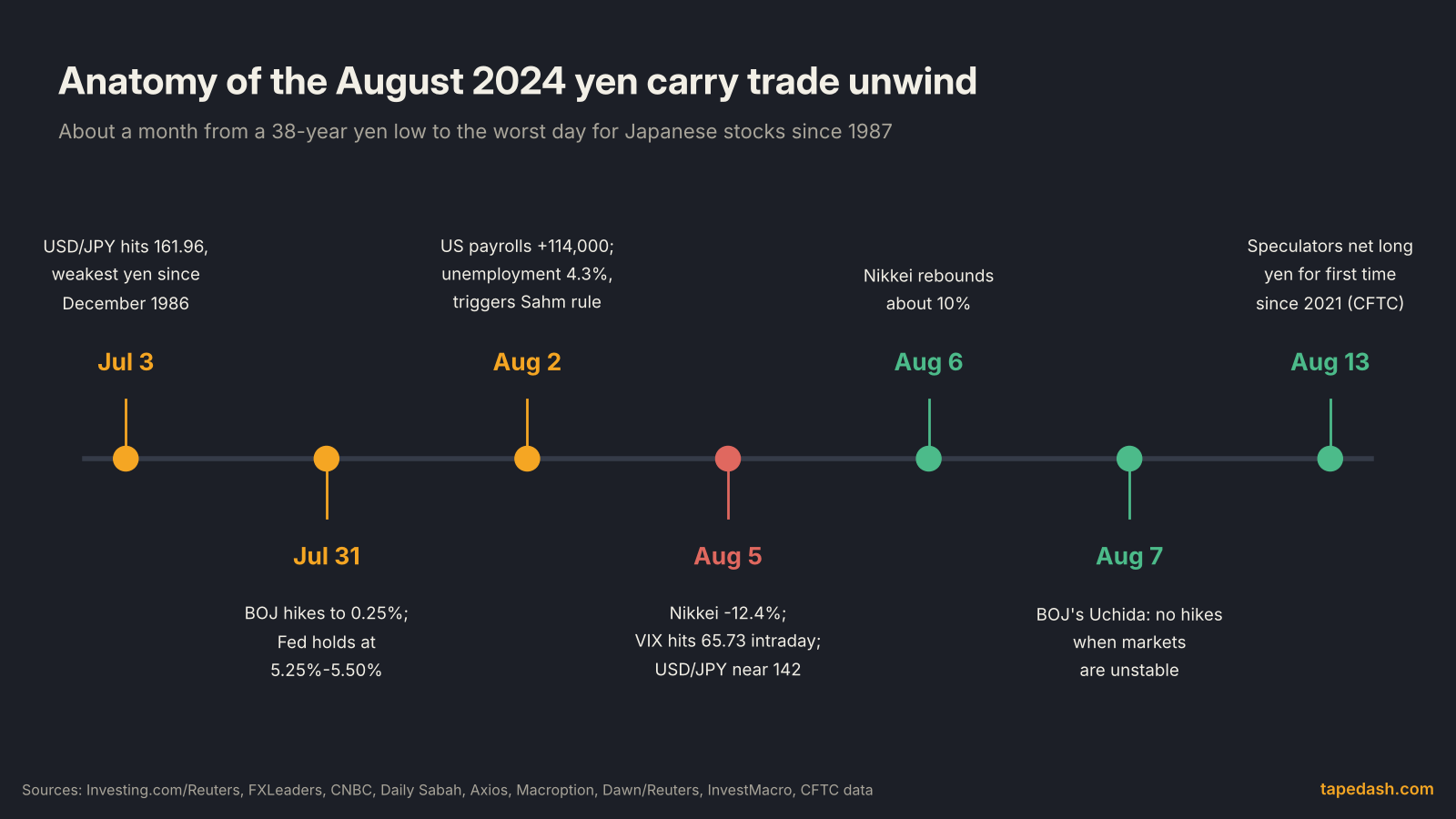
The setup. Speculators were heavily short the yen. CFTC data showed them net short about 184,000 yen futures contracts in early July, their biggest bet against the yen in 17 years, according to Reuters and InvestMacro, which recorded -184,223 contracts on July 2.
The triggers. On July 31 the Bank of Japan raised its policy rate to 0.25% from a range of 0% to 0.1%. The same day, the Fed held at 5.25% to 5.50% while Chair Jerome Powell said a cut could come in September, as Euronews reported. Two days later the July jobs report showed only 114,000 jobs added and unemployment rising to 4.3%, enough to trigger the Sahm rule recession indicator. Now the gap was closing from both sides: Japan hiking, the U.S. expected to cut faster.
The break. On Monday, August 5, the Nikkei fell 12.4%, or 4,451 points, to 31,458.42, and the broader Topix fell 12.2%, per CNBC and Daily Sabah. The dollar dropped to around 142 yen, the yen’s strongest level since early January, and Reuters noted the yen had gained about 14% in three weeks. Before the U.S. open, the VIX hit 65.73, then closed at 38.57, according to Reuters and Macroption.
The stop. The Nikkei bounced about 10% the next day. On August 7, Bank of Japan Deputy Governor Shinichi Uchida said, in Reuters’ report, “We won’t raise interest rates when financial markets are unstable.” The yen weakened on the remarks. By the week ending August 13, speculators were net long the yen for the first time since March 2021. The crowded short had been cleared.
What strikes me looking back is how ordinary the triggers were. A 15 basis point hike and one weak jobs report. The damage came from positioning, not news. That is the lesson I carry into every Bank of Japan meeting.
The Bank of Japan’s policy path and what it means now
Since August 2024 the BOJ has kept tightening, slowly and with plenty of warning.
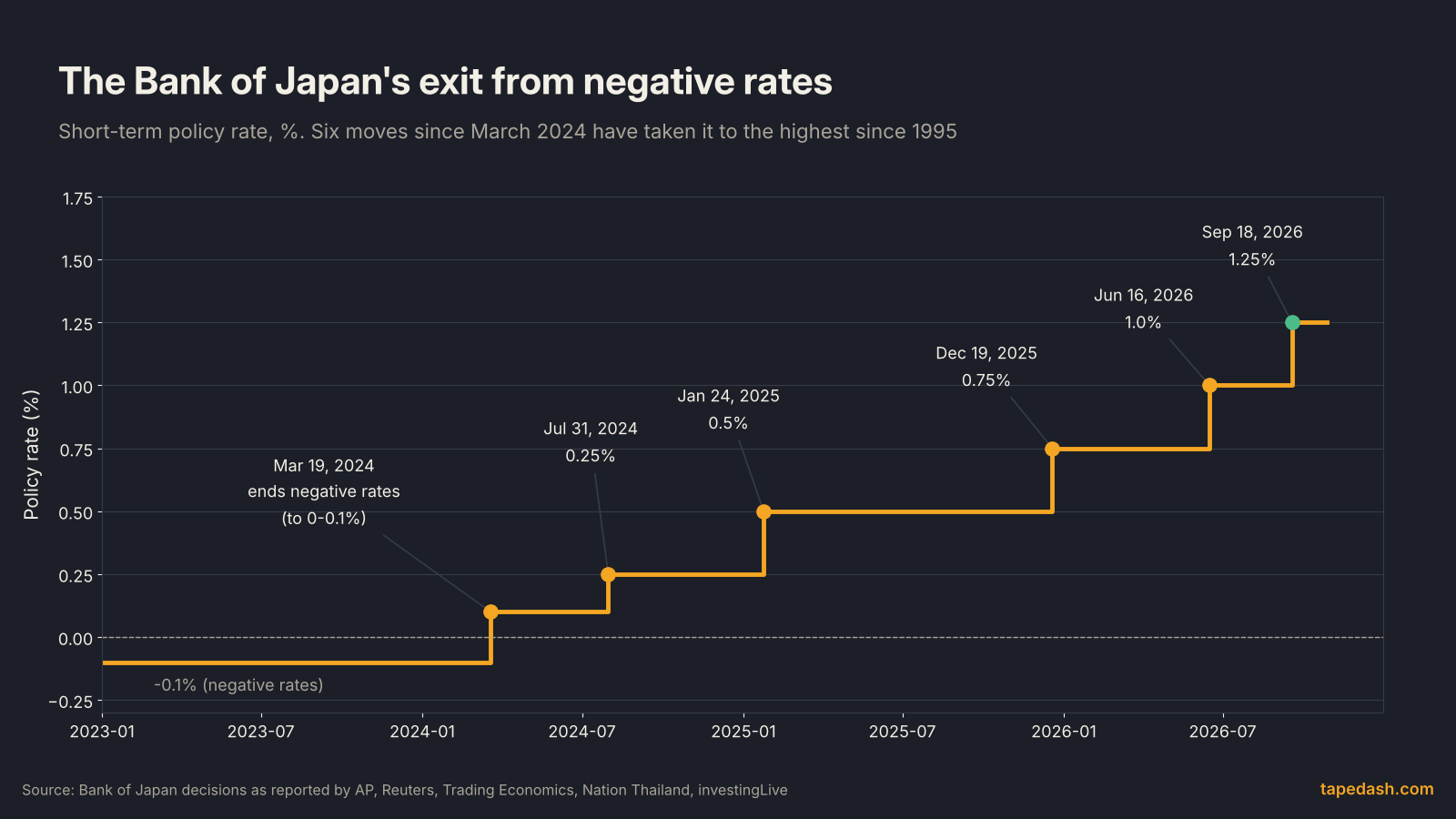
It went to 0.5% on January 24, 2025, to 0.75% on December 19, 2025, to 1% on June 16, 2026, and to 1.25% on September 18, 2026 in a 7-2 vote, the highest since 1995. Its statement said it expects core inflation to run clearly above 2% from the second half of fiscal 2026, per the Summary of Opinions coverage.
You would expect all those hikes to have crushed the carry trade. They have not, and the reason is the other side of the gap. The Fed raised its target to 3.75% to 4.00% at its September 15 to 16 meeting, its first increase since 2023, and that was still the range going into Wednesday’s decision, per Newsquawk.
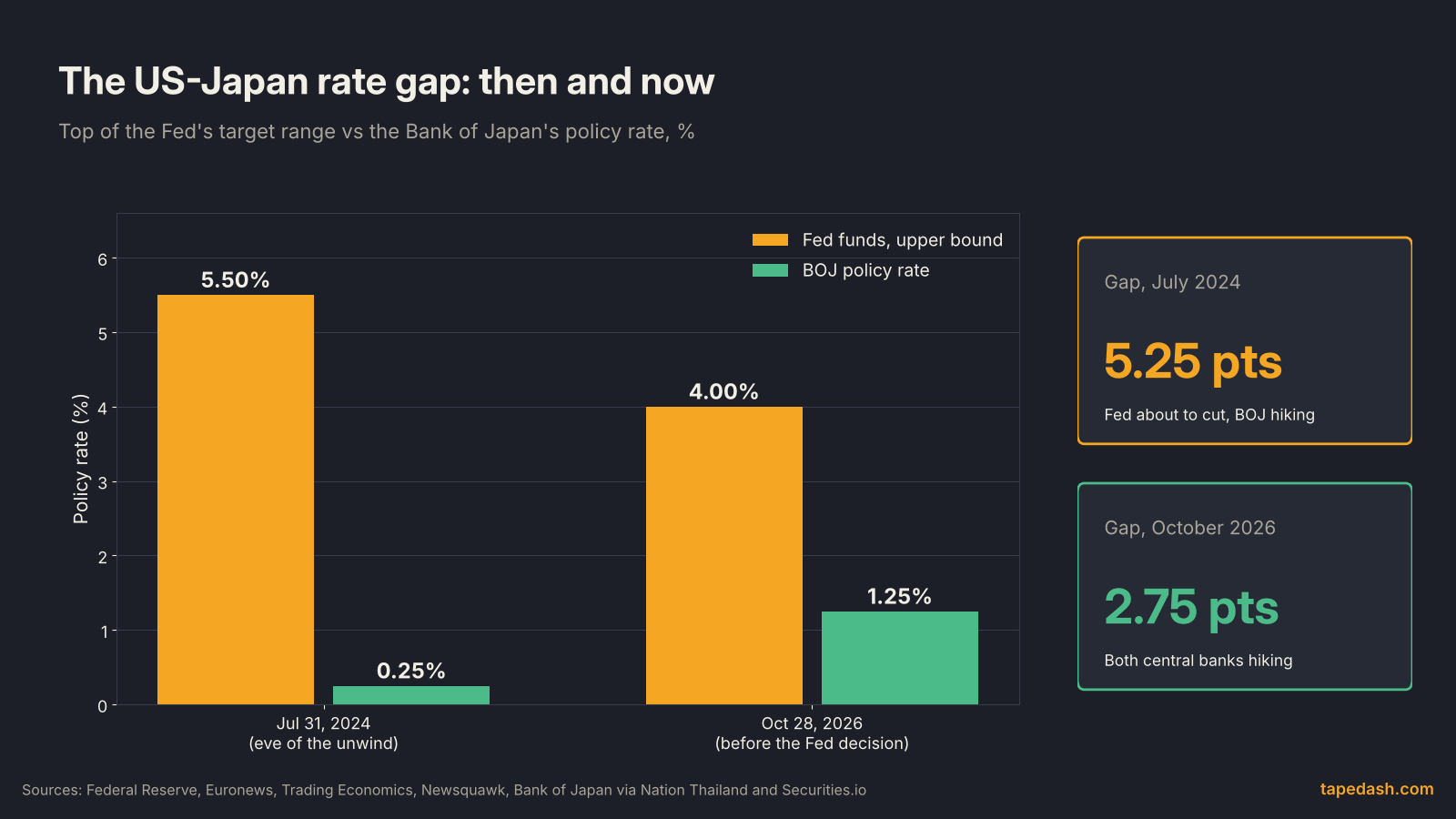
The yen has stayed weak anyway. The dollar pushed past 163 yen in July 2026, again the weakest yen since 1986 according to NewsBytes. This month it has traded roughly between 156 and 159, closing Monday, October 26 near 156.8 per Pound Sterling Live and Trading Economics. A 2.75-point gap with a weak yen still pays carry traders, and Trading Economics notes carry trades are still weighing on the currency.
Here is how the two setups compare.
| Factor | July 2024 (before the unwind) | October 2026 (now) |
|---|---|---|
| BOJ policy rate | 0.25% after the July 31 hike | 1.25% after the September 18 hike |
| Fed target range | 5.25% to 5.50% | 3.75% to 4.00% before the Oct 28 decision |
| Gap to the Fed’s upper bound | 5.25 points | 2.75 points |
| USD/JPY | 161.96 peak on July 3 | Roughly 156 to 159 in October |
| Fed direction | Signaling a September cut | Hiked in September, December in play |
| Speculative yen position | Biggest net short in 17 years | Check the latest weekly CFTC report |
| Main unwind risk | Gap closing from both sides at once | A hawkish BOJ surprise meeting a dovish Fed turn |
The table makes the key point. In 2024 the danger was that both central banks were moving to narrow the gap at the same moment, with positioning stretched. Today the BOJ is still hiking, but the Fed is leaning the other way. If the Fed held firm while the BOJ kept going, the gap would narrow gradually, which carry traders can handle. The scenario to respect is a hawkish surprise from Tokyo landing in the same week as a soft U.S. data turn that drags Fed expectations lower. That is the 2024 recipe.
How to read yen carry trade signals
No single number tells you an unwind is coming. What I look for is several of these moving the wrong way at once.
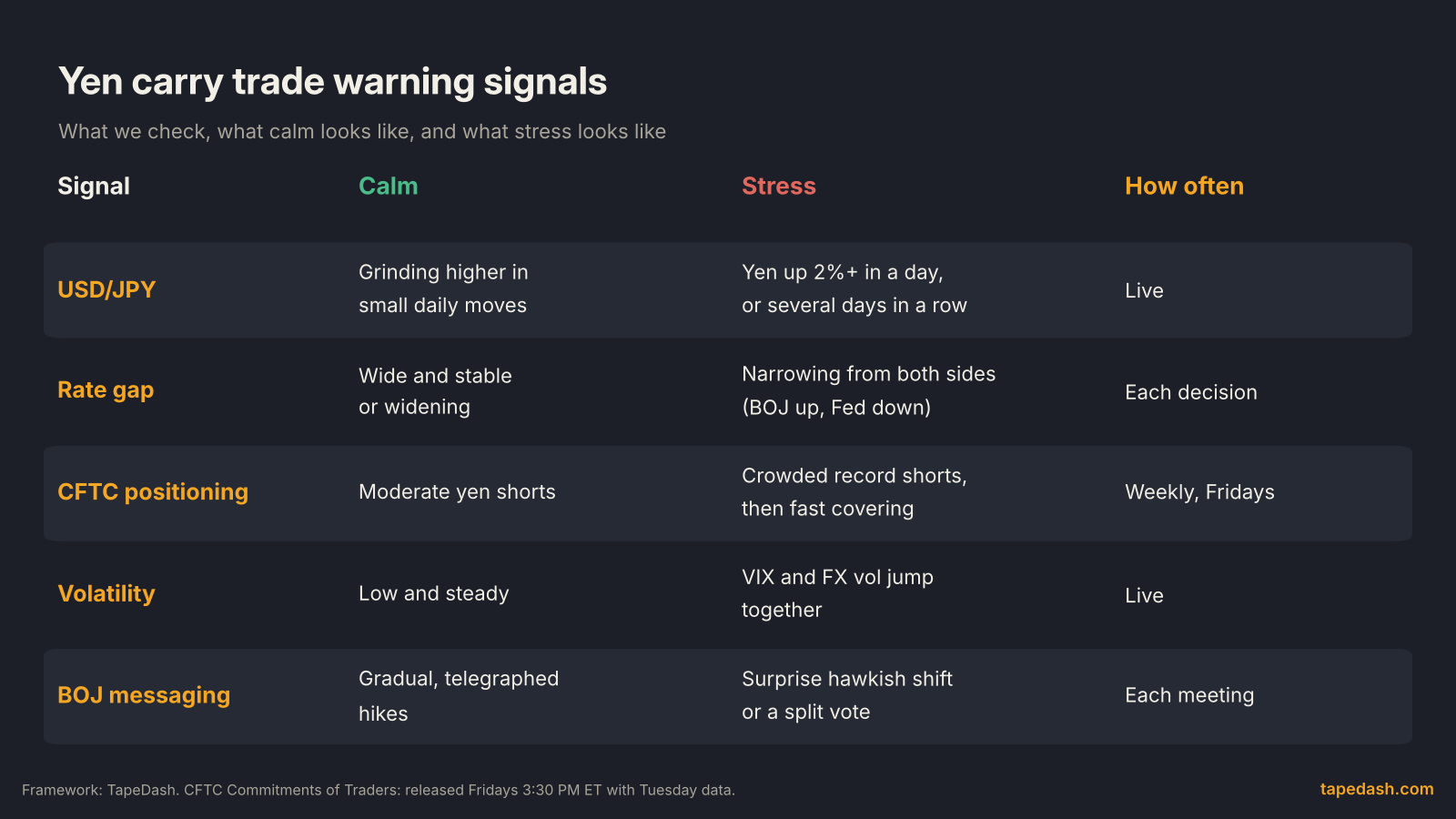
USD/JPY: speed matters more than level
A carry-friendly yen weakens slowly. The warning is a fast move the other way. On August 5, 2024 the yen gained more than 2% in a day after weeks of gains. When the dollar drops a big figure or two against the yen in a session, with no Japan-specific headline, assume positions are being closed. Also watch for intervention: Tokyo stepped into the market to support the yen in April and May 2024, and intervention days can trigger sharp reversals.
The rate gap: direction and the two-year yield
Policy rates move eight times a year. The market’s expectation of them moves every day. I watch the U.S. two-year Treasury yield against Japan’s short rates, because the two-year reprices Fed expectations first. A falling U.S. two-year with a rising Japanese yield is the gap closing in real time. If you want a refresher on how the front of the curve works, see our yield curve explainer, and for reading Fed odds, our guide to CME FedWatch.
CFTC positioning: is the trade crowded?
The CFTC’s Commitments of Traders report shows who holds yen futures. It is released Fridays at 3:30 PM ET with data as of the previous Tuesday, as Barchart also notes. The Traders in Financial Futures version breaks out a “Leveraged Funds” category, which is the closest public proxy for hedge-fund carry. A record net short is fuel. A fast drop in that short is the unwind under way. The data is three days old when you see it, so use it to judge how much fuel is in the tank, not to time the day.
Volatility: the amplifier
Carry dies when volatility rises, because risk budgets shrink. Watch equity volatility and currency volatility together. When the VIX and yen volatility jump on the same day, the unwind loop is running. When equity volatility spikes but the yen is quiet, the stress is probably coming from somewhere else.
BOJ messaging: surprise is the trigger
The BOJ has learned from 2024. It now telegraphs hikes well ahead, and a well-telegraphed hike usually does little. The risk is a surprise, either an unexpected move or a sudden hawkish change in guidance. Split votes matter too, because they tell you how many board members want to go faster.
What to watch next
The calendar for the next two months is crowded.
October 29 to 30, Bank of Japan meeting. The decision is due at noon Tokyo time on Friday, October 30, which is 11 PM ET on Thursday, October 29, per TradingNews and LiveExchanges. It comes with a new quarterly Outlook Report. Trading Economics says the BOJ is widely expected to hold, with attention on any signal for December. The hold is not what moves the yen. The guidance is.
Every Friday at 3:30 PM ET, CFTC positioning. The October 30 report covers positions as of October 27, before the BOJ meeting. The November 6 report will be the first to show how funds positioned around it.
December 8 to 9, Fed meeting. The Federal Reserve calendar has the year’s last FOMC decision on December 9, with new projections.
December 17 to 18, Bank of Japan meeting. The decision is due at noon Tokyo time on December 18, which is 10 PM ET on December 17, per FinanceCalendar and LiveExchanges. This one lands nine days after the Fed, so the two decisions will be read together. If the Fed sounds softer and the BOJ hikes, that is the gap closing from both sides again.
How TapeDash tracks cross-asset stress
If you want to watch whether a carry unwind is starting, this is what we track. The Macro and Regime page in the Terminal Preview follows rates, the dollar and credit alongside the market’s risk regime label, so you can see whether a yen move is staying in currencies or spilling into the rest of the tape. That spillover is the tell. A strong yen on a quiet day is a currency story. A strong yen with credit widening and the regime flipping to risk-off is the 2024 pattern.
The Volatility Desk shows whether implied volatility is rising across the names you trade, which is the amplifier in the unwind loop. On a fast day the Live Scanner flags gaps, sudden moves and unusual options flow as they happen, which is how you spot forced selling in crowded winners before the headlines explain it. You can try all of it free without an account, or get the evening read in the free TapeDash Daily. The first 200 members lock Pro at $99 a month for as long as they stay.
Yen carry trade FAQ
Is the yen carry trade still happening?
Yes. Even with the Bank of Japan at 1.25%, U.S. rates are about 2.75 points higher at the top of the Fed’s range, and the yen has stayed weak through 2026. That gap still pays investors who borrow in yen. It is smaller than in 2024, which leaves less cushion if the yen rallies.
What causes a yen carry trade unwind?
Anything that makes the yen rise quickly or makes the rate gap look likely to shrink: a Bank of Japan hike or hawkish signal, weak U.S. data that pulls Fed expectations down, or a broad risk-off shock. The trigger can be small. The size of the move depends on how crowded positioning is when it hits.
How does the yen carry trade affect U.S. stocks?
Through forced selling. Funds that borrowed yen often hold popular, liquid assets, including large U.S. tech stocks. When the yen jumps, they sell those assets to cover losses and repay yen. Volatility-targeting funds then cut exposure as the VIX rises, adding a second wave of selling. That is why a decision in Tokyo can show up in the Nasdaq.
The one idea to keep
The yen carry trade is a bet that two things stay calm: the gap between Japanese and foreign rates, and the yen itself. It pays a little every day and can take years of gains back in a week. The trigger is rarely dramatic. A 15 basis point hike and one soft jobs report were enough in 2024. So watch positioning and direction, not just levels, and pay closest attention when Tokyo and Washington start moving toward each other at the same time.
See it on the tape, not just in the headlines
TapeDash is the research desk for traders and investors: live options flow, dealer positioning, a real-time market scanner and trade alerts graded in public. Memberships open January 1, 2027, and the first 200 members lock Pro at $99 a month for as long as they stay.
Join the waitlistClick through the terminalSee the track recordSources
- BIS Bulletin No. 90: The market turbulence and carry trade unwind of August 2024
- RePEc listing: BIS Bulletin No. 90 abstract
- The Full FX: What does $250 billion buy? A carry trade blow up
- Investing.com: Yen's wild ride, ups, downs and Bank of Japan interventions (Aug 11, 2024)
- FXLeaders: The yen hits a new 38-year low (Jul 3, 2024)
- CNBC Africa: Japan's Nikkei logs worst day since 1987 Black Monday crash (Aug 5, 2024)
- Daily Sabah: Japan's Nikkei suffers biggest rout since 1987 Black Monday (Aug 5, 2024)
- Business Recorder (Reuters): Yen rises to seven-month high as US slowdown fears spread (Aug 5, 2024)
- Investing.com (Reuters): Wall Street fear gauge logs record jump (Aug 5, 2024)
- Macroption: VIX all-time highs and biggest spikes
- Fortune: VIX fear gauge hits highest level since 2020 (Aug 5, 2024)
- Axios: US economy adds 114,000 jobs in July, unemployment rate spikes (Aug 2, 2024)
- Fortune: Sahm rule recession indicator triggered (Aug 2, 2024)
- Dawn (Reuters): Bank of Japan plays down chance of near-term rate hike (Aug 7, 2024)
- Christian Science Monitor: Carry trades partly drove market jitters (Aug 6, 2024)
- The Financial Express (Reuters): Funds go long yen for first time in four years (Aug 2024)
- InvestMacro: Forex speculators push Japanese yen bets higher for record 10-week gain (Sep 2024)
- Federal Reserve: FOMC statement, July 31, 2024
- Euronews: Fed holds rates steady as Powell hints at September cut (Aug 1, 2024)
- AP via News4Jax: Bank of Japan ends negative rate policy (Mar 19, 2024)
- Business Standard: Bank of Japan raises rates to highest since 2008 (Jan 24, 2025)
- The Star (Reuters): Bank of Japan raises rates to 30-year high (Dec 19, 2025)
- Trading Economics: Japan raises policy rate to highest since 1995 (Dec 19, 2025)
- investingLive: BOJ hikes to 1% (Jun 16, 2026)
- FocusEconomics: Bank of Japan holds rates in July 2026
- Nation Thailand: Bank of Japan lifts rate to 31-year high of 1.25% (Sep 18, 2026)
- Securities.io: Bank of Japan releases opinions behind September hike to 1.25%
- China Daily HK: Yen falls to lower 163 range, unseen since 1986 (Jul 22, 2026)
- NewsBytes: Yen drops past 163 per dollar, weakest since 1986 (Jul 22, 2026)
- Trading Economics: Japanese yen news, Oct 26 to 28, 2026
- Trading Economics: Yen edges up ahead of BOJ policy meeting (Oct 22, 2026)
- Pound Sterling Live: US dollar to Japanese yen history, 2026
- TradingNews: USD/JPY range and BoJ expectations (Oct 21, 2026)
- Trading Economics: Fed raises rates for the first time since 2023 (Sep 16, 2026)
- Newsquawk: Preview of the Federal Reserve rate decision due Oct 28, 2026
- Federal Reserve: FOMC meeting calendars
- FinanceCalendar: Bank of Japan rate decision, December 2026
- LiveExchanges: BoJ meeting schedule 2026
- CFTC: Commitments of Traders report descriptions
- Barchart: When is Commitment of Traders data updated
This article is for educational and informational purposes only. It is not financial, investment, medical or legal advice, and it is not a recommendation to buy or sell any security. Figures come from the sources listed and were checked on the date of publication; markets change quickly. Options trading involves substantial risk of loss.