CVS Split Explained: Why Aetna and the Pharmacy Are Parting Ways
The CVS split separates Aetna and Caremark from about 9,000 pharmacies by 2028. What each company gets, why the stock fell on a beat, and what to watch.
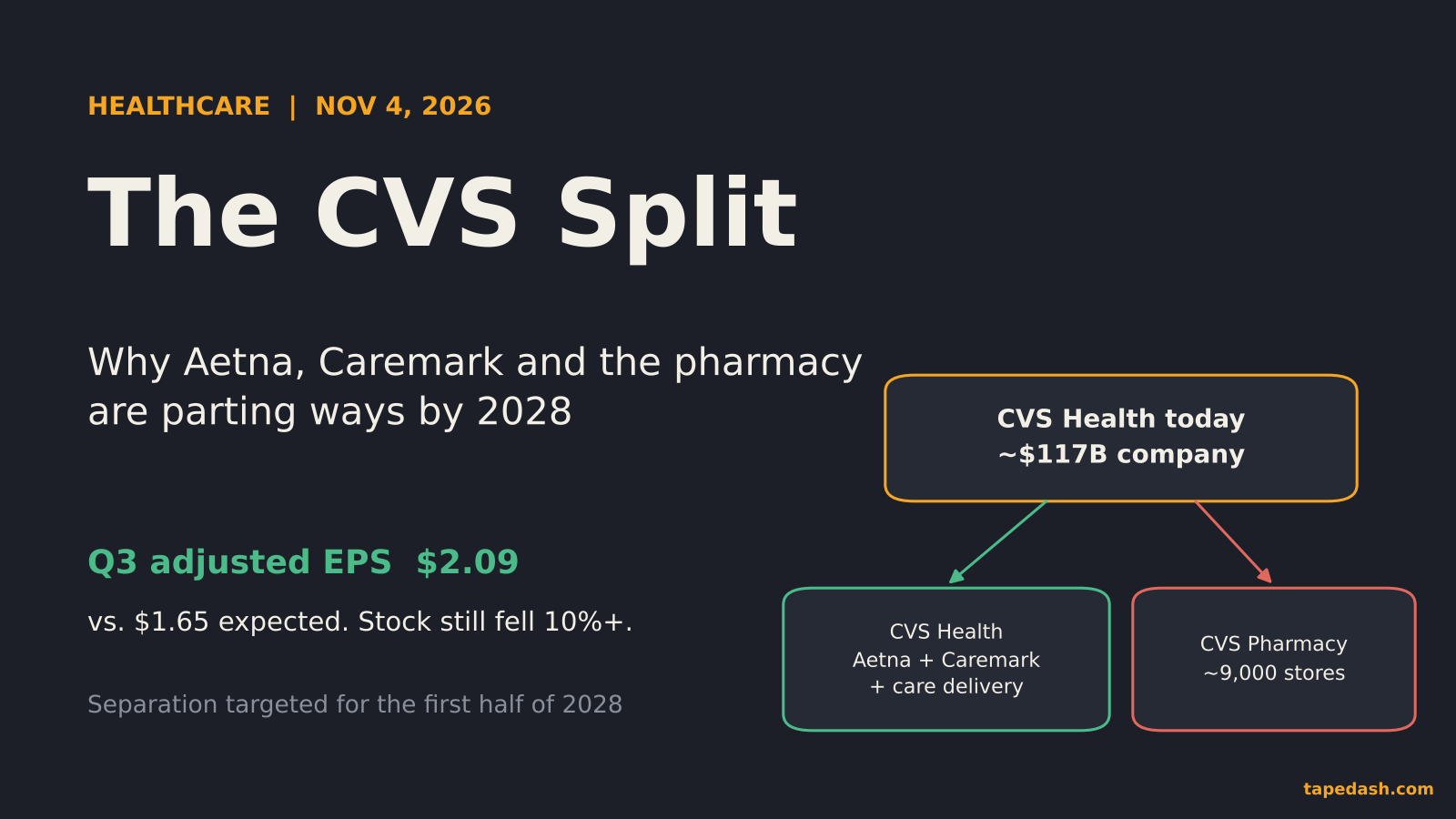
CVS Health said on Wednesday that it will split into two public companies. One keeps the CVS Health name and holds Aetna, the Caremark pharmacy benefit manager, the specialty pharmacy and the care-delivery businesses. The other, CVS Pharmacy, takes roughly 9,000 drugstores, mail order and MinuteClinic. The separation is expected to be done in the first half of 2028, and shareholders are expected to own shares of both, according to AJMC and Yahoo Finance.
That is a reversal of the whole idea CVS has sold investors for most of two decades. The company spent $78 billion on Aetna in a deal that closed in 2018, as both Healthcare Dive and Reuters noted, precisely so the insurer, the drug middleman and the pharmacy could live under one roof. Now the roof is coming off.
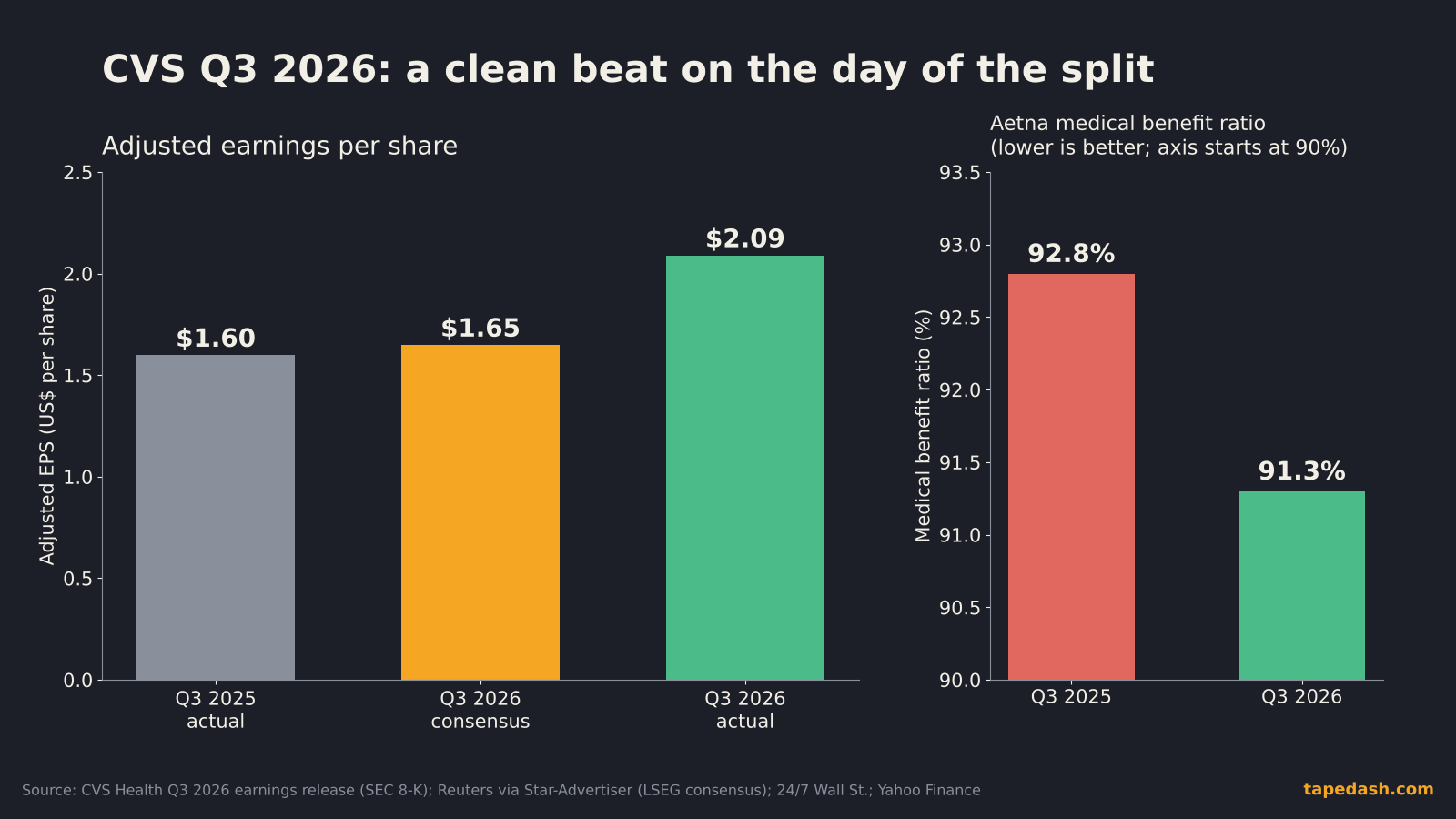
The part that tells you the most is the tape. CVS beat earnings badly on the same morning. Adjusted EPS was $2.09 against a consensus of $1.65, per Reuters and 24/7 Wall St., and the company raised its full-year outlook. The stock still fell more than 10% during the session, as CNBC and Reuters reported, on a day when the Dow gained more than 1,500 points. When a stock sells off on a beat and a raise while the market rips, the market is telling you the news it cares about is somewhere else. Here it is the breakup, and how little we know about what it costs.
- The CVS split creates two companies by the first half of 2028: CVS Health (Aetna, Caremark, specialty, Oak Street, Signify) and CVS Pharmacy (about 9,000 stores, mail order, MinuteClinic).
- Q3 was strong: revenue of $108.4 billion, up 5.4%, and adjusted EPS of $2.09 versus $1.65 expected. Full-year guidance rose to at least $8.20.
- The stock fell more than 10% anyway, because the breakup came with little detail on separation costs, debt or dividends.
- The deeper driver is regulatory pressure on vertical integration, including state laws in Arkansas and Tennessee that bar PBMs from owning pharmacies.
- The next real information arrives in the Form 10 filing, which will show each company’s balance sheet and standalone economics.
What the CVS split actually separates
The cleanest way to think about the CVS split is to sort the businesses by who pays them.
The new CVS Health is the payer side. Aetna collects premiums from employers, individuals and the government, and pays for care. Caremark manages the drug benefit for Aetna and for outside clients, negotiating with drugmakers and setting what pharmacies get paid. CVS Specialty handles expensive specialty drugs. Oak Street Health runs primary-care clinics for seniors, and Signify Health does in-home health assessments. David Joyner, the current chairman and CEO, keeps both roles at this company, according to AJMC and Healthcare Dive.
CVS Pharmacy is the provider side, the part you walk into. It gets the roughly 9,000 retail pharmacies, mail-order pharmacy, MinuteClinic (including virtual care) and a technology unit called Health100. Prem Shah, currently a group president, becomes its CEO.
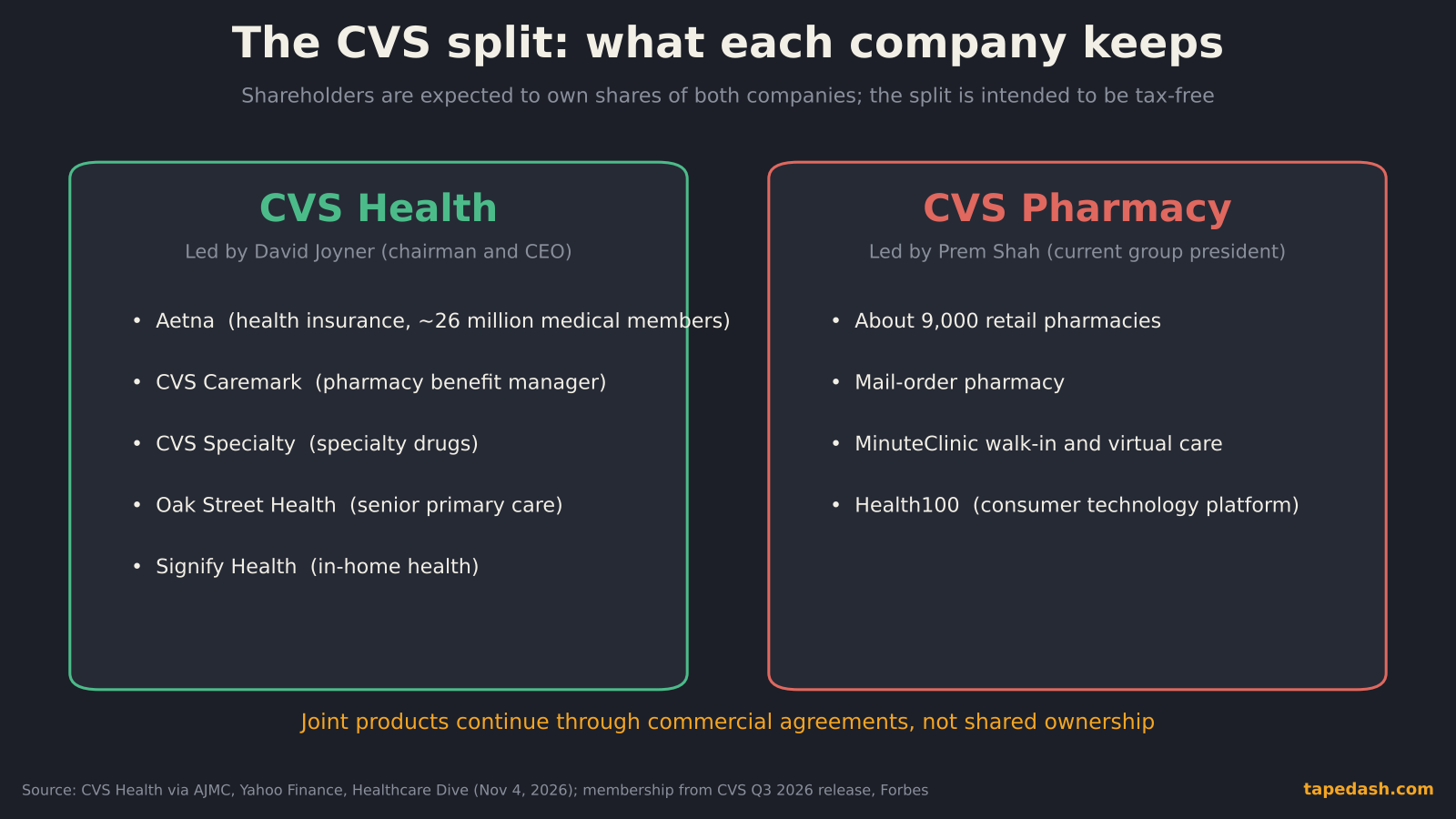
Aetna ended the third quarter with about 26.1 million medical members, per the company’s Q3 release, which Forbes described as more than 26 million. That is the asset most investors will value first. The surviving CVS Health looks a lot more like UnitedHealth or Cigna than like a drugstore, which Healthcare Dive pointed out directly.
The transaction is intended to be tax-free to CVS and its shareholders for U.S. federal income tax purposes. It still needs final board approval and an effective Form 10 registration with the SEC, according to AJMC and 24/7 Wall St. In plain terms, nothing is final, and the financial details investors want have not been published yet.
Why CVS is splitting now
CVS gave a business answer. Joyner said two focused companies can move faster and compete better, and he described the move as coming from a position of strength. He also said regulation is not the reason.
The market heard that and did what markets do, which is weigh the incentives. A few threads run through every analyst comment I read today.
The regulatory squeeze on vertical integration
Pharmacy benefit managers have been under bipartisan fire for years over opaque pricing and over conflicts of interest when one company owns the insurer, the PBM and the pharmacy. Arkansas and Tennessee have passed laws that would bar PBMs and pharmacies from sharing a parent company, and CVS is challenging them, according to both Healthcare Dive and AJMC. Federal lawmakers from both parties have proposed similar ideas.
Leerink’s Michael Cherny called the announcement a “complete shock,” per Healthcare Dive, and suggested that avoiding state scrutiny of vertical integration could be part of the logic. UBS’s Kevin Caliendo described it to Reuters as a defensive move against regulation rather than an offensive one. Morningstar’s Julie Utterback said CVS has more vertical-integration exposure than anyone in the industry and may have moved before a law or a court forced its hand.
Healthcare Dive also noted that scrutiny is likely to continue into 2027 after the change in control of Congress. I’m not going to handicap Washington. The trading point is simpler: if the rules may force a separation anyway, choosing your own timeline and structure is worth something.
The pharmacy business stopped bleeding
The second reason is that the stores can now stand on their own. That wasn’t obviously true two years ago. Joyner told Reuters that when he took over, the pharmacy business was projected to shrink. Since then CVS closed stores, cut costs and moved to a new reimbursement model called CostVantage, which ties what CVS gets paid more closely to what a drug actually costs. Cherny credited that model with stabilizing gross margins. Healthcare Dive put it bluntly: the pharmacies have stabilized for the first time in years.
You can’t spin off a melting ice cube without wrecking the stock and the bond ratings. You can spin off a business that’s flat to growing. Timing a breakup right after the patient leaves the ICU is classic corporate finance.
Aetna got its margins back
Third, the insurer is healthier. Aetna’s medical benefit ratio, the share of premium dollars paid out in medical costs, improved to 91.3% from 92.8% a year earlier, per the Q3 release and 24/7 Wall St.. A point and a half doesn’t sound like much. On a premium base this size, it is the difference between a bad year and a good one.
How the money moves inside CVS today
To understand why critics hate vertical integration and why CVS built it anyway, follow one prescription.
An employer or Medicare plan sponsor pays Aetna premiums. Aetna hands the drug benefit to Caremark. Caremark negotiates rebates from drugmakers, builds the formulary (the list of covered drugs and what tier they sit on) and decides what pharmacies get reimbursed. The patient picks up the drug at a pharmacy, often a CVS, and pays a copay. Caremark pays the pharmacy the rest.
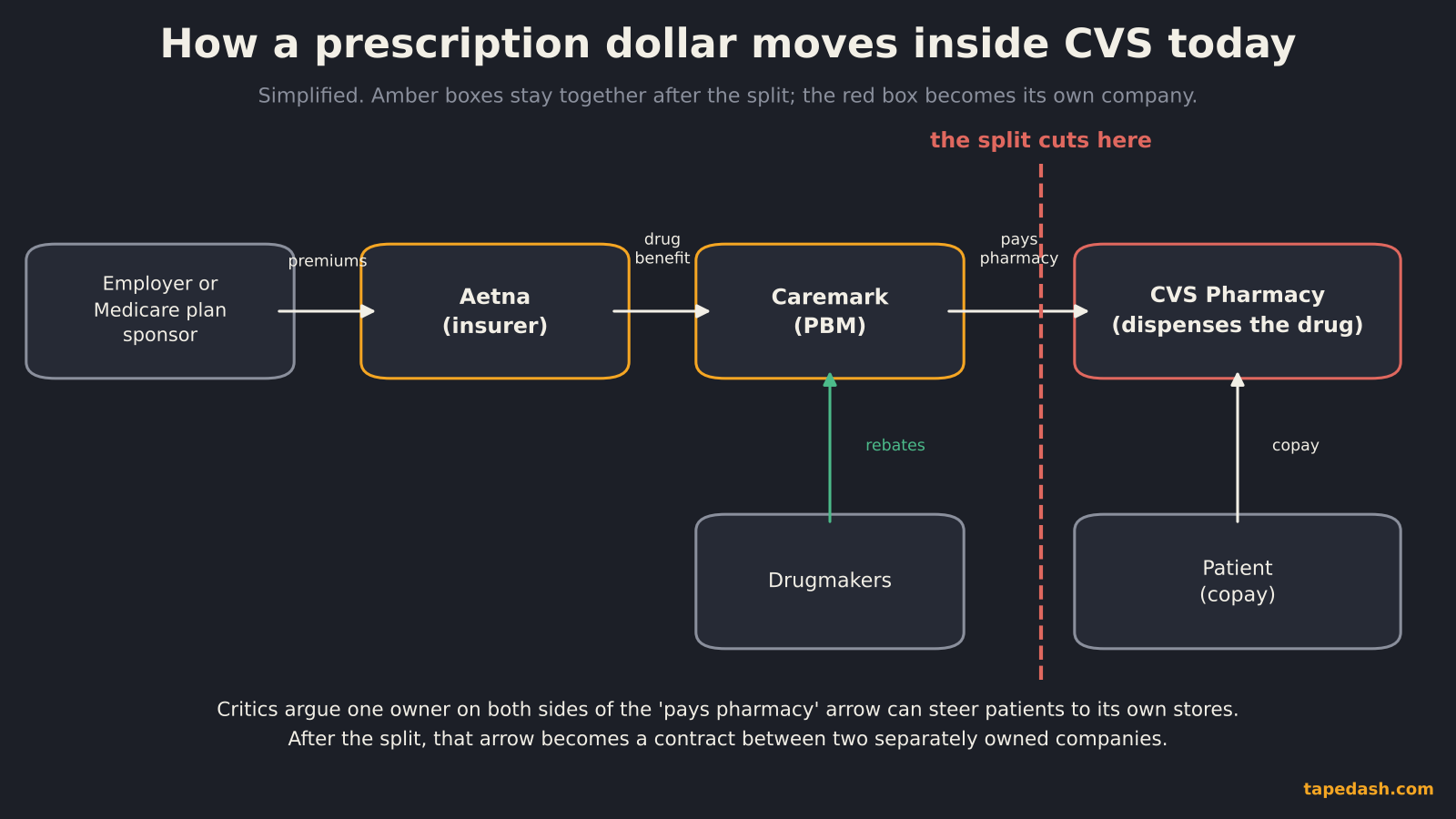
Here’s the conflict critics point at. When the same parent owns the PBM that sets pharmacy reimbursement and the pharmacy that gets reimbursed, it can pay its own stores better, steer members toward them, or squeeze competing pharmacies. CVS has always argued the integration lowers costs and coordinates care. Both can be partly true. The split doesn’t settle the argument. It moves the line.
Notice where the line goes. Aetna and Caremark stay together. The insurer-PBM combination, which is where most of the money and most of the formulary power sits, survives intact. What leaves is the store. So the new CVS Health still looks like its integrated rivals, and CVS Pharmacy becomes a large independent chain that has to win PBM contracts, including from its former parent, under commercial agreements rather than shared ownership.
Why CVS stock fell on a beat and raise
This is the “how to read it” part, and it’s the most useful habit to take from today.
Start with the quarter, because on its own it was very good. Revenue rose 5.4% to $108.4 billion from $102.9 billion, according to the company and Yahoo Finance. Adjusted EPS of $2.09 compared with $1.60 a year ago. Reuters noted that CVS has now beaten estimates eight quarters in a row.
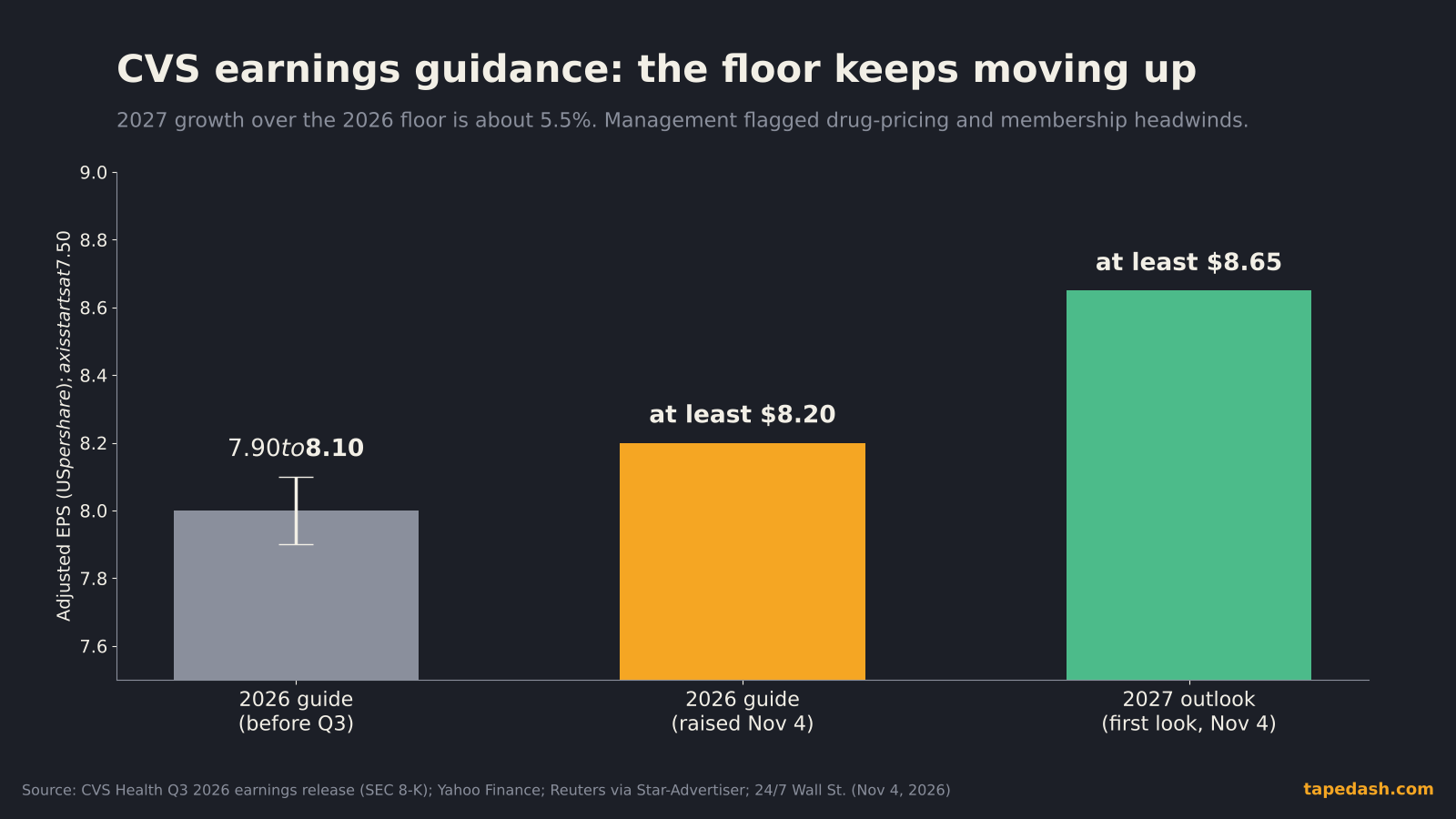
Guidance went up too. The full-year 2026 adjusted EPS outlook moved to at least $8.20 from a prior range of $7.90 to $8.10, and cash flow from operations guidance rose to at least $15.5 billion, per the release and 24/7 Wall St. CVS also gave a first look at 2027: adjusted EPS of at least $8.65, according to Reuters and 24/7 Wall St.
So why the drop? Three reasons, in the order I’d weight them.
Uncertainty about the deal itself. Barclays analyst Andrew Mok told Reuters that the lack of financial detail on the breakup was the main investor concern. Nobody knows yet how the debt gets divided, what each company’s dividend looks like, or how big the dis-synergies are. Dis-synergies are the costs that appear when one company becomes two: duplicate corporate functions, lost purchasing scale, a second public-company overhead. Markets price the unknown at a discount, and they do it fast.
The 2027 growth step looks modest. The math on the guidance is simple: $8.65 over $8.20 is about 5.5% growth. CFO Brian Newman flagged 2027 headwinds to Reuters, including pressure on the PBM business from a government drug-pricing program, a weaker selling season and falling health-plan membership. Kevin Gade of Bahl & Gaynor said investors see a 2027 earnings stumble while peers accelerate.
Positioning. CVS had already run up a lot under Joyner, and a stock that’s been working attracts holders who leave at the first sign of a messier story. When the news is complicated and the market is ripping elsewhere, that money finds other homes. On Wednesday it seemed to; 24/7 Wall St. noted insurer peers like Elevance and Cigna traded higher.
The lesson for reading any earnings day: the headline beat only matters if it’s the thing the market is trying to price. Today it wasn’t. If you want the longer version of this habit, I wrote about it in How to Read an Earnings Report Like a Trader.
Who wins and who loses from the CVS split
It’s early, and the Form 10 will change some of this. Here is how I’d frame the interested parties today.
| Group | What changes | What to watch |
|---|---|---|
| CVS shareholders | Own two stocks instead of one, in a tax-free split (as intended) | Debt allocation, dividend policy at each company, dis-synergy estimates |
| CVS Health (Aetna, Caremark) | Valued against UnitedHealth and Cigna instead of a drugstore discount | Medicare Advantage margins, PBM pricing pressure, membership |
| CVS Pharmacy | Becomes a standalone chain that has to win PBM contracts on its own | Reimbursement terms with its former parent, front-store sales, store count |
| Rival PBMs and insurers | Pressure grows on integrated peers to defend their own structures | Whether regulators or rivals cite the CVS split as precedent |
| Independent pharmacies | Possibly less steering if a big PBM no longer owns stores | State PBM laws, how Caremark networks are written after 2028 |
| Index and ETF holders | One holding becomes two; weightings shift | Index classification decisions for each new company |
On that last row, 24/7 Wall St. pointed out that CVS was 2.30% of the Health Care Select Sector SPDR (XLV) as of June 30, which means even a sharp CVS drop moves that fund only modestly. If you own a broad healthcare ETF, the split is a holdings change, not a crisis.
The group with the most at stake is CVS Pharmacy’s future management team. A drugstore chain without a captive insurer has to prove it can grow on its own. Walgreens is the cautionary comparison everyone will reach for. Reuters noted that it sold its Boots business and was taken private by Sycamore Partners. CVS Pharmacy starts in better shape, but investors will demand evidence, not promises.
A short history: building the conglomerate, then taking it apart
The CVS split is the end of a long arc. CVS bought Caremark in the mid-2000s, then made the Aetna deal in 2018, then added Oak Street Health and Signify Health to own the care itself. Each step followed the same thesis: own every link in the chain, from the premium to the pill to the doctor visit, and capture the savings from coordinating them.
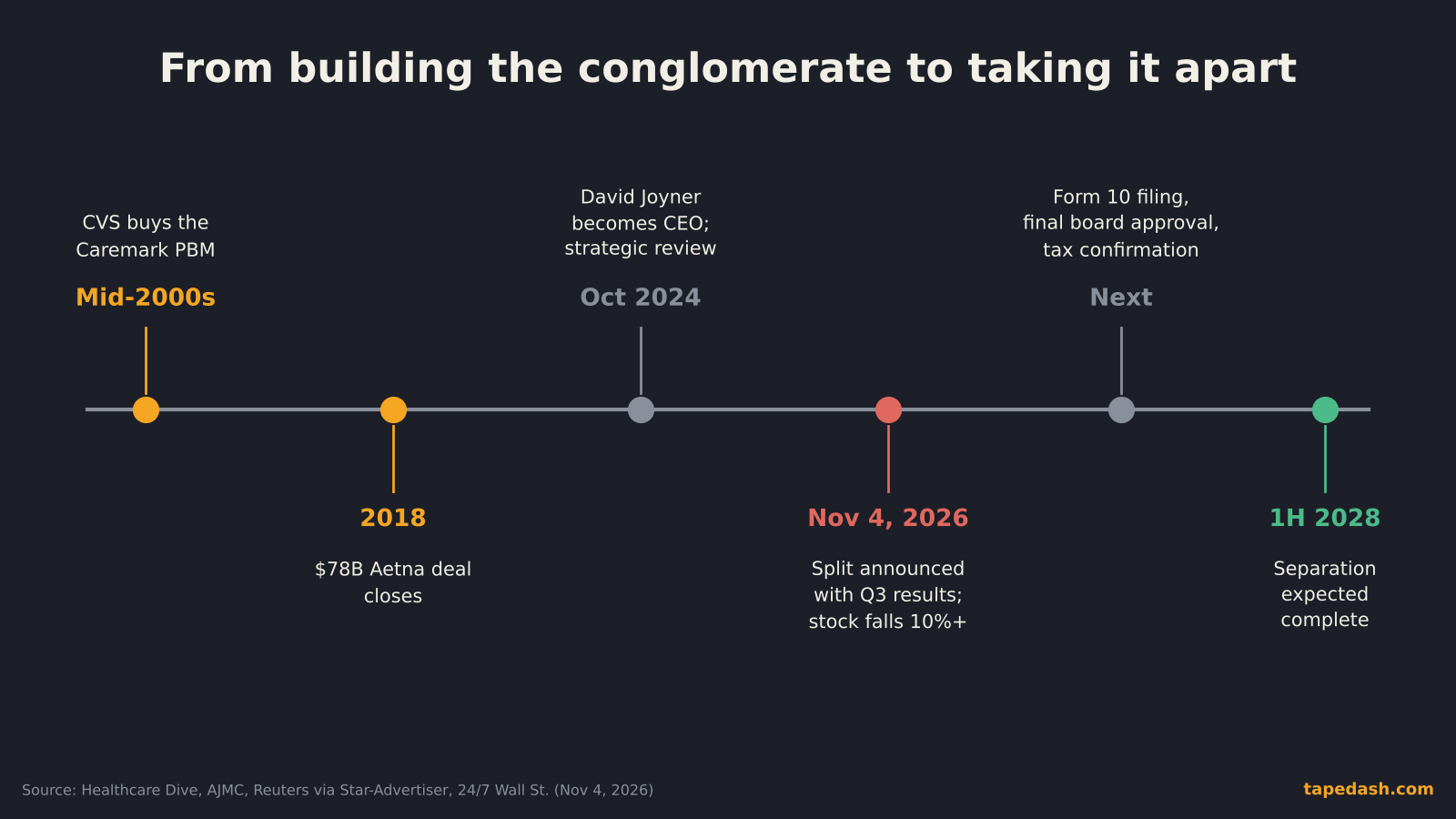
The thesis ran into two problems. First, medical costs surprised Aetna to the upside in recent years, especially in Medicare Advantage, and the integrated model didn’t protect the margins. Second, politics turned against vertical integration across healthcare. Joyner became CEO in October 2024, and CVS brought in advisers for a strategic review that weighed exactly this kind of breakup, per AJMC. Today is the result.
Corporate America has done this before. Conglomerates tend to get built in good times on synergy stories and taken apart when the parts are worth more alone than together, or when regulators make the combination expensive. The pattern doesn’t tell you the stock’s next move. It does tell you what the debate is about: whether the sum of the parts is worth more than the whole, after the cost of separating them.
How to trade around a corporate breakup
I’ll keep this to process, since that’s what matters on a story that will run for 18 months.
First, separate the two clocks. The business clock is quarterly: Medicare Advantage costs, PBM pricing, pharmacy reimbursement. The deal clock runs on filings: the Form 10, any investor day, board approval, the distribution date. Most of the big moves in a spin-off story happen when the deal clock produces new information.
Second, expect volatility around each filing. The first Form 10 usually brings the first real numbers on debt and standalone margins. That’s when the market can actually value each half, and implied volatility in the options often reflects it. If you haven’t used the expected move before, our explainer on implied volatility and the expected move is the place to start.
Third, think in scenarios, not targets. The two variables I care about are how expensive the separation turns out to be, and whether the 2027 earnings floor holds.
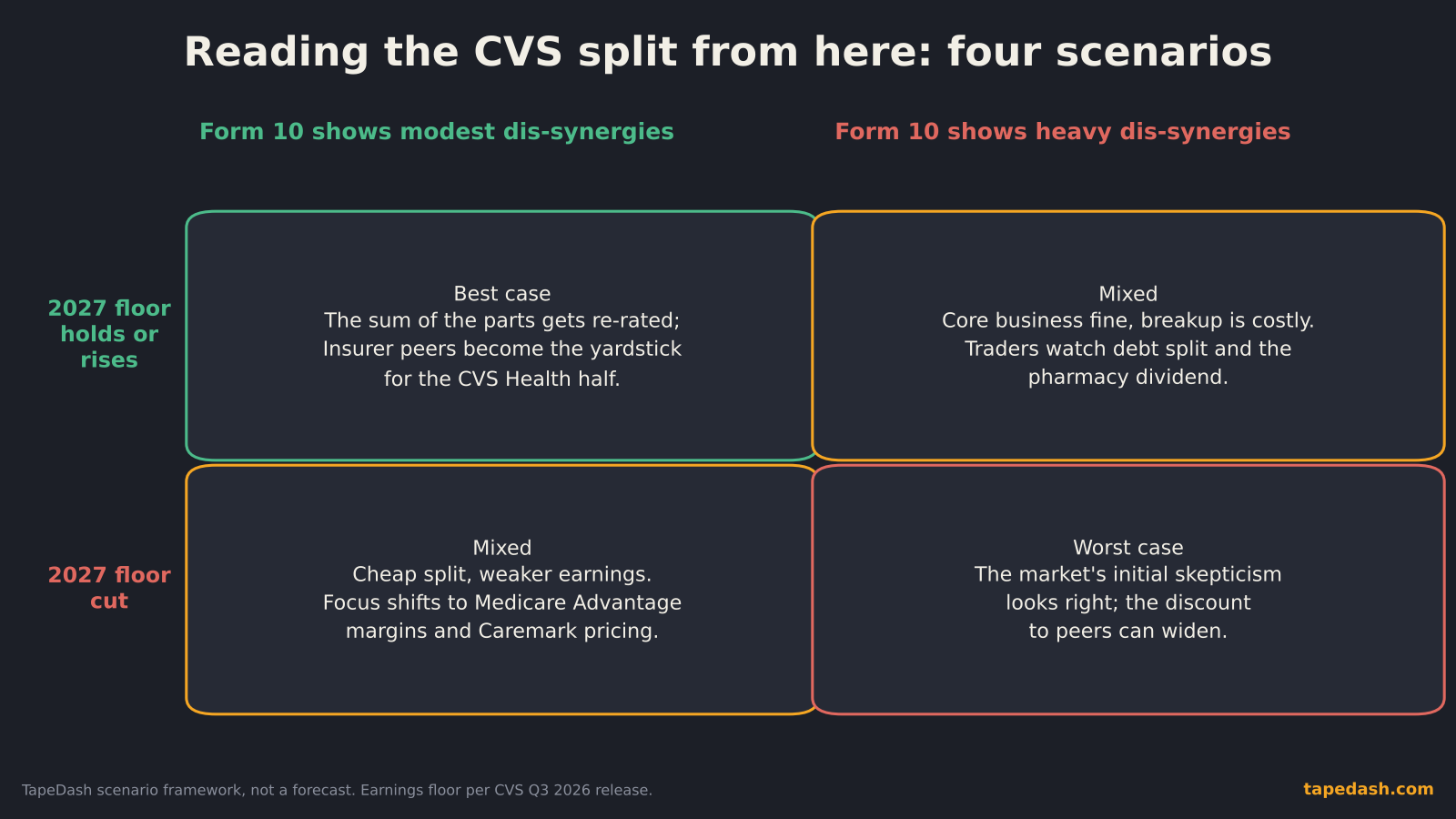
If the Form 10 shows modest dis-synergies and the 2027 floor holds, the sum-of-the-parts argument gets its hearing, and traders will compare the insurer half to UnitedHealth and Cigna multiples. If the costs are heavy and the floor gets cut, today’s skepticism looks right and the discount can widen. The two mixed boxes are where most outcomes usually land, and where the stock tends to chop.
What to watch next
December 7, 2026: Medicare open enrollment closes. Open enrollment for 2027 Medicare plans runs from October 15 to December 7, according to CMS and KOLD. CFO Newman already flagged declining membership and a weaker selling season for 2027, so any early read on Aetna’s Medicare Advantage enrollment will matter.
The Form 10 registration. No date has been given. When it lands, it will lay out each company’s financials, debt and capital structure, as 24/7 Wall St. noted. This is the single most important document in the story.
Q4 earnings early next year. CVS has to show that the 2026 floor of $8.20 holds and that the 2027 outlook of at least $8.65 survives contact with a new year of medical costs.
State PBM laws. Watch the court challenges in Arkansas and Tennessee. A ruling either way changes how much the split is a choice versus a necessity, and it shapes the rules for every integrated rival.
Leadership and board announcements for CVS Pharmacy. AJMC reported that additional leadership and board members will be named later. Who runs a standalone pharmacy chain tells you a lot about the strategy it will pursue.
How we’re tracking the CVS split at TapeDash
If you want to watch whether the market warms up to the CVS split or keeps discounting it, this is what we track: unusual options activity in CVS and the big managed-care names around each filing, how implied volatility behaves into the Form 10, and whether the money that left CVS today rotates into peers like Elevance and Cigna or out of the group entirely. The TapeDash Live Scanner flags that flow as it prints, so you can see whether large trades are hedges or directional bets.
If you’d rather get the short version every morning, the free TapeDash Daily covers stories like this in a few minutes, alongside the day’s key flow. And if you want to see how our calls have actually played out, the public track record is open to everyone.
CVS split FAQ
When will the CVS split happen?
CVS expects to complete the separation in the first half of 2028. It still needs final board approval, an effective Form 10 registration with the SEC and customary tax confirmations.
What happens to CVS shareholders in the split?
Current shareholders are expected to own shares in both companies after the separation, and the transaction is intended to be tax-free for U.S. federal income tax purposes. The exact ratio and the capital structure of each company haven’t been disclosed yet.
Does the CVS split change my pharmacy or my Aetna plan?
Not right away. CVS says joint products will continue through commercial agreements, and the separation isn’t expected until 2028. For questions about your own coverage, check with your plan.
The one thing to remember
CVS didn’t break up because the quarter was bad. It broke up after its best stretch in years, while the rules around owning the insurer, the PBM and the pharmacy are getting harder to live with. The stock’s reaction says investors want numbers before they believe the parts are worth more than the whole. Those numbers arrive with the Form 10. Until then, every filing is the catalyst, and the quarterly beats are background noise.
See it on the tape, not just in the headlines
TapeDash is the research desk for traders and investors: live options flow, dealer positioning, a real-time market scanner and trade alerts graded in public. Memberships open January 1, 2027, and the first 200 members lock Pro at $69.99 a month on their account, even if they cancel and come back later.
Join the waitlistClick through the terminalSee the track recordSources
- CVS Health: Third Quarter 2026 Results, Form 8-K Exhibit 99.1 (Nov 4, 2026)
- AJMC: CVS Health to Split Retail Pharmacy From Aetna, Caremark by 2028 (Nov 4, 2026)
- Healthcare Dive: CVS to split into two companies in stunning strategic about-face (Nov 4, 2026)
- Yahoo Finance: CVS announces plan to split into 2 companies (Nov 4, 2026)
- Reuters via Honolulu Star-Advertiser: CVS shares plunge 13% after surprise plan to split company (Nov 4, 2026)
- 24/7 Wall St.: CVS Is Breaking Itself Up. What That Means for Your Healthcare ETF (Nov 4, 2026)
- CNBC: CVS to split off drugstore business; shares fall 10% (Nov 4, 2026)
- Forbes: CVS Health To Split Into Two Companies (Nov 4, 2026)
- TheStreet: Stock market today, Nov. 4, 2026
- VistaP Global: Stock market today, November 4, 2026
- CMS: 2027 Medicare Advantage and Part D landscape fact sheets
- KOLD: Medicare open enrollment begins, what to expect for 2027 (Oct 15, 2026)
This article is for educational and informational purposes only. It is not financial, investment, medical or legal advice, and it is not a recommendation to buy or sell any security. Figures come from the sources listed and were checked on the date of publication; markets change quickly. Options trading involves substantial risk of loss.