Tubeless Insulin Pump Race: What Tandem's FDA Clearance Changes
Tandem stock jumped nearly 15% after the FDA cleared a tubeless Mobi. How it stacks up against Omnipod, what the pharmacy shift means, and what to watch.
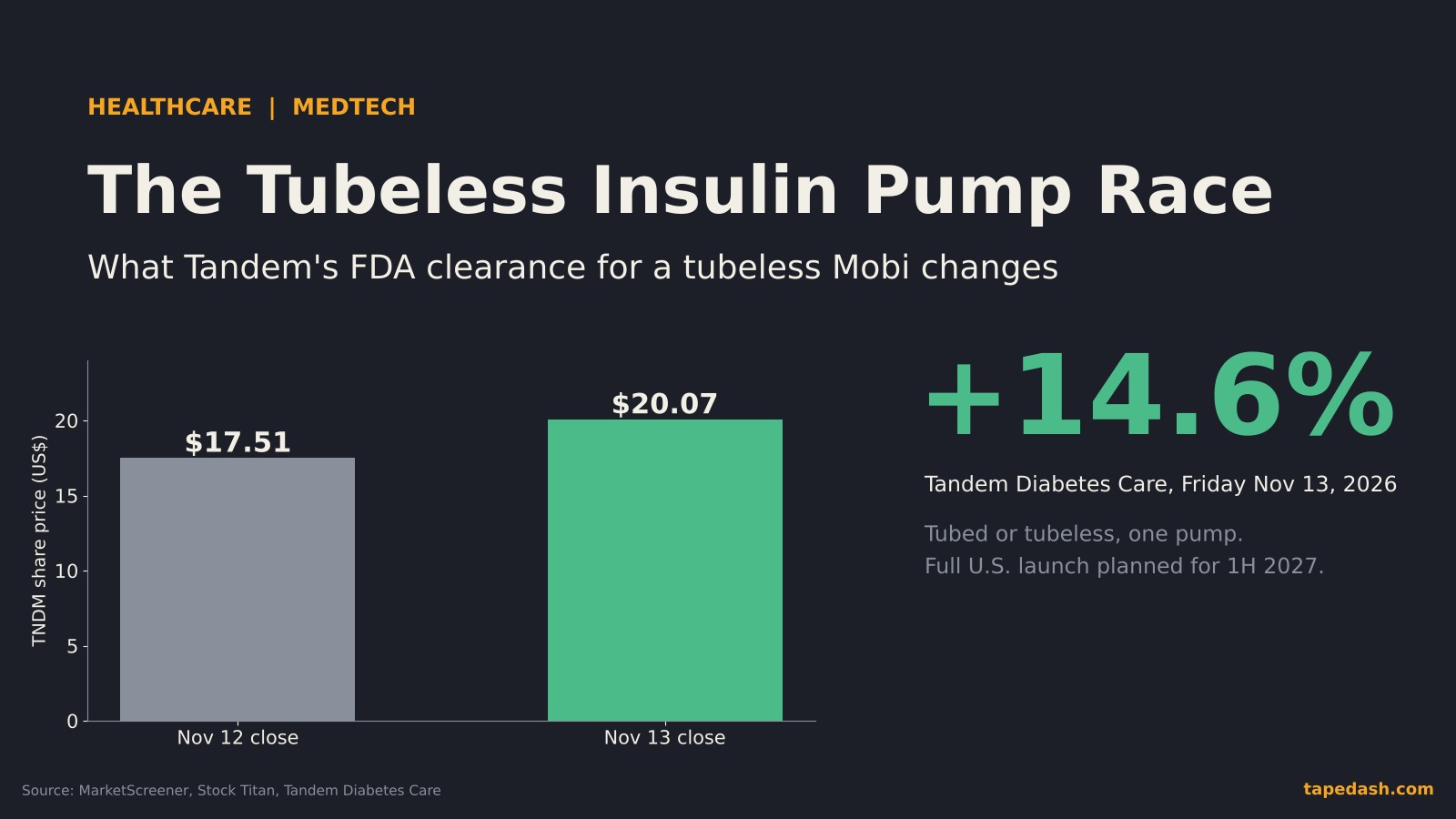
On a Friday when chip stocks were bleeding, one small medtech name went the other way. Tandem Diabetes Care closed at $20.07 on November 13, up 14.6% from Thursday’s $17.51, after the FDA cleared a tubeless version of its Tandem Mobi insulin pump (MarketScreener, Stock Titan). It was one of the bigger gainers on the tape that day.
Here is why a cartridge and an infusion set moved a stock that much. For years the fastest-growing corner of the insulin pump business has been the tubeless one, and for years Insulet’s Omnipod has had that corner almost to itself. Tandem’s clearance turns the existing Mobi pump into a tubeless automated insulin delivery (AID) system with an infusion set that can be worn for up to seven days, and the company says it is now the only pump that can be worn either tubed or tubeless (Tandem Diabetes Care, Mugglehead).
So the short answer to “what does the tubeless Mobi change?” is this: it gives Tandem a product in the segment where new patients are actually going, at the same moment Insulet is telling investors its growth will slow in 2027 and a third competitor, MiniMed, is lining up its own patch pump. The longer answer is about business models, margins and timing, and that is where the trade gets interesting.
- The FDA cleared a tubeless Tandem Mobi on November 13. Tandem stock rose 14.6% to $20.07. Full U.S. launch is planned for the first half of 2027.
- Tubeless pumps are where the growth is. Insulet’s revenue grew 19.2% last quarter, against 14% for Tandem’s total sales.
- Tandem is moving from selling pumps up front to a pharmacy pay-as-you-go model. That hurts reported sales now and lifts margins later.
- Insulet already guided to slower 2027 growth and cited new competition. MiniMed’s own patch pump is planned for a summer 2027 launch.
- Watch November 16 (new Tandem CEO starts), November 24 (MiniMed earnings) and February (Insulet’s formal 2027 guidance).
What the FDA cleared: the tubeless Tandem Mobi explained
The Tandem Mobi was already on the market as a very small tubed pump. What the FDA cleared on Friday is a new tubeless cartridge and infusion set that let the same pump stick directly to the body. The infusion set can stay on for up to seven days. The insulin cartridge is changed every three days (Tandem Diabetes Care, Mugglehead).
That design choice matters more than it sounds. Existing Mobi pumps are compatible, so a customer who is still under warranty does not need a new device to go tubeless. Tandem can upsell its own installed base on day one of the launch without a hardware cycle.
There are limits. Tandem said full commercial availability is planned for the first half of 2027, after a limited release to some customers, and the tubeless supplies will be sold only through the pharmacy channel (Tandem Diabetes Care, MarketBeat via TradingView). The company estimates pharmacy coverage for Mobi customers at about 50% of insured lives in the U.S. right now, so half of the market cannot easily get it on day one (Tandem Diabetes Care, Mugglehead). On the earnings call a week earlier, management also said the first submission covered wear on the abdomen only, with more wear sites to be worked out with the FDA later (The Motley Fool).
None of this was a surprise in timing. Management had said on November 5 that it expected clearance in the fourth quarter (The Motley Fool, MarketBeat via TradingView). The stock moved anyway, which tells you how much doubt the market had priced into a small-cap medtech waiting on a 510(k). Device clearances are usually less dramatic, but when a clearance opens a new market segment, the reaction can look a lot like a drug approval.
How automated insulin delivery works, and why tubing matters
To see why investors care about a tube, it helps to understand what these systems do. This section is about the science and the business, not medical advice. Anyone choosing a device should work with their care team.
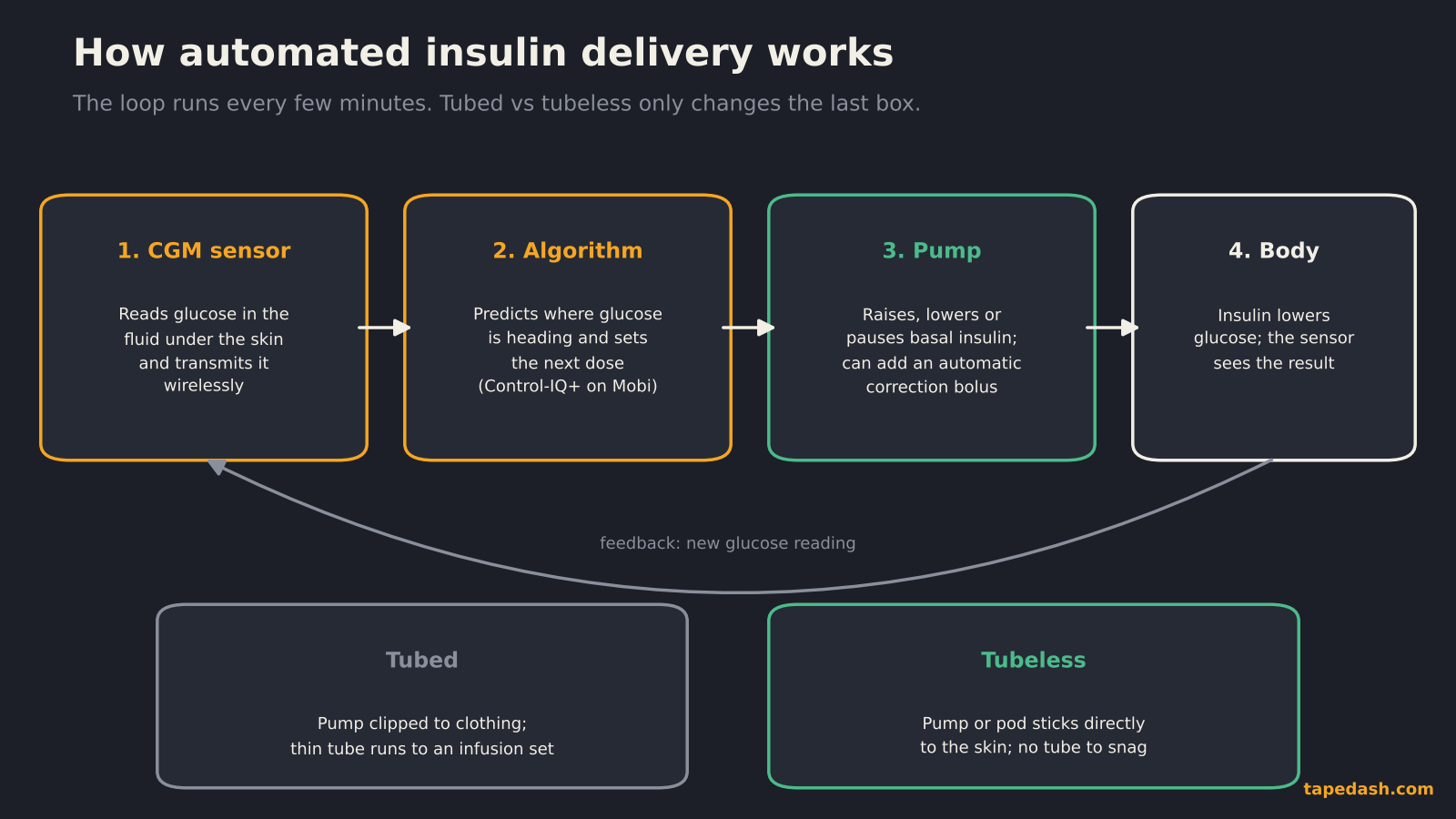
An automated insulin delivery system has three parts that talk to each other. A continuous glucose monitor (CGM) sits under the skin and reads glucose levels every few minutes. An algorithm takes those readings, predicts where glucose is heading, and decides how much insulin to give. The pump then delivers it, raising or lowering background insulin and, on newer systems, adding small automatic correction doses. Tandem’s version of the algorithm is called Control-IQ+, and it is cleared for people with type 1 diabetes and for adults with type 2 (Tandem Diabetes Care).
The loop itself has become fairly standard across the industry. What separates products now is the hardware experience: how big the device is, how often you change it, where you can wear it, and whether there is a tube.
A traditional pump clips to a belt or sits in a pocket, with thin tubing running to an infusion site on the body. Tubing snags on door handles. It gets in the way during sports and sleep. For a lot of people, that is the reason they never switch from injections. A tubeless pump sticks straight to the skin and is controlled from a phone or handheld device.
That last point is why the tubeless segment grows faster. On their latest earnings calls, both Insulet and Tandem said most of their new customers come from multiple daily injections rather than from other pumps (Investing.com, MarketBeat via TradingView). In other words, the market is still mostly about converting people who have never used a pump, and the tube is one of the main reasons people say no.
Tandem vs Omnipod: how the tubeless insulin pumps compare
Omnipod 5 is the incumbent. Each pod holds up to 200 units of insulin and is worn for up to 72 hours before the whole thing is thrown away and replaced. It is cleared for type 1 diabetes from age 2 and for adults with type 2 (Omnipod, ADCES danatech).
Tandem’s approach is different. The Mobi itself is a reusable, rechargeable pump that stays with the patient. Only the cartridge and infusion set are disposable. The tubeless set lasts longer than a pod (up to seven days versus three) while the cartridge is changed on a similar three-day rhythm.
MiniMed, the diabetes business that Medtronic spun off, is the third player. It submitted its first patch pump, called MiniMed Fit, to the FDA ahead of its fall target and plans a full U.S. launch in summer 2027 (MiniMed 8-K, MedTech Dive).
| Omnipod 5 (Insulet) | Tandem Mobi tubeless | MiniMed Fit | |
|---|---|---|---|
| Status | On the market | FDA cleared Nov 13, 2026 | Submitted to FDA |
| U.S. availability | Now | Full launch 1H 2027 | Planned summer 2027 |
| Wear | Pod up to 72 hours | Set up to 7 days, cartridge 3 days | Not yet cleared |
| Hardware model | Fully disposable pod | Reusable pump, disposable set and cartridge | Patch pump |
| Can also be worn tubed | No | Yes | No |
| U.S. channel | Pharmacy | Pharmacy only (tubeless supplies) | To be determined |
A comparison table makes it look like a feature war, and partly it is. But the bigger difference is economic. A fully disposable pod means every unit of revenue is recurring. A reusable pump means a large chunk of revenue arrives in lumps. Which leads to the part of this story most coverage skipped.
Tandem’s pharmacy shift: why sales slow before margins rise
For most of its history Tandem sold pumps the old way, through the durable medical equipment (DME) channel. A patient’s insurer pays for the pump up front, Tandem books a large sale when it ships, and supplies trickle in until the warranty runs out and the next pump is due. That model produces lumpy revenue and puts a big deductible bill in front of patients.
Insulet built Omnipod around the pharmacy benefit instead. The pod is dispensed like a prescription, covered through pharmacy benefit managers (PBMs), and paid for month after month. If you want a refresher on how much power PBMs have in this system, I covered it in CVS Split Explained: Why Aetna and the Pharmacy Are Parting Ways.
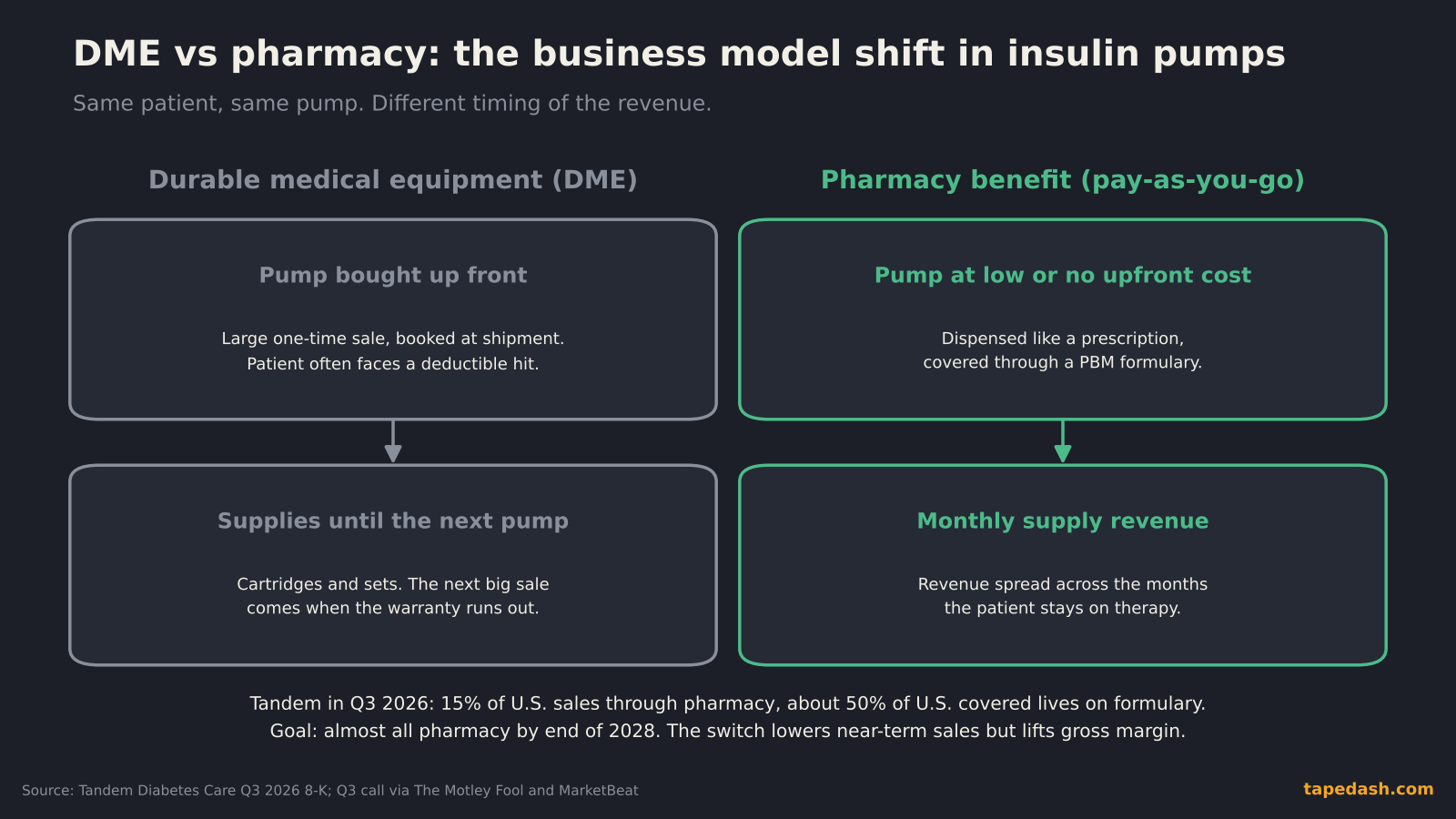
Tandem is now moving to the Insulet model. In the third quarter, 15% of its U.S. sales came through the pharmacy channel (SEC 8-K, BioPharma Watch). Management said the long-term goal is for the business to be almost all pharmacy rather than DME by the end of 2028 (The Motley Fool).
Why the switch hurts first
When a pump ships under pay-as-you-go, Tandem does not book the big upfront sale. It collects smaller monthly payments instead. So the faster patients move into the pharmacy channel, the more near-term sales are pushed into later periods. That is why CFO Leigh Vosseller called mid-to-high single-digit revenue growth “a really fair starting point” for 2027, while warning the pharmacy transition could keep weighing on sales into next year (The Motley Fool, MarketBeat via TradingView). That was not formal guidance, but it is the number analysts are anchoring to.
Why it pays later
The other side is margin. Tandem’s gross margin hit 57% in the third quarter, up from 54% a year earlier, and management credited pricing from the business model change (SEC 8-K, BioPharma Watch). The operating loss shrank to 1% of sales from 9%.
Now compare that with Insulet, which has lived on the pharmacy model for years. Its third-quarter gross margin was 75.1% and its GAAP operating margin was 22.5%, up from 16.7% a year earlier (SEC 8-K, Panabee).
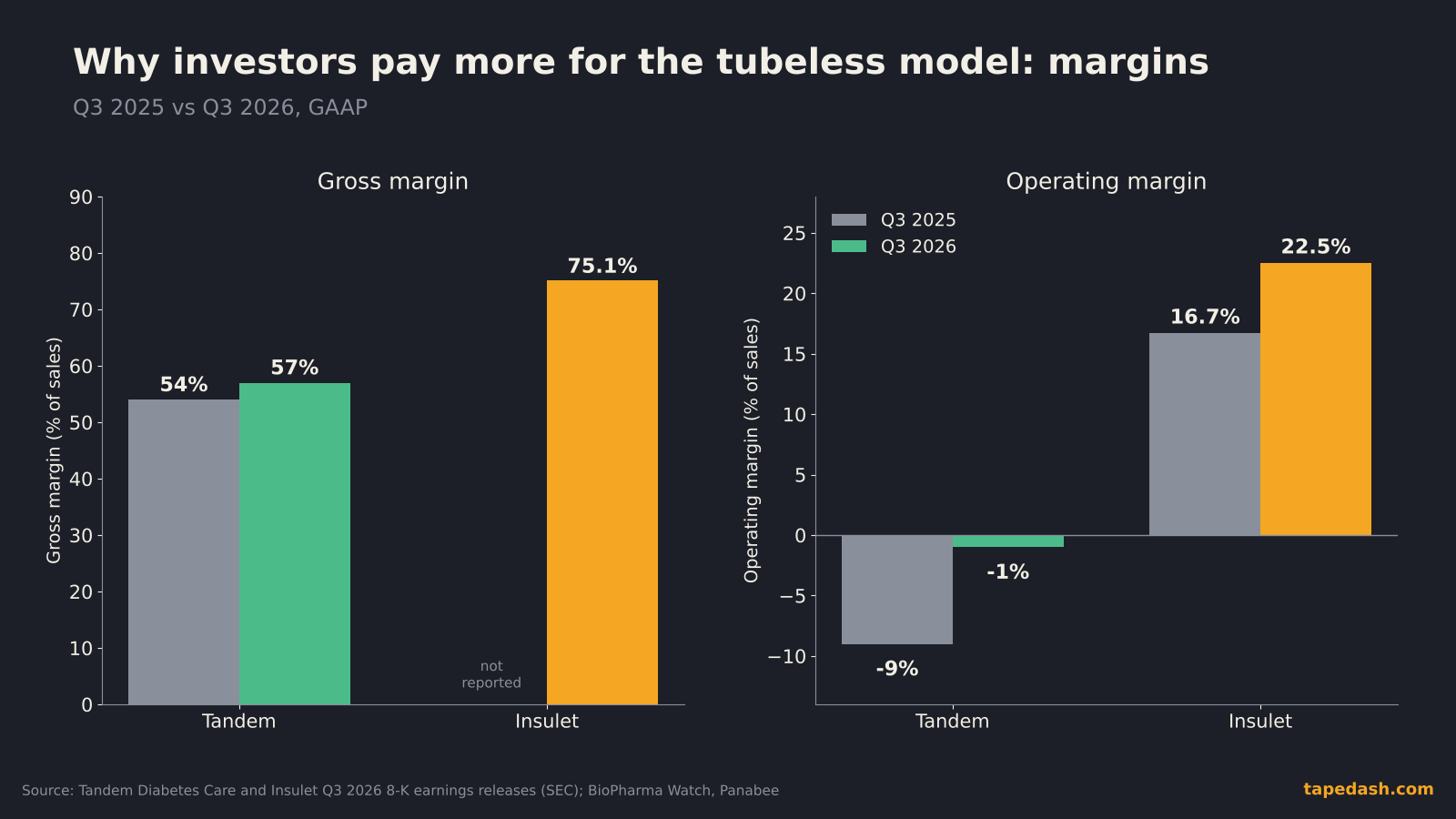
That gap is the whole bull case in one picture. If Tandem can turn into a smaller version of Insulet’s economics, today’s slower sales are an accounting timing issue, not a demand problem. If it cannot, the stock is a slow-growing pump company that keeps promising margins tomorrow. The tubeless Mobi matters because it is sold only through the pharmacy channel. Every tubeless patient Tandem signs is, by construction, a patient on the recurring model.
Insulet’s 2027 growth outlook and the competition question
Insulet’s latest quarter was strong on the surface. Revenue was $842.0 million, up 19.2%, with U.S. Omnipod sales up 14.7% and international Omnipod up 31.7% (SEC 8-K, Investing.com, Panabee). Adjusted earnings per share came in at $1.99 and both lines beat estimates.
The details underneath were softer. U.S. new customer starts were flat from a year earlier. Management said total company growth in 2027 would come in modestly below its prior mid-teens framework, with U.S. growth toward the low end of its earlier range, and it named new competition as one reason for the more measured U.S. outlook (Yahoo Finance, Investing.com). Formal 2027 guidance comes in February.
Put those together and you get the setup behind Friday’s move. The leader of the tubeless market told investors, before Tandem’s clearance, that it expects to give up some share of new patients. Tandem then got the product that competes most directly for those patients. On its own call, Tandem’s management described the tubeless Mobi as going head to head with the other tubeless option on the market (The Motley Fool).
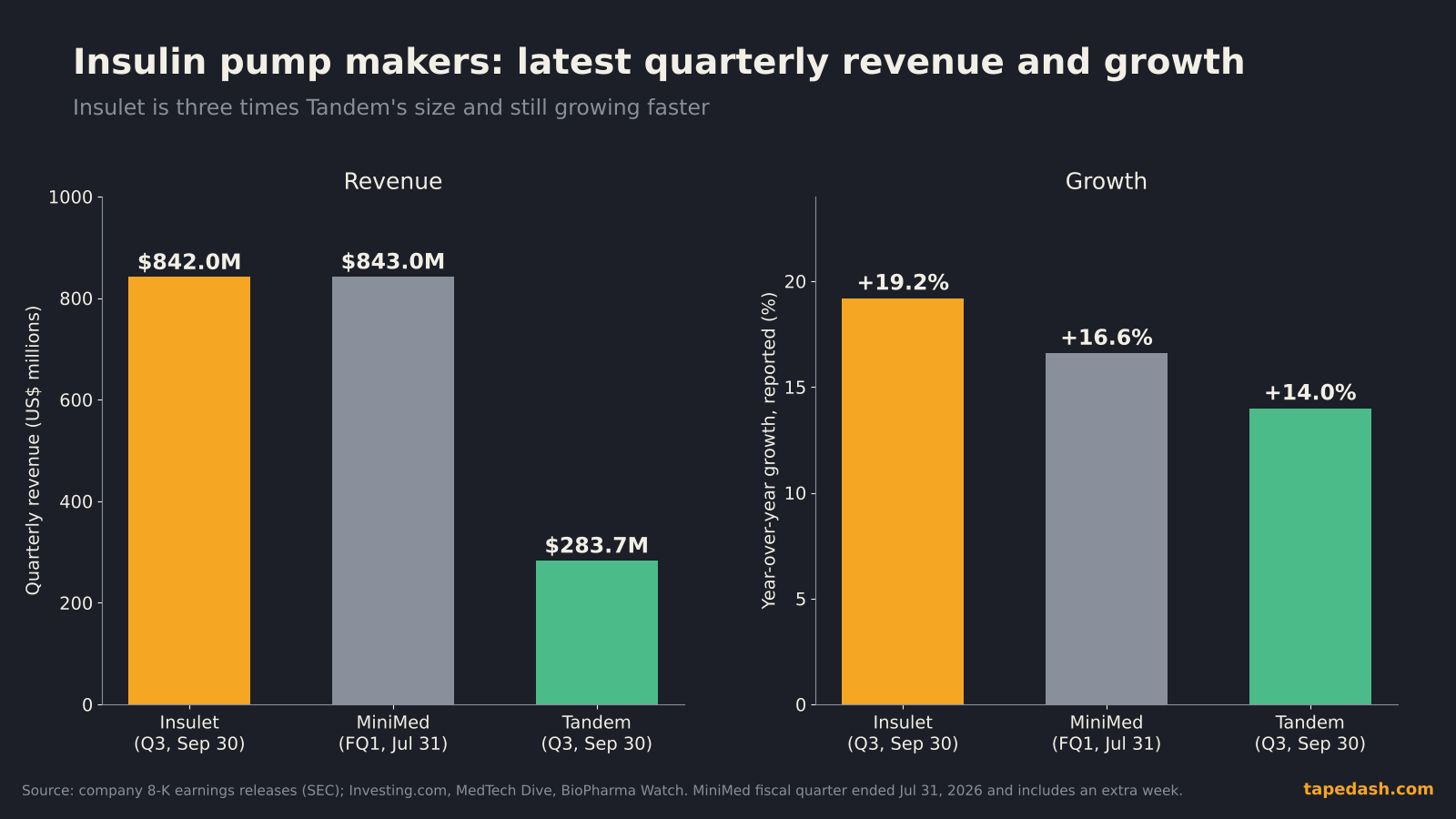
Scale is the part people miss. Tandem’s third-quarter sales were $283.7 million, up 14% (SEC 8-K, BioPharma Watch), roughly a third of Insulet’s. MiniMed’s most recent fiscal quarter, which ended July 31, came in at $843 million, up about 17%, though that figure includes CGM sensors and an extra week (MiniMed 8-K, MedTech Dive). A modest share shift that barely dents Insulet’s growth rate could change Tandem’s quite a bit.
The type 2 opportunity
Type 2 diabetes is the bigger long-run prize for everyone. More than 40% of Insulet’s U.S. new customer starts in the third quarter were people with type 2 (Investing.com, Yahoo Finance), and management said it has not seen GLP-1 drugs hurt those starts. If you have followed the GLP-1 story, that is worth noting, because “GLP-1s shrink the diabetes device market” has been a popular bear thesis. I covered the broader ripple effects in GLP-1 Stocks Explained: The Science, the Makers and the Ripples.
For Tandem, the type 2 opening is partly regulatory. CEO John Sheridan described Medicare’s C-peptide requirements, a lab-test hurdle for pump coverage, as a major obstacle to type 2 access and said the company is waiting on CMS decisions (The Motley Fool). No date has been set for that, so I would treat it as upside, not as a catalyst with a calendar.
Who wins and who loses from a tubeless Tandem Mobi
Tandem gets a product for the segment it was locked out of, plus a reason for existing tubed Mobi users to stay. The risk is execution. It has a new CEO starting next week, a business model transition that suppresses reported sales, and a launch that will not be fully available until sometime in the first half of next year. Jeannette Bankes, previously CEO of GE HealthCare’s patient care solutions business, starts November 16, and Sheridan retires at the end of 2026 (MedTech Dive, MarketBeat via TradingView).
Insulet faces its first real tubeless competition in the U.S., but from a position of strength: scale, near-universal pharmacy coverage, and a habit among doctors of prescribing Omnipod for injection converts. Its own outlook already assumes some share loss. The question for Insulet holders is whether that assumption proves too optimistic once both Tandem and MiniMed are on the market.
MiniMed has a patch pump coming too, so a tubeless Tandem raises the bar it will be measured against next summer.
Patients and payers probably win from more choice. More competitors in the pharmacy channel tend to mean harder bargaining with PBMs, and Insulet management said new entrants have been disciplined on price so far (Investing.com). If that discipline breaks, margins across the group are the casualty.
How to read a medtech clearance like a trader
A device clearance is not a drug approval, and the stock reaction is often a poor guide to what happens to revenue. Here is the checklist I run through when a medtech name gaps on FDA news.
First, separate clearance from launch. The FDA said yes on November 13. Revenue shows up when supplies ship broadly, which Tandem has pegged to the first half of 2027. Between those two points the stock trades on expectations, and expectations can drift either way.
Second, find the channel. A device that needs a new reimbursement pathway takes longer to ramp. Tubeless Mobi supplies go only through pharmacy, where Tandem estimates about half of insured U.S. lives are covered today. The pace of that coverage number is a better leading indicator than any analyst upgrade.
Third, check whether the market was surprised. Tandem had guided to a fourth-quarter clearance. A double-digit move on an expected event tells you positioning was skeptical going in. That can mean the move has room, or it can mean short sellers covered and the easy part is done. The options market usually tells you which. If implied volatility collapses after the gap, traders think the uncertainty is resolved. If it stays high, they think the next leg is still open.
Fourth, read the next earnings report for the right line. For Tandem the lines to watch are the pharmacy share of U.S. sales, gross margin, and any disclosed tubeless uptake. Headline revenue growth will be noisy because of the channel shift. My general approach is in How to Read an Earnings Report Like a Trader.
What to watch next in the tubeless insulin pump race
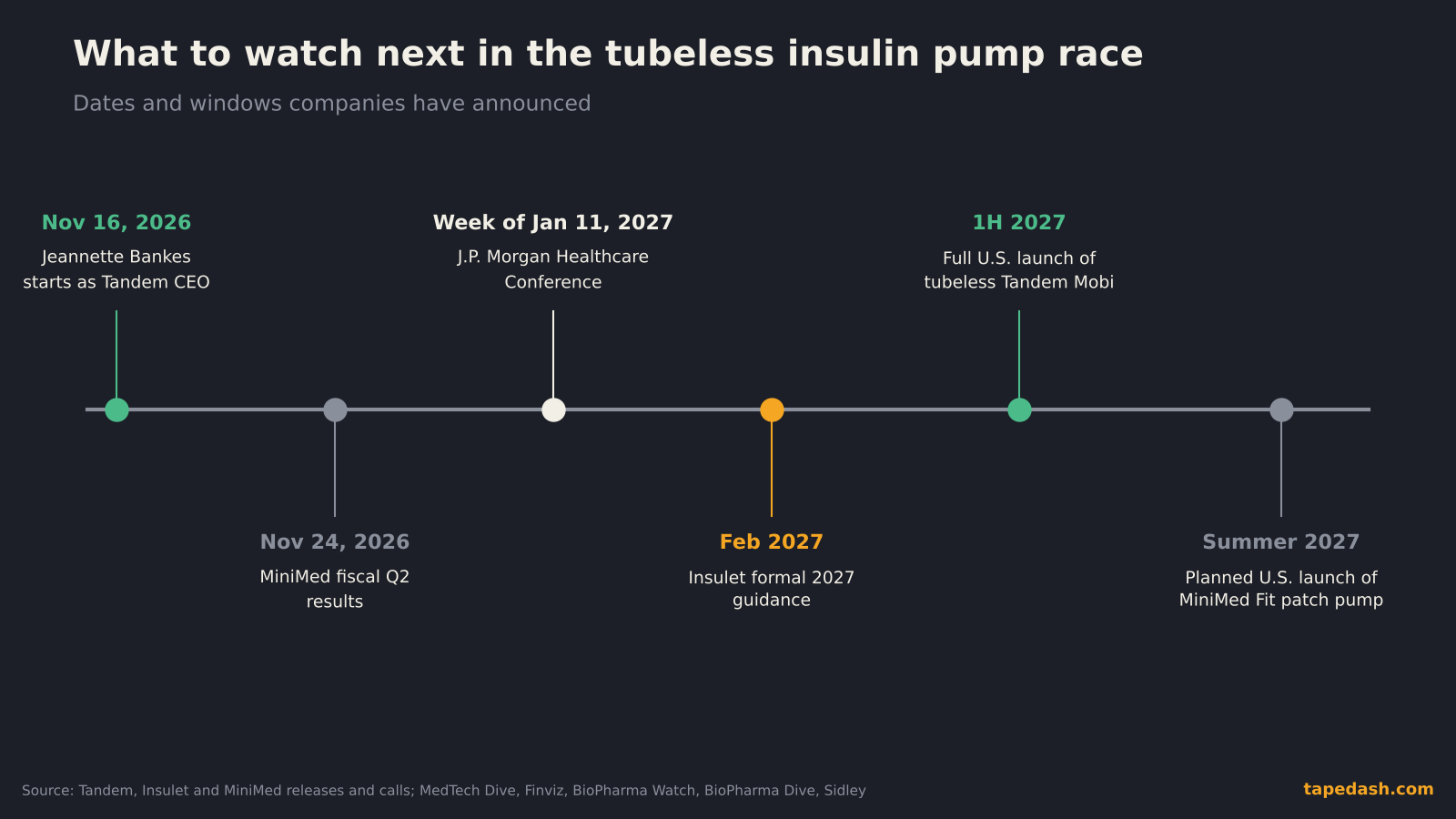
Monday, November 16: new Tandem CEO. Jeannette Bankes takes over (MedTech Dive, MarketBeat via TradingView). New CEOs often reset expectations early. Watch for any change in the 2027 framing.
Tuesday, November 24: MiniMed fiscal second-quarter results. The release is expected before the U.S. open (Finviz, BioPharma Watch). Listen for any update on the MiniMed Fit review and how management talks about the tubeless segment now that Tandem has a cleared product.
Week of January 11, 2027: J.P. Morgan Healthcare Conference. This is where medtech companies tend to give their first look at the new year (BioPharma Dive, Sidley). Tandem’s pharmacy coverage number and Insulet’s PBM contract status are the two items I would listen for.
February 2027: Insulet’s formal 2027 guidance. Management has already pointed to slower growth (Investing.com, Yahoo Finance). If the formal U.S. guide comes in below the low end of its earlier range, the market will read that as competition biting faster than expected.
First half of 2027: full launch of the tubeless Mobi. The first quarter with meaningful tubeless shipments is the real scorecard. Until then, expect the stock to trade on coverage updates and sell-side channel checks.
Summer 2027: MiniMed Fit. A planned launch, assuming FDA clearance (MiniMed 8-K, MedTech Dive). That would make it a three-way tubeless market for the first time.
How TapeDash tracks medtech catalysts like this one
Device names like Tandem do not get much attention until they gap. If you want to see whether the tubeless story is building or fading between now and the 2027 launch, this is what we track: unusual options activity in TNDM, PODD and MMED, and whether that flow is opening new positions or closing old ones; analyst rating changes as the new CEO settles in; and the news and filings that explain a move when it happens. The Unusual Flow and Why It’s Moving tools cover those, and the Live Scanner shows the flow as it prints.
If you would rather get a short read on the market each evening, including healthcare movers on days like Friday, the free TapeDash Daily is the easiest place to start. And if you want the full research toolkit, the first 200 members lock Pro at $69.99 a month on their account, even if they cancel and come back later.
Tubeless insulin pump FAQ
What is a tubeless insulin pump?
It is an insulin pump that attaches directly to the skin instead of connecting to an infusion site through tubing. Omnipod 5 uses a disposable pod. The newly cleared Tandem Mobi tubeless setup uses a reusable pump with a disposable tubeless cartridge and infusion set. In both cases the pump can work with a continuous glucose monitor and an algorithm to adjust insulin automatically.
When will the tubeless Tandem Mobi be available?
Tandem plans a full U.S. commercial launch in the first half of 2027, after a limited initial release. The tubeless supplies will be sold only through the pharmacy channel, and existing in-warranty Mobi users will not need a new pump (Tandem Diabetes Care, Mugglehead).
Why did Tandem Diabetes stock jump?
The clearance gives Tandem a product in the tubeless segment, the fastest-growing part of the pump market, which Insulet’s Omnipod has largely owned. It also arrived a week after Insulet said it expects slower growth and some share loss to new competitors in 2027. The stock closed up 14.6% at $20.07 on November 13.
The one thing to remember
The tubeless Mobi does not make Tandem an Insulet overnight. What it does is put Tandem’s product and Tandem’s business model in the same place for the first time: a pump people actually want to switch to, sold on the recurring pharmacy model that made Insulet’s margins. Whether Friday’s jump holds depends less on the clearance itself and more on how fast that pharmacy coverage number climbs from roughly half of insured Americans toward all of them.
See it on the tape, not just in the headlines
TapeDash is a market research and data analytics platform for traders and investors: live options flow, dealer positioning, a real-time market scanner, stock ratings, and macro and earnings data in one terminal. Memberships open Black Friday, November 27, and the first 200 members lock Pro at $69.99 a month on their account, even if they cancel and come back later.
Join the waitlistClick through the terminalSee the track recordSources
- Tandem Diabetes Care: Tandem Mobi now FDA cleared as world's first and only tubeless AID system with up to seven days of wear (Nov 13, 2026)
- MarketScreener: Tandem Diabetes Care shares rise after obtaining US FDA clearance for tubeless automated insulin delivery system (Nov 13, 2026)
- Stock Titan: Stocks close lower in the stock market today, November 13, 2026 (Nov 13, 2026)
- Seeking Alpha: Tandem Diabetes Care jumps 12% on FDA clearance for tubeless Mobi (Nov 13, 2026)
- Mugglehead: Tandem Diabetes Care gets FDA clearance for tubeless Mobi (Nov 13, 2026)
- Finimize: Healthcare stocks ended Friday higher on IPO pop and FDA news (Nov 13, 2026)
- SEC: Tandem Diabetes Care third quarter 2026 earnings release, Form 8-K Exhibit 99.1 (Nov 5, 2026)
- BioPharma Watch: Tandem Diabetes Care reports Q3 2026 results (Nov 5, 2026)
- The Motley Fool: Tandem (TNDM) Q3 2026 earnings call transcript (Nov 6, 2026)
- MarketBeat via TradingView: What Tandem Diabetes Care said on its Q3 earnings call (Nov 6, 2026)
- MedTech Dive: Tandem Diabetes Care names next CEO (Nov 6, 2026)
- SEC: Insulet third quarter 2026 results, Form 8-K Exhibit 99.1 (Nov 4, 2026)
- Investing.com: Earnings call transcript, Insulet tops Q3 2026 estimates as growth outlook cools (Nov 4, 2026)
- Yahoo Finance: What Insulet (PODD) said on its Q3 earnings call (Nov 2026)
- Panabee: Insulet Q3 revenue climbs 19% to $842 million (Nov 4, 2026)
- Omnipod: Omnipod 5 product information for healthcare providers
- ADCES danatech: Omnipod 5 product detail
- SEC: MiniMed fiscal 2027 first quarter earnings release, Form 8-K Exhibit 99.1 (Sep 1, 2026)
- MedTech Dive: MiniMed submits new patch pump for FDA clearance (Sep 1, 2026)
- Finviz: MiniMed to announce its fiscal year 2027 second quarter financial results
- BioPharma Watch: MiniMed fiscal year 2027 Q2 results date
- BioPharma Dive: Top biotech, pharma and medical conferences of 2027
- Sidley: 2027 J.P. Morgan Healthcare Conference events
This article is for educational and informational purposes only. It is not financial, investment, medical or legal advice, and it is not a recommendation to buy or sell any security. Figures come from the sources listed and were checked on the date of publication; markets change quickly. Options trading involves substantial risk of loss.