GLP-1 Stocks Explained: The Science, the Makers and the Ripples
GLP-1 stocks explained: how the drugs work, who makes them, how pricing and Medicare coverage are shifting, and what the ripple effects mean for investors.
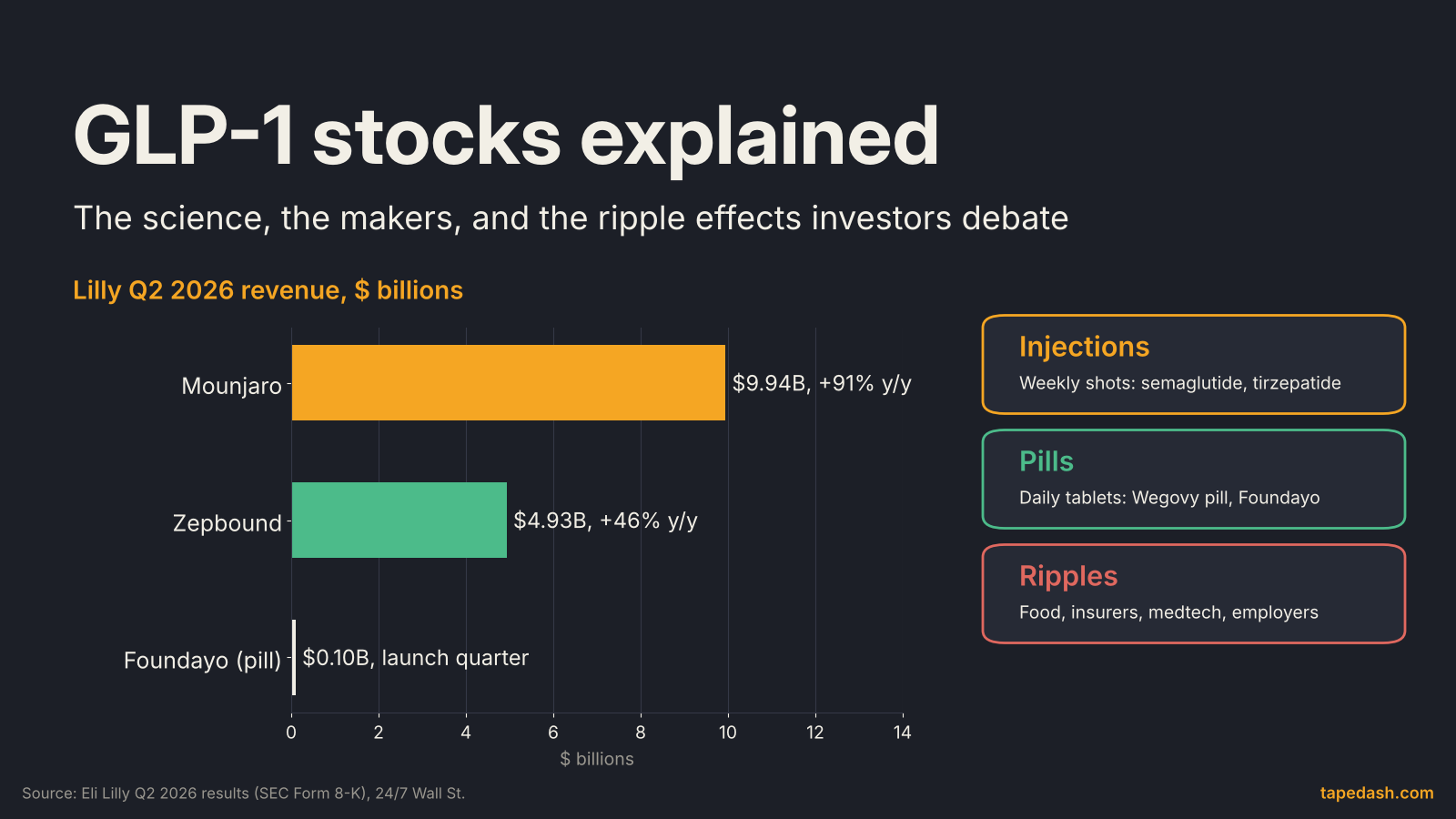
Eli Lilly reports third-quarter results tomorrow morning, October 29, with its conference call at 10 a.m. Eastern. Last quarter, its two GLP-1 brands, Mounjaro and Zepbound, brought in about $14.9 billion between them, and the company raised its 2026 revenue guidance to $85 billion to $87 billion, according to Lilly’s Q2 filing and 24/7 Wall St. Novo Nordisk, the company that started the boom with Ozempic and Wegovy, follows on November 4. Between those two prints sits most of what moves GLP-1 stocks.
So what are GLP-1 stocks, exactly? The core is the two drugmakers that sell nearly all of these medicines today, Eli Lilly and Novo Nordisk. Around them sits a much wider ring of companies whose sales, costs or growth assumptions change when tens of millions of people eat less: snack and packaged-food makers, insurers and pharmacy benefit managers, employers, pharmacies and some medical device makers. Investors argue about that outer ring constantly, and most of the argument happens without anyone explaining the science or the pricing underneath it.
This guide fills that gap. It covers how GLP-1 drugs work in plain language, who makes what, why the price you hear depends on who is paying, the shift from weekly injections to daily pills, and the second-order effects the market keeps trying to price. It is written for investors. Nothing here is medical advice, and the science section explains mechanisms rather than telling anyone what to take.
- GLP-1 drugs copy a gut hormone that raises insulin when blood sugar is high, slows the stomach and quiets appetite. The same molecules treat type 2 diabetes and obesity.
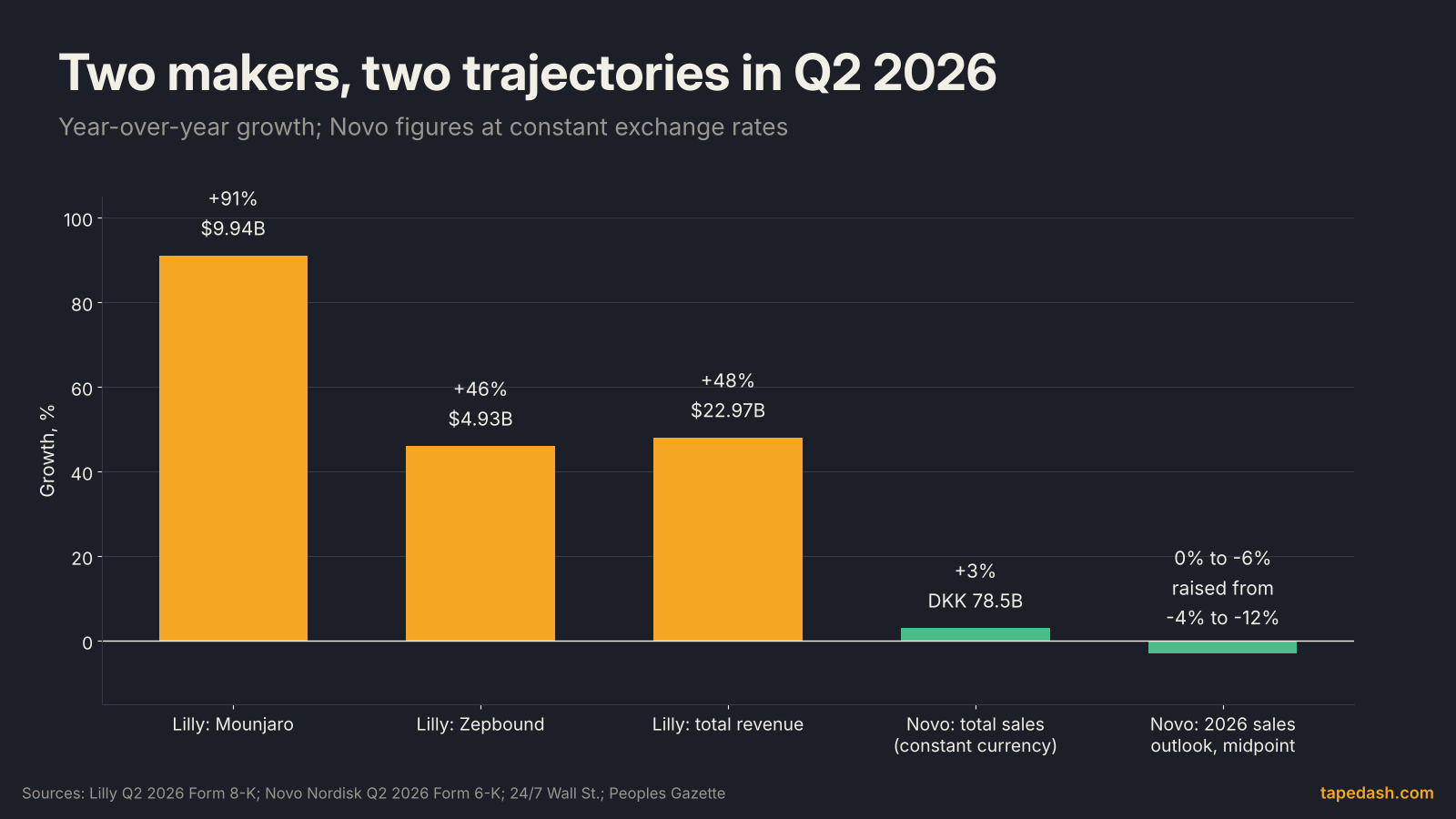
- Two makers dominate. In Q2 2026 Lilly’s Mounjaro grew 91% to $9.94 billion, while Novo Nordisk’s sales rose 3% at constant exchange rates.
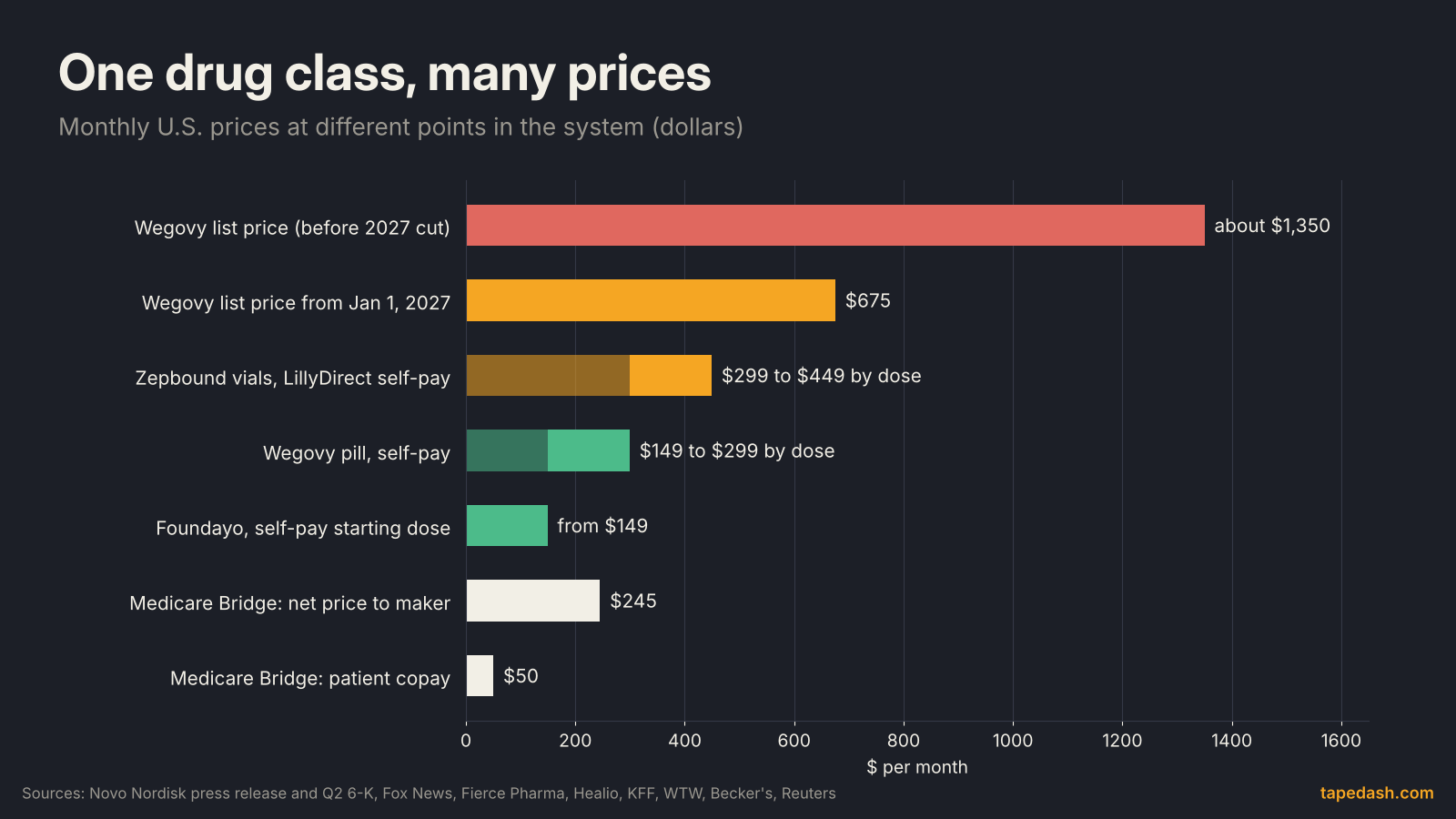
- Price depends on the payer. Wegovy’s list price drops to $675 a month on January 1, 2027, Medicare’s Bridge program pays makers a net $245, and patients there pay $50.
- Pills are the new front. The Wegovy pill launched in January 2026 and Lilly’s Foundayo was approved April 1, 2026, which widens the market but pressures price per patient.
- The ripple effects are real but uneven. GLP-1 households cut grocery spending about 5.5% in six months, and the share of large employers covering the drugs for weight loss fell from 72% to 60%.
How GLP-1 drugs work, in plain language
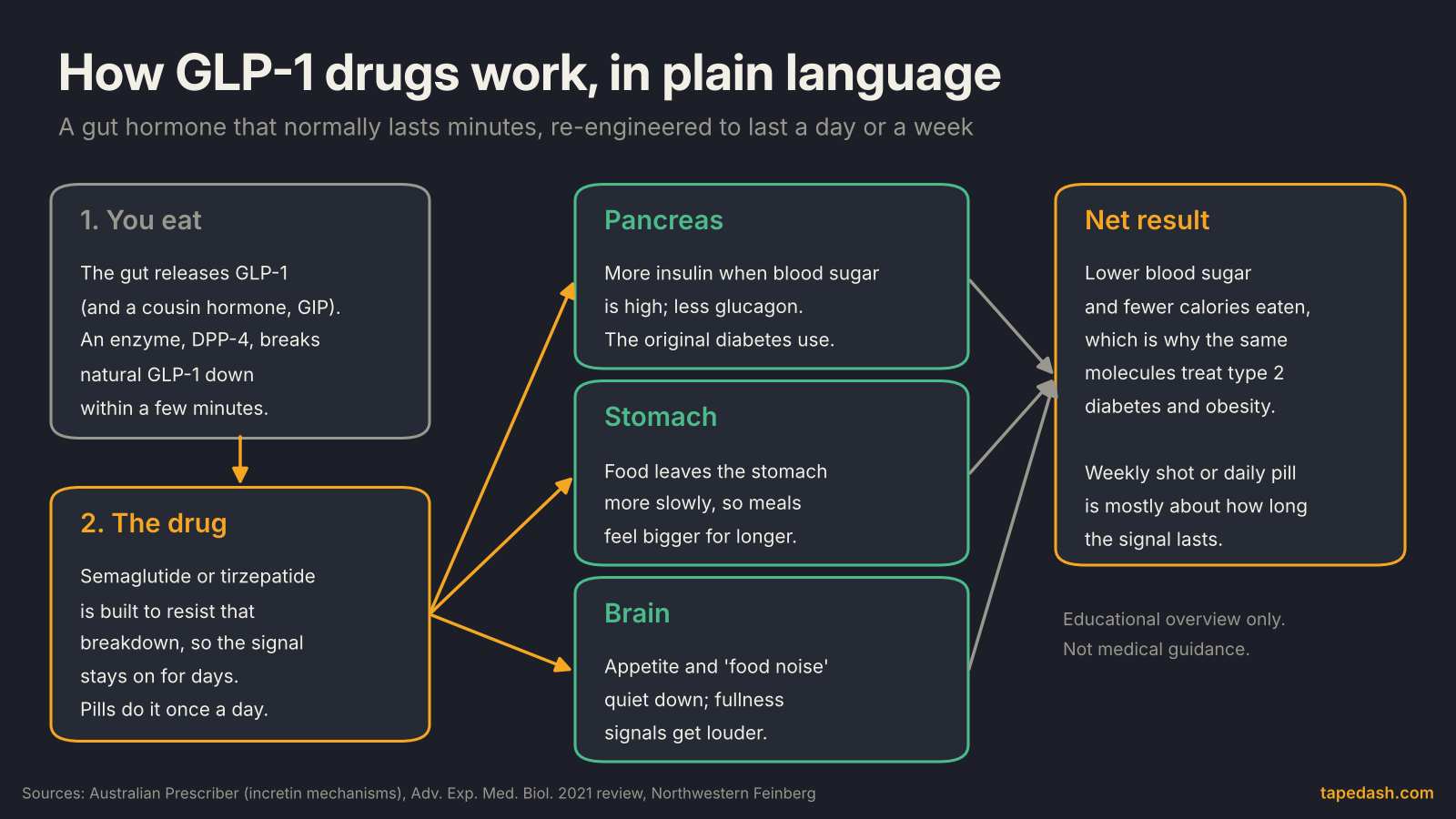
GLP-1 stands for glucagon-like peptide-1. It is a hormone your gut releases after you eat. It does three useful things at once. It tells the pancreas to release more insulin, but only when blood sugar is high. It tells the pancreas to release less glucagon, the hormone that pushes the liver to put sugar into the blood. And it slows the rate at which food leaves the stomach while sending fullness signals to the brain. Australian Prescriber’s overview of incretin mechanisms lays out each of those effects, including appetite suppression and delayed gastric emptying.
The catch with the natural hormone is that it barely lasts. An enzyme called DPP-4 chops it up within a few minutes; the Australian Prescriber piece puts the half-life at 1 to 2 minutes, and a 2021 review on GLP-1 and gastric physiology gives 2 to 3 minutes. The whole drug class is an engineering answer to that problem. Semaglutide (the molecule in Ozempic, Wegovy and Rybelsus) and tirzepatide (Mounjaro and Zepbound) are built to resist that breakdown, so one weekly injection keeps the signal on for days.
Why tirzepatide is different
Tirzepatide is a dual agonist. It activates the GLP-1 receptor and the receptor for a second gut hormone, GIP. Researchers are still mapping why that combination matters. A Northwestern Feinberg study in mice found these drugs quiet hunger-driving neurons in the brain, and that GIP signaling was essential to one of the gut-to-brain pathways involved. For an investor, the practical point is simple: the second receptor is a big part of why Lilly’s products took share so quickly, and every next-generation drug in the pipeline is trying to add a third or fourth lever.
Diabetes brand versus obesity brand
This trips people up when reading earnings. Ozempic and Wegovy contain the same molecule, semaglutide. Mounjaro and Zepbound contain the same molecule, tirzepatide. The first name in each pair is marketed for type 2 diabetes, the second for chronic weight management, at different doses and with different insurance treatment. When a company reports “Mounjaro up 91%,” that is the diabetes label, though in practice the split between uses is messier than the brand names suggest.
The main GLP-1 makers and their products
Two companies sell almost all of the volume. Here is what each looks like going into this earnings cycle.
Eli Lilly: the share taker
Lilly’s second quarter was the kind of print that resets a sector. Total revenue rose 48% to $22.97 billion. Mounjaro rose 91% to $9.94 billion and Zepbound rose 46% to $4.93 billion, per the company’s Form 8-K, figures matched by American Pharmaceutical Review and 24/7 Wall St. Its new pill, Foundayo, added $98 million in its launch quarter.
There was one number underneath that I would circle before tomorrow. Excluding rebate and discount adjustments, Lilly said U.S. prices would have fallen about 9%. Volume is carrying the story while price per prescription comes down. That trade-off is the central question for the whole group, and we come back to it below.
Novo Nordisk: the pioneer playing defense
Novo’s picture is flatter. Reported net sales in Q2 were DKK 78.5 billion, up 3% at constant exchange rates, according to its Q2 company announcement and Peoples Gazette. The good news for holders was the outlook: Novo now expects 2026 adjusted sales growth of 0% to minus 6% at constant exchange rates, raised from minus 4% to minus 12%. Read that twice. A raise that still allows for a decline tells you how much ground the company has given up and how much price it is trading away.
Who else is in the race
The rest of the field is mostly pipeline. Novo’s next big bet, CagriSema, has a U.S. decision expected in the fourth quarter of 2026, per Novo’s filing and Zacks. Lilly plans to submit retatrutide, a triple agonist, to the FDA in the first quarter of 2027. Larger pharma companies and a long list of biotechs have obesity programs, but until they have approved products, they trade on trial readouts and FDA calendars. If that is the part of the theme you follow, our explainer on PDUFA dates and FDA approvals covers how those binary events get priced.
GLP-1 pricing, insurers and Medicare: who pays what
Ask what a GLP-1 drug costs and the honest answer is “for whom?” There are at least four prices in play, and they are moving in the same direction: down.
List price. This is the sticker price before rebates. Novo announced in February that from January 1, 2027, the list price of Wegovy, Ozempic and Rybelsus will be $675 a month, a cut of about 50% for Wegovy and about 35% for Ozempic, according to Novo’s release and FOX 9. Novo has said the change will hit 2027 cash flow.
Self-pay price. Both companies now sell directly to patients paying cash. Lilly’s Zepbound vials run $299 to $449 a month by dose through LillyDirect, per Fierce Pharma and FOX 32. The newer pills start at $149 a month.
Medicare price. This is the big 2026 change. Medicare law historically excluded drugs for weight loss. Under the Medicare GLP-1 Bridge, which started July 1, 2026 and runs through December 31, 2027, eligible Part D enrollees pay a $50 monthly copay and manufacturers supply the drugs at a net price of $245 a month, according to KFF, WTW and CBS News. Covered products are Wegovy (shot and pill), Zepbound and Foundayo, with eligibility tied to body mass index thresholds and related conditions. CMS’s broader plan, the BALANCE model, was delayed indefinitely in Part D after major plan sponsors were reluctant to sign on, KFF reports. Early demand has been strong: a Walgreens pharmacy executive told Becker’s that uptake was “far exceeding” what the company expected.
Commercial net price. This is what employers and insurers actually pay after rebates, and it is the least visible. It is also the number that decides margins.
Why insurers and employers keep changing their minds
Coverage decisions have whipsawed. CVS Caremark dropped Zepbound from its commercial formularies on July 1, 2025 in favor of Wegovy, per FOX 32 and a member notice posted by Indiana University, then announced this year that it would add Zepbound back. Employers are moving the other way. The share of large employers covering GLP-1s for obesity fell from 72% in 2025 to 60% in 2026, and pharmacy now accounts for about a quarter of employer health spending, according to the Business Group on Health survey as reported by Reuters and Insurance Business.
For investors, this creates a tug-of-war. Lower prices and Medicare coverage push volume up. Employer pullback pushes the commercial channel down and shifts patients toward cash-pay and direct-to-consumer routes, which the drugmakers increasingly control themselves. Whether that mix is good or bad for margins is one of the questions analysts will press on both calls.
What happened to compounded versions
During the shortage years, compounding pharmacies were allowed to sell their own versions of semaglutide and tirzepatide. The FDA declared the shortages resolved by early 2025 (the FDA’s compounding guidance and CNN’s report cover the semaglutide decision), which removed the legal basis for most mass compounding. The cheaper branded cash prices you see today are partly the makers’ answer to that cash-pay market.
Oral GLP-1 pills versus injections
The next phase of the theme is the pill. Two are now on the U.S. market.
The Wegovy pill, a once-daily 25 mg tablet of semaglutide, was approved on December 22, 2025, per Novo’s filing and Becker’s. In its main trial, people who stuck with treatment lost 16.6% of body weight on average. It launched in the U.S. in early January 2026, and Novo says total prescriptions have passed 5 million, a figure Peoples Gazette also reported.
Foundayo (orforglipron), Lilly’s pill, was approved on April 1, 2026, per Healio and Pharmacy Times. It is a small molecule rather than a peptide, which matters for manufacturing, and it can be taken without the food and water timing rules that apply to oral semaglutide. Average weight loss at the top dose in its 72-week trial was roughly 11% to 12%, depending on how the analysis handles people who stopped treatment.
Do not compare those trial figures head to head. They come from different studies with different populations and methods. What matters for the stocks is the business logic of pills, which comes down to three points.
- Reach. A daily tablet removes the needle barrier for people who would never start a shot, which expands the addressable market.
- Price. Pills launched at lower cash prices than injections, so each new patient brings in less revenue.
- Manufacturing. Small-molecule pills like Foundayo can be made at scale in conventional chemical plants, which eases the supply constraints that capped injectable growth in earlier years.
| Product | Maker | Molecule | How it is taken | What to know in 2026 |
|---|---|---|---|---|
| Wegovy (injection) | Novo Nordisk | Semaglutide | Weekly injection | List price falls to $675 on Jan 1, 2027 |
| Zepbound | Eli Lilly | Tirzepatide (GLP-1 plus GIP) | Weekly injection | Q2 2026 sales $4.93B, up 46% |
| Wegovy pill | Novo Nordisk | Oral semaglutide 25 mg | Daily tablet with timing rules | Launched Jan 2026; over 5M prescriptions |
| Foundayo | Eli Lilly | Orforglipron (small molecule) | Daily tablet, no food or water rules | Approved Apr 1, 2026; $98M in launch quarter |
| CagriSema | Novo Nordisk | Cagrilintide plus semaglutide | Weekly injection | U.S. decision expected Q4 2026 |
Second-order effects: food, medtech and insurers
This is where the debate gets loud, and where I think it pays to separate measured effects from extrapolation.
Food and snack makers
The best data so far comes from a Cornell University and Numerator study of a 150,000-household panel. Households where someone started a GLP-1 cut grocery spending by about 5.5% within six months, households earning over $125,000 cut 8.6%, and spending on savory snacks such as chips fell by more than 10%, according to NJBIZ and Baking Business. The reductions shrank after a year but stayed negative.
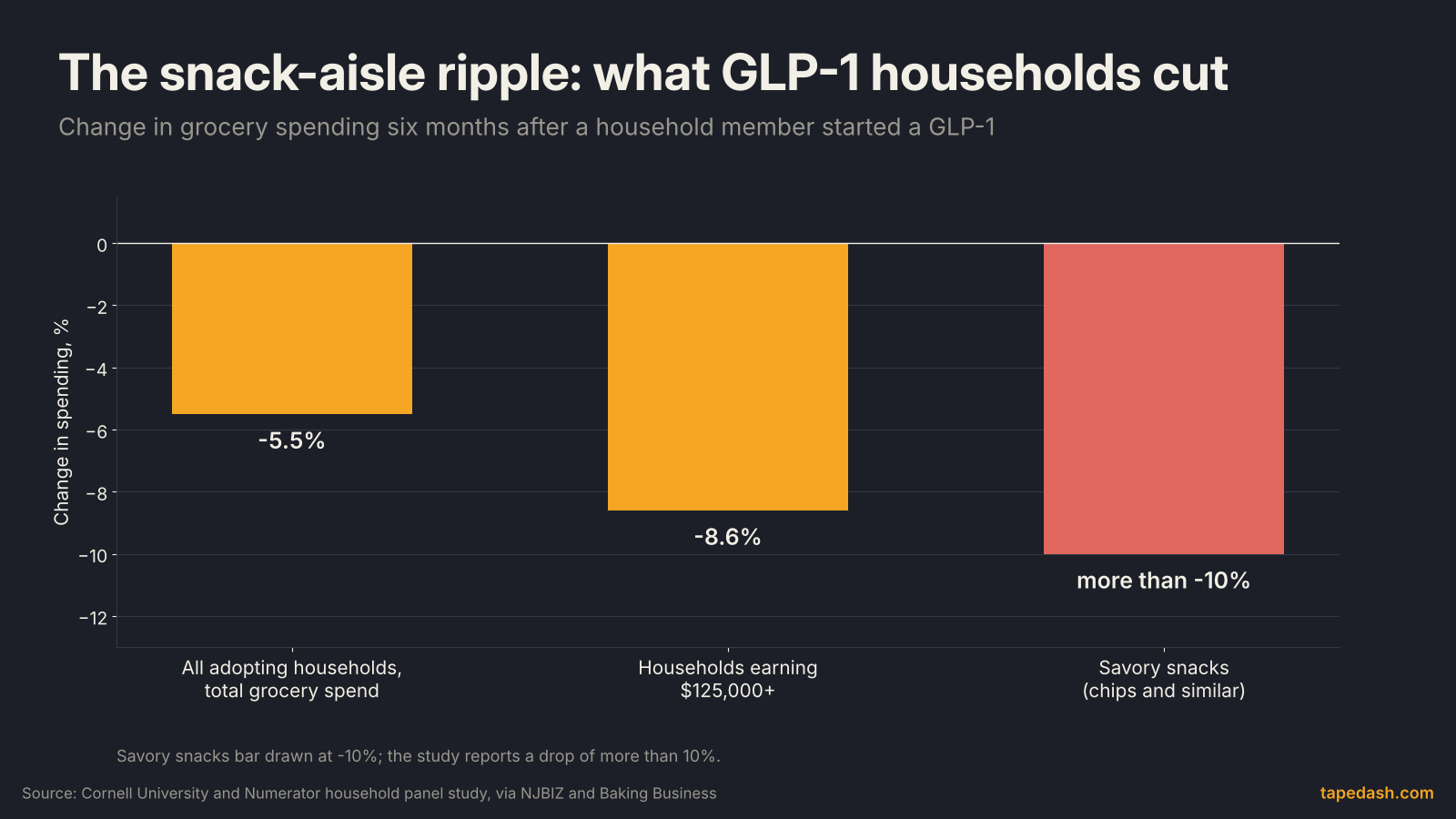
Here is how I read it. A 5.5% cut in one household’s grocery bill only becomes a sector problem when multiplied by enough households, and adoption is still a minority of the population. The categories hit hardest, snacks and sweet baked goods, are a specific slice of the shelf. So the honest framing for food stocks is a slow headwind on volume in particular categories, layered on top of everything else that moves those names (pricing power, input costs, private label). Cheaper pills and Medicare coverage push adoption up, which is why each pricing headline tends to ripple into snack makers.
Medtech and sleep apnea
Zepbound became the first drug approved for moderate-to-severe obstructive sleep apnea in adults with obesity on December 20, 2024, per Becker’s and Pharmacy Times. That put CPAP makers on the list of names investors check against GLP-1 headlines. The counterargument is that more people entering the healthcare system for weight treatment also means more diagnoses. The same two-sided debate applies to bariatric surgery devices, diabetes supplies and orthopedics.
Insurers, PBMs and pharmacies
For health insurers and PBMs, GLP-1s are a cost line first. More covered patients means higher pharmacy spend now, against a hoped-for drop in heart, kidney and joint costs years later. That timing gap is why employers have pulled back even as Medicare stepped in. Pharmacies sit on the other side: Bridge prescriptions are volume through their counters, at a fixed $50 patient copay.
How to read GLP-1 stocks around earnings
Earnings season is when this theme gets repriced in a single morning. Here is the checklist we run for Lilly tomorrow and Novo next week.
- Separate volume from price. The headline growth rate hides the mix. Look for the company’s own breakdown of U.S. volume versus realized price. Lilly’s Q2 showed both clearly; expect analysts to ask how much further price falls as Medicare and pills scale.
- Watch the pill numbers. Foundayo’s second full quarter and the Wegovy pill’s trajectory are the cleanest read on whether oral drugs expand the market or mostly cannibalize injections.
- Listen for 2027 guidance language. Novo’s $675 list price takes effect January 1. Any early color on 2027 revenue or cash flow will matter more than the quarter itself.
- Track the channel mix. Self-pay, Medicare Bridge and commercial insurance carry very different net prices. Commentary on where new patients come from is a margin signal.
- Compare the move to the expected move. Before the print, the options market prices an implied move. If the stock moves less than that, option buyers lose even when they guessed the direction. Our guide to implied volatility and the expected move walks through the arithmetic.
- Check the ripple names after the call. If Lilly or Novo signals faster adoption, watch how snack makers, insurers and CPAP makers trade the same day. Those reactions tell you how much of the second-order story is already priced.
What to watch next for GLP-1 stocks
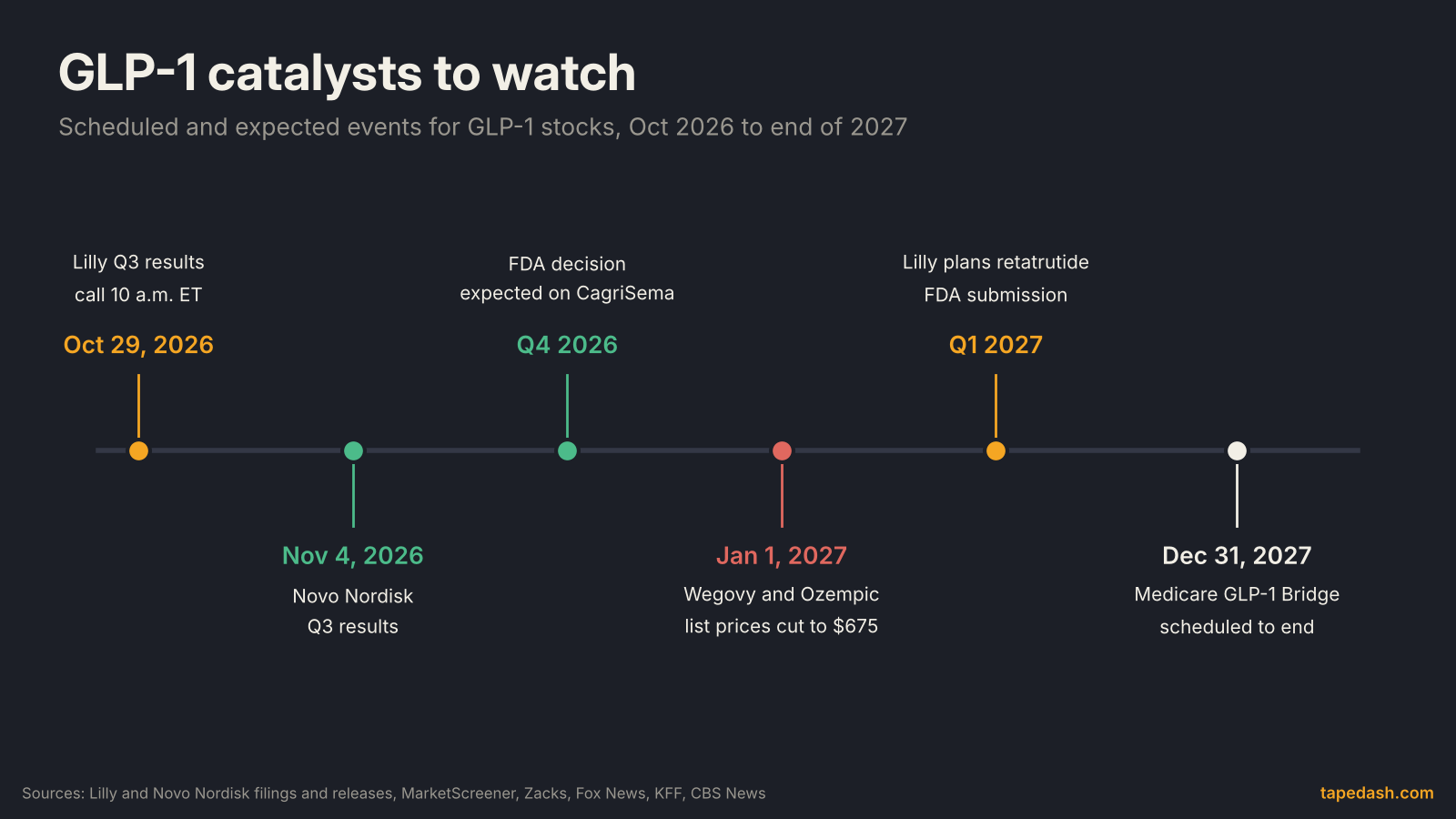
The calendar for the next 14 months is unusually crowded.
- October 29, 2026: Lilly third-quarter results, call at 10 a.m. ET (per Lilly’s announcement and 24/7 Wall St).
- November 4, 2026: Novo Nordisk nine-month results (per Novo’s Q2 filing and MarketScreener).
- Q4 2026: Expected FDA decision on CagriSema.
- January 1, 2027: Wegovy and Ozempic list prices fall to $675 a month.
- Q1 2027: Lilly’s planned FDA submission for retatrutide (per Lilly’s Q2 filing and 24/7 Wall St).
- December 31, 2027: The Medicare GLP-1 Bridge is scheduled to end unless extended.
Outside the U.S., semaglutide patents lapsed in 2026 in Canada, India and China, opening those markets to generic versions, per Manufacturing Chemist and Asia IP Law. That is a pricing pressure point for Novo’s international business worth tracking quarter by quarter.
How we track GLP-1 stocks in TapeDash
If you want to watch how the market positions into these reports, this is what we track. The Earnings page in TapeDash shows the implied move for upcoming reports, read from the options market, so you can see the hurdle for Lilly tomorrow and Novo next week before the numbers drop. The Volatility Desk is where we check whether options on a healthcare name are carrying an unusual earnings premium compared with its own history.
For positioning, Large Prints and Flow Edge show the biggest options trades and whether flow in a name is building in one direction over several sessions, which is how we spot money leaning into a catalyst rather than reacting to it. The same view works for the ripple names: when a snack maker or an insurer suddenly draws heavy put buying the day of a GLP-1 headline, that is worth noticing. Our guide on how to read options flow explains how to tell a real bet from a hedge.
You can explore all of it in the Terminal Preview, free with no account, or get the evening read in the free TapeDash Daily. The first 200 members lock Pro at $99 a month for as long as they stay.
GLP-1 stocks FAQ
Which companies make GLP-1 drugs?
Eli Lilly and Novo Nordisk sell almost all approved GLP-1 drugs in the U.S. Lilly makes Mounjaro, Zepbound and the Foundayo pill. Novo makes Ozempic, Wegovy, the Wegovy pill and Rybelsus. Other drugmakers have candidates in development but are not yet selling approved obesity products at scale.
Are GLP-1 pills replacing injections?
Not yet, and maybe never entirely. Pills are adding patients who would not use a needle, and the Wegovy pill has passed 5 million U.S. prescriptions since its January launch. Injections still produce most of the revenue. The investment question is whether pills grow the total market or mostly shift existing patients to a cheaper product.
Do GLP-1 drugs hurt food stocks?
They create a measurable headwind in specific categories. The Cornell and Numerator study found households with a GLP-1 user cut grocery spending about 5.5% in six months and savory snacks by more than 10%. How much that matters to any one company depends on its product mix and on how fast adoption grows.
The one idea to keep
GLP-1 drugs are the rare medical story that reaches into grocery aisles, insurance budgets and federal programs at the same time. For the makers, the question has shifted from “can they make enough?” to “how fast does price per patient fall as volume rises?” Watch that trade-off in tomorrow’s Lilly report and next week’s Novo report, and you will understand most of what moves GLP-1 stocks, and most of what ripples out from them.
See it on the tape, not just in the headlines
TapeDash is the research desk for traders and investors: live options flow, dealer positioning, a real-time market scanner and trade alerts graded in public. Memberships open January 1, 2027, and the first 200 members lock Pro at $99 a month for as long as they stay.
Join the waitlistClick through the terminalSee the track recordSources
- Eli Lilly Q2 2026 results, Form 8-K exhibit (SEC)
- 24/7 Wall St: catalysts for Eli Lilly into Oct 29 results
- American Pharmaceutical Review: Lilly Q2 revenue jumps 48%
- Lilly confirms date and conference call for Q3 2026 results (via Finviz)
- Novo Nordisk Q2 2026 company announcement, Form 6-K (SEC)
- Peoples Gazette: Novo Nordisk raises 2026 forecast after Wegovy pill sales
- MarketScreener: Novo Nordisk events calendar
- Novo Nordisk: FDA approval of Wegovy pill, Form 6-K (SEC)
- Becker's Hospital Review: FDA approves Wegovy pill as first oral GLP-1 for weight loss
- Healio: FDA approves orforglipron, an oral GLP-1 for adults with obesity
- Pharmacy Times: FDA approves orforglipron without food or water restrictions
- Novo Nordisk: reduction in US list price for Wegovy, Ozempic and Rybelsus (via BioSpace)
- FOX 9: Novo Nordisk to slash list prices of Ozempic, Wegovy by up to 50%
- KFF: What to know about the BALANCE Model and the Medicare GLP-1 Bridge
- WTW: Medicare's GLP-1 Bridge program, what employers need to know
- CBS News: Medicare GLP-1 weight-loss drug coverage starts July 1
- Becker's Hospital Review: Medicare's GLP-1 program is far exceeding expectations
- Fierce Pharma: Lilly joins Novo in GLP-1 self-pay price cuts
- FOX 32: CVS Caremark to cover Zepbound again
- Reuters (via KFGO): More US employers to drop weight-loss drugs in 2027
- Insurance Business: Employers cut GLP-1 coverage as pharmacy costs hit 25% of health spend
- NJBIZ: GLP-1 users spend less at the supermarket, Cornell study finds
- Baking Business: Grocery spending shrinks with GLP-1 drug use
- Becker's Hospital Review: FDA approves Zepbound for obstructive sleep apnea
- Pharmacy Times: FDA approves tirzepatide for obstructive sleep apnea
- Australian Prescriber: Incretin mimetics and enhancers, mechanisms of action
- PubMed: Effects of GLP-1 and its analogs on gastric physiology (2021 review)
- Northwestern Feinberg: Obesity drugs regulate neural systems to curb appetite
- Manufacturing Chemist: Semaglutide patent cliff
- Asia IP Law: Ozempic patent expiry opens door for generics in India, China, Canada
- Zacks: Can CagriSema help Novo Nordisk close the gap with Lilly
- Indiana University HR: CVS Caremark changes coverage for weight loss drug
- FDA: FDA clarifies policies for compounders as national GLP-1 supply begins to stabilize
- CNN (via ABC17): Ozempic and Wegovy are no longer in shortage, FDA says
This article is for educational and informational purposes only. It is not financial, investment, medical or legal advice, and it is not a recommendation to buy or sell any security. Figures come from the sources listed and were checked on the date of publication; markets change quickly. Options trading involves substantial risk of loss.