PDUFA Dates Explained: How FDA Decisions Move Biotech Stocks
A PDUFA date is the FDA's goal date to rule on a new drug. How the approval path works, why biotech options price huge moves into it, and how to read it.
A PDUFA date is the deadline the FDA sets for itself to decide whether to approve a new drug or biologic. The name comes from the Prescription Drug User Fee Act, the 1992 law that lets drug makers pay fees to fund faster reviews in exchange for firm review goals. When the FDA accepts an application, it assigns a goal date. That date is the most important day on many small biotech companies’ calendars, because a single letter can double the stock or cut it in half.
That is why biotech options often price enormous moves into a PDUFA date, and why so many traders who buy calls or straddles into the decision lose money even when they guess the outcome correctly. The option market is pricing a coin flip with a weighted coin, and once the coin lands, the premium built for the uncertainty disappears overnight.
This guide walks through the whole FDA approval path, from the first trial filing to the decision letter, then explains how options price a PDUFA date, what IV crush does to those trades, and how we read a company’s catalyst calendar on the desk.
- A PDUFA date is the FDA’s goal date to act on a drug application: about 10 months for a standard review and 6 months for priority review, with the clock starting after a 60-day filing period for new molecular entities and original biologics.
- Only about 7.9% of drugs entering Phase 1 are eventually approved, but 90.6% of applications that reach the FDA review stage get approved, according to the BIO 2011 to 2020 study.
- The outcome is binary: approval or a complete response letter (CRL). Options price this as one wide bell curve, so the “expected move” is an average of two very different results.
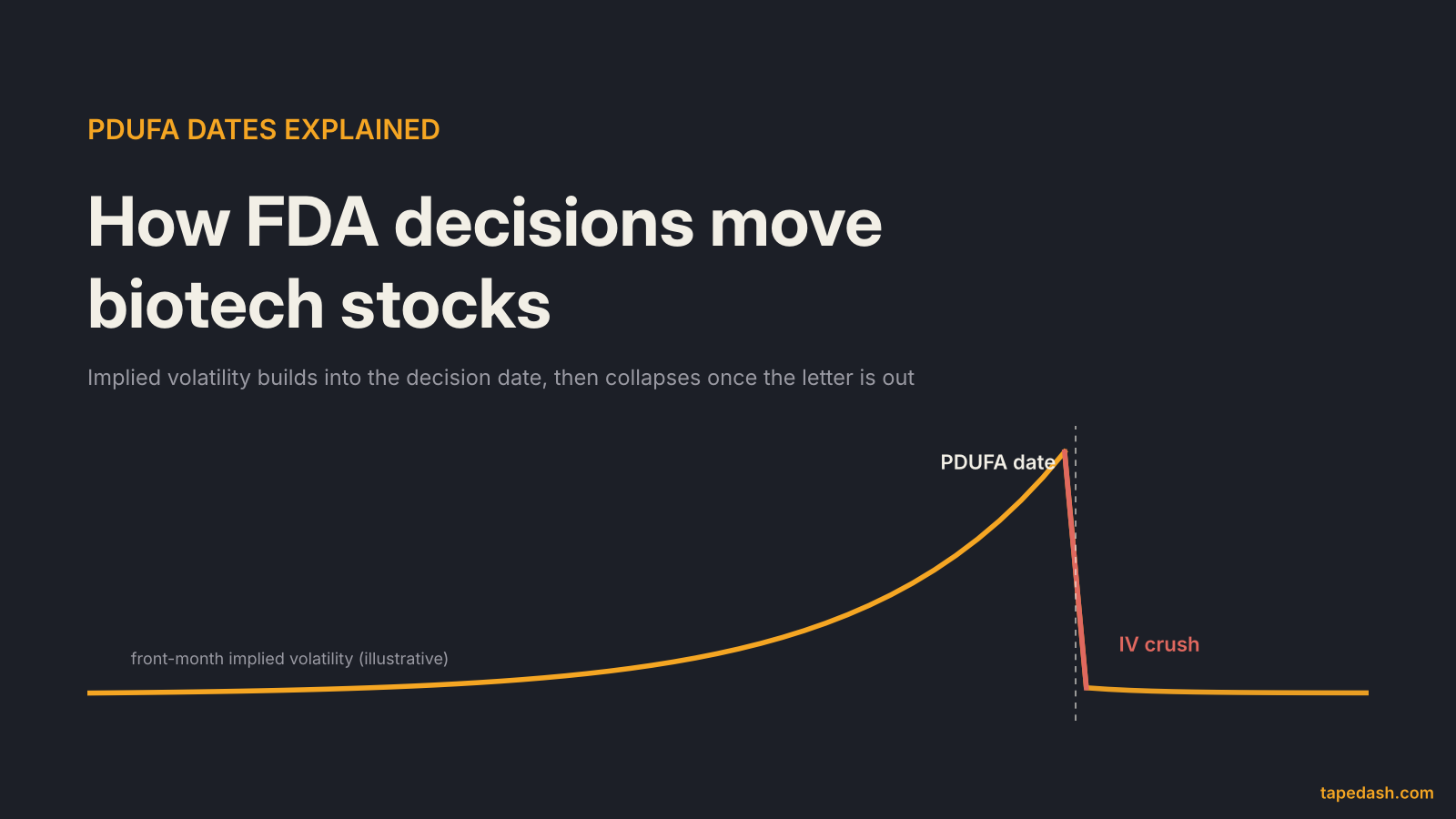
- After the decision, front-month implied volatility usually collapses. That IV crush can sink option buyers who were right about direction.
- PDUFA dates come from company disclosures, not the FDA. Read the press release, the review type and whether an advisory committee is scheduled before trusting a calendar entry.
What is a PDUFA date?
Before 1992, drug reviews had no firm timelines, and the FDA was chronically short of reviewers. The Prescription Drug User Fee Act changed the deal: companies pay application fees, and the FDA commits to performance goals for how quickly it acts. Congress has to reauthorize the program every five years, which is why you see roman numerals attached to it. The current version, PDUFA VII, covers fiscal years 2023 through 2027 under its commitment letter, and it is set to expire on September 30, 2027. The FDA has already been negotiating PDUFA VIII with industry since late 2025.
The PDUFA date itself is simply the target action date for one application. Three details about it matter for traders.
It is a goal, not a deadline. The commitment letter asks the FDA to meet its review timelines for 90% of applications, a standard that has carried across PDUFA cycles. The agency can act before the date, and occasionally it misses, so the event window starts before the date on the calendar.
It can move. If the company submits a major amendment during review (new analyses, a big chunk of new data), the commitment letter allows the FDA to extend the goal date by three months, once per review cycle. Companies usually announce these extensions, and the stock often reacts, because an extension changes when the binary event lands and hints that the review is not simple.
The FDA will not tell you about it. Under 21 CFR 314.430, the agency does not publicly disclose that an application even exists before approval unless the company has already made it public, a rule the FDA Law Blog notes dates to 1985. Every PDUFA date you see on a biotech calendar traces back to a company press release or SEC filing.
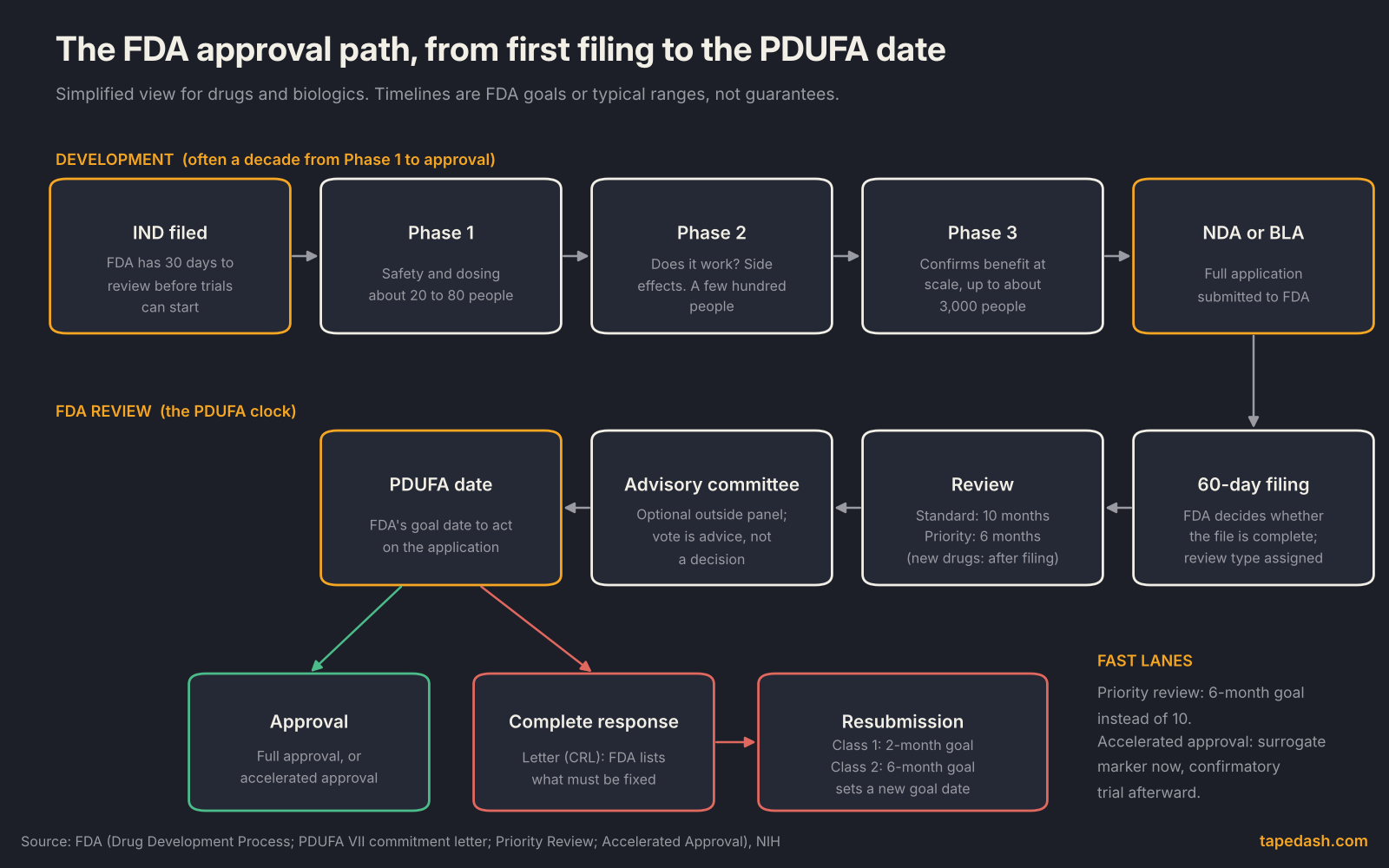
The FDA approval process, step by step
A PDUFA date sits at the very end of a long road. Knowing the road helps you judge how much risk is left at the end of it.
IND and the clinical trial phases
A company first files an Investigational New Drug application, or IND. The FDA has 30 days to review it before human trials can begin, and it can place a clinical hold if it sees unreasonable risk to participants.
Then come the phases. Phase 1 tests safety and dosing in roughly 20 to 80 people, according to both the FDA and the NIH. Phase 2 asks whether the drug works and what the side effects look like, usually in a few hundred patients. Phase 3 confirms the benefit at scale, in studies that can run up to about 3,000 patients and take years.
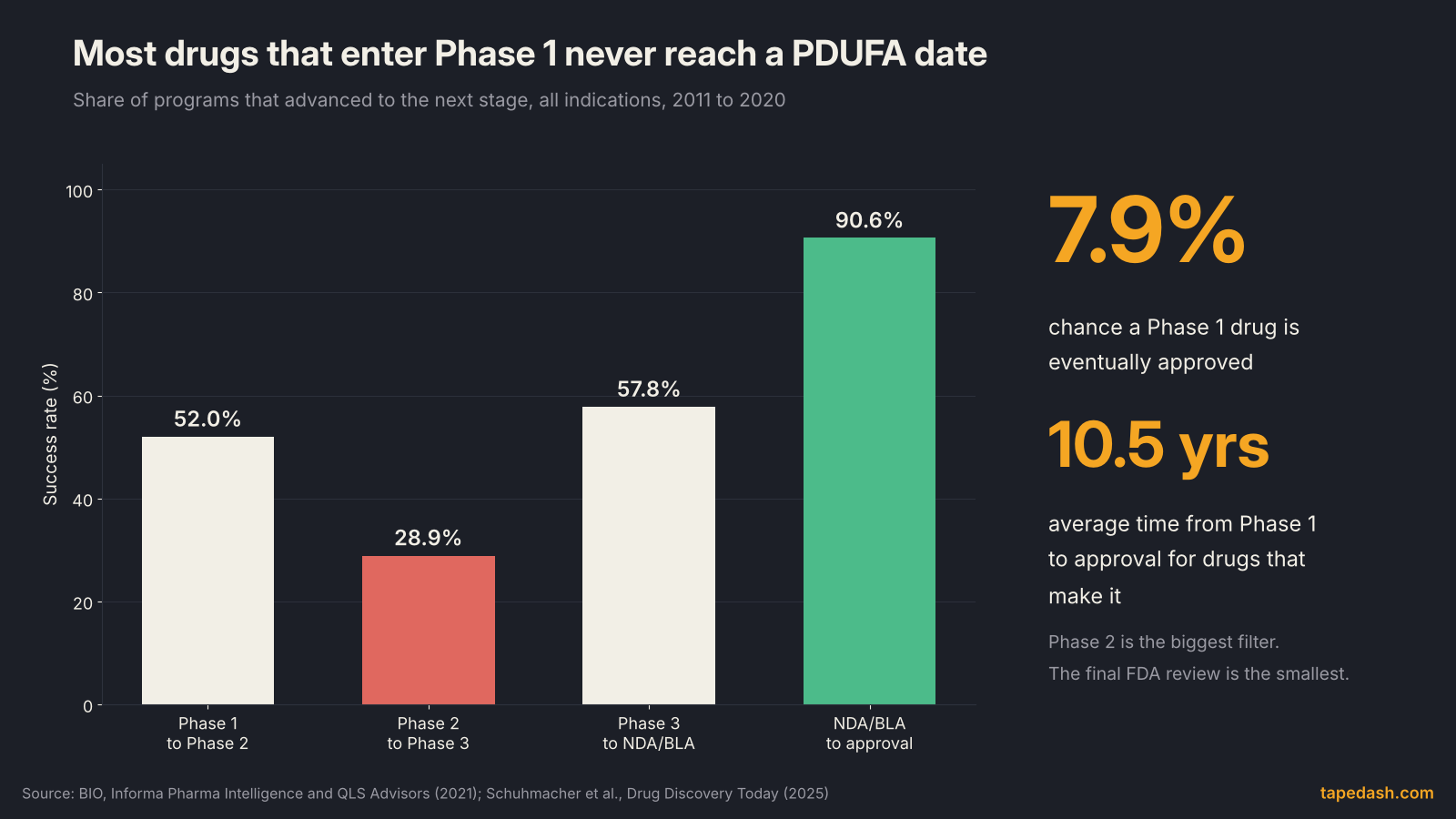
Most drugs never make it through. The largest recent study of success rates, published in 2021 by BIO, Informa Pharma Intelligence and QLS Advisors, tracked 12,728 phase transitions from 2011 to 2020. It found that only 7.9% of drugs entering Phase 1 were eventually approved, and that the drugs which did succeed took about 10.5 years from Phase 1 to approval, figures BioWorld also reported. A 2025 paper in Drug Discovery Today cites the same stage-by-stage rates shown below.
NDA or BLA, and the review clock
When Phase 3 is done, the company submits a New Drug Application (NDA) for a chemical drug or a Biologics License Application (BLA) for a biologic, such as an antibody or a vaccine. The FDA spends the first 60 days deciding whether the file is complete enough to review. It also decides whether the application gets priority review, which is meant for drugs that could offer a significant improvement in treating a serious condition, and notifies the company within those 60 days.
Under PDUFA VII, the review goals are 10 months for a standard review and 6 months for a priority review. For new molecular entities and original BLAs, that clock starts at the end of the 60-day filing period, which adds two months to the total. So a standard review of a brand-new drug lands about 12 months after submission, and a priority review about 8 months after.

Priority review changes timing only. The FDA says plainly that the designation does not lower the standard for approval or the quality of evidence required.
Advisory committees
For some applications, the FDA convenes an advisory committee: a panel of outside experts who hear presentations and vote on whether the benefits outweigh the risks. The vote is advice. The FDA is free to disagree.
How often does it? A study in the Milbank Quarterly looked at 376 voting meetings from 2008 to 2015 and found the FDA’s final action was at odds with the committee’s recommendation 22% of the time. When the two disagreed, the FDA was usually the stricter one: 62 of the 83 discordant cases were unfavorable FDA decisions after a positive vote. Split votes were the strongest predictor of disagreement.
For trading, an advisory committee is a second binary event in front of the first. The stock and the options often reprice hard on the vote, and a positive vote shrinks, but does not remove, the uncertainty left for the PDUFA date.
Complete response letters
If the FDA does not approve, it sends a complete response letter, or CRL. It lists the problems, which can be about efficacy, safety, manufacturing or other deficiencies, and often explains what would fix them. A CRL is not a permanent rejection. The company can resubmit. A Class 1 resubmission (minor fixes, such as labeling) carries a 2-month review goal, and a Class 2 resubmission carries a 6-month goal, which sets a new PDUFA date.
The big change here is transparency. Historically, investors only saw the company’s summary of a CRL. On July 10, 2025, the FDA published more than 200 past CRLs for products that were later approved. On September 4, 2025, it went further: it released 89 letters for pending or withdrawn applications and said it would release new CRLs promptly after issuing them, a shift the FDA Law Blog also documented. For traders, that means the second day after a CRL can bring a second move, once the actual letter shows whether the company’s framing matched the FDA’s.
Accelerated approval and the newest fast lane
Accelerated approval, in place since 1992, lets the FDA approve drugs for serious conditions based on a surrogate endpoint, a marker such as tumor shrinkage or a lab value that is expected to predict real clinical benefit. The company must then run confirmatory trials, and if those fail, the FDA can withdraw the approval or narrow the label. Since the Food and Drug Omnibus Reform Act of late 2022, the FDA can require confirmatory trials to be underway before it grants accelerated approval.
The newest lane is the Commissioner’s National Priority Voucher. On October 16, 2025, the FDA named the first nine recipients of this pilot, which aims to cut the usual 10 to 12 month review to 1 to 2 months after filing. For traders, that compresses the event window dramatically and makes the exact decision date harder to pin down.
FDA review pathways compared
| Pathway | Typical review goal | What it changes | What traders watch |
|---|---|---|---|
| Standard review | 10 months (12 from submission for new drugs and BLAs) | Nothing about the evidence bar | The PDUFA date and any 3-month extension |
| Priority review | 6 months (8 from submission for new drugs and BLAs) | Timing only | An earlier, tighter event window |
| Accelerated approval | Standard or priority clock | Approval on a surrogate marker; confirmatory trial required | Label scope and the confirmatory trial timeline |
| Class 1 resubmission | 2 months | Fixes minor issues after a CRL | Whether the CRL was really minor |
| Class 2 resubmission | 6 months | Fixes bigger issues, often new data | A new PDUFA date and a second binary event |
| National priority voucher (pilot) | 1 to 2 months after filing | Team-based, faster review | A decision that can arrive with little warning |
Why biotech options price huge moves into a PDUFA date
Here is the core problem. A PDUFA date has two main outcomes, and they are far apart. Standard option pricing assumes stock returns are spread out in one smooth curve. The market deals with the mismatch by pumping up implied volatility in every expiration that includes the decision, until the options are priced for a move big enough to cover both outcomes on average.
Let me walk through a made-up example so you can see the arithmetic. These are hypothetical numbers, not a real company.
A small biotech trades at $20 with one drug under review. Traders think approval sends it to about $26, up 30%, and a CRL sends it to about $9, down 55%. If $20 is a fair price, the market is implying roughly a 65% chance of approval, because 0.65 times $26 plus 0.35 times $9 comes out to about $20.
Now price the $20 straddle (a call and a put at the same strike) in the first expiration after the date. If the stock goes to $26, the straddle is worth $6. If it goes to $9, it is worth $11. Weight those by the same odds and the straddle is worth about $7.76. Divide by the stock price and the options are implying a move of about 39%.
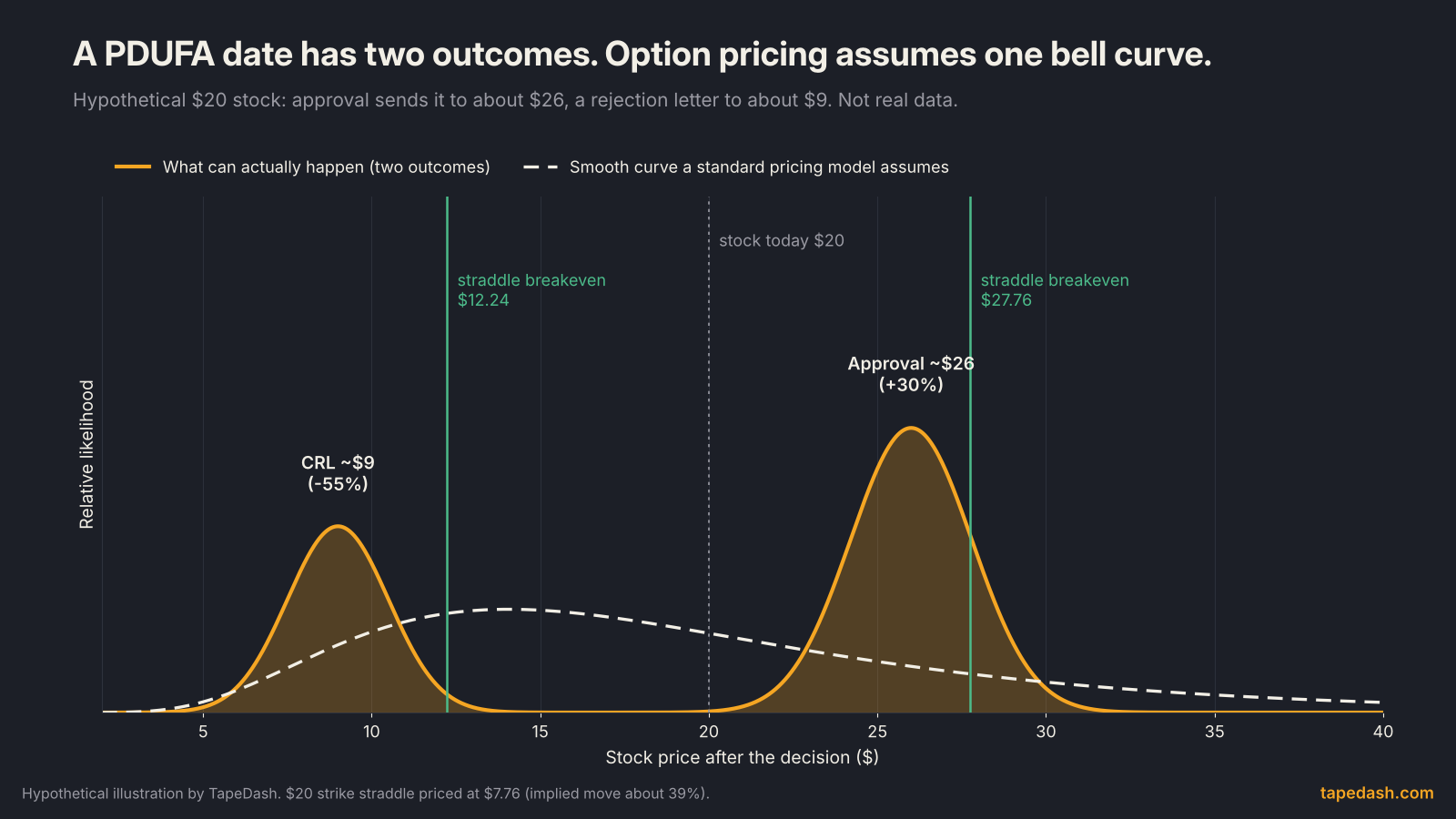
Read the chart carefully, because it explains most of the confusion around biotech catalysts. The implied move is not a forecast that the stock will move 39%. It is the probability-weighted average of a 30% jump and a 55% drop. In this example, if the drug is approved, the straddle buyer loses money: the stock lands at $26, inside the $27.76 breakeven. The straddle only pays if the bad outcome hits, and it pays a lot.
That asymmetry is common because approval is usually partly priced in, so price each outcome separately before looking at the implied move. Our guide to implied volatility and the expected move covers how the straddle and IV translate into a dollar range.
Binary event risk and IV crush after the PDUFA date
The second half of the trade is what happens to volatility once the answer is known.
Before the decision, the expiration that contains the PDUFA date carries a huge event premium. In our hypothetical, a straddle worth $7.76 a week before the date on a $20 stock corresponds to an implied volatility in the neighborhood of 350%. Expirations further out carry some of that premium too, but it is spread across more days, so their IV is much lower.

When the letter comes out, that premium vanishes. Front-month IV falls back toward whatever the stock’s normal volatility is. tastylive lists FDA approvals alongside earnings as classic IV crush events, and Option Alpha describes the same mechanics for clinical trial results. The effect is the one we covered in our IV crush and earnings options guide: an option can lose value overnight even when the stock moves the way you expected, because the move was smaller than what you paid for.
Selling that premium is not safe either, because a CRL can gap a stock through any strike. On December 31, 2025, Corcept Therapeutics disclosed a CRL for relacorilant in hypercortisolism, and the stock fell about 50% that day, according to both BioSpace and Nasdaq. There was no orderly path from one price to the other for a stop order to work with.
So every PDUFA trade falls into one of three buckets. Long options before the date bet that the real move beats the implied move. Short premium bets the opposite and carries gap risk many times the premium collected. Waiting until after the letter gives up the event but skips the binary risk, and the repricing of a newly approved drug’s sales prospects is often the more analyzable trade. None of these is right in general. Sizing decides whether you survive being wrong, which is why we treat binary events with the rules in our options position sizing guide.
How to read a biotech catalyst calendar
A catalyst calendar is a list of upcoming PDUFA dates, advisory committee meetings and trial readouts. It is a starting point, not a source. Here is the checklist we use before trusting an entry.
- Find the original disclosure. Look for the company’s press release on the FDA accepting the application, then check the latest 10-Q or 8-K. No company source means the date is a guess.
- Note the review type. Standard or priority, full or accelerated. Accelerated approval means the label and the confirmatory trial plan become part of the story.
- Check for an advisory committee. If one is scheduled, you have two binary events instead of one.
- Watch for extensions. A three-month extension pushes the event out and hints at a complicated review.
- Check the day of the week. PDUFA dates can fall on weekends. The FDA can act before the goal date, so the first business days before a Saturday or Sunday date are live.
- Size the drug against the company. A single-product company and a diversified large-cap react to the same kind of letter very differently.
- Map the date to an expiration. Compare the IV of the first expiration after the PDUFA date with the next one out. The gap is the event premium.
- Read the flow, cautiously. Big buying in the event expiration can be hedging as easily as conviction. Our options flow guide covers how to tell an opening bet from a hedge.
What to watch next: upcoming PDUFA dates
Two scheduled decisions in November show the range of what a PDUFA date can look like. These are dates, not predictions.
Summit Therapeutics, ivonescimab, PDUFA date November 14, 2026. The BLA covers ivonescimab with chemotherapy in a form of EGFR-mutated non-small cell lung cancer after prior targeted therapy. The FDA accepted it in January 2026, as OncoDaily reported, and Summit restated the goal date in a July 22, 2026 filing. November 14 is a Saturday, which makes the days before it part of the event window.
Vertex, povetacicept, PDUFA date November 30, 2026. This is a BLA for accelerated approval in IgA nephropathy, a kidney disease, based on an interim analysis of proteinuria, a surrogate marker, with a longer-term kidney function analysis to follow. As of October 23, Vertex said the review remained on track for that date.
PDUFA VIII. The current law expires September 30, 2027, and the FDA’s reauthorization page tracks the negotiations and the proposed commitment letter. Changes to review timelines or fees in the next agreement would reset the clocks described in this article.
How TapeDash tracks PDUFA-date volatility and flow
If you want to watch how much the options market is pricing into a specific FDA decision, this is what we track. The Volatility Desk in TapeDash is where we check implied volatility before any event trade, including whether the expiration that contains the PDUFA date carries a premium over the next one out. That spread is the cleanest read on the expected move, and it is the number to hold the actual reaction up against once the letter is out.
For positioning, Large Prints keeps the session’s biggest options trades in one place, so you can see whether size is showing up in the event expiration, and Flow Edge shows whether a name’s flow has been building in one direction over several days. Before putting on any position through a binary date, the Options Risk Desk is where we look at what the trade does in each outcome rather than in the average one.
You can explore all of these in the Terminal Preview, free and without an account. The free TapeDash Daily covers what moved after the close each evening, and the first 200 members lock Pro at $99 a month for as long as they stay.
PDUFA date FAQ
Can the FDA approve a drug before its PDUFA date?
Yes. The PDUFA date is a goal date for the latest action, not a scheduled announcement. The FDA can and sometimes does act before it, which is why the trading days before the date, especially before a weekend date, carry event risk.
What happens if the FDA misses a PDUFA date?
There is no automatic approval or rejection. The application stays under review until the FDA acts. A miss usually comes with company commentary about outstanding questions, and the stock tends to trade on that uncertainty until a decision arrives.
Does an FDA approval mean the stock goes up?
Not necessarily. If the market already priced a high chance of approval, the stock may move less than expected, and a narrow label, safety warnings or a required confirmatory trial can disappoint. The question to ask is how the outcome compares with what was priced, not whether the outcome is good.
The one idea to keep
A PDUFA date is the moment years of scientific risk collapse into a single letter. The options market handles it by pricing an average of two outcomes, approval and rejection, into one implied move that rarely matches either. Price each outcome yourself, find the expiration that holds the event premium, and expect that premium to disappear the morning after. Do that, and a PDUFA date turns from a gamble on headlines into a question about whether the market’s odds are right.
See it on the tape, not just in the headlines
TapeDash is the research desk for traders and investors: live options flow, dealer positioning, a real-time market scanner and trade alerts graded in public. Memberships open January 1, 2027, and the first 200 members lock Pro at $99 a month for as long as they stay.
Join the waitlistClick through the terminalSee the track recordSources
- FDA: Step 3, Clinical Research (Drug Development Process)
- NIH Intramural Research Program: Get Involved with Clinical Research
- FDA: PDUFA VII Commitment Letter, Fiscal Years 2023 to 2027
- ProPharma Group: Extended Review Timeline for Certain Applications under PDUFA V
- FDA: Priority Review
- FDA: Accelerated Approval
- Ropes and Gray: FDA Draft Guidance on Confirmatory Trials for Accelerated Approval
- Research!America: PDUFA Fact Sheet
- Holland and Knight: FDA User Fee Act Reauthorization (March 2026)
- FDA: PDUFA VIII, Fiscal Years 2028 to 2032
- BIO, Informa Pharma Intelligence and QLS Advisors: Clinical Development Success Rates 2011 to 2020
- Schuhmacher et al., Benchmarking R&D Success Rates of Leading Pharmaceutical Companies, Drug Discovery Today (2025)
- BioWorld: Machine learning identifies top predictors of clinical success
- Milbank Quarterly: FDA Advisory Committee Recommendations and Agency Actions, 2008 to 2015
- Fierce Biotech: FDA goes against AdComm votes 22% of the time, study finds
- RAPS: FDA publishes 200 complete response letters in transparency push
- FDA: Real-time release of complete response letters, batch of 89
- The FDA Law Blog: Radical Transparency, Act II
- FDA: First-ever national priority vouchers awarded to nine sponsors
- Akin Gump: FDA Names the First Nine National Priority Voucher Recipients
- BioSpace: FDA Rejects Corcept and Outlook Filings, Crushing Stock Prices
- Nasdaq (Zacks): Corcept Tanks on FDA's CRL to Relacorilant NDA in Hypercortisolism
- Summit Therapeutics: HARMONi update, Form 8-K exhibit, July 22, 2026 (SEC)
- OncoDaily: Summit Therapeutics announces FDA acceptance of ivonescimab BLA
- Vertex: FDA acceptance of BLA for accelerated approval of povetacicept (via BioSpace)
- HCPLive: RAINIER povetacicept data in IgA nephropathy (October 23, 2026)
- tastylive: What is an Implied Volatility (IV) Crush
- Option Alpha: IV Crush
- Cornell Legal Information Institute: 21 CFR 314.430
- The FDA Law Blog: CRLs Today, (Potential) Lawsuits Tomorrow
- The FDA Law Blog: GAO Analysis Says FDA is Meeting PDUFA Commitments
This article is for educational and informational purposes only. It is not financial, investment, medical or legal advice, and it is not a recommendation to buy or sell any security. Figures come from the sources listed and were checked on the date of publication; markets change quickly. Options trading involves substantial risk of loss.