Ionis Stock Plunges: Why the Tryngolza Launch Is Running Slow
Ionis stock fell about 28% after it halved 2026 Tryngolza sales guidance. What slowed the sHTG launch, the price-cut math, and what to watch next.
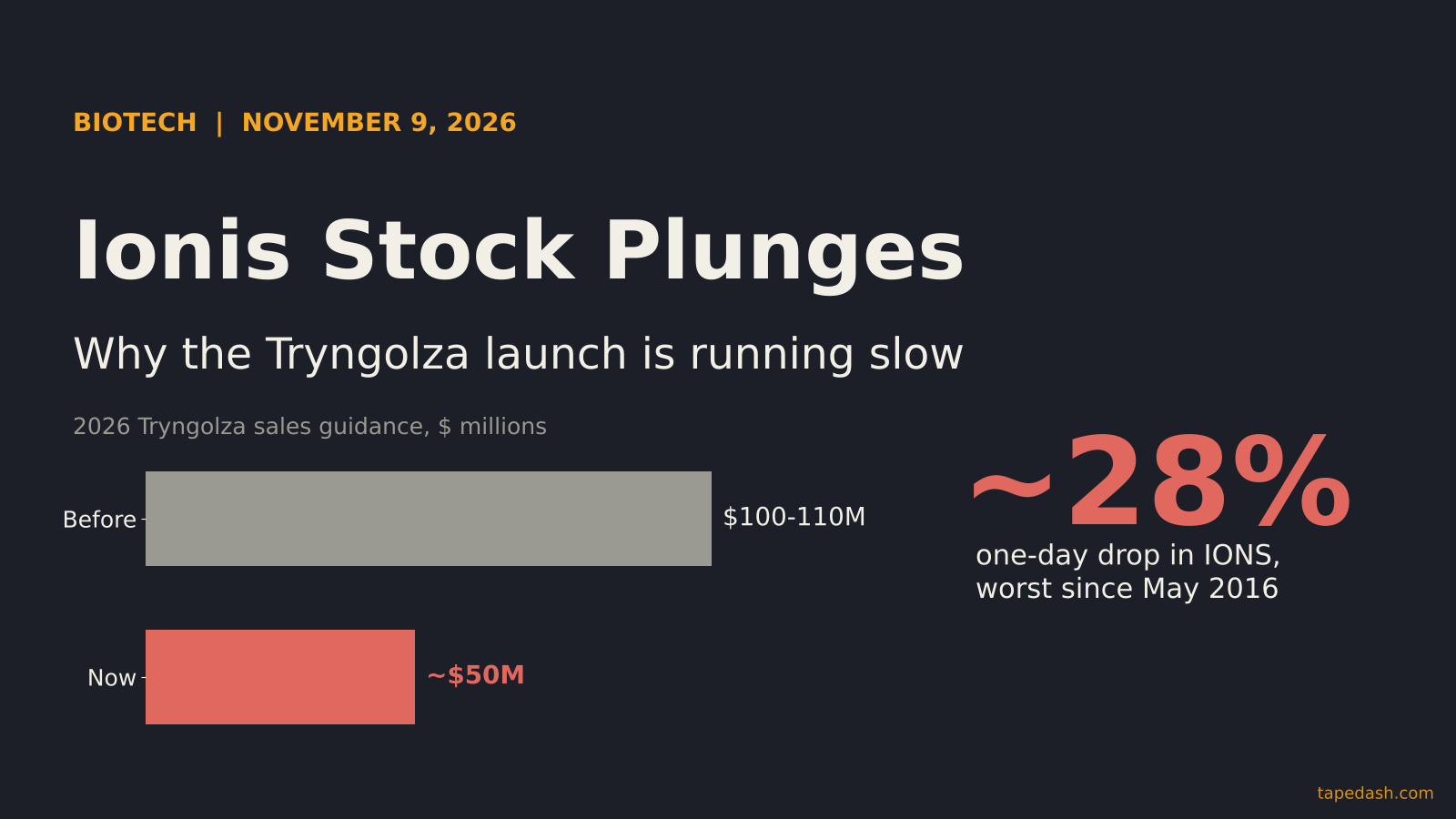
Ionis Pharmaceuticals stock fell roughly 28% on Monday, its worst one-day drop since May 2016, after the company cut its 2026 sales forecast for Tryngolza (olezarsen) to about $50 million from $100 million to $110 million (Ionis 8-K, IBTimes, Blockonomi). It happened on a day when the Dow rose more than 1,100 points and the S&P 500 gained over 2% as oil slid toward $88 a barrel (TheStreet, Stock Titan). A biotech getting cut by a quarter while the tape rips is a stock-specific verdict, and a loud one.
So why did Ionis stock fall when the company beat on revenue? Because the market had stopped valuing Ionis on this quarter. It was valuing the company on one question: can Tryngolza become a large, primary-care-adjacent drug for severe hypertriglyceridemia (sHTG)? Monday’s guidance cut said the answer will take longer to arrive than anyone modeled. Ionis described a “more gradual launch ramp than we had anticipated,” per IBTimes, and it pushed its target for sustained positive cash flow from 2028 to 2029 (Investing.com).
This post walks through what Tryngolza does, why a drug with strong trial data can still launch slowly, the price-cut arithmetic that set the bar higher than it looked, and the specific signals that will tell you whether this is a delay or a broken launch.
- Ionis cut 2026 Tryngolza sales guidance to about $50 million from $100 million to $110 million, and the stock fell roughly 28%, its worst day since May 2016.
- Third-quarter revenue of $243 million beat expectations, and total 2026 revenue guidance of $875 million to $900 million held. The market didn’t care, because the story is the sHTG launch.
- The April price cut from $595,000 to $40,000 a year means Ionis needs roughly 15 times as many patients just to match its old revenue. The volume hasn’t shown up yet.
- The science isn’t the problem: in the CORE trials the drug cut acute pancreatitis events by about 85%. The friction is diagnosis, prescriber habits and payer approvals.
- Watch repeat prescribing, payer coverage, the EU decision this quarter and Arrowhead’s competing filing before year-end.
What happened to Ionis stock on November 9
The numbers in the third-quarter report were, on their face, fine. Revenue came in at $243 million, up 55% from a year earlier, against analyst expectations of about $178 million (Ionis 8-K, Blockonomi). The net loss narrowed to $110 million (IBTimes, Ionis 8-K). Dawnzera, the hereditary angioedema drug, sold $37 million in the quarter and stayed on track for its $110 million to $120 million full-year guide (GuruFocus, Blockonomi). Cash and short-term investments sat at about $1.9 billion.
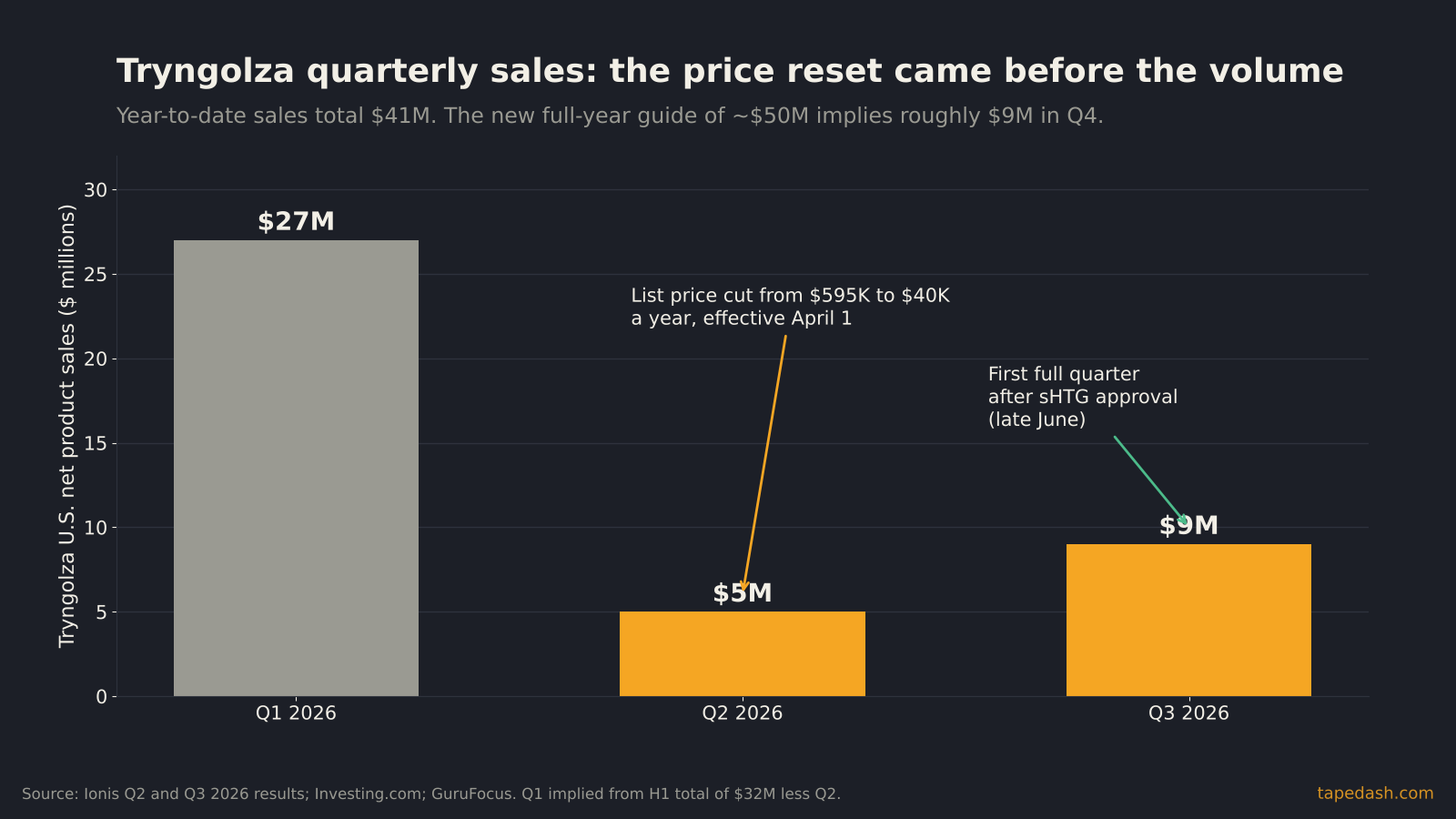
Then there was Tryngolza. Third-quarter U.S. sales were $9 million, and year-to-date sales were $41 million (Ionis 8-K, GuruFocus). The new full-year number of roughly $50 million implies a fourth quarter of around $9 million, which is flat with the third. That is the line that broke the stock. A launch that is working is supposed to show a slope.
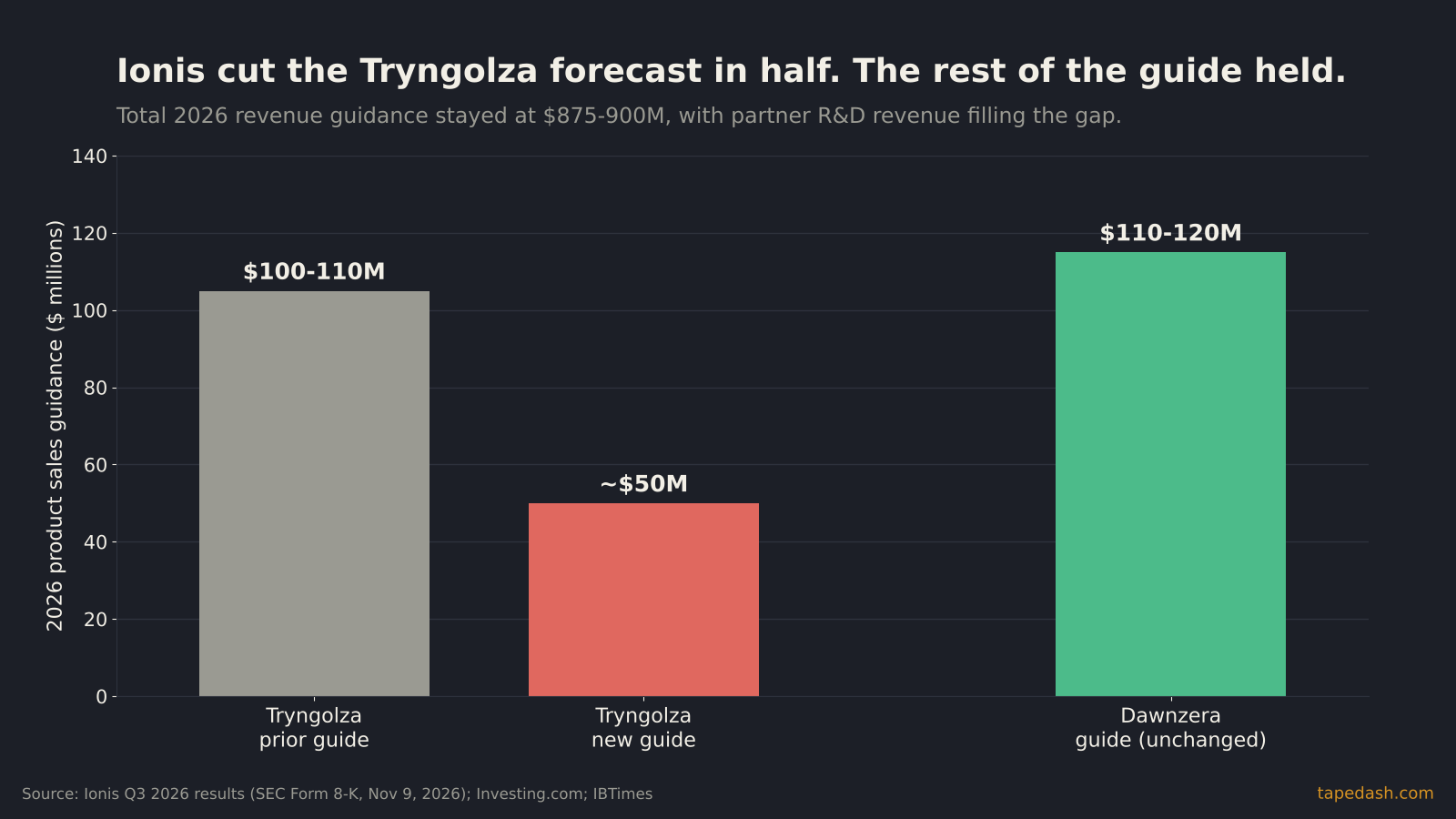
Total 2026 revenue guidance stayed at $875 million to $900 million, with research and collaboration revenue expected to offset the Tryngolza shortfall (IBTimes, Ionis 8-K). That sounds reassuring, and for a balance-sheet analyst it is. For a growth investor it is the opposite. Collaboration money is lumpy and finite. Product revenue is what a commercial-stage company is supposed to be building, and the product that was meant to carry the next leg just got cut in half.
The context matters too. Before Monday the stock was already down about 63% for 2026 (IBTimes, Blockonomi). The same report confirmed that pelacarsen, the Lp(a) program, and the eplontersen cardiomyopathy study did not deliver what investors hoped. When a stock has already been bleeding on pipeline news, the commercial launch becomes the one thing holding up the bull case. Take a piece out of that and there is nothing underneath to catch it.
How Tryngolza works, in plain English
Tryngolza is an antisense drug. That’s Ionis’s whole craft, and it’s worth understanding because it shapes the business.
Your liver makes a protein called APOC3. One of its jobs is to slow down the clearance of triglyceride-rich particles from the blood. It does that partly by inhibiting lipoprotein lipase, the enzyme that breaks those particles down, and partly by blocking the liver from pulling them back in. People with very high APOC3 activity end up with blood that is, in a literal sense, full of fat. At extreme levels that raises the risk of acute pancreatitis, which is painful and sometimes deadly.
Olezarsen is a short, synthetic strand of genetic material designed to latch onto the messenger RNA that carries the instructions for APOC3. When it binds, the cell destroys that message, so the liver makes far less of the protein. Less APOC3 means the brakes come off, and triglycerides fall. Patients take it as a monthly injection under the skin.
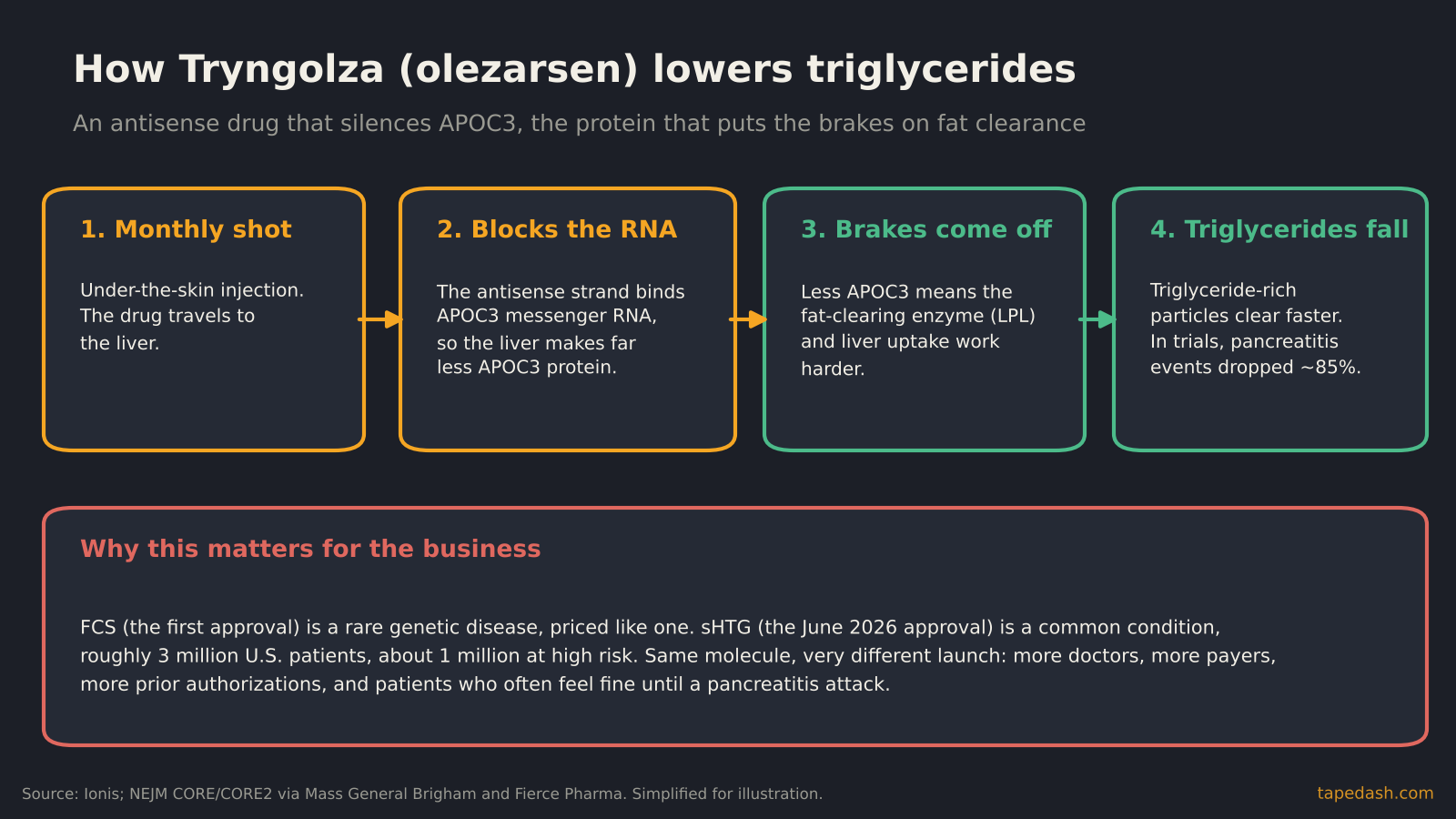
The clinical data are strong. In the CORE and CORE2 Phase 3 trials, published in the New England Journal of Medicine, olezarsen cut acute pancreatitis events by about 85% compared with placebo, and more than 85% of treated patients got their triglycerides below 500 mg/dL (Mass General Brigham, Fierce Pharma). Those are the trials that won the FDA’s broad sHTG label in late June 2026, just ahead of the June 30 target date (Nasdaq, Ionis Q2 release).
So Monday’s problem isn’t about whether the drug works. It’s about how a drug that works gets into the hands of the right patients. This is the business side, and none of it is medical advice. Treatment decisions belong to patients and their doctors.
FCS vs sHTG: why one drug needs two launches
Tryngolza was first approved for familial chylomicronemia syndrome (FCS), a rare genetic disease. Rare-disease launches follow a familiar script. There are only a few thousand patients, a handful of lipid specialists know most of them by name, the price is very high, and payers approve it because the population is small and the need is obvious.
sHTG is a different animal. Ionis cites roughly 3 million U.S. patients, about 1 million of them at high risk (Fierce Pharma, Pharmacally). Those patients are spread across cardiologists, endocrinologists and primary-care offices. Many are on cheap fibrates or prescription fish oil already. Many don’t feel sick until the day they land in an emergency room with pancreatitis.
| FCS launch | sHTG launch | |
|---|---|---|
| Patient pool | Rare, genetic, a few thousand | Roughly 3 million U.S. patients, about 1 million high risk |
| Annual list price | $595,000 (before April 1) | $40,000 (from April 1) |
| Who prescribes | A small group of lipid specialists | Cardiologists, endocrinologists, primary care |
| Payer posture | Small population, approvals are easier | Large population, prior authorization and step edits likely |
| Existing habits | Few alternatives | Fibrates, fish oil, diet changes come first |
| What success looks like | Find every diagnosed patient | Change thousands of doctors’ default behavior |
A rare-disease launch is a search problem. A large-indication launch is a behavior-change problem, and behavior change is slow. Ionis’s own CEO, Brett Monia, framed Tryngolza in the release as “a new treatment paradigm” for the sHTG population (Ionis 8-K). New paradigms are exactly what doctors are slowest to adopt. On the call and in the slides, Ionis pointed to the early shape of the launch, with prescriber counts growing but a minority of doctors writing a second prescription and commercial coverage still only partly in place (Investing.com).
The Tryngolza price cut math the market missed
Here is the part I think a lot of people underweighted in the spring.
Effective April 1, 2026, Ionis cut Tryngolza’s annual list price from $595,000 to $40,000, a 93% reduction, so that payers could build it into their 2027 contracts ahead of the sHTG decision (Fierce Pharma, Rallies.ai). The stock jumped on it at the time. The logic was sound: a $40,000 price is a much easier conversation with a pharmacy benefit manager than a $595,000 price, and the sHTG market is hundreds of times larger than FCS.
The cost of that logic shows up in the quarterly sales. First-quarter Tryngolza sales were about $27 million, the last quarter at the old price. Second-quarter sales fell to $5 million, as the new price hit before the new label arrived. Third-quarter sales, the first full quarter with the sHTG label, came in at $9 million (Ionis Q2 release, Investing.com).
Now do the arithmetic. At $595,000 a year, $100 million of annual revenue takes about 170 patient-years of therapy at list price. At $40,000 it takes about 2,500. That is roughly 15 times as many patients to stand still, and it is a floor, because real net prices after rebates and discounts are lower than list. To reach the multibillion-dollar peak sales that bulls talk about, the count runs into the tens of thousands.
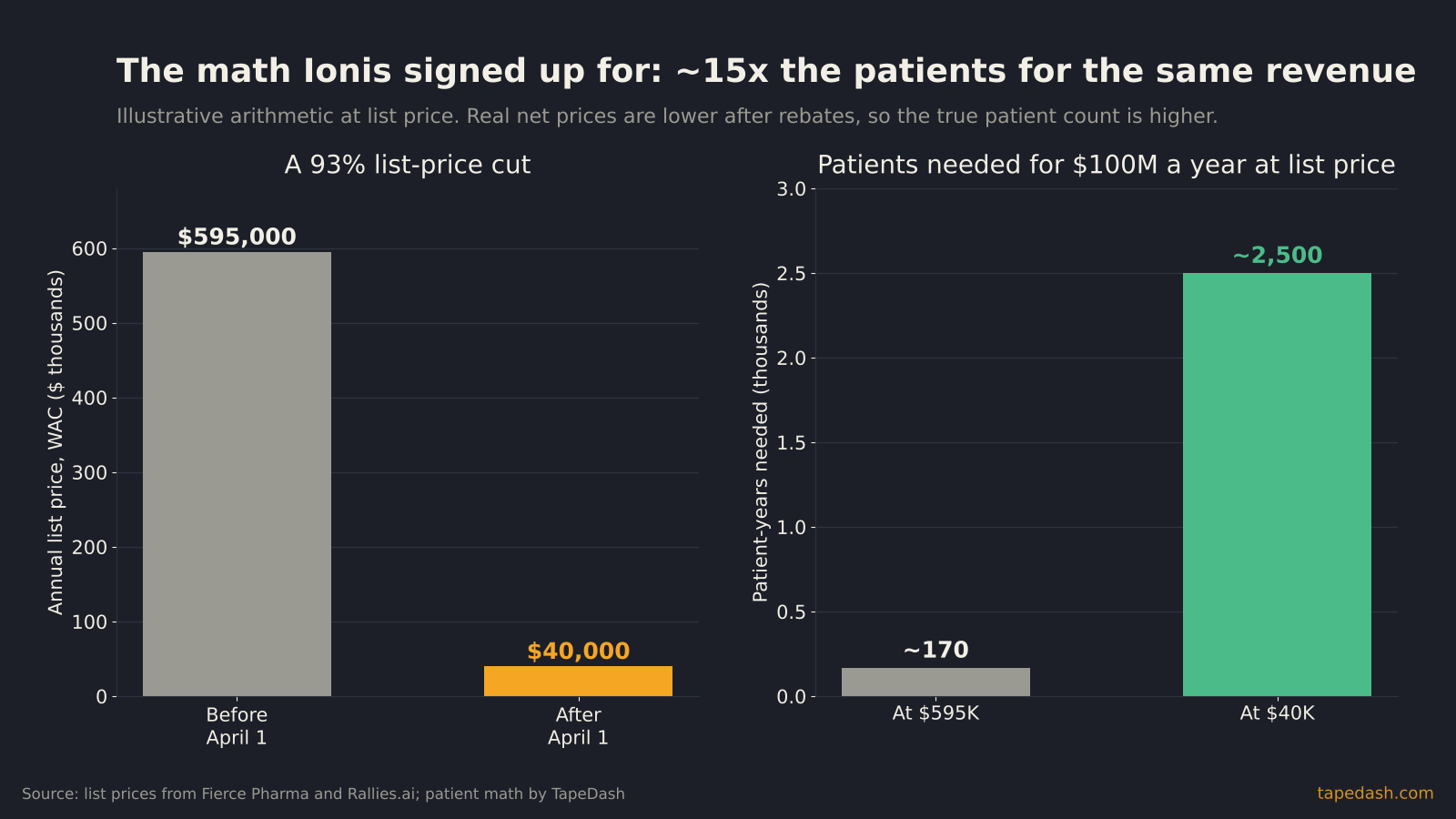
None of that makes the price cut a mistake. It may well prove right over a five-year view, since broad access is the only way to reach a 3 million patient market. But it front-loaded the pain and back-loaded the reward, and Monday was the market repricing the “back.”
How to read a drug launch like a trader
This is the section I’d bookmark, because the same toolkit applies to every big biotech launch, from GLP-1s to gene therapies. (If you’re newer to biotech catalysts, our explainer on PDUFA dates and how FDA decisions move biotech stocks covers the step before this one.)
Separate the label from the launch
Approval is a binary event. Launch is a curve. The stock usually prices the binary within minutes and then spends quarters arguing about the curve. When you see a strong label like Tryngolza’s broad sHTG indication, the question to ask is: what has to change in the real world for the label to turn into scripts? Here the answers were diagnosis, referral, physician habit and payer coverage. Every one of those moves at the speed of humans, not markets.
Watch the funnel before the revenue line
Revenue is the last thing to move and it is muddied by inventory, rebates and free-drug programs. The leading indicators sit higher up the funnel.
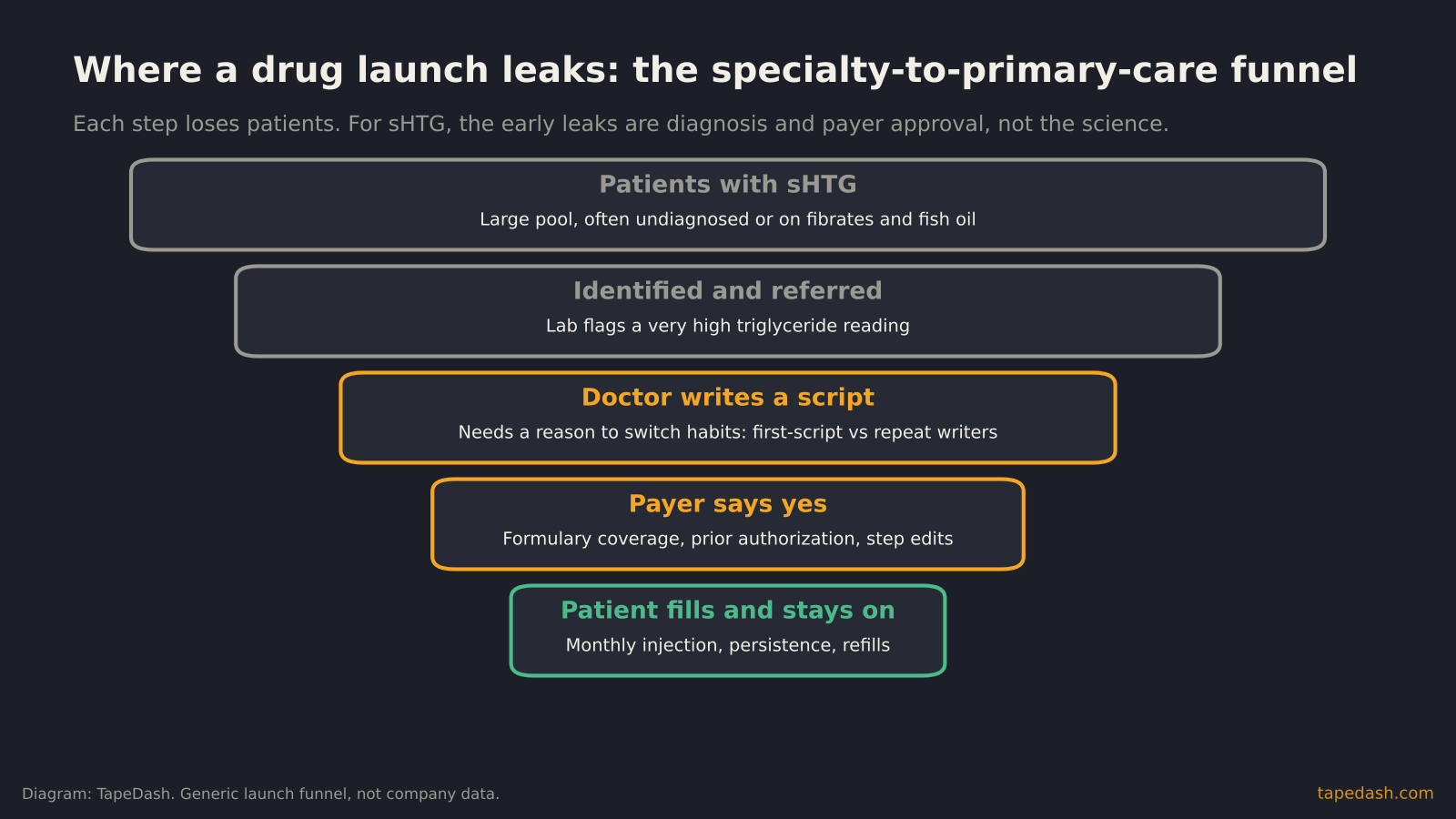
On the desk, these are the questions we ask on every launch call:
- Breadth: how many doctors have written at least one script?
- Depth: what share have written a second? Repeat writers are the real signal, since a first script is curiosity and a second is conviction.
- Access: what share of covered lives have the drug on formulary, and with what restrictions?
- Persistence: are patients refilling month after month?
- Gross-to-net: how big is the gap between list price and what the company actually collects?
When breadth grows but depth lags, you’re looking at a launch that is being sampled, not adopted. That is roughly where Tryngolza sits today.
Read the guidance change, not the beat
A company can beat consensus on revenue and still get crushed if the forward guide moves. We’ve written about this in how to read an earnings report like a trader. Ionis is a textbook case: a big top-line beat, driven mostly by collaboration revenue, sitting next to a 50% cut in the one product line that defines the growth story. The market will always price the second number.
Respect the volatility around launch updates
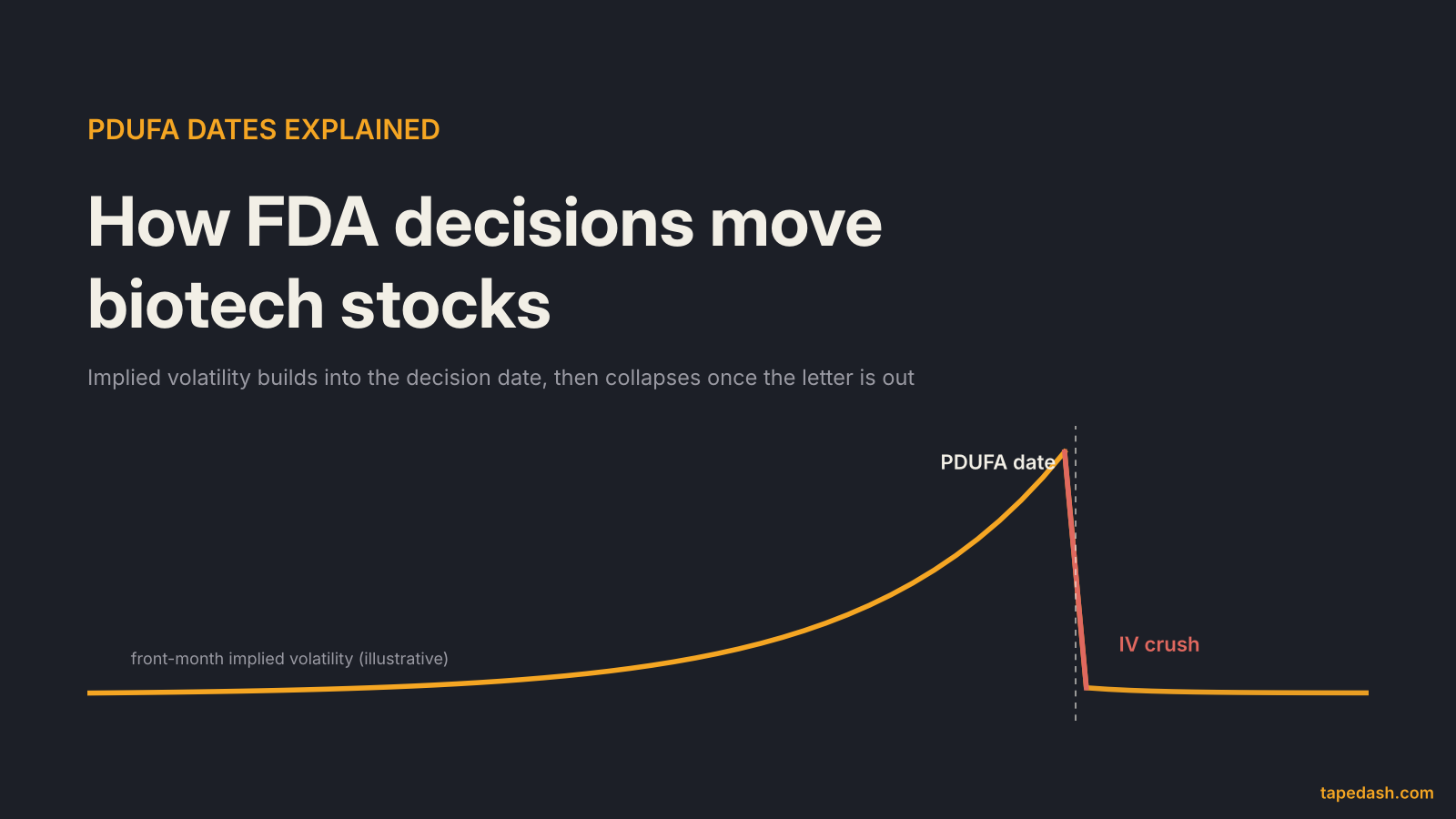
Small and mid-cap biotechs carry huge implied volatility into earnings when a launch is in play, and options often price a double-digit move. A drop of roughly 28% blew through what most traders would have expected. If you trade around these events, our post on IV crush after earnings explains why options can lose value even when you get the direction right, and why the one-day move can still overwhelm the premium when the news is a guidance reset.
Who wins and who loses from a slow sHTG launch
The obvious loser is Ionis shareholders, who now have to wait longer for proof. The cash-flow target slipping from 2028 to 2029 matters because Ionis runs a large pipeline, and every extra year of losses is funded by cash on hand or by partners.
The more interesting name is Arrowhead Pharmaceuticals. Its drug plozasiran is already approved as Redemplo for FCS, and it works on the same target, APOC3, using an RNA-interference approach instead of antisense (Pharmacy Times). Arrowhead reported positive Phase 3 SHASTA-3 and SHASTA-4 results in sHTG in July and said it plans to file for the broader indication before the end of 2026 (BioWorld, Pharmacy Times).
There are two ways to read Ionis’s stumble for Arrowhead, and both are reasonable. The bearish read: if the first mover is finding the sHTG market slow to build, the second mover faces the same slow market. The bullish read: Ionis is spending the money to educate doctors and to fight through payer contracts, and a second entrant often benefits from a market someone else had to create. Which one wins out will depend on how much of the slowness is structural (doctor habits, diagnosis) versus specific to Ionis (execution, sales force, contracting).
Patients and payers are the quiet winners of the price cut either way. A $40,000 list price for a drug that cuts pancreatitis risk this much is a very different conversation from a rare-disease price.
What the Ionis selloff says about biotech sentiment
Analysts mostly stayed on side: 22 of the 25 who cover the stock still rate it a buy (IBTimes, Blockonomi). That gap between sell-side ratings and the tape is common after a launch reset. Analysts model peak sales years out; the stock trades on the next two quarters of evidence.
I’d also note the setting. Monday was a broad risk-on day, driven by falling oil and a rebound in chip stocks (TipRanks, TheStreet). Several other biotechs also sold off hard on company news. When the index is up 2% and a name is down 28%, the market is telling you it has no patience for “it’ll come later” in commercial-stage biotech. Investors will pay for slope. They won’t pay for promises of slope.
What to watch next for Ionis and Tryngolza
These are the dates and data points that will decide whether the bear case hardens or fades.
Fourth quarter 2026: the EU decision for sHTG. Europe’s drug committee (CHMP) already issued a positive opinion, and Ionis expects the final EU approval decision this quarter (Ionis 8-K, Blockonomi). Approval is expected; the real question is how pricing and partner economics work outside the U.S.
Before year-end 2026: Arrowhead’s sHTG filing. If Arrowhead files on schedule (BioWorld, Pharmacy Times), a competitor is on the clock, and every quarter of slow uptake for Ionis is a quarter of less head start.
January 2027: the new payer year. The April price cut was timed so payers could include Tryngolza in their 2027 contracting cycles (Pharmacally, Fierce Pharma). If coverage widens on January 1, the first quarter of 2027 is when it should start to show in fills.
The fourth-quarter report early next year. This is where Ionis will give 2027 Tryngolza guidance. The new 2026 number already implies a flat fourth quarter of about $9 million. If Q4 comes in meaningfully above that, the narrative flips from “stalled” to “sandbagged.” If it comes in below, expect another leg of the debate about whether the market is structurally smaller than modeled.
Here is how I’d frame the scenarios for the next two quarters:
- If repeat prescribing and coverage both improve, quarterly sales should start stepping up in early 2027, and traders will watch whether the stock reclaims the gap from Monday.
- If prescribers keep growing but repeats stay low, the launch is being tried and not adopted. Expect continued pressure and more questions about sales-force size and targeting.
- If coverage stalls into the 2027 payer year, the price cut didn’t buy what it was meant to buy, and the 2029 cash-flow target is at risk.
How to track this on TapeDash
If you want to watch whether the Tryngolza launch turns, this is what we track. A guidance reset like Monday’s tends to leave a trail: abnormal volume for days afterward, heavy put buying or call selling as holders hedge, and sometimes large off-exchange prints as institutions reposition. The Live Scanner flags unusual volume and options activity in real time, so you can see if money is quietly coming back into IONS or ARWR ahead of the EU decision or Arrowhead’s filing, instead of finding out after the fact.
For the bigger picture, the Terminal Preview lets you set a biotech watchlist and see options flow and dark-pool activity side by side, which is the fastest way to tell a real reversal from a dead-cat bounce. If you’d rather get the highlights in your inbox, the free TapeDash Daily covers big catalyst moves like this one each morning. And if you’re thinking about going further, the first 200 members lock Pro at $69.99 a month on their account, even if they cancel and come back later.
Ionis stock FAQ
Why did Ionis stock drop today?
Ionis cut its 2026 Tryngolza sales forecast to about $50 million from $100 million to $110 million, citing a slower launch ramp in severe hypertriglyceridemia. The stock fell roughly 28% even though third-quarter revenue beat expectations.
Is Tryngolza approved for severe hypertriglyceridemia?
Yes. The FDA expanded Tryngolza’s label to include sHTG in late June 2026, based on the CORE and CORE2 trials. A final EU decision on the same use is expected in the fourth quarter of 2026.
Who competes with Tryngolza?
Arrowhead Pharmaceuticals’ plozasiran, sold as Redemplo for FCS, targets the same protein (APOC3). Arrowhead plans to file for the broader sHTG indication before the end of 2026.
The one idea to remember
A great label doesn’t make a great launch. Tryngolza has strong data, a broad approval and a price payers can live with, and it still has to convince thousands of doctors to change what they do on a Tuesday afternoon. Ionis bet that the price cut would buy volume. Monday’s guidance said the volume is late. The next two quarters of repeat prescribing and coverage will tell you whether it’s late or missing.
See it on the tape, not just in the headlines
TapeDash is the research desk for traders and investors: live options flow, dealer positioning, a real-time market scanner and trade alerts graded in public. Memberships open Black Friday, November 27, and the first 200 members lock Pro at $69.99 a month on their account, even if they cancel and come back later.
Join the waitlistClick through the terminalSee the track recordSources
- Ionis Pharmaceuticals: Third quarter 2026 financial results, SEC Form 8-K Exhibit 99.1 (Nov 9, 2026)
- Ionis Pharmaceuticals: Second quarter 2026 financial results, via BioSpace (Jul 29, 2026)
- Investing.com: Ionis Q3 2026 slides, earnings beat can't offset Tryngolza concerns (Nov 9, 2026)
- IBTimes: Ionis shares plunge after Tryngolza sales forecast cut (Nov 9, 2026)
- Blockonomi: Why Ionis stock crashed Monday even after beating earnings (Nov 9, 2026)
- GuruFocus: Ionis shares drop 27% after lowered Tryngolza revenue forecast (Nov 9, 2026)
- Seeking Alpha: Ionis plummets as it cuts 2026 revenue guidance for Tryngolza (Nov 9, 2026)
- Fierce Pharma: Ionis slashes Tryngolza's price tag by 93% ahead of anticipated label expansion
- Rallies.ai: Ionis jumps as Tryngolza $40,000 repricing boosts expansion optimism
- Pharmacally: Ionis cuts Tryngolza price ahead of potential sHTG approval (Mar 26, 2026)
- Fierce Pharma: Ionis scores transformational FDA label expansion for Tryngolza
- Nasdaq / Zacks: FDA expands Ionis' Tryngolza label to treat severe hypertriglyceridemia (Jun 25, 2026)
- Mass General Brigham: Olezarsen significantly reduces rate of acute pancreatitis (NEJM, CORE and CORE2)
- Pharmacy Times: Plozasiran slashes triglycerides, pancreatitis events in sHTG (Jul 2026)
- BioWorld: Arrowhead rises on phase III hypertriglyceridemia readout (Jul 22, 2026)
- TheStreet: Stock market today, Nov. 9, 2026
- TipRanks: Why is the stock market up today, 11/9/26
- Stock Titan: Stock market today live, November 9, 2026
This article is for educational and informational purposes only. It is not financial, investment, medical or legal advice, and it is not a recommendation to buy or sell any security. Figures come from the sources listed and were checked on the date of publication; markets change quickly. Options trading involves substantial risk of loss.