Sanofi Insmed Deal: Why $41B Buys Time Before the Dupixent Cliff
Sanofi will buy Insmed for $175 a share in cash. What the $41B deal buys, why Dupixent's patent cliff forced it, and how to read the merger spread.
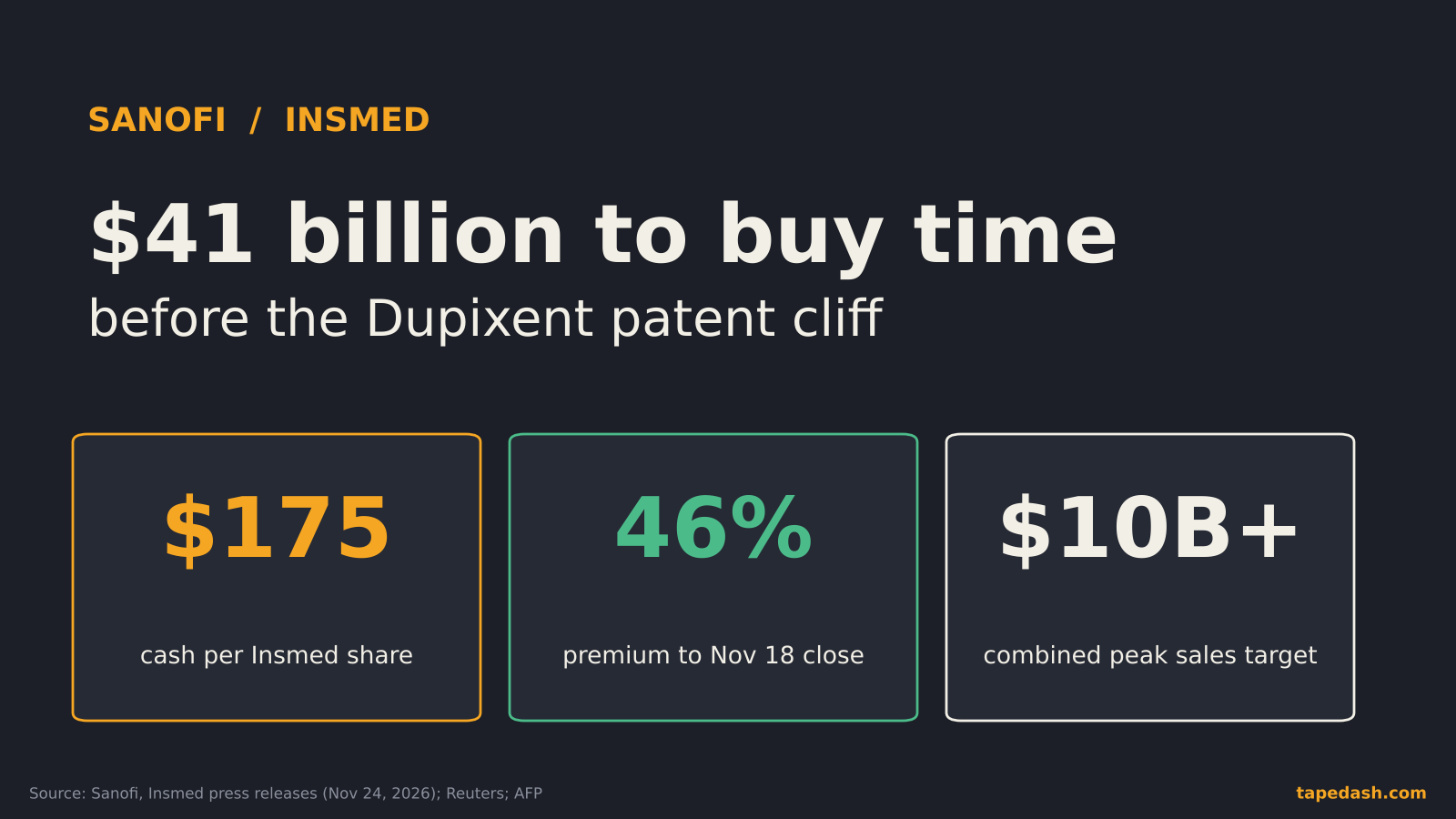
Sanofi (SNY) agreed on Tuesday to buy Insmed (INSM) for $175 a share in cash, about $41 billion in total. The price is roughly 46% above where Insmed closed on November 18, the last day before reports of a possible sale hit the tape (Sanofi, Insmed, RTTNews). It is the largest pharmaceutical acquisition since Pfizer (PFE) bought Seagen in 2023 (CNBC, BioSpace).
The short answer to why Sanofi did this deal is one drug: Dupixent. It brings in close to 40% of Sanofi’s revenue, and its key patents run out in the early 2030s (Reuters via Medical Dialogues, GeneOnline). Insmed brings a lung drug, Brinsupri, that crossed $1 billion in sales in its first 14 months, plus a second marketed product and a Phase 3 pipeline. Sanofi is paying today’s price for revenue it needs in 2031.
Investors liked it on both sides. Insmed rose about 14% on the news and Sanofi gained about 9% in Paris, which is unusual for a buyer writing a $41 billion check. This piece covers what Sanofi actually bought, why the timing makes sense, how to read the small gap between Insmed’s stock and the offer, and what has to happen before the deal closes.
- Sanofi will pay $175 a share in cash for Insmed, about $41 billion, a 46% premium to the November 18 close. It is pharma’s largest deal since Pfizer and Seagen in 2023.
- The deal is about the Dupixent patent cliff. Dupixent is close to 40% of Sanofi’s sales and loses key protection in the early 2030s.
- Brinsupri, Insmed’s bronchiectasis pill, did $1.09 billion in sales from its August 2025 launch through September 2026. Sanofi targets more than $10 billion in combined peak sales from Insmed’s portfolio.
- Insmed trades around $170, about 3% under the offer. That spread implies the market sees roughly 9-in-10 odds the deal closes.
- Watch the Arikayce FDA decision on January 28, 2027, the Insmed shareholder vote and antitrust review. Sanofi expects to close in the first half of 2027.
Sanofi Insmed deal terms: what Sanofi is paying
The headline terms are simple. Insmed holders get $175 in cash per share. The equity value is about $41.0 billion, or EUR 37.6 billion (Sanofi, RTTNews). Both boards have approved it. Sanofi is paying with a mix of cash on hand and new debt, with committed financing already lined up (Sanofi, AFP via Yahoo Finance).
The premium depends on where you measure it. Against the November 18 close, the last price before deal talk leaked, it is about 46%, which puts the undisturbed price near $120. Against Insmed’s close on Monday, November 23, after the rumor had already lifted the stock, it was about 17% (GeneOnline, Reuters via Medical Dialogues). Use the first number when you think about value and the second when you think about what the market gave holders on announcement day.
Sanofi expects the deal to add to its business earnings per share by the end of 2028 and says it will not change its 2026 guidance (Sanofi, RTTNews). Management also talked about more than $500 million a year in cost savings, mostly from overhead rather than sales or research (AFP via Yahoo Finance, MarketBeat via Yahoo Finance). That detail matters. When a buyer says it will protect the commercial team, it is telling you the plan is to grow the launch, not to strip the target for parts.
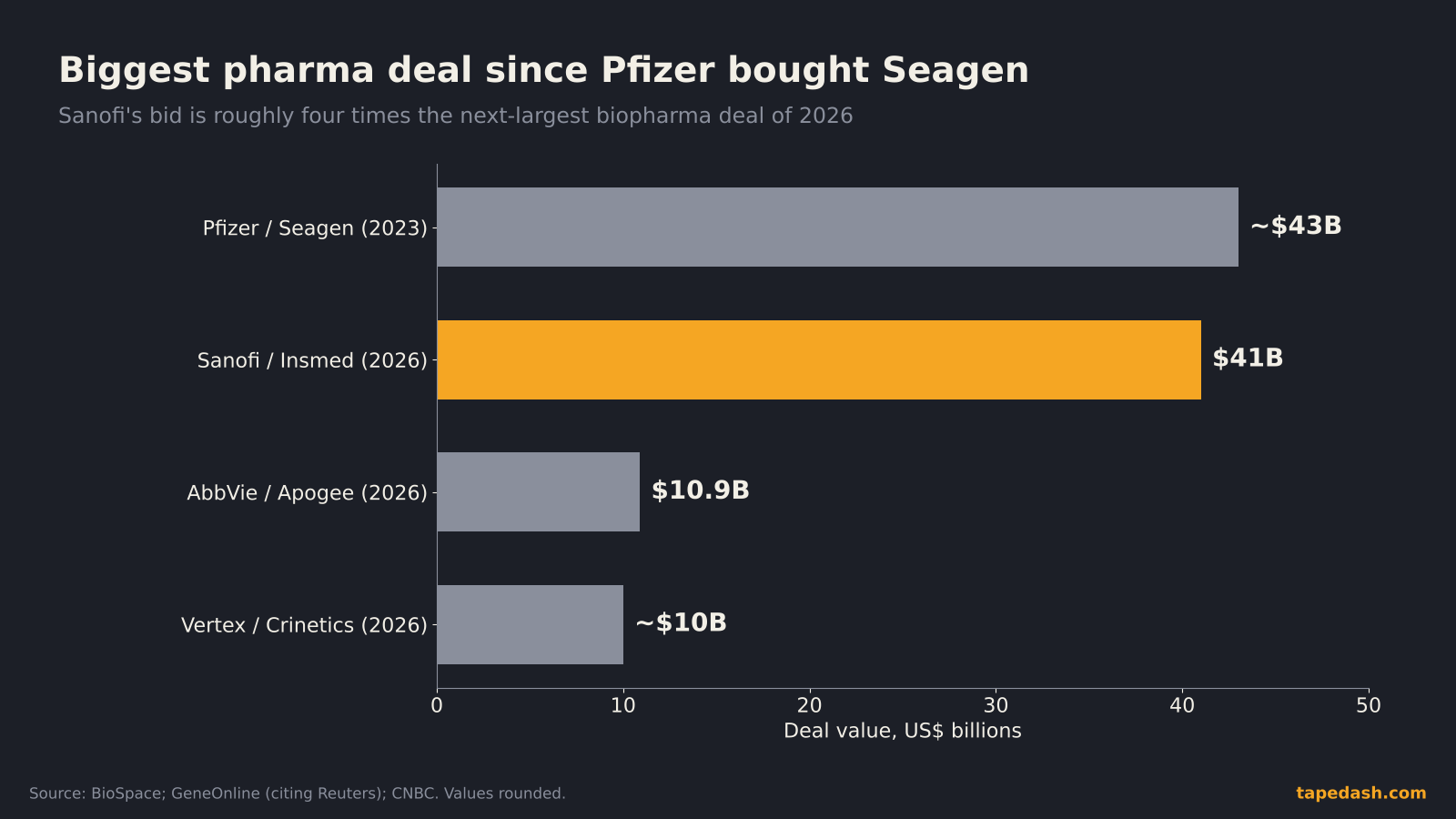
For scale, the next-biggest biopharma deal of 2026 was AbbVie’s (ABBV) $10.9 billion purchase of Apogee in June (BioSpace, GeneOnline). Sanofi’s bid is close to four times that.
Why Sanofi bought Insmed: the Dupixent patent cliff
Dupixent, the antibody Sanofi sells with Regeneron (REGN) for eczema, asthma and a growing list of inflammatory diseases, sold more than EUR 15 billion last year (AFP via Yahoo Finance, Reuters via Medical Dialogues). It is close to 40% of Sanofi’s revenue. That is a great drug and an uncomfortable concentration.
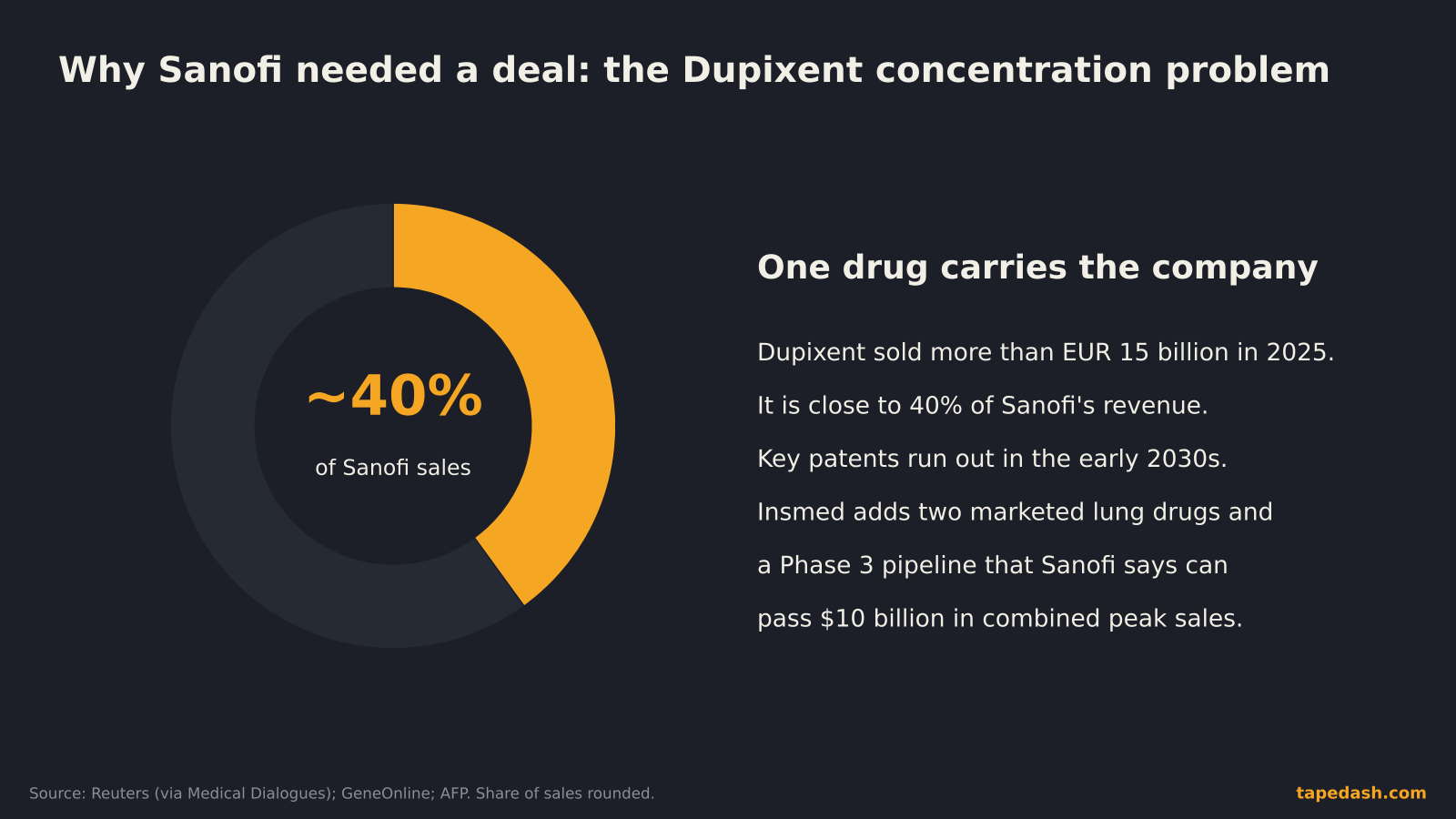
Big biologics do not fall off a cliff the day a patent expires, because biosimilars take time to launch and win share. But the direction is not in doubt. Reuters reports patent expiries in the early 2030s, and GeneOnline points to a key US compound patent running out in 2031 (Reuters via Medical Dialogues, GeneOnline). The analysts at Jefferies summed it up well: the deal “buys time,” but it is not a silver bullet (per Reuters).
That framing is the right one. Sanofi cannot replace EUR 15 billion of revenue with one acquisition. What it can do is add a product that is still early in its growth curve, so that by the time Dupixent starts to slide, a second engine is already running. The question for investors is whether Brinsupri gets big enough, fast enough.
Why a lung company and not something else
Insmed fits two things Sanofi already does well. Dupixent is approved in asthma and COPD, so Sanofi has sales teams calling on lung specialists every day. Insmed’s drugs go to many of the same doctors. Sanofi’s own statement frames the deal as broadening its respiratory presence while adding to its immunology and rare disease work (Sanofi, Insmed). That overlap is where the cost savings and the sales upside both come from.
What Insmed actually sells: Brinsupri, Arikayce and TPIP
This section is about the science and the business, not medical advice.
Brinsupri (brensocatib) is a once-daily pill for non-cystic fibrosis bronchiectasis, a chronic lung disease where the airways become permanently widened and scarred, mucus builds up and patients cycle through infections and flare-ups. The drug blocks an enzyme called DPP1, which turns on the destructive enzymes inside neutrophils, a type of white blood cell. Less neutrophil damage should mean fewer flare-ups. It is the first approved treatment for the condition and the first drug in its class (Sanofi, Insmed).
Insmed estimates about 500,000 diagnosed patients in the US alone (Insmed, Trefis). It launched in the US in August 2025 and brought in $1.09 billion through September 30, 2026 (Insmed, Trefis). Third-quarter Brinsupri sales were $400.1 million, up 29% from the second quarter (GeneOnline, Trefis), and Insmed’s 2026 guidance for the drug stood at $1.35 billion to $1.40 billion (RTTNews, Trefis). A first-year launch that grew 29% in its latest quarter is the kind of curve big pharma pays up for.
Arikayce is an inhaled antibiotic for a hard-to-treat lung infection caused by Mycobacterium avium complex (MAC). It made $433.8 million in 2025, up 19% (Insmed, GeneOnline). Today its US label covers a narrow group of patients who did not respond to other treatment. The FDA is reviewing a broader label under priority review, with a decision date of January 28, 2027 (RTTNews, Finviz). If you want the mechanics of how those decision dates work, I covered them in PDUFA dates explained.
TPIP is an inhaled, once-daily dry powder version of treprostinil for pulmonary hypertension and related lung diseases. It is in Phase 3 and not approved anywhere (Sanofi, GeneOnline). Sanofi describes it as a growth driver beyond 2030. In other words, it is the part of the deal that lines up most directly with the Dupixent cliff, and also the part with the most risk.
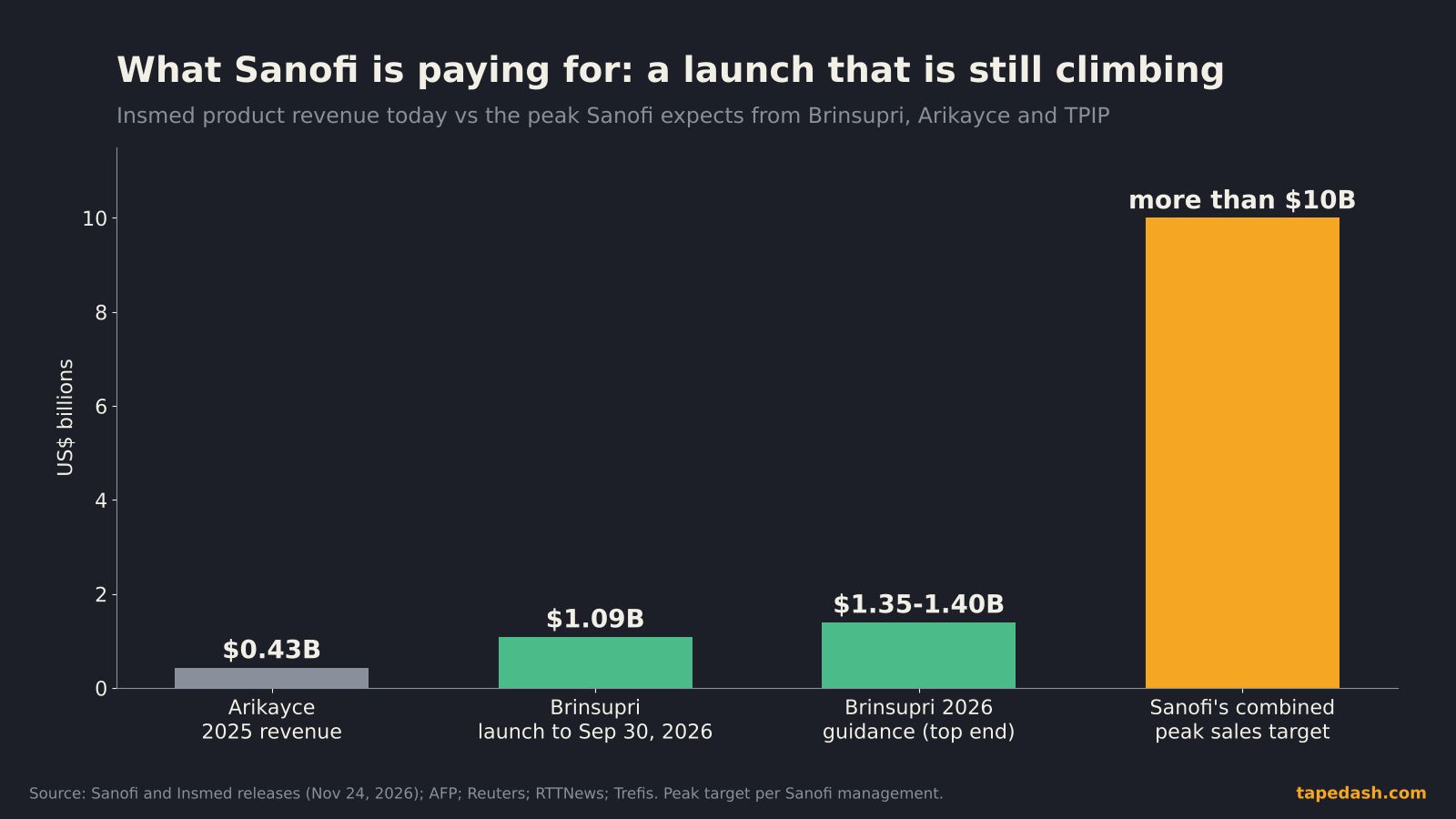
Sanofi’s management says the combined peak sales of Insmed’s portfolio should top $10 billion (AFP via Yahoo Finance, GeneOnline). Insmed’s own projection had been higher, and Sanofi’s figure reflects its own risk adjustment (MarketBeat via Yahoo Finance). I like that a buyer is putting a lower number on the target than the target put on itself. It suggests the price was not built on the most optimistic case.
Insmed stock after the deal: how to read the merger spread
Once a cash deal is signed, the target’s stock stops trading on its own story and starts trading on the odds and timing of the deal. Insmed rose about 14% on announcement day and has traded around $170 since, about $5 below the $175 offer (RTTNews, Trefis). That gap, a little under 3%, is the merger arbitrage spread.
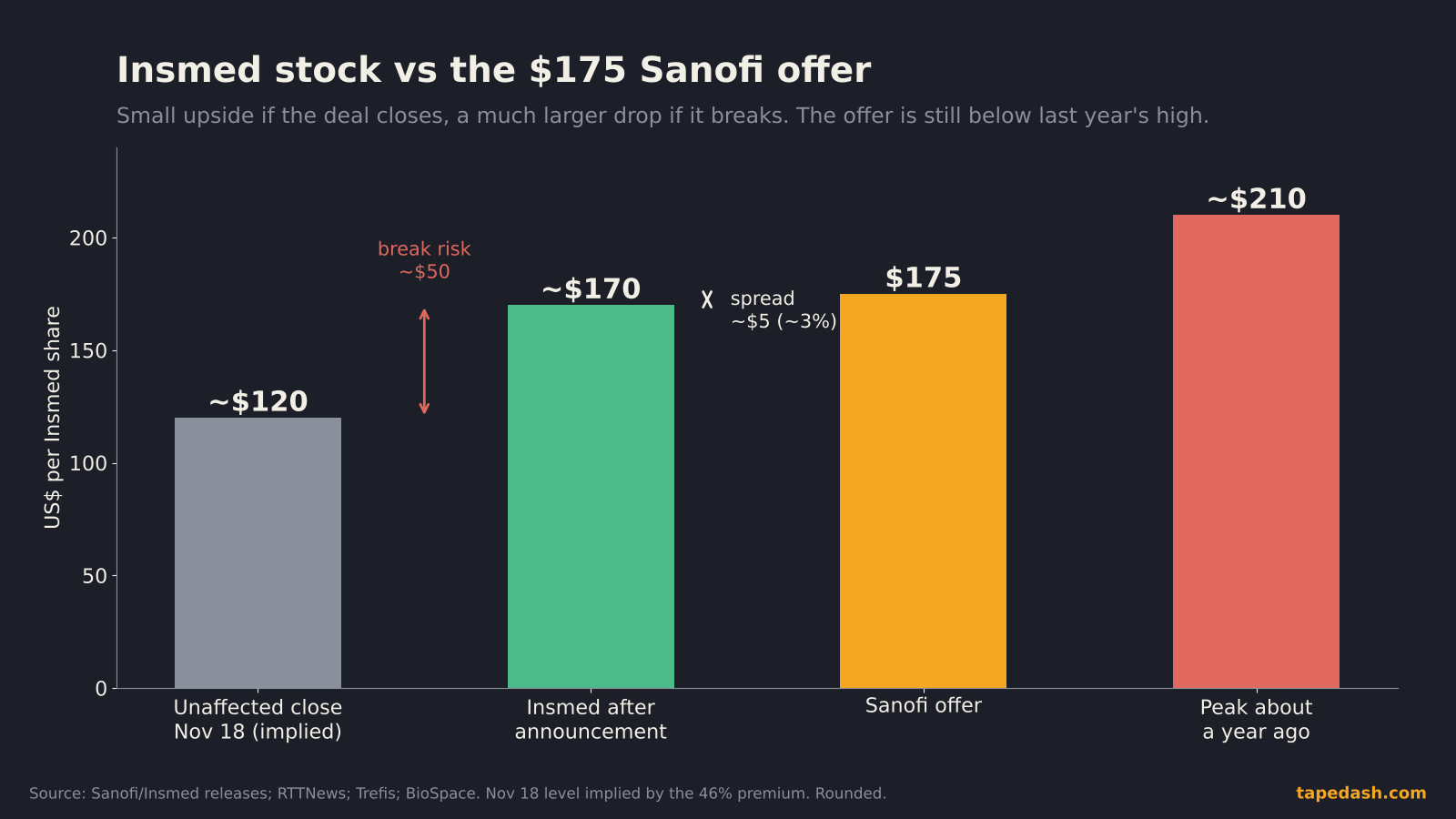
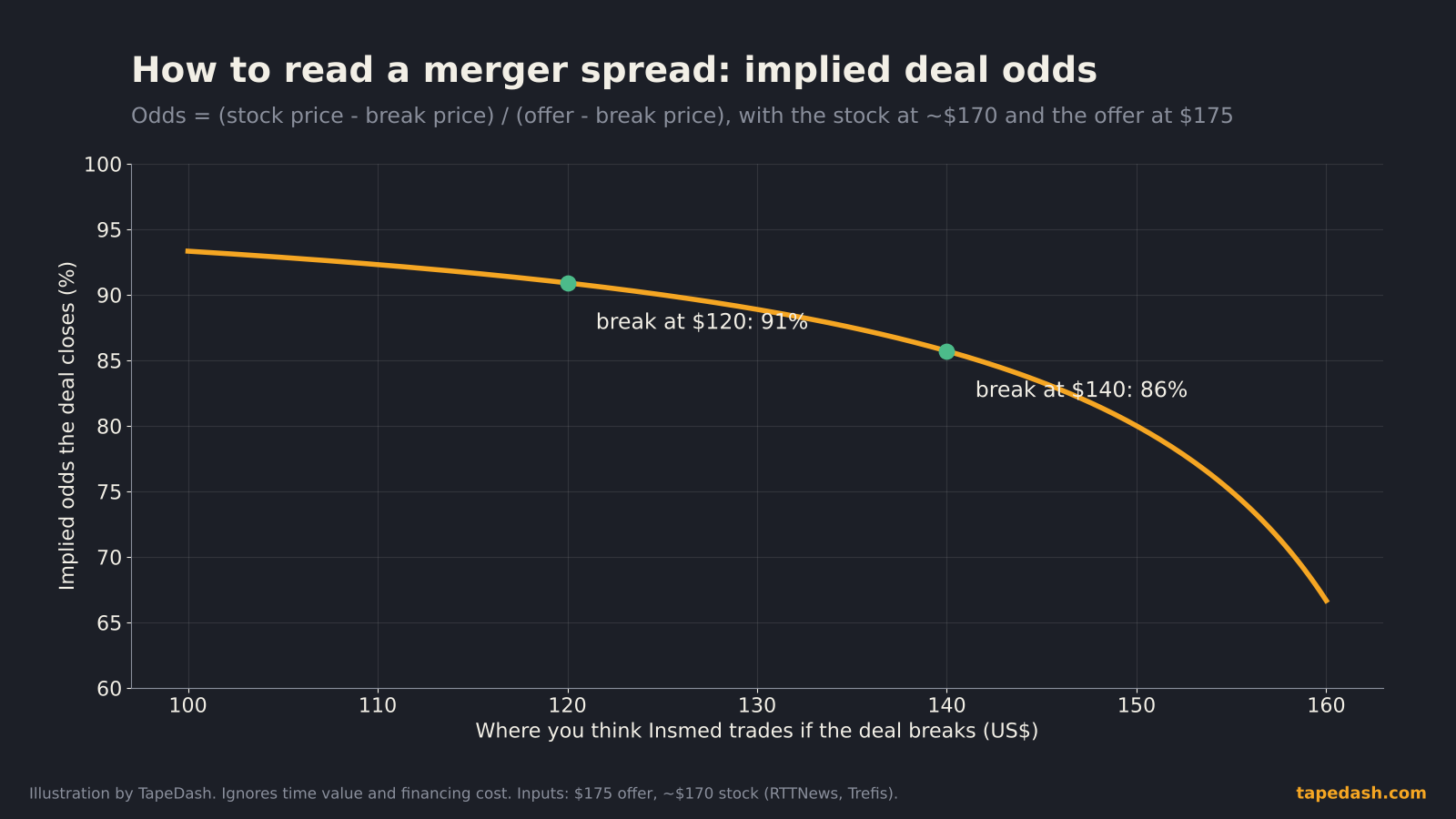
Here is how I read it. The spread pays you for two things: waiting, and the chance the deal breaks. If you know the price you would expect Insmed to fall back to on a break, you can back out the odds the market is assigning. The formula is simple: odds of closing = (stock price minus break price) divided by (offer minus break price).
With the stock near $170, the offer at $175 and a break price near the undisturbed $120, the math gives about 91%. If you think Insmed would hold up better on a break, say $140, because Brinsupri has kept growing since November 18, the implied odds drop to about 86%. Neither number is a forecast. It is the market’s price, translated into a probability you can argue with.
Three things that move the spread
Time. Sanofi expects to close in the first half of 2027 (Sanofi, RTTNews). Earn about 3% over five to seven months and you are looking at a mid-single-digit annualized return, which is not much above what short-term Treasuries pay. That tells you the market sees this as a clean deal. A spread this tight on a $41 billion cash deal says very little regulatory fear.
Antitrust. Sanofi does not sell a bronchiectasis drug or an inhaled MAC antibiotic, so there is little product overlap for regulators to object to. That is the main reason the spread is narrow. The deal still needs US and certain non-US approvals and an Insmed shareholder vote (Sanofi, Insmed).
A competing bid. Sometimes a spread trades negative, with the target above the offer, because traders are betting on a higher bid. Insmed trades below $175, which says the market is not expecting a rival. BioSpace reported Truist’s view that there are few credible alternative buyers (BioSpace).
I walked through the same math on a stock-for-stock deal earlier this week in the CrowdStrike Zscaler deal breakdown. Cash deals like this one are simpler: there is no buyer’s stock price in the formula, only $175 and the calendar.
What the options market adds
After a cash deal, implied volatility on the target usually collapses, because the stock is pinned near the offer. If Insmed’s implied vol stays well above what a sleepy, pinned stock would need, someone is paying up for a break or a bump. Watching that is a faster signal than waiting for a filing. If you are new to this, implied volatility and the expected move explains how to turn an option price into a range.
Who wins and who loses from the Sanofi Insmed deal
| Group | What changed | What to watch |
|---|---|---|
| Insmed holders | A $175 cash exit, about 46% above the undisturbed price but below last year’s high above $200 | The spread, the shareholder vote, any sign of a rival bid |
| Sanofi holders | A $41B bet on lung disease growth, EPS accretive by end of 2028, more than $500M of planned savings | Debt levels, the December strategy update, Brinsupri sales each quarter |
| Regeneron | Its Dupixent partner now has a second growth engine outside the partnership | Dupixent growth and biosimilar timing in the early 2030s |
| Other mid-cap biotechs | A fresh benchmark: big pharma will pay up for a fast-growing launch | Takeover speculation in names with growing first products |
Insmed holders are the clearest winners on paper, with one caveat. The stock traded above $200 about a year ago and spent much of 2026 well below that level (BioSpace, Trefis). Long-time holders who bought near the top are being taken out below their cost.
Sanofi holders got a rare thing: a buyer’s stock that went up on a large deal. Analysts at Jefferies said Sanofi could afford the deal without putting its dividend or credit rating at risk, and Oddo BHF read it as a sign that the new management team can make big strategic calls (AFP via Yahoo Finance). Sanofi’s statement also says it will keep its progressive dividend policy. The market seems to have been more worried about Sanofi doing nothing than about Sanofi overpaying.
There is also a sector read. BMO’s healthcare research head described the recent move into pharma stocks as a “flight to safety with pharma names” (per BioSpace). After the tech selloff of the past month, large pharma has been a place to hide, and a strong stock price makes it easier for a company to finance a large deal. If that mood holds, more large pharma buyers may follow, and the GLP-1 and immunology names I covered in GLP-1 stocks explained show how fast investors re-rate a whole group when one launch takes off.
What to watch next for Sanofi and Insmed
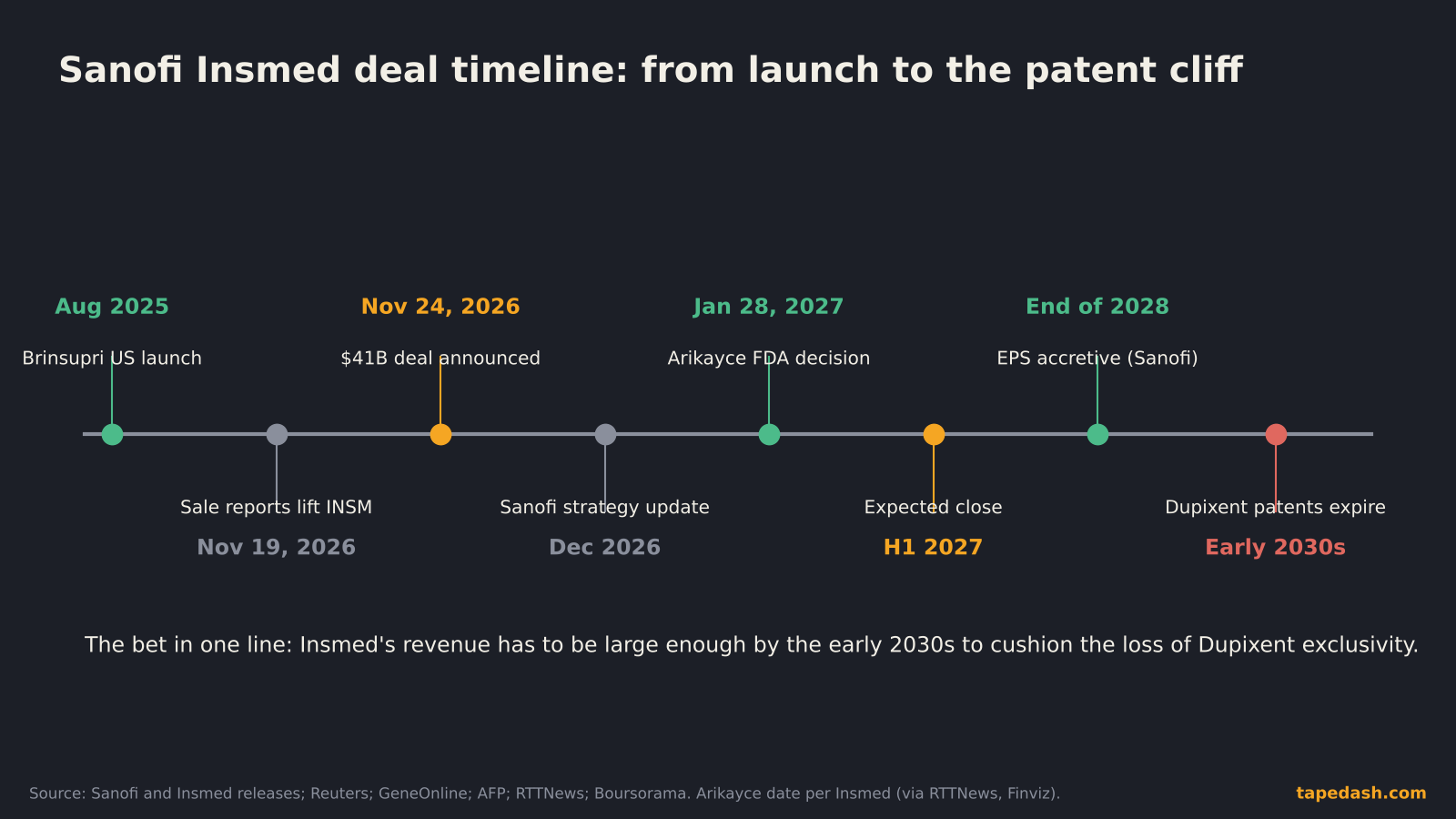
Sanofi’s strategy update in December. Sanofi plans to lay out its new strategy in December (Boursorama, MarketBeat via Yahoo Finance). Expect more detail on how Insmed fits, how fast Sanofi plans to pay down the new debt, and what it says about future deal size.
The Arikayce decision on January 28, 2027. A broader label would move Arikayce from a niche product to an earlier line of treatment for MAC lung disease. It is the first hard catalyst inside the deal window. An approval should not change the $175 price, but it would make Sanofi’s peak sales target look more reachable.
The proxy and shareholder vote. The merger proxy will lay out how the deal came together and whether other buyers were involved. No vote date is set yet.
Brinsupri’s fourth-quarter sales. Insmed will still report as a stand-alone company until closing. A quarter that keeps the growth rate near 30% supports Sanofi’s math. A clear slowdown would not break the deal, but it would make Sanofi holders less happy with the price.
Other big biotech decisions. The deal makes the market more sensitive to every large FDA call. Vertex Pharmaceuticals (VRTX) fell about 5% on Friday after the FDA extended its review of povetacicept for IgA nephropathy into 2027 (The Motley Fool, StockTitan). Delays like that are a reminder that a pipeline is a set of probabilities, which is exactly why Sanofi paid for a drug that is already selling.
How to track the Sanofi Insmed deal on TapeDash
If you want to watch whether this spread holds and whether anyone is betting on a break, here is what we track. The Terminal Preview shows INSM and SNY with price, volume and options data side by side, so you can see every day whether Insmed is still pinned near $175 or starting to drift. The options flow view shows whether large traders are buying Insmed puts as break protection or selling calls against arbitrage positions. The options flow section of Every TapeDash tool, explained covers how we sort hedges from directional bets.
The Live Scanner is the tool for the second-order trade: unusual volume and implied volatility in mid-cap biotech names when the market starts hunting for the next target. Our dealer positioning and ratings pages, described in the market data and ratings sections of the tools guide, help you see whether a sudden pop in a takeover candidate is real buying or options hedging. If you’d rather start with a daily read of moves like this one, the free TapeDash Daily lands each morning, and the first 200 members lock Pro at $69.99 a month on their account, even if they cancel and come back later.
Sanofi Insmed deal FAQ
How much is Sanofi paying for Insmed?
Sanofi is paying $175 per Insmed share in cash, about $41 billion in equity value. That is roughly 46% above Insmed’s November 18 close, the last price before reports of a possible sale.
When will the Sanofi Insmed deal close?
Sanofi expects to close in the first half of 2027. It needs Insmed shareholder approval and US and certain non-US regulatory approvals first.
Why did Sanofi buy Insmed?
To build revenue that can cushion the loss of Dupixent’s patent protection in the early 2030s. Dupixent is close to 40% of Sanofi’s sales. Insmed adds Brinsupri, a fast-growing bronchiectasis drug, Arikayce and the Phase 3 drug TPIP, which Sanofi says can top $10 billion in combined peak sales.
The one thing to remember
Sanofi did not buy Insmed for what it earns today. It bought a launch curve and a pipeline that line up with the years when Dupixent starts to fade. The tight spread on Insmed says the market expects the deal to close. The real test comes later, quarter by quarter, as Brinsupri either grows into a $41 billion price tag or doesn’t.
See it on the tape, not just in the headlines
TapeDash is a market research and data analytics platform for traders and investors: live options flow, dealer positioning, a real-time market scanner, stock ratings, and macro and earnings data in one terminal. Memberships are open. Founding spots (Pro at $69.99 a month, locked to your account) are open to everyone until 11:59 PM ET tonight. No waitlist needed.
Get startedClick through the terminalSee the track recordSources
- Sanofi: Sanofi to acquire Insmed in strategic step that strengthens long-term future, press release (Nov 24, 2026)
- Insmed: Sanofi to acquire Insmed, press release (Nov 24, 2026)
- Insmed: Form 8-K exhibit 99.1 (Nov 24, 2026)
- AFP via Yahoo Finance: Sanofi to buy US biopharma group Insmed for $41 bn in cash (Nov 24, 2026)
- RTTNews: Sanofi to buy Insmed for $41 bln in cash; shares gain (Nov 24, 2026)
- CNBC: Insmed shares rally 14% after Sanofi agrees to buy it in pharma's biggest deal in three years (Nov 24, 2026)
- MarketBeat via Yahoo Finance: Sanofi bets $41 billion on Insmed to fuel growth beyond Dupixent (Nov 24, 2026)
- Reuters via Medical Dialogues: Sanofi strikes $41 billion Insmed deal, bets on future beyond Dupixent (Nov 25, 2026)
- GeneOnline: Sanofi bets $41 billion on Insmed as Dupixent's 2031 patent cliff looms (Nov 25, 2026)
- BioSpace: Sanofi's $41B megadeal lands as pharma enjoys macro boost (Nov 25, 2026)
- Trefis: Sanofi pays $41 billion for Insmed's lung pill (Nov 26, 2026)
- Trefis: Insmed's sales gave notice a year early (Nov 27, 2026)
- RTTNews: Insmed's Arikayce sNDA gets FDA priority review, PDUFA set for January 2027 (Sep 2026)
- Finviz: FDA grants priority review to Insmed's sNDA for Arikayce, PDUFA date January 28, 2027 (Sep 2026)
- Boursorama: Sanofi presentera sa nouvelle strategie en decembre
- The Motley Fool: Stock market today, Nov. 27, S&P 500 posts best week in 19 months (Nov 27, 2026)
- StockTitan: Stock market today, November 27, 2026 (Nov 27, 2026)
This article is for educational and informational purposes only. It is not financial, investment, medical or legal advice, and it is not a recommendation to buy or sell any security. Figures come from the sources listed and were checked on the date of publication; markets change quickly. Options trading involves substantial risk of loss.