0DTE Options Explained: How Same-Day Expirations Changed Trading
0DTE options now make up most S&P 500 index option volume. Here is how same-day expirations work, why they move so fast, and how traders read them.
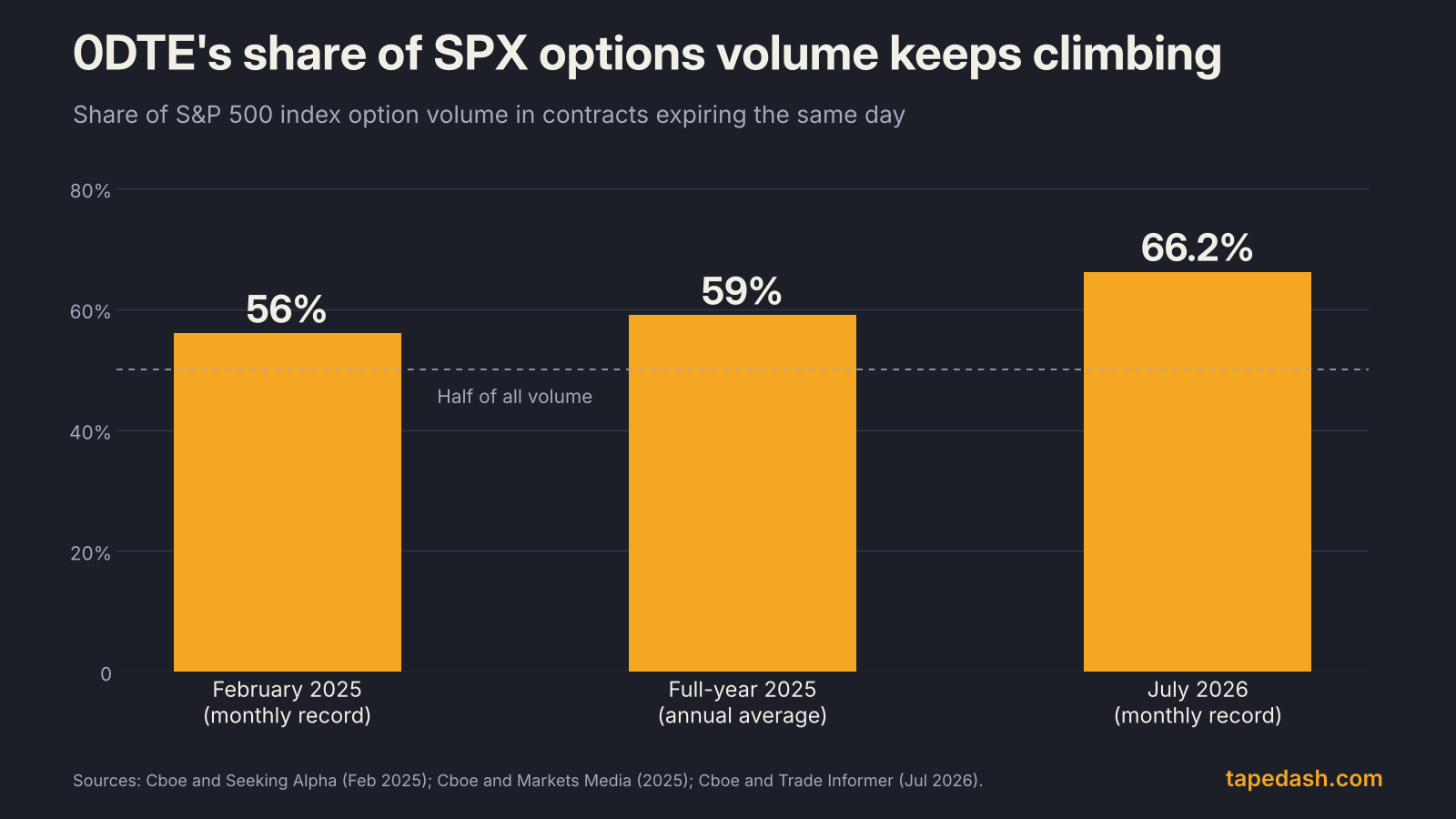
0DTE options are options with zero days to expiration: contracts that expire at the end of the same trading day you buy or sell them. On the S&P 500 index (SPX), every weekday is now an expiration day, so a trader can open a position at 10:00 AM that settles in cash at the 4:00 PM close. In July 2026, same-day contracts made up a record 66.2% of all SPX options volume, according to Cboe, a figure also reported by Trade Informer.
That is a structural change, and it reaches well past the people trading these contracts. When two out of every three index option contracts expire within hours, the way dealers hedge, the way volatility gets priced around events like CPI and Fed days, and even the shape of intraday price action all shift with it.
This guide covers what 0DTE options are, how they became the biggest corner of the index options market, why they behave so differently from longer-dated contracts, the debate over whether they move the market, and the specific things we watch when 0DTE volume is heavy.
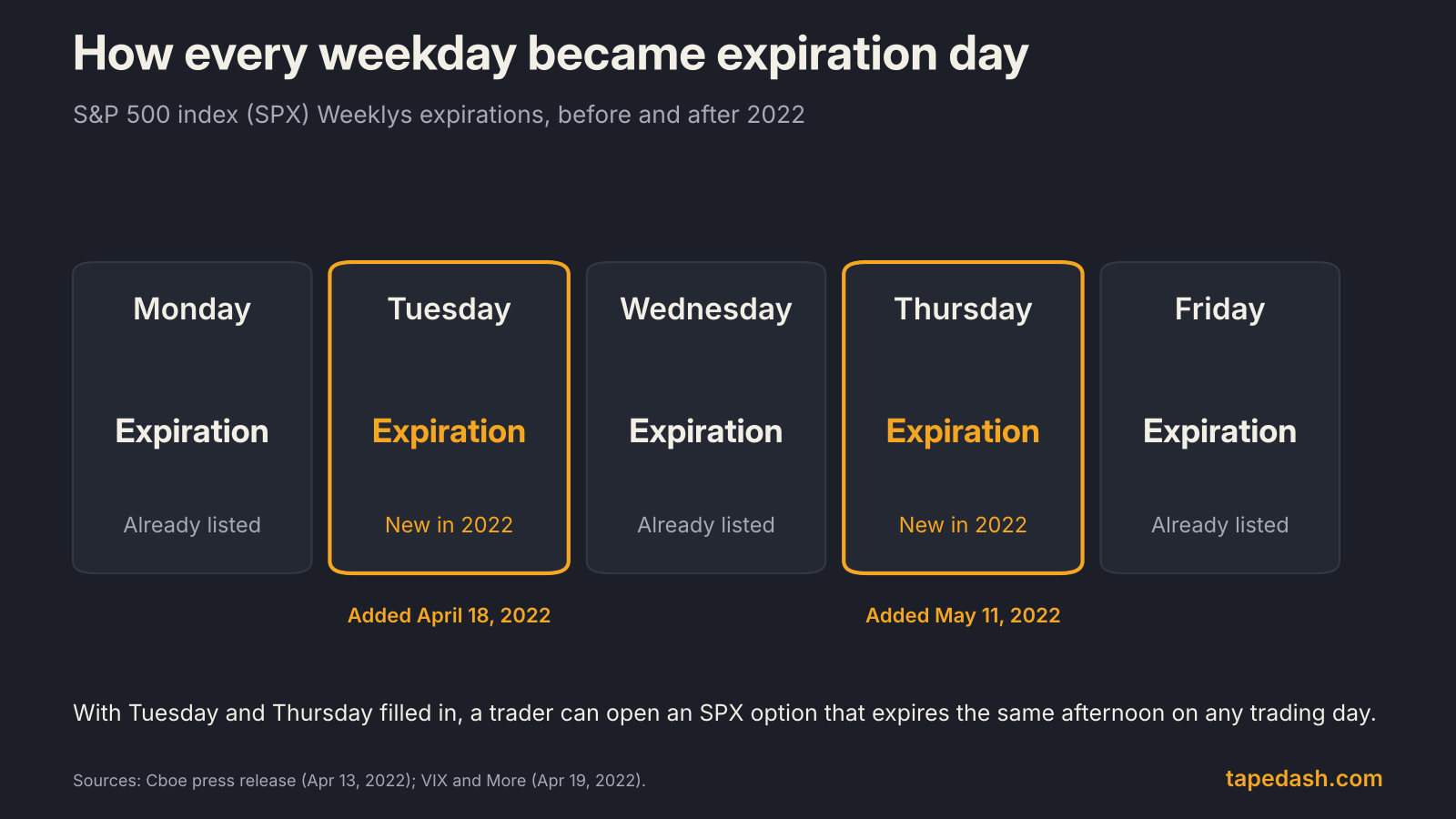
- 0DTE means an option on its final trading day. SPX has had an expiration every weekday since Tuesday and Thursday contracts were added in April and May 2022.
- Same-day contracts averaged about 2.3 million contracts a day and 59% of SPX volume in 2025, then hit a record 66.2% in July 2026.
- On expiration day, time decay and gamma are compressed into hours. Small index moves create very large swings in option value.
- Whether 0DTE flows amplify market moves is still debated. The answer depends on whether customer flow is balanced or one-sided on a given day.
- Treat 0DTE data as a map of where the day’s pressure sits, and keep any 0DTE trade small and defined-risk.
What are 0DTE options?
Any option becomes a 0DTE option on the morning of its expiration date. A monthly contract listed a year ago is a 0DTE contract on its final day, the same as a weekly listed last Thursday. The term describes the moment in an option’s life, not a special product.
What changed is how often that moment comes around. For years, index options mostly expired on Fridays. Cboe then built out S&P 500 Weeklys expiring on Mondays, Wednesdays and Fridays. In 2022 it filled the remaining gaps: Tuesday expirations started listing on April 18, 2022 and Thursday expirations on May 11, 2022, which, as VIX and More noted at the time, meant SPX options would expire every day of the week.
The ETF market followed. In November 2022 the options exchanges began listing Tuesday and Thursday expirations on SPY and QQQ, per notices from Cboe and BOX. Single stocks are moving the same way more slowly. In January 2026 the SEC approved a Nasdaq ISE rule allowing Monday and Wednesday expirations on a short list of the largest, most heavily traded stocks and ETFs, as reported by Bloomberg Law and published in the Federal Register. The bar is high. The qualifying tests cover market value, options volume and position limits, which restricts the program to the very largest names.
How 0DTE became most of SPX options volume
The growth has been steady and large. Same-day contracts hit a record 56% share of SPX volume in February 2025, a milestone Seeking Alpha also reported. For all of 2025, 0DTE averaged about 2.3 million contracts a day and 59% of SPX volume, per Cboe’s year-end review and Markets Media. By July 2026 the share had reached 66.2%.
Four reasons come up again and again, and they reinforce each other.
Cost. A same-day at-the-money option carries only one session of time value, so it is cheap in dollar terms compared with a 30-day contract on the same strike. A small account can get index exposure for a defined premium.
Precision around events. CPI at 8:30 AM, a Fed statement at 2:00 PM, a mega-cap earnings report after the bell the night before. A 0DTE contract lets a trader express a view on that one day without paying for weeks of time they don’t need.
Defined risk. Cboe’s research on 0DTE positioning found that the large majority of trades use limited-risk structures such as long options and spreads, where the maximum loss is known at entry (Cboe, May 2025).
Access. Retail brokers widened access to index options, and Cboe has repeatedly tied jumps in 0DTE activity to retail participation. Institutions use them too, for hedging and for fine-tuning exposure around events.
How 0DTE options behave: theta and gamma on expiration day
Everything that makes options tricky gets squeezed into a few hours on the last day. Two of the Greeks matter most.
Time decay happens by the hour
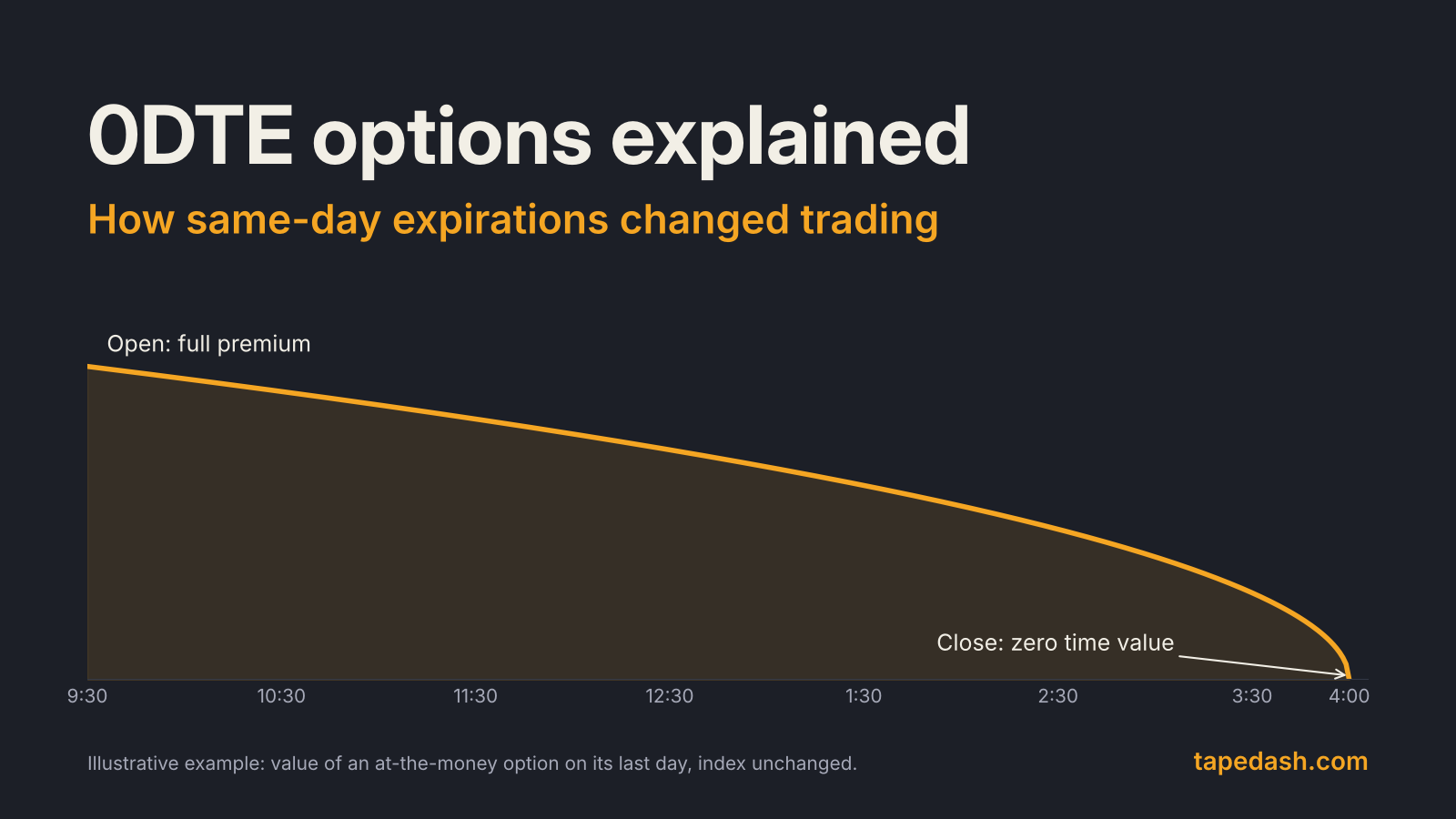
An option’s time value shrinks as expiration approaches, and the decay accelerates near the end. On a 30-day contract you measure theta per day. On a 0DTE contract you can watch it by the hour.
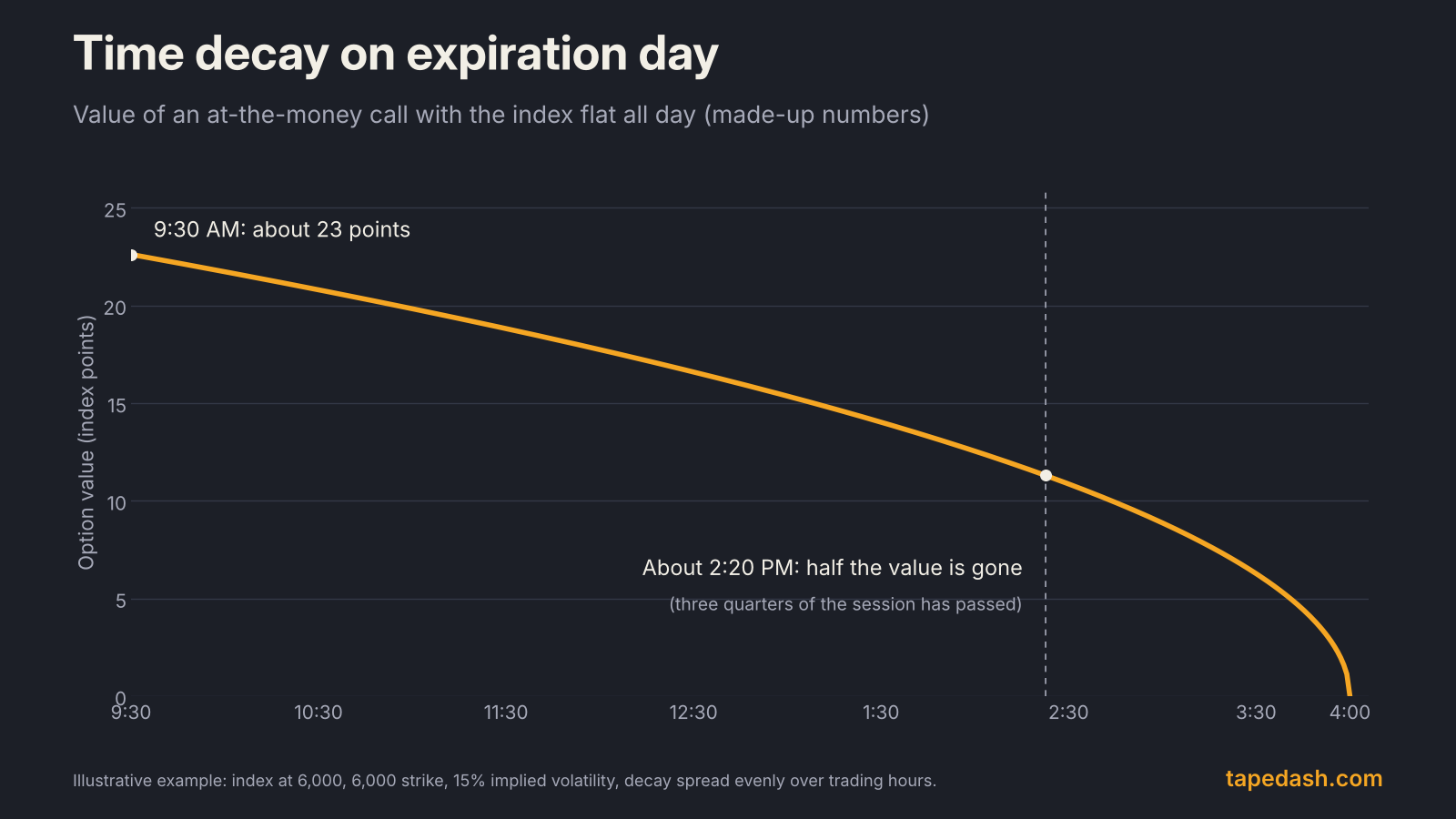
In this illustrative example, an at-the-money call is worth about 23 index points at the open. If the index goes nowhere, half of that is gone by about 2:20 PM and all of it by the close. Real days are lumpier than the smooth curve, because the market prices extra movement around scheduled events. A 0DTE option on a CPI morning carries more premium before 8:30 AM than after, and a Fed-day contract holds its value until the 2:00 PM statement and then drops fast if the reaction is muted.
That is the core trade-off. Buyers need a move, and they need it soon. Sellers collect the decay but take on the risk that a move arrives before the clock runs out.
Gamma turns small moves into big swings
Delta tells you how much an option’s value changes for a one-point move in the index. Gamma tells you how fast delta itself changes. Near expiration, gamma for at-the-money strikes becomes enormous.
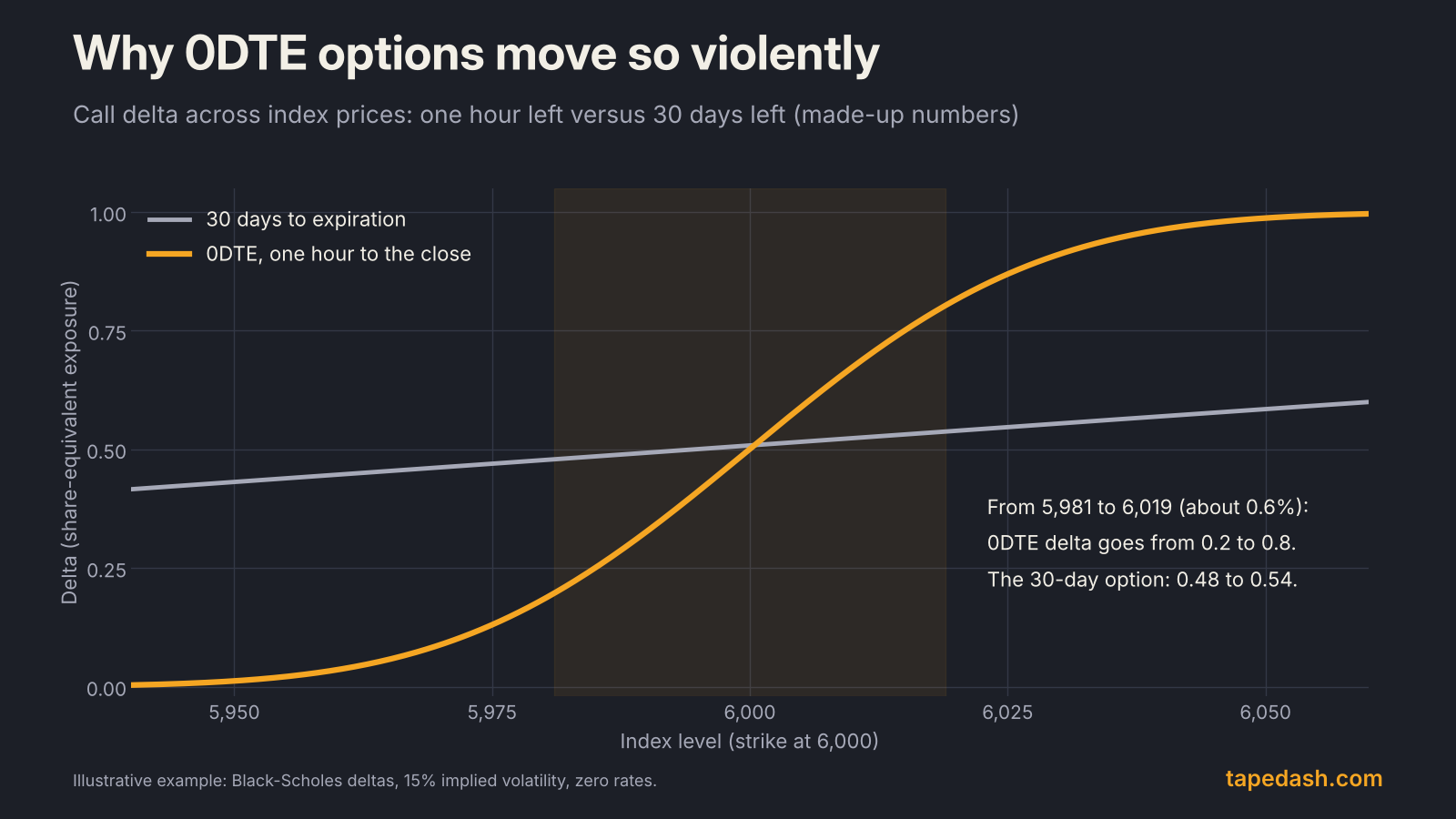
In the illustrative chart above, an hour before the close, a move from 5,981 to 6,019 (about 0.6%) takes the 0DTE call’s delta from roughly 0.2 to 0.8. The same move nudges a 30-day option’s delta from 0.48 to 0.54. That steep curve is why 0DTE positions can double or go to zero in minutes, and why dealers who take the other side of that flow have to hedge so actively. If you want the full mechanics of how that hedging feeds back into prices, our guide to dealer gamma exposure walks through it step by step.
SPX vs. SPY vs. XSP for 0DTE trading
Most 0DTE volume runs through three S&P 500 products, and the contract details matter more on expiration day than on any other. The table below compares them using specifications from Cboe and Option Alpha.
| Feature | SPX | XSP (Mini-SPX) | SPY |
|---|---|---|---|
| Underlying | S&P 500 index | S&P 500 index | SPDR S&P 500 ETF |
| Size | Full index value | One-tenth of SPX | Roughly one-tenth of SPX |
| Settlement | Cash | Cash | Shares of the ETF |
| Exercise style | European (expiration only) | European (expiration only) | American (any time) |
| Early assignment risk | None | None | Yes |
| U.S. tax treatment | May qualify for Section 1256 (60/40) | May qualify for Section 1256 (60/40) | Standard capital gains rules |
| Daily expirations | Yes | Yes | Yes |
The settlement row is the one that bites people. A short SPY option that finishes in the money gets assigned, and you wake up with an ETF position you may not want, along with weekend or overnight gap risk. SPX and XSP settle in cash, so the position simply closes at the settlement value. Taxes depend on your own situation, so check with a tax professional before leaning on the 60/40 line.
Do 0DTE options move the market?
This is the argument that has followed 0DTE since the boom began, and both sides have a point.
The worried view was put most memorably by JPMorgan’s Marko Kolanovic in early 2023, when he warned that the growth of same-day options could set off a “Volmageddon 2.0,” a reference to the February 2018 collapse of short-volatility products. His argument, as reported by BNN Bloomberg, was that dealer hedging of 0DTE flow tends to calm markets on normal days but could force heavy selling into a large down move once those contracts swing into the money.
The other side came quickly. Bank of America strategists argued that positioning looked far more balanced than it did before 2018 and that 0DTE activity was two-way, with traders buying and selling through the day rather than piling into one bet (Advisor Perspectives). Cboe’s own research has since made a similar case: customer 0DTE flow tends to be balanced between buyers and sellers, so the net hedging dealers must do is small relative to the size of the S&P 500 market (Cboe).
Here is how I square the two. On most days the flow is balanced and 0DTE is noise around the edges. The risk shows up on the days it isn’t: when a surprise sends everyone the same direction at once, the hedging that usually dampens moves can briefly reinforce them. That is a conditional risk, not a constant one, and it is why we watch positioning rather than headline volume.
There is a quieter effect too. Heavy open interest at a few strikes on expiration day can coincide with the index drifting toward those levels into the close as dealers rebalance. Whether that “pinning” is real or just a story traders tell themselves is the subject of our piece on max pain and options expiration.
How to use 0DTE data as a trader
You don’t have to trade 0DTE options to benefit from understanding them. The flow tells you where the day’s pressure points are. This is the routine we use on the desk, in order.
1. Start with the calendar. Check what is scheduled for the session: an 8:30 AM data release, a 2:00 PM Fed decision, a large earnings report that landed overnight. Event days carry more 0DTE premium and attract more one-sided flow. The October 28 Fed decision at 2:00 PM ET is a textbook example of a session where same-day premium builds into a single scheduled moment.
2. Find the heavy strikes. Look at where same-day open interest and volume are concentrated. Large clusters near the current price are the levels where dealer hedging will be most active as the day goes on.
3. Read the gamma regime. If dealers are net long gamma, their hedging tends to buy dips and sell rips, which dampens moves. If they are net short gamma, hedging tends to chase price, and moves extend. The same 0DTE volume means very different things in those two regimes.
4. Watch the clock. Gamma near the money climbs through the afternoon. The last 90 minutes are when hedging flows are largest relative to the remaining premium, and when sharp moves toward or away from big strikes are most common.
5. If you trade them, define the risk first. Use spreads or long options, size each trade as a small fraction of your account, and decide your exit before you enter. A position that can double in ten minutes can also go to zero in ten minutes.
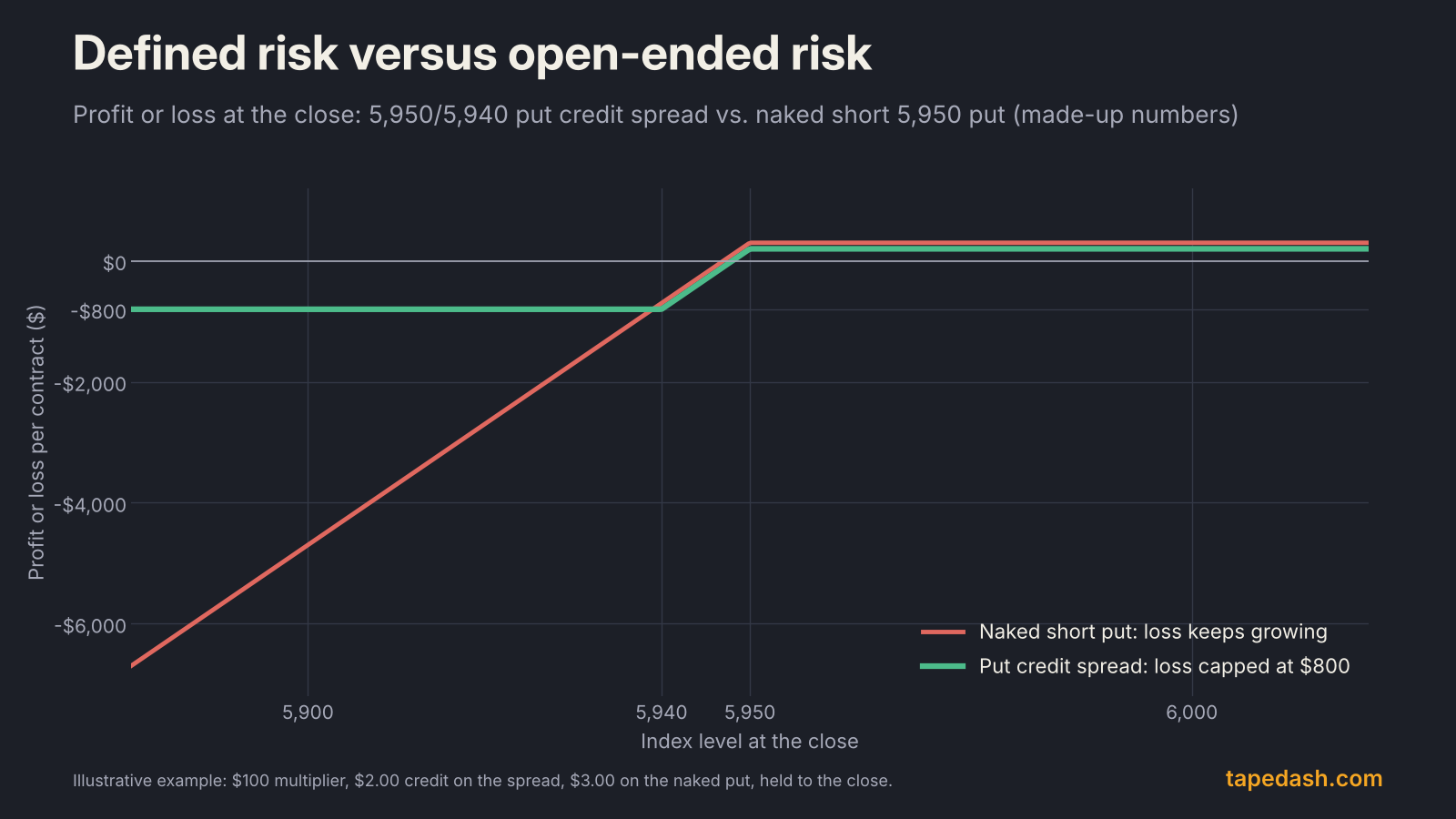
The payoff chart makes the point with made-up numbers. A naked short put collects a slightly bigger credit, but a sharp afternoon selloff can produce a loss many times that credit. The spread gives up a little premium to cap the damage at a known amount. For the full framework on how big any single options position should be, see our guide to options position sizing.
What to watch next
Three things are worth tracking from here. First, event days: the October 28 Fed decision and the December 8 to 9 meeting are exactly the sessions where 0DTE flow concentrates and becomes more one-sided. Second, Cboe’s monthly volume reports, published in the first days of each month, which show whether the 0DTE share keeps setting records after July’s 66.2%. Third, the single-stock rollout. The Nasdaq ISE rule is narrow for now, but the more expirations that reach individual mega-caps, the more the same-day dynamics described here will show up in the stocks that drive the index.
How to track 0DTE flow with TapeDash
If you want to see where same-day pressure is building, these are the TapeDash pages built for it. DTE Tide splits options flow by days to expiration, so you can see in real time whether the session’s premium is going into same-day contracts or longer-dated ones, and whether it leans toward calls or puts. Dealer Gamma maps estimated dealer exposure by strike, which tells you whether hedging is more likely to dampen or extend a move and which levels matter into the close.
When you are sizing a trade, the Options Risk Desk shows how a position’s value and Greeks change as the index moves and the clock runs down, which is the part of 0DTE that catches people off guard. You can try the terminal in the free Terminal Preview with no account, or join the TapeDash waitlist for the daily recap and launch details.
0DTE options FAQ
Are 0DTE options riskier than regular options?
Per contract, the dollar premium is usually smaller, but the speed of price changes is much higher. Gamma and time decay are at their most extreme on the last day, so a position can lose most of its value within an hour. The risk is manageable with defined-risk structures and small sizing, and very hard to manage without them.
What time do SPX 0DTE options expire?
SPX Weeklys, including the daily expirations, are P.M.-settled, which means they settle based on the index at the 4:00 PM ET close of their expiration day. They are European-style and cash-settled, so there is no early assignment and no delivery of shares.
Do 0DTE options cause market crashes?
There is no clear evidence that they do on their own. The concern is that on a day when everyone positions the same way, dealer hedging could amplify a sharp move. Research from Cboe and others suggests that on most days customer flow is balanced and the net hedging effect is small. It is a risk to monitor, not a constant force.
The one idea to keep
A 0DTE option is just any option on its final day, but now that every weekday is that day, same-day contracts have become the largest share of the index options market. They compress decay and gamma into hours, which makes them powerful tools and fast ways to lose money. Read them as a map of the day’s pressure points, and if you trade them, decide the most you can lose before you decide how much you might make.
See it on the tape, not just in the headlines
TapeDash is the research desk for traders and investors: live options flow, dealer positioning, a real-time market scanner and trade alerts graded in public. Memberships open January 1, 2027, and the first 200 members lock Pro at $99 a month for as long as they stay.
Join the waitlistClick through the terminalSee the track recordSources
- Cboe: SPX 0DTE options jumped to record 56% share in February (Mar 3, 2025)
- Seeking Alpha: Zero-day options soar to record share of SPX volume (Mar 3, 2025)
- Cboe: The State of the Options Industry, 2025 (Jan 22, 2026)
- Markets Media: Cboe reports record trading volume for 2025 (Jan 7, 2026)
- Cboe: Market Metrics That Matter, derivatives July 2026 volume highlights
- Trade Informer: Cboe reports July growth as 0DTE reaches 66.2% of SPX volume (Aug 6, 2026)
- Cboe: Cboe to add Tuesday and Thursday expirations for SPX Weeklys options (Apr 13, 2022)
- VIX and More: SPX weekly options will soon be available every day (Apr 19, 2022)
- Cboe: Product update, SPY and QQQ Tuesday and Thursday expiring weekly options (2022)
- BOX Exchange: BOX to list SPY and QQQ Tuesday and Thursday expiring weekly options (Nov 14, 2022)
- Cboe: 0DTEs decoded, positioning, trends and market impact (May 2, 2025)
- Cboe: Why trade XSP vs. SPY
- Option Alpha: SPX vs. SPY, how to trade the S&P 500
- BNN Bloomberg: JPMorgan's Kolanovic warns of Volmageddon 2.0 risk in options (Feb 2023)
- Advisor Perspectives: Bank of America says options-driven Volmageddon 2.0 warning is overblown (Feb 2023)
- Bloomberg Law: SEC gives Nasdaq approval for Monday, Wednesday stock options expiries (Jan 16, 2026)
- PolicyRisk: Federal Register notice 2026-01118, Nasdaq ISE short-term option series (Jan 22, 2026)
- Finance Calendar: FOMC rate decision, October 2026
- Thrive in Markets: FOMC 2026 meeting dates
This article is for educational and informational purposes only. It is not financial, investment, medical or legal advice, and it is not a recommendation to buy or sell any security. Figures come from the sources listed and were checked on the date of publication; markets change quickly. Options trading involves substantial risk of loss.