Max Pain Explained: Does Options Expiration Pin Stocks?
Max pain is the strike where the most options expire worthless. Here is how it is calculated, what the research on pinning shows, and how to use it.
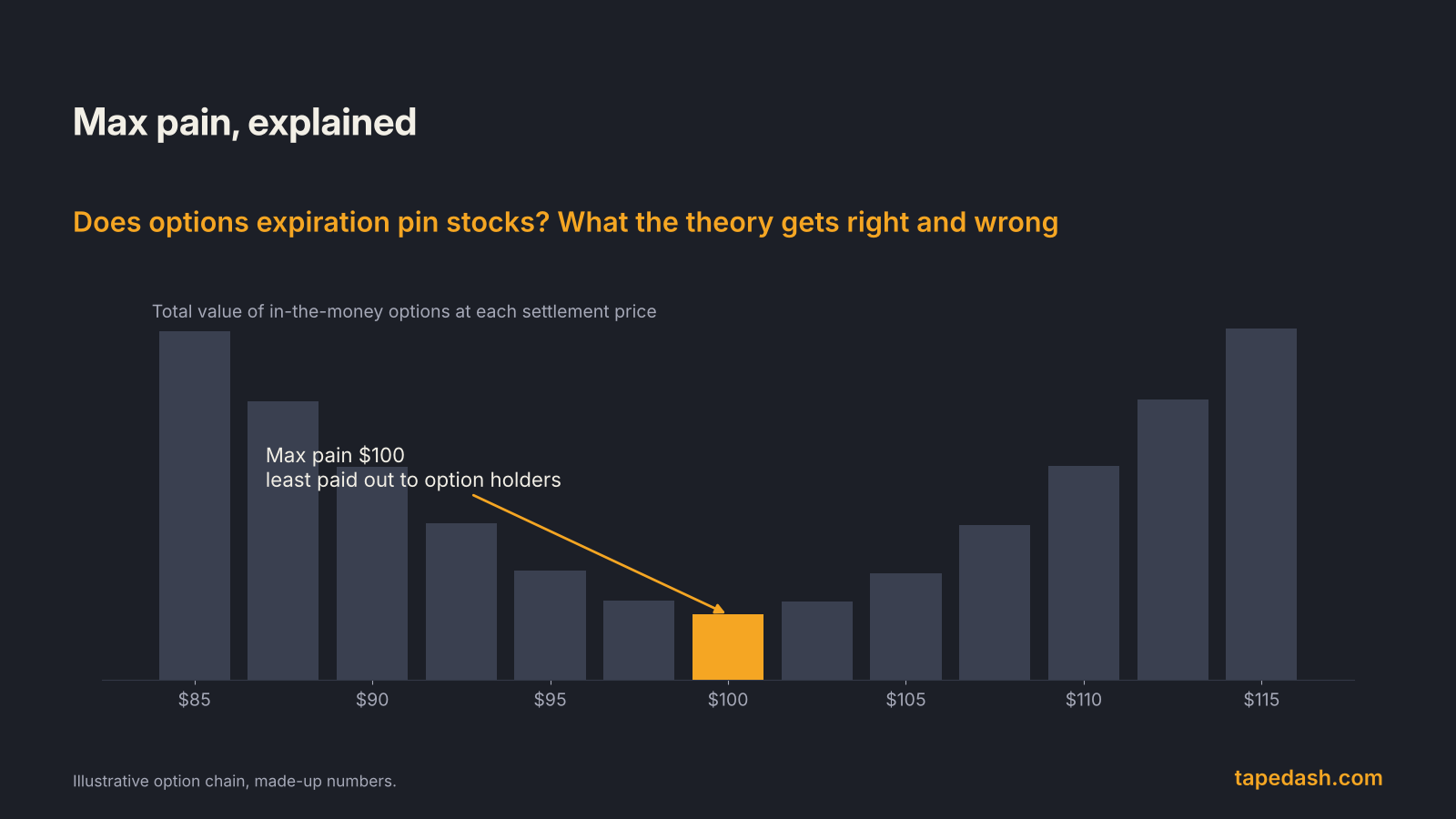
Max pain is the strike price where the largest dollar amount of options would expire worthless. If a stock settles exactly there on expiration day, option buyers as a group collect the least, and the people who sold those options keep the most premium. The theory attached to the number says stocks tend to drift toward it as expiration approaches.
Here is the honest answer to whether that works: stocks with listed options do tend to close near strike prices on expiration days more often than chance would suggest, and academic research has measured it. But the cause is ordinary hedging by market makers, not a hidden hand steering prices toward a single max pain strike. That difference decides when the number is useful and when it is noise.
This guide walks through how max pain is calculated, using a made-up option chain so you can follow every step, what the pinning research actually found, and how we use the number on the desk without treating it as a price target.
- Max pain is the expiration price at which the total value of in-the-money calls and puts is lowest. It is calculated purely from open interest.
- Research published in the Journal of Financial Economics found stocks with listed options cluster at strike prices on expiration dates, shifting returns by at least 16.5 basis points per expiration on average.
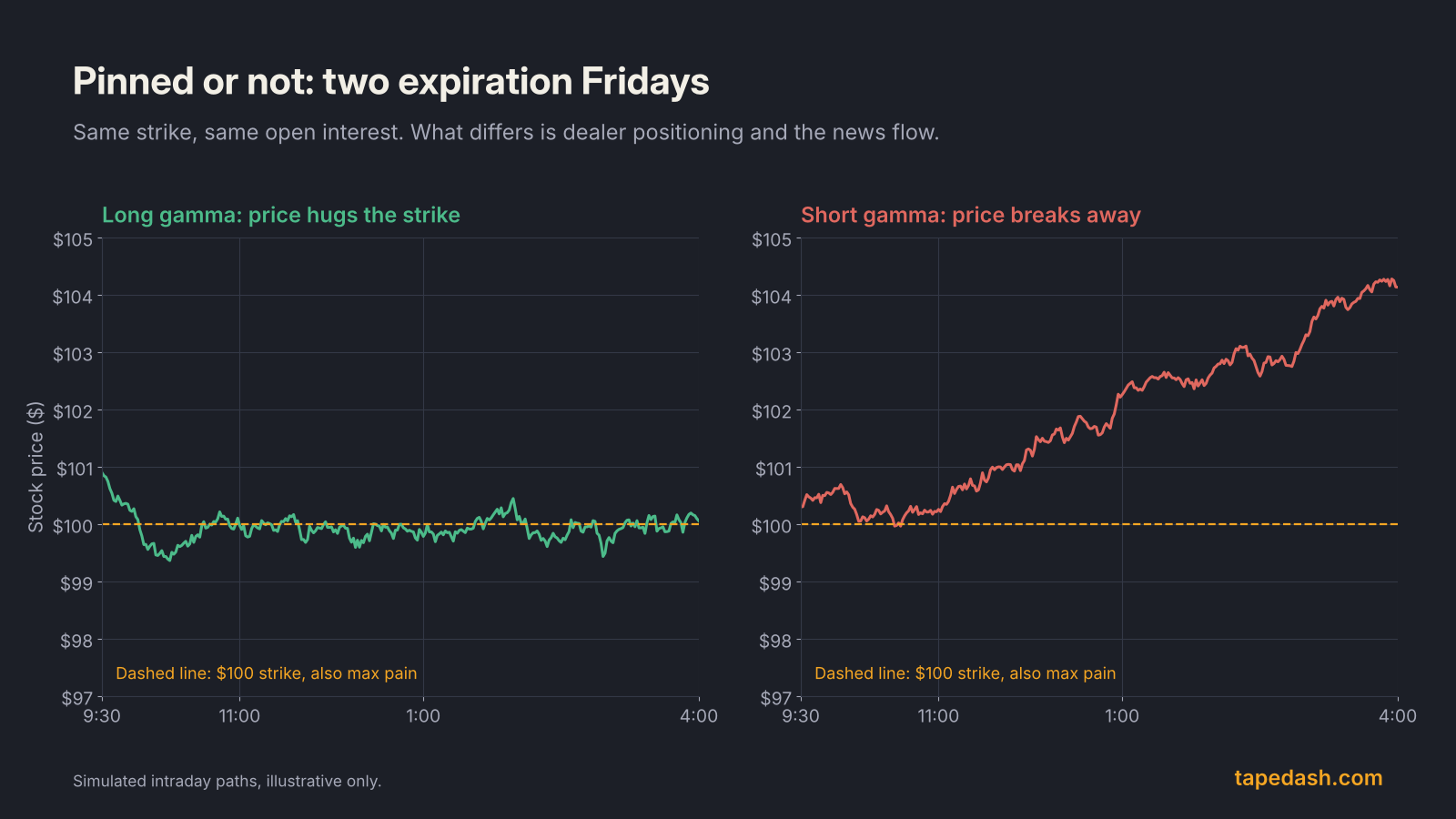
- The best explanation is dealer delta hedging. When dealers are net long options near a big strike, their hedging leans against moves and can pin the price.
- When dealers are net short options, or when news hits, hedging can push price away from the strike instead.
- Treat max pain as a map of where open interest sits, not as a forecast. It matters most on the final day, in names with heavy open interest relative to volume.
What is max pain in options?
Every listed option has an owner and a writer. At expiration, an in-the-money option is worth its intrinsic value: for a call, the stock price minus the strike, and for a put, the strike minus the stock price. Everything out of the money expires at zero.
Max pain asks one question of the whole option chain: at which settlement price would the combined intrinsic value of all open calls and puts be smallest? That price is the point of maximum disappointment for option holders, hence the name. Option Alpha describes it as the strike at which the largest total value of options expires out of the money, and the Corporate Finance Institute frames it as the price toward which a stock supposedly settles near expiration.
Two details matter before we calculate anything. First, max pain uses open interest, the number of contracts still open, not trading volume. Second, it is calculated for one expiration at a time. A stock with weekly options has a different max pain for each Friday, and the monthly expiration usually carries the most open interest. Standard monthly stock and ETF options expire on the third Friday of the month, with trading in them ending at the 4:00 PM ET close that day.
How to calculate max pain, step by step
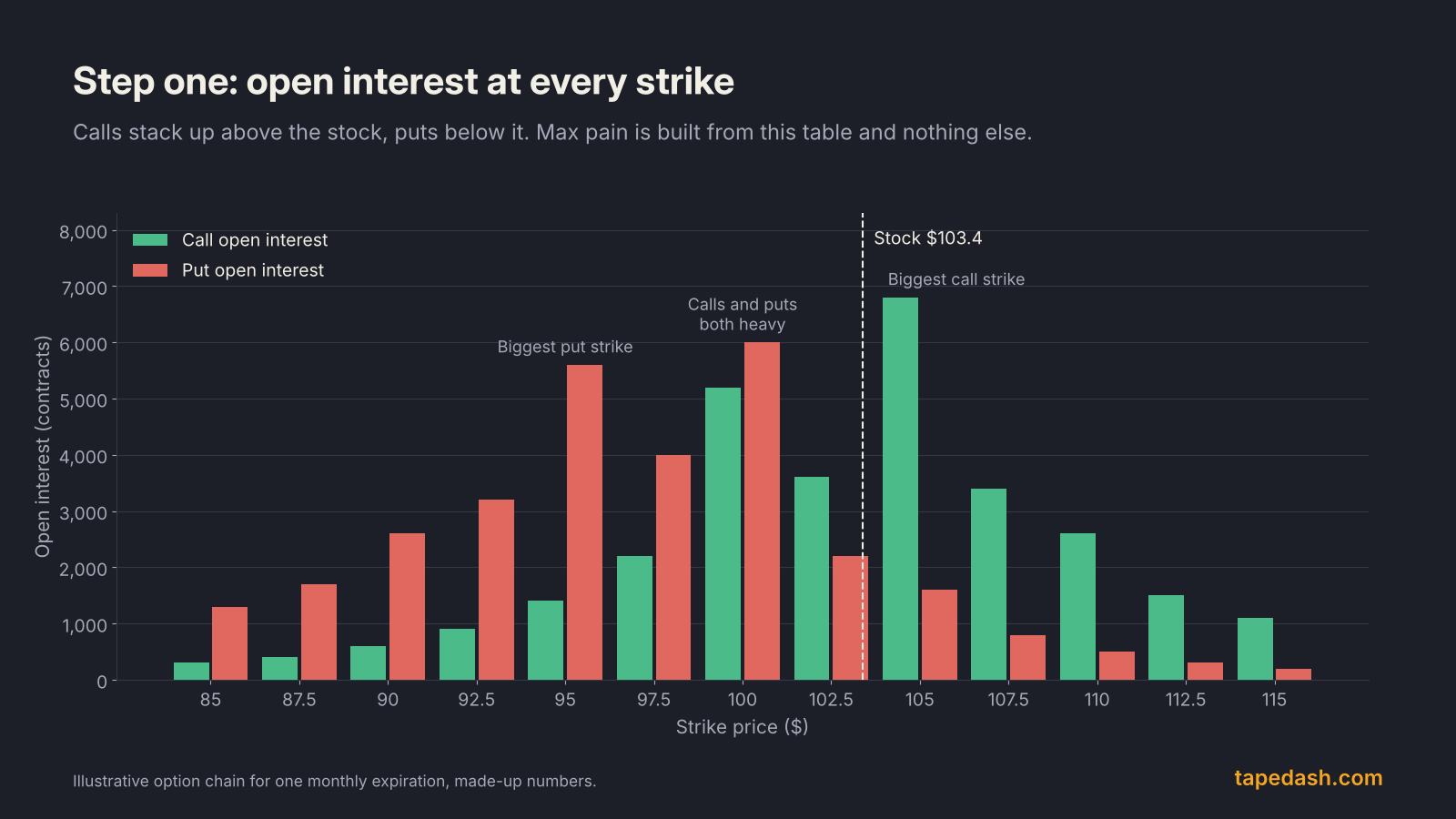
Max pain is simple arithmetic repeated many times. Here is an illustrative example with made-up numbers: a stock trading at $103.40 with strikes every $2.50 from $85 to $115.
Step one: gather open interest at every strike
Pull the open interest for every call and put in the expiration you care about. In a typical chain, call open interest builds up above the current price (upside bets and covered calls) and put open interest builds below it (hedges and downside bets). Round-number strikes collect more of both.
Step two: test every possible settlement price
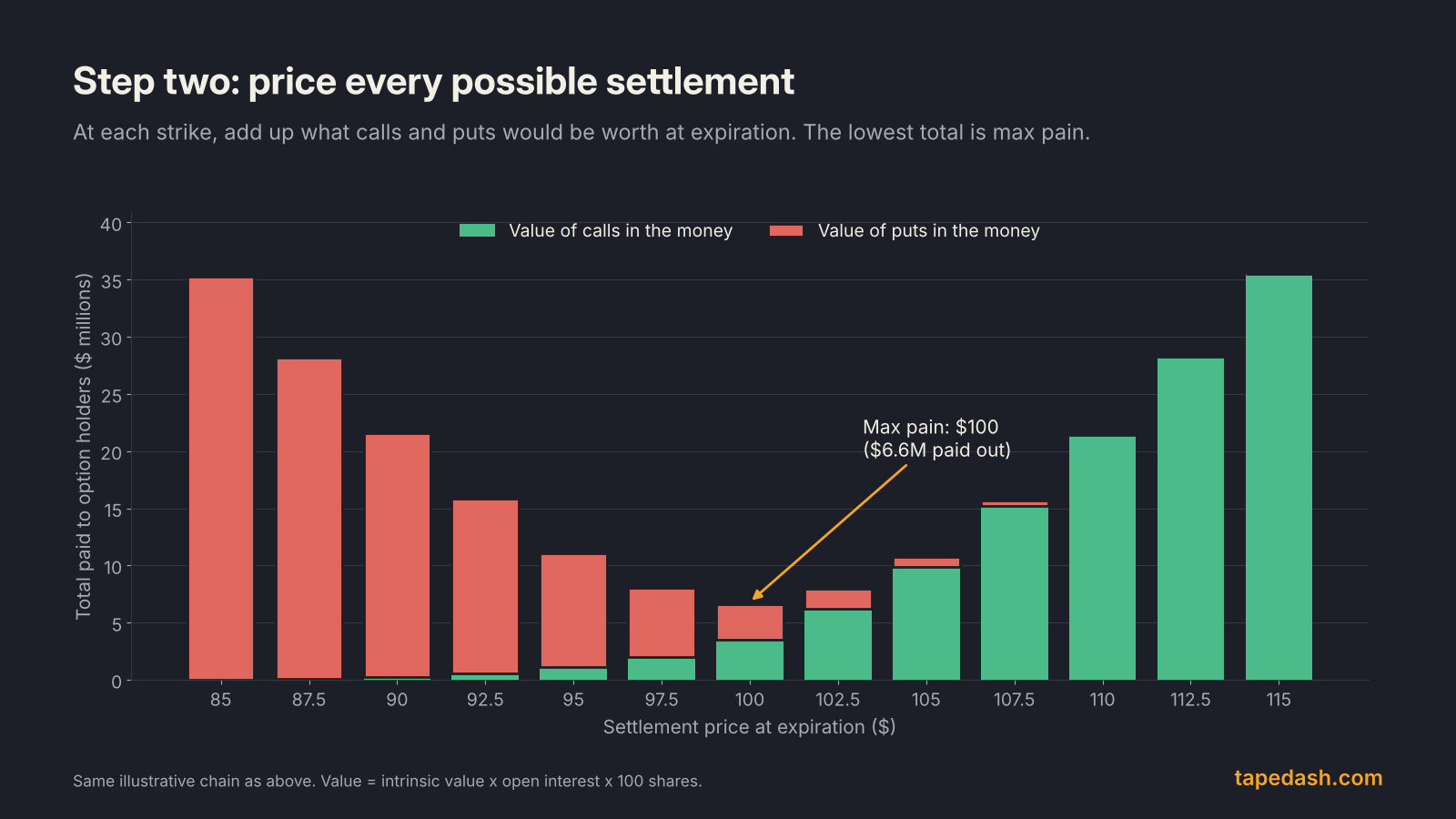
Now pretend the stock settles at each strike in turn. At a $95 settlement, every call with a strike below $95 is in the money, and so is every put with a strike above $95. Multiply each in-the-money option’s intrinsic value by its open interest and by 100 shares per contract. Add calls and puts together. That is the total paid to option holders if the stock closes at $95.
Repeat for $97.50, $100, $102.50 and so on. You end up with a curve shaped like a bowl. Far below the current price, puts are worth a fortune. Far above it, calls are. Somewhere in the middle sits the bottom of the bowl.
Step three: read off the lowest total
The strike with the lowest total payout is max pain. In our example that is $100, even though the stock trades at $103.40. One small trap: some explainers phrase the last step as picking the strike with the highest total, which only works if you calculate “losses to holders” instead of “value paid to holders.” Whichever way you set it up, the answer is the strike where option buyers collectively collect the least.
You will almost never do this by hand. Most options platforms calculate max pain automatically, and the number updates as open interest changes. That last part is important, and we will come back to it.
Does options expiration really pin stocks?
This is the part most max pain articles skip, and it is the only part that matters for trading.
The best-known study is “Stock Price Clustering on Option Expiration Dates” by Sophie Ni, Neil Pearson and Allen Poteshman, published in the Journal of Financial Economics in 2005. They found that on expiration dates, closing prices of stocks with listed options cluster at strike prices. The effect was large enough to measure: the authors estimated that returns of optionable stocks were shifted by at least 16.5 basis points on average per expiration date, which added up to roughly $9 billion of market capitalization, according to summaries from OptionMetrics and the SUFE academic newsletter.
They pointed to two causes. One was hedge rebalancing by option market makers. The other was attempts by proprietary traders at firms to move stock prices. Note what they did not say: nothing in the paper tests “max pain” as a forecasting tool. The finding is that prices cluster at strikes, which is a different and narrower claim than prices gravitating to one specific strike calculated from the whole chain. CXO Advisory’s review of this research makes the same point, and adds that the distortions looked too small for individual traders to exploit and that faster electronic trading since those sample years may have changed the picture.
The hedging mechanism behind stock pinning
The cleanest explanation comes from a model by Marco Avellaneda and Michael Lipkin, published in Quantitative Finance in 2003. Their presentation on stock pinning lays it out in a few steps.
Market makers hedge the options they hold so that small moves in the stock do not change their profit much. That hedge is called delta hedging. If dealers are net long options at a strike with very large open interest, they are long gamma there. As the stock rises toward or above the strike, the delta of their long calls grows, so they sell stock to stay hedged. As the stock dips below, delta shrinks and they buy stock back. Rallies get sold and dips get bought, over and over, and the stock gets held near the strike. The effect strengthens as expiration nears, because gamma near the money gets very large in the final hours.
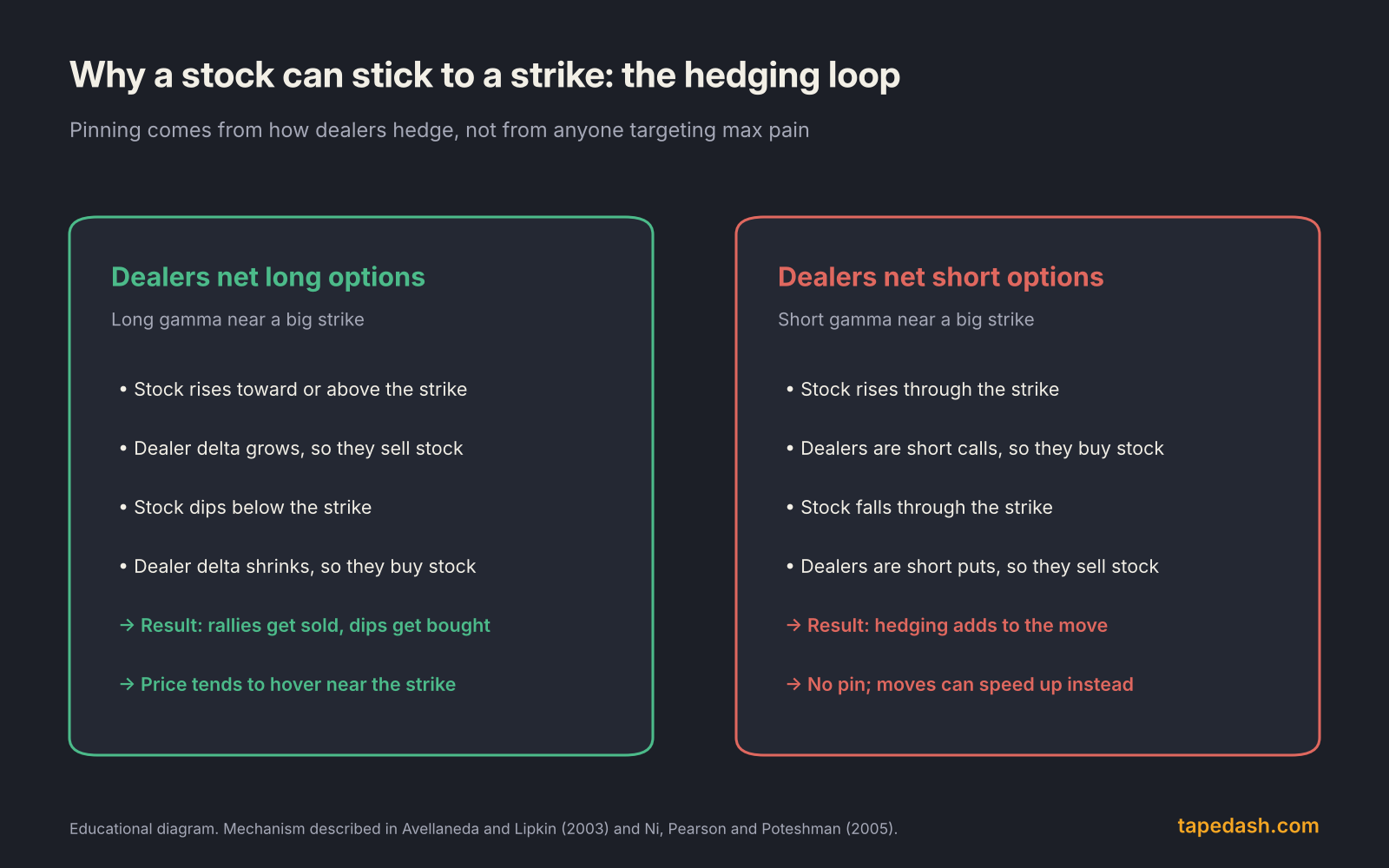
Flip the position and the effect flips too. If dealers are net short options near that strike, they have to buy as the stock rises and sell as it falls. Their hedging adds fuel to the move rather than damping it. The Avellaneda slides note that, in the data they examined, pinning was strongest when market makers were net long, with little evidence of the opposite effect when they were net short. This is the same machinery we cover in more depth in our guide to dealer gamma exposure.
So the real question on expiration day is not “where is max pain?” It is “where is the biggest open interest, and which side of it are dealers on?”
Why max pain often misses
Max pain fails more often than its fans admit, for reasons you can see coming.
It ignores who owns what. Open interest tells you how many contracts exist, not whether customers bought them or sold them. A huge block of call open interest could be retail traders buying upside (dealers short, no pin) or a fund writing covered calls (dealers long, possible pin). The max pain calculation treats both the same.
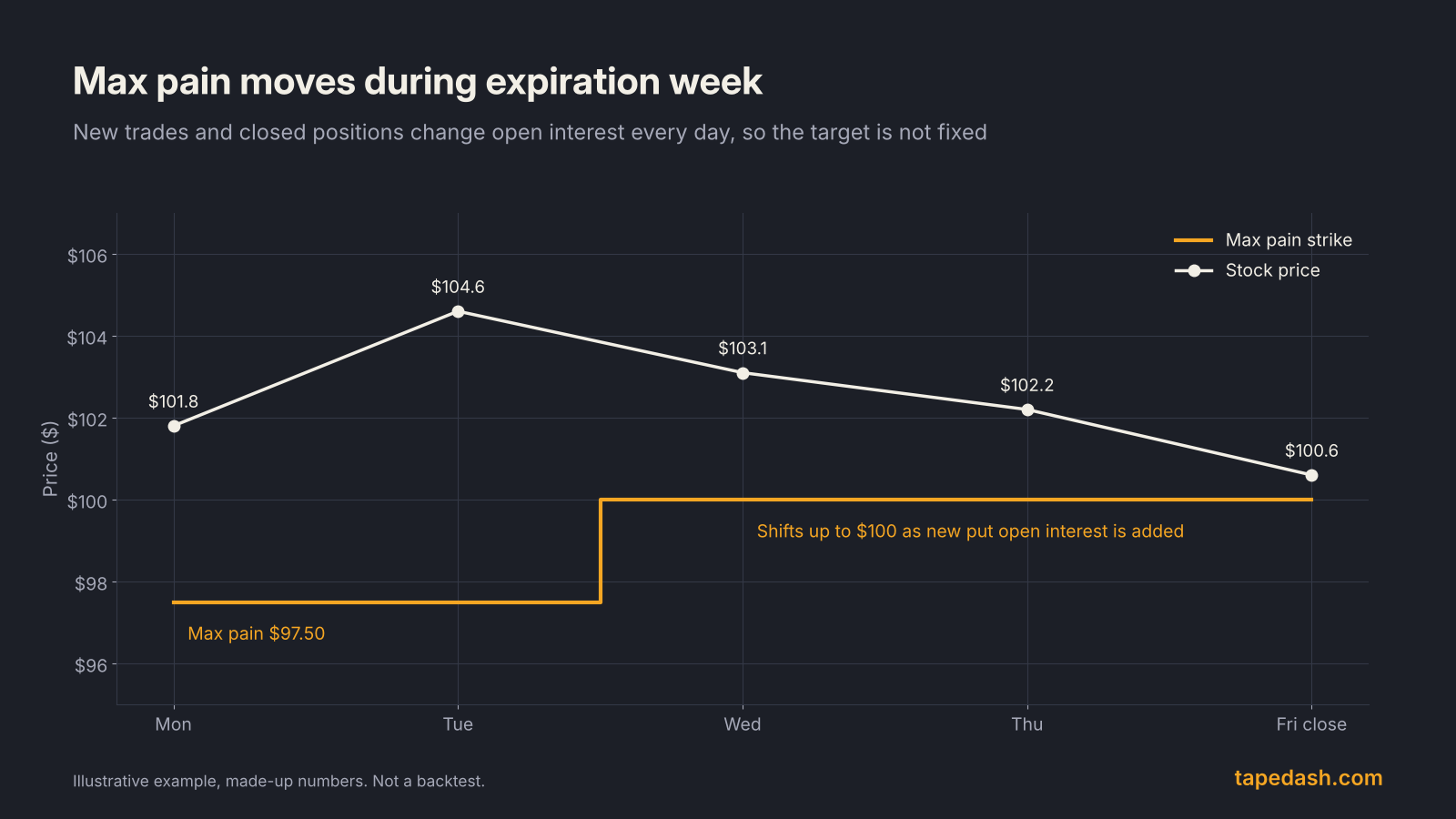
It moves. New positions open and old ones close every day. A max pain that sits at $97.50 on Monday can be $100 by Wednesday. CFI notes that max pain can shift hourly or daily, which makes it hard to use as a fixed level.
News beats hedging. A pin is a small, steady force. An earnings surprise, a Fed decision or a sector headline is a big, sudden one. If a stock gaps 5% on news, nobody’s delta hedge drags it back to a strike.
Big moves blow through. Once price leaves the neighborhood of the heavy strike, the gamma that held it there fades. The force that pins a stock within a dollar of a strike has very little to say about where it ends up if it is already $8 away on Thursday.
When max pain is more likely to matter
Put the research and the mechanism together and you get a short list of conditions that make pinning more likely. None of them is the max pain number itself.
| Condition | Pin more likely | Pin less likely |
|---|---|---|
| Open interest at the strike | Very large relative to daily share volume | Small or spread across many strikes |
| Dealer positioning | Net long options (long gamma) near the strike | Net short options (short gamma) near the strike |
| Distance from the strike | Price within about one expected daily move | Price far from any heavy strike |
| Time to expiration | Final day, especially the last few hours | Several days out |
| News flow | Quiet tape, no scheduled catalysts | Earnings, Fed decisions, major macro data |
| Liquidity of the stock | Thinner names where hedge flows are a big share of volume | Mega-caps and index ETFs with deep liquidity |
The row about relative size comes straight from the Avellaneda and Lipkin setup: pinning needs open interest that is unusually large compared with how many shares normally trade. In a stock that trades tens of millions of shares a day, even a large options position can be a small share of the flow.
How to use max pain in your own trading
Here is how we use it on the desk, as a process rather than a signal.
- Start with the open interest map, not the max pain dot. Look at which strikes carry the most open interest for the coming expiration. Max pain is a summary of that map, and the map tells you more.
- Check positioning. Use options flow and a dealer gamma view to judge whether the heavy strikes were mostly bought or sold by customers. Long dealer gamma near a big strike is the setup where a pin has a real mechanism behind it.
- Measure distance in expected moves. If the stock is within one expected daily move of a heavy strike on expiration day, the strike is in play. If it is three expected moves away, max pain is trivia.
- Check the calendar. Earnings, a Fed decision or a major data release during expiration week makes pin behavior much less reliable. The next standard monthly expirations are November 20 and December 18, 2026, and December’s is a quarterly triple witching expiration, when stock options, index options and index futures all expire together.
- Use it for risk, not direction. The most practical use is defensive. If you are short options near a heavy strike, expect the stock to chop around it, and plan exits accordingly. If you own short-dated options that need a big move, know that a pin is the scenario that drains them fastest.
- Recheck on the final morning. Open interest updates overnight. Thursday’s number is stale by Friday’s open.
What we do not do is buy or sell a stock because it is $3 above max pain on a Tuesday. That trade has no mechanism behind it.
How TapeDash shows max pain and the strikes that matter
If you want to watch whether a pin is forming into expiration, this is what we track. The Max Pain page in TapeDash keeps the max pain level for upcoming expirations in front of you, so you are not rebuilding the calculation from an option chain every Friday. We read it next to the Dealer Gamma page, because dealer positioning is the piece that tells you whether a heavy strike is more likely to act as a magnet or a launchpad. For expiration-week context, DTE Tide looks at options activity by days to expiration, which matters on Fridays when 0DTE trading adds its own hedging flows.
You can try these pages in the Terminal Preview, free and without an account. If you prefer the read after the close, the free TapeDash Daily covers what moved and why each evening, and the first 200 members lock Pro at $99 a month for as long as they stay.
Max pain FAQ
Is max pain accurate?
Not as a forecast. Research shows stocks with listed options cluster near strike prices on expiration days more than chance would predict, but that is a statement about strikes in general, not about the single max pain strike. Max pain is most relevant on the last day of an expiration, near very large open interest, when dealers are long gamma and there is no major news.
Who sets max pain, and can market makers manipulate it?
Nobody sets it. Max pain is a calculation from public open interest. The pinning research did point to two causes, hedge rebalancing by market makers and attempts at manipulation by some proprietary traders in the sample, but the mechanism most traders can observe and use is hedging, which happens without anyone targeting a price.
When is max pain calculated, and does it change?
It is calculated for each expiration from current open interest, and it changes as positions open and close. Open interest is reported once a day, so the number usually updates overnight. Recheck it on the morning of expiration rather than relying on a figure from earlier in the week.
The one idea to keep
Max pain is a tidy summary of where option holders would be most disappointed, but stocks do not care about anyone’s disappointment. What they do respond to is hedging. Read the open interest map, figure out whether dealers are long or short gamma at the heavy strikes, and check the news calendar. If those line up on a quiet expiration Friday, a pin is a reasonable expectation. If they do not, the max pain number is just a number.
See it on the tape, not just in the headlines
TapeDash is the research desk for traders and investors: live options flow, dealer positioning, a real-time market scanner and trade alerts graded in public. Memberships open January 1, 2027, and the first 200 members lock Pro at $99 a month for as long as they stay.
Join the waitlistClick through the terminalSee the track recordSources
- Corporate Finance Institute: Max Pain (Options)
- Option Alpha: Max Pain Options
- Ni, Pearson and Poteshman, Stock Price Clustering on Option Expiration Dates, Journal of Financial Economics 78(1), 2005 (RePEc listing)
- SUFE Academic Newsletter: summary of Stock Price Clustering on Option Expiration Dates
- OptionMetrics: Stock Price Clustering on Option Expiration Dates (abstract)
- CXO Advisory: Stock Price Pinning at Options Expiration
- Avellaneda: Stock pinning on option expiration dates (NYU Courant slides)
- MarketXLS: Option Expiration Calendar 2026
- Achievable: Options expiration definition
- tastylive: What is triple witching
This article is for educational and informational purposes only. It is not financial, investment, medical or legal advice, and it is not a recommendation to buy or sell any security. Figures come from the sources listed and were checked on the date of publication; markets change quickly. Options trading involves substantial risk of loss.